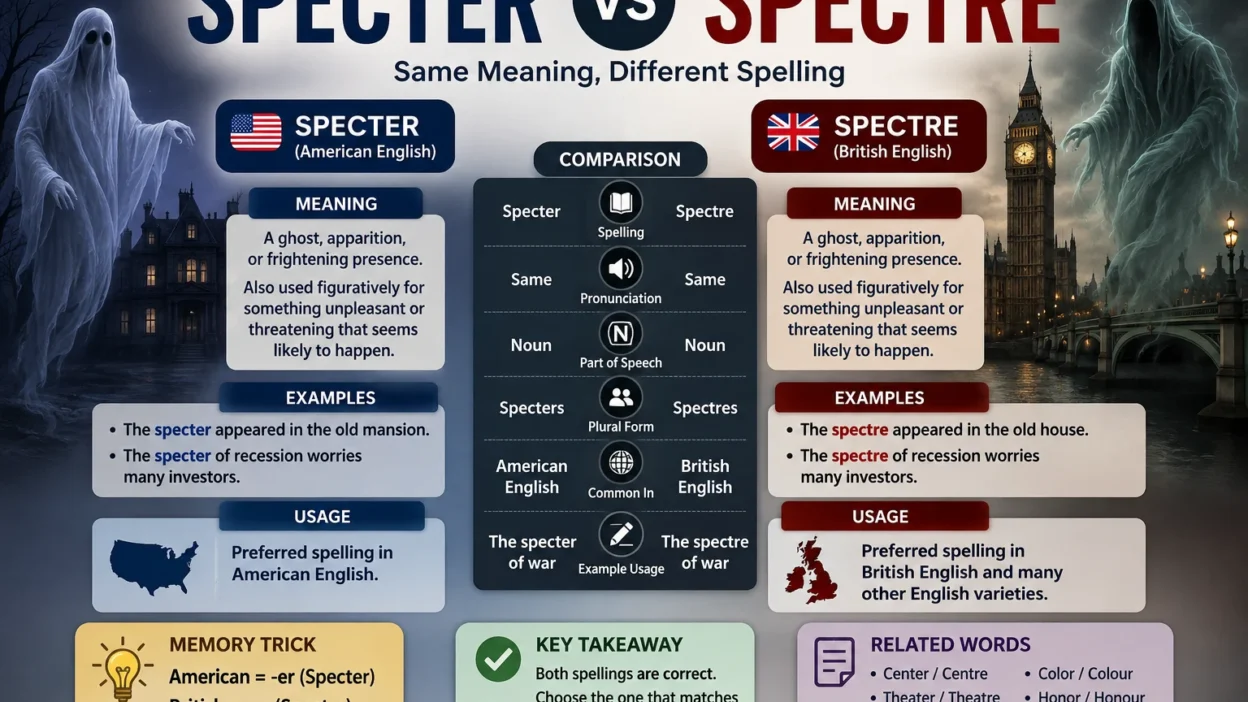
If you have ever wondered about specter vs spectre, you are not alone. These two words look different, but they have the same meaning and pronunciation.
Both refer to a ghost, apparition, or frightening presence. They can also describe something unpleasant or threatening that seems likely to happen. The main difference is not meaning but regional spelling.
Specter is the standard spelling in American English, while spectre is preferred in British English and other varieties of English.
Understanding this difference can help you choose the right spelling for academic writing, professional communication, journalism, and creative writing.
In this guide, we will explore the specter vs spectre difference, meanings, examples, grammar forms, common mistakes, and practical usage so you can use either form confidently.
Quick Answer: Specter vs Spectre
Specter and spectre have the same meaning and pronunciation.
Specter is the preferred American English spelling.
Spectre is the preferred British English spelling.
Both can mean a ghost or a frightening possibility.
What Does Specter Mean?
Specter is an American English noun meaning a ghost, apparition, or frightening supernatural figure.
It can also be used figuratively for something unwanted or threatening that people fear may happen.
Examples of Specter
- A specter appeared in the old mansion.
- The specter of war worried the entire region.
- Unemployment remains a specter hanging over the economy.
- The story describes a mysterious specter haunting the village.
The word can therefore have either a literal supernatural meaning or a figurative meaning.
What Does Spectre Mean?
Spectre has exactly the same meaning as specter, but it is the preferred spelling in British English.
It can refer to a ghost, an apparition, or an unpleasant possibility that causes fear or concern.
Examples of Spectre
- A spectre was seen near the abandoned house.
- The spectre of poverty affected the community.
- The novel centers around a mysterious spectre.
- The spectre of economic decline worried investors.
So, when comparing specter vs spectre, remember that the definition does not change.
Specter vs Spectre: Main Difference
The primary difference between specter and spectre is geographical spelling.
| Feature | Specter | Spectre |
|---|---|---|
| Meaning | Ghost or threatening possibility | Ghost or threatening possibility |
| Pronunciation | Same | Same |
| Part of speech | Noun | Noun |
| American English | Preferred | Less common |
| British English | Less common | Preferred |
| Canadian English | Common | Also used |
| Australian English | Less common | Preferred |
| New Zealand English | Less common | Preferred |
| Meaning difference | None | None |
The simplest rule is: American English → specter; British English → spectre.
Specter vs Spectre Pronunciation
Both spellings are generally pronounced the same way.
The pronunciation is approximately:
SPEK-ter
The additional -re in spectre does not create a different pronunciation.
| Word | Approximate pronunciation | Difference |
|---|---|---|
| Specter | SPEK-ter | American spelling |
| Spectre | SPEK-ter | British spelling |
This makes the two words homophones in ordinary pronunciation, even though their written forms differ.
Specter vs Spectre in American English
In American English, specter is the standard spelling.
For example:
The specter of recession affected consumer confidence.
An American newspaper, textbook, website, or business document would normally use specter.
The same applies when the word is used literally:
The children believed they had seen a specter in the hallway.
If your target audience primarily uses American English, specter is usually the better choice.
Specter vs Spectre in British English
British English generally uses spectre.
For example:
The spectre of war continued to concern politicians.
You will also encounter spectre in British literature, journalism, academic writing, and everyday usage.
If you are writing specifically for a British audience, consistently using spectre is the safer choice.
Specter vs Spectre in Different English Varieties
Regional spelling is one of the easiest ways to understand the difference.
| Variety of English | Common spelling |
|---|---|
| American English | Specter |
| British English | Spectre |
| Australian English | Spectre |
| New Zealand English | Spectre |
| Canadian English | Both, depending on style |
| International English | Either, depending on audience |
There is no universal rule that one spelling is always correct. The appropriate spelling depends largely on the English variety you are following.
Literal Meaning vs Figurative Meaning
Both specter and spectre have two important uses.
1. Literal meaning
The word can describe a ghost or supernatural apparition.
American English:
A specter appeared at the window.
British English:
A spectre appeared at the window.
2. Figurative meaning
The word can describe an unpleasant possibility or threat.
American English:
The specter of unemployment frightened many workers.
British English:
The spectre of unemployment frightened many workers.
The meaning remains the same in both examples.
Specter vs Spectre in Business
In business and economics, the word is often used figuratively.
It can describe a serious problem that threatens an organization, industry, or economy.
| Context | American English | British English |
|---|---|---|
| Economic crisis | Specter of recession | Spectre of recession |
| Job losses | Specter of unemployment | Spectre of unemployment |
| Inflation | Specter of inflation | Spectre of inflation |
| Bankruptcy | Specter of bankruptcy | Spectre of bankruptcy |
| Financial instability | Specter of instability | Spectre of instability |
Business Examples
American English:
The specter of bankruptcy forced the company to reduce expenses.
British English:
The spectre of bankruptcy forced the company to reduce expenses.
Neither sentence changes in meaning.
Specter vs Spectre in Education
Students may encounter both spellings depending on the country, textbook, or source they are reading.
For example:
The specter of war appears throughout the novel.
A British textbook might instead write:
The spectre of war appears throughout the novel.
When writing an essay, students should follow the spelling system expected by their school, university, or instructor.
Specter vs Spectre in Science
The word is not usually a technical scientific term, but it can appear in scientific or medical writing when describing a feared possibility metaphorically.
For example:
Researchers are concerned about the specter of antibiotic resistance.
In British English:
Researchers are concerned about the spectre of antibiotic resistance.
The regional spelling changes, but the figurative meaning remains identical.
Grammar Forms of Specter and Spectre
Both words are nouns and behave grammatically in the same way.
| Grammar form | American English | British English |
|---|---|---|
| Singular | Specter | Spectre |
| Plural | Specters | Spectres |
| Indefinite article | A specter | A spectre |
| Definite article | The specter | The spectre |
| Possessive | Specter’s | Spectre’s |
Singular Examples
A specter appeared in the story.
A spectre appeared in the story.
Plural Examples
Several specters haunted the castle.
Several spectres haunted the castle.
The plural spelling follows the same regional pattern.
Common Phrases With Specter and Spectre
Both forms appear in similar expressions.
| American English | British English |
|---|---|
| The specter of war | The spectre of war |
| The specter of death | The spectre of death |
| The specter of poverty | The spectre of poverty |
| The specter of unemployment | The spectre of unemployment |
| The specter of failure | The spectre of failure |
| A haunting specter | A haunting spectre |
These expressions are especially common in formal, journalistic, literary, and political writing.
Why Do People Confuse Specter and Spectre?
The confusion mainly comes from regional spelling differences.
English has many words that follow different spelling conventions in American and British English. For example:
- center / centre
- theater / theatre
- meter / metre
- color / colour
- honor / honour
- specter / spectre
Because the pronunciation of specter and spectre is essentially the same, writers may not realize that they are choosing between two regional spellings.
Common Mistakes With Specter vs Spectre
Mistake 1: Treating Them as Different Words
Incorrect idea:
Specter and spectre have different meanings.
Correct:
Specter and spectre have the same meaning; they are different regional spellings.
Mistake 2: Mixing Regional Styles
A writer may use American and British spellings inconsistently in the same document.
For example:
The spectre appeared near the center of the building.
If you are following American English, specter and center would normally be expected.
If following British English, spectre and centre would be more consistent.
Mistake 3: Assuming Spectre Is More Formal
Spectre is not inherently more formal than specter.
The difference is primarily regional, not one of formality.
Mistake 4: Changing the Pronunciation
The spelling spectre does not mean the word needs a completely different pronunciation.
Both forms are generally pronounced SPEK-ter.
Correct vs Incorrect Examples
| Incorrect assumption | Correct explanation |
|---|---|
| Specter means a ghost, while spectre means a threat. | Both can mean either a ghost or a threatening possibility. |
| Spectre is always more formal. | Neither spelling is inherently more formal. |
| Specter is the only correct spelling. | Spectre is standard in British English. |
| Spectre is the only correct spelling. | Specter is standard in American English. |
| They are pronounced differently. | They are generally pronounced the same way. |
Memory Trick for Specter vs Spectre
A simple memory trick can make this spelling difference easier.
Think:
American = -er → specter
British = -re → spectre
You can connect spectre with other British spellings such as:
- centre
- theatre
- metre
- litre
When you see -re, think of the British spelling pattern.
Specter vs Spectre: Comparison by Context
| Situation | Recommended American spelling | Recommended British spelling |
|---|---|---|
| School essay | Specter | Spectre |
| Business report | Specter | Spectre |
| Newspaper article | Specter | Spectre |
| Fiction | Specter | Spectre |
| Academic paper | Specter | Spectre |
| Website content | Specter | Spectre |
| Formal letter | Specter | Spectre |
The most important factor is consistency.
Professional and Industry Usage
Different professional environments may favor one spelling because of their regional style guide.
| Industry | American English | British English |
|---|---|---|
| Journalism | Specter | Spectre |
| Publishing | Specter | Spectre |
| Education | Specter | Spectre |
| Business | Specter | Spectre |
| Government | Specter | Spectre |
| Literature | Specter | Spectre |
| Marketing | Specter | Spectre |
| Academic writing | Specter | Spectre |
For international audiences, either form can work, but you should choose one spelling system and use it consistently.
Specter vs Spectre: Real-Life Example Sentences
Examples With Specter
- The specter of war dominated the political debate.
- The old house was said to contain a frightening specter.
- Rising costs created a specter of financial trouble.
- The specter of failure made the team nervous.
- The novel introduces a mysterious specter.
Examples With Spectre
- The spectre of war dominated the political debate.
- The old house was said to contain a frightening spectre.
- Rising costs created a spectre of financial trouble.
- The spectre of failure made the team nervous.
- The novel introduces a mysterious spectre.
Notice that the sentence structure and meaning remain essentially identical.
When Should You Use Specter?
Use specter when you are writing in American English.
For example:
The specter of inflation remains a major concern.
It is especially appropriate for American websites, publications, school assignments, professional documents, and general writing.
When Should You Use Spectre?
Use spectre when you are writing in British English or another variety that traditionally follows British spelling conventions.
For example:
The spectre of inflation remains a major concern.
The spelling is completely standard in British English.
Specter vs Spectre: Which One Is Correct?
Both are correct.
The choice depends on the variety of English you are using.
If your audience expects American English, choose specter. If your audience expects British English, choose spectre.
Therefore, asking which spelling is “correct” without considering regional English is incomplete. Both are legitimate standard spellings.
Specter vs Spectre vs Ghost
Although specter and spectre can mean a ghost, they can have a slightly different tone from the everyday word ghost.
| Word | Typical meaning | Tone |
|---|---|---|
| Ghost | Spirit of a dead person | Common |
| Specter | Ghost or frightening apparition | More literary/formal |
| Spectre | Ghost or frightening apparition | More literary/formal |
For ordinary conversation, ghost is usually more natural.
Specter/spectre often creates a more dramatic, literary, or ominous feeling.
SEO-Friendly Quick Comparison
| Question | Answer |
|---|---|
| Are specter and spectre the same word? | Yes, they have the same meaning. |
| Is specter American or British? | Specter is the standard American spelling. |
| Is spectre American or British? | Spectre is the standard British spelling. |
| Do specter and spectre sound the same? | Yes, they are generally pronounced the same. |
| What is the plural of specter? | Specters. |
| What is the plural of spectre? | Spectres. |
| Which spelling should I use? | Match your audience’s English variety. |
FAQs About Specter vs Spectre
1. What is the difference between specter and spectre?
There is no meaningful difference in definition. Specter is the American spelling, while spectre is the British spelling.
2. Is specter American or British?
Specter is primarily the American English spelling.
3. Is spectre British English?
Yes. Spectre is the traditional British English spelling and is also common in other varieties influenced by British English.
4. Are specter and spectre pronounced the same?
Yes. Both are generally pronounced approximately SPEK-ter.
5. Can specter mean something other than a ghost?
Yes. It can figuratively refer to a frightening possibility or threat, such as the specter of war.
6. Which is correct: specter or spectre?
Both are correct. Choose specter for American English and spectre for British English.
Conclusion: Specter vs Spectre
The key difference in specter vs spectre is spelling, not meaning. Specter is the standard American English form, while spectre is the standard British English form.
Both words can describe a ghost, apparition, or frightening possibility, and both are generally pronounced the same way.
The best rule is simple: use specter for American English and spectre for British English.
If you are writing for an international audience, either can be understood, but consistency matters.
Once you remember the regional spelling pattern, choosing between specter vs spectre becomes straightforward.