If you have ever seen the words opposed vs apposed, you may have wondered whether they are interchangeable.
They look and sound similar, but they have completely different meanings and grammatical uses.
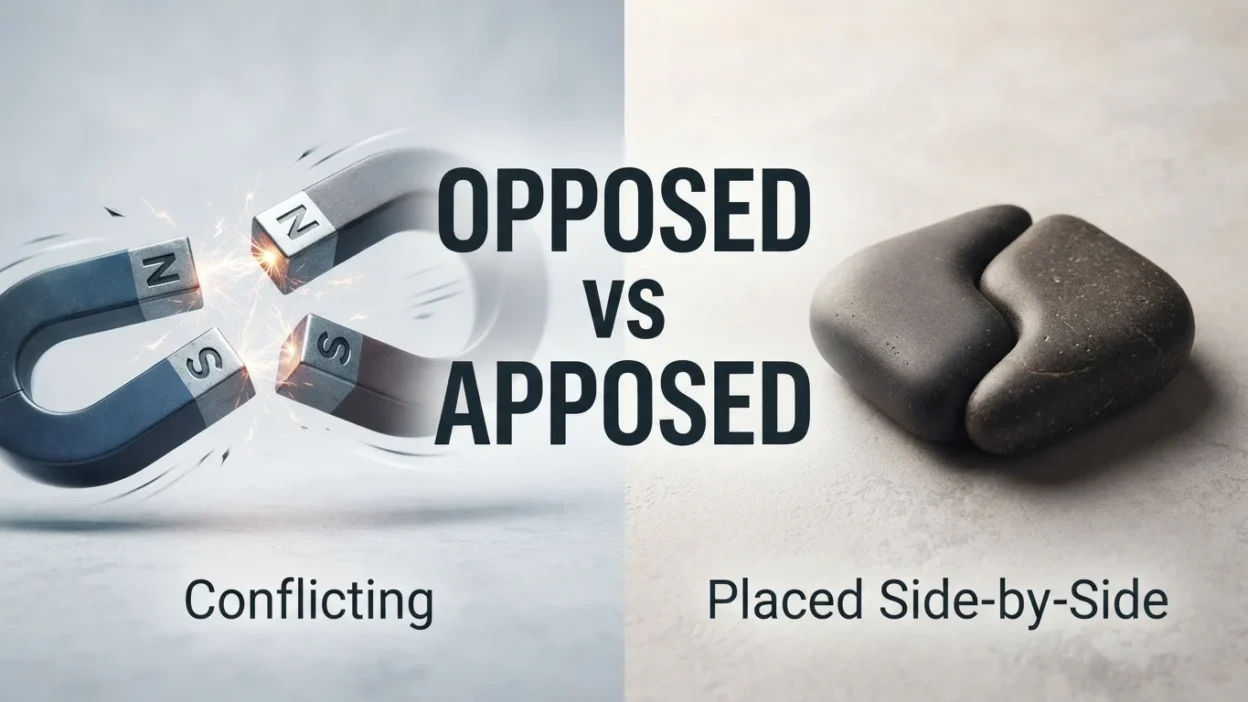
One describes disagreement or resistance, while the other refers to something being placed or positioned next to something else.
Understanding opposed vs apposed is especially useful for students, writers, editors, and English learners because choosing the wrong word can change the meaning of an entire sentence.
In this guide, we will explain the meaning, difference, usage, grammar forms, examples, common mistakes, and practical memory tricks for using both words correctly.
Quick Answer: Opposed vs Apposed
Opposed means against, disagreeing with, or resisting something.
Apposed means placed next to or alongside something else.
For example: “They are opposed to the proposal” means they disagree with it, while “The label was apposed to the diagram” means it was placed beside it.
What Does “Opposed” Mean?
Opposed is the past tense and past participle of the verb oppose. It means to disagree with something, resist something, or take a position against it.
It is commonly used when talking about opinions, decisions, policies, proposals, plans, or people.
Examples of “Opposed”
- The employees opposed the new working policy.
- She is strongly opposed to unnecessary spending.
- Many residents opposed the construction project.
- The committee was opposed to the proposed changes.
- He opposed the decision because he believed it was unfair.
The most common grammatical pattern is opposed to + noun or -ing form.
We are opposed to the plan.
They are opposed to increasing the price.
What Does “Apposed” Mean?
Apposed comes from the verb appose, which means to place one thing beside or next to another thing.
This word is much less common than opposed and is mainly found in technical, grammatical, scientific, or formal writing.
For example:
The researcher apposed the label to the figure.
Here, apposed means that the label was positioned beside or alongside the figure.
The noun apposition is more commonly used in grammar and linguistics.
Opposed vs Apposed: Main Difference
The easiest way to understand opposed vs apposed is to focus on their core ideas.
| Word | Meaning | Main Idea | Example |
|---|---|---|---|
| Opposed | Against or disagreeing with something | Resistance | She is opposed to the proposal. |
| Apposed | Placed beside or next to something | Position | The note was apposed to the diagram. |
In simple terms:
Opposed = against
Apposed = placed beside
They may look nearly identical, but they describe completely different relationships.
Opposed vs Apposed: Comparison Table
| Feature | Opposed | Apposed |
|---|---|---|
| Base verb | Oppose | Appose |
| Meaning | To resist or disagree | To place beside |
| Commonness | Very common | Uncommon |
| Typical context | Opinions, policies, decisions | Grammar, technical writing, positioning |
| Preposition | Often “to” | Often “to” |
| Example | They are opposed to the plan. | The caption was apposed to the image. |
| Related noun | Opposition | Apposition |
The shared ending -posed can make these words confusing, but their prefixes provide an important clue.
Grammar Forms of Oppose and Appose
Knowing the related forms makes the difference easier to remember.
| Grammar Form | Oppose | Appose |
|---|---|---|
| Base form | oppose | appose |
| Third-person singular | opposes | apposes |
| Past tense | opposed | apposed |
| Present participle | opposing | apposing |
| Past participle | opposed | apposed |
| Noun | opposition | apposition |
| Adjective | opposed | apposed |
Because appose is uncommon, you are far more likely to encounter opposed, oppose, and opposition in everyday English.
How to Use “Opposed” Correctly
Use opposed when someone disagrees with, resists, or objects to something.
A particularly common construction is:
subject + be + opposed to + noun/gerund
Examples:
- I am opposed to the proposal.
- The teachers are opposed to changing the schedule.
- She was opposed to the idea.
- The organization is opposed to unnecessary restrictions.
Be careful with the phrase opposed to. Here, to is a preposition, so a verb following it normally takes the -ing form.
Correct:
He is opposed to changing the policy.
Incorrect:
He is opposed to change the policy.
How to Use “Apposed” Correctly
Use apposed when you mean that something was placed beside, alongside, or in relation to another thing.
Examples include:
- The diagram was apposed to the explanatory text.
- A second image was apposed to the original illustration.
- The researcher apposed the sample to the reference material.
- The grammatical phrase was apposed to the noun.
Because appose is rare, ordinary English often uses simpler alternatives such as placed beside, positioned next to, or set alongside.
For example:
The image was placed beside the text.
is much more natural for most general readers than:
The image was apposed to the text.
Opposed vs Apposed in Everyday English
In everyday conversations, opposed is overwhelmingly more common.
You might hear:
“I’m opposed to that idea.”
You are much less likely to hear:
“The picture was apposed to the text.”
This difference in frequency is important. If you are writing ordinary English and want to express disagreement, opposed is almost certainly the word you need.
If you mean physical or grammatical placement, apposed may be appropriate, especially in specialized writing.
Opposed vs Apposed in Business
Business writing frequently uses opposed when discussing disagreement with proposals, strategies, policies, or decisions.
Business examples
- The board is opposed to the proposed merger.
- Several investors opposed the new strategy.
- Employees were opposed to reducing their benefits.
- The manager opposed the proposed budget cuts.
Apposed is much less common in business communication. It might appear when describing the placement of information, labels, or documents, but simpler wording is usually preferred.
| Business Situation | Better Word | Example |
|---|---|---|
| Disagreeing with a proposal | Opposed | Investors opposed the proposal. |
| Resisting a policy | Opposed | Employees were opposed to the policy. |
| Positioning information beside something | Apposed | The note was apposed to the chart. |
Opposed vs Apposed in Education
Students commonly encounter opposed in essays, debates, and argumentative writing.
Examples:
- The students were opposed to the new rule.
- The author is opposed to censorship.
- Several researchers opposed the original theory.
Apposed may appear in linguistics or grammar lessons, particularly when discussing apposition.
For example, two grammatical elements can be placed together so that one explains or identifies the other.
My friend, Sarah, arrived early.
Here, Sarah is in apposition to my friend.
Opposed vs Apposed in Science
Science writing can use both words, but their meanings remain completely different.
Opposed can describe conflicting theories, forces, viewpoints, or experimental positions.
The researchers were opposed to the original hypothesis.
Apposed can describe objects or structures positioned alongside one another.
The structures were apposed along the boundary.
| Scientific Context | Word | Meaning |
|---|---|---|
| Conflicting theories | Opposed | In disagreement |
| Competing explanations | Opposed | Against |
| Structures placed together | Apposed | Positioned beside |
| Labels beside figures | Apposed | Placed alongside |
Opposed vs Apposed in Grammar and Linguistics
The word apposed has an important connection to apposition, a grammatical relationship in which one element is placed next to another to identify, explain, or rename it.
For example:
My brother, James, is a doctor.
The name James provides additional information about my brother.
By contrast, opposed has nothing to do with apposition. It relates to opposition or disagreement.
| Linguistic Term | Meaning |
|---|---|
| Oppose | Resist or disagree |
| Opposed | Against |
| Opposition | Resistance or disagreement |
| Appose | Place beside |
| Apposed | Placed beside |
| Apposition | Grammatical or positional relationship |
Common Mistakes With Opposed vs Apposed
Because the two words look so similar, writers sometimes substitute one for the other.
Mistake 1
❌ I am apposed to the new policy.
✅ I am opposed to the new policy.
The speaker means they disagree with the policy, so opposed is correct.
Mistake 2
❌ The diagram was opposed to the label.
✅ The diagram was apposed to the label.
If the meaning is that the diagram and label were placed beside one another, apposed is appropriate.
Mistake 3
❌ She is apposed to changing the schedule.
✅ She is opposed to changing the schedule.
This sentence expresses disagreement, not physical placement.
Mistake 4
❌ The two labels were opposed beside each other.
✅ The two labels were apposed to each other.
Here the intended meaning is positional rather than argumentative.
Why Do People Confuse Opposed and Apposed?
There are several reasons these words are easy to mix up.
First, both words end in -posed, which comes from a Latin root associated with placing or putting.
Second, both can appear with the preposition to:
- opposed to
- apposed to
Third, apposed is uncommon, so many readers have never encountered it before. When they see it, they may assume it is simply a spelling mistake for opposed.
The meaning of the sentence should therefore guide your choice.
A Simple Memory Trick
Try this easy trick:
Opposed = Opposition
Both begin with opp-, helping you remember that opposed means being against something.
Apposed = Adjacent
Think of A = alongside. If something is apposed, it is placed alongside something else.
| Word | Memory Association | Meaning |
|---|---|---|
| Opposed | Opposition | Against |
| Apposed | Alongside | Beside |
So remember:
Opposed = against
Apposed = beside
Opposed vs Apposed: Step-by-Step Choice
When you are unsure which word to use, follow these steps.
| Step | Question | If Yes |
|---|---|---|
| 1 | Does the sentence express disagreement? | Use opposed |
| 2 | Does it describe resistance? | Use opposed |
| 3 | Does it describe something being placed beside something else? | Consider apposed |
| 4 | Is the context grammar or linguistics? | Apposed/apposition may be appropriate |
| 5 | Is the word unfamiliar and the meaning simply “beside”? | Consider “placed beside” for clarity |
This simple process can prevent most mistakes.
Professional and Industry Usage
Different fields favor the two words differently.
| Industry | Opposed | Apposed |
|---|---|---|
| Business | Very common | Rare |
| Education | Common | Occasional |
| Politics | Very common | Rare |
| Law | Common | Occasional |
| Science | Common | Technical |
| Medicine | Common | Technical |
| Linguistics | Common | Commoner in specialized contexts |
| General conversation | Very common | Very rare |
If you are writing for a general audience, opposed will usually be the more familiar word.
If your field specifically discusses positioning, anatomy, linguistics, or technical relationships, apposed may be useful.
Opposed vs Apposed Examples at a Glance
| Sentence | Correct Word | Why |
|---|---|---|
| We are ___ to the proposal. | Opposed | Means against |
| The workers ___ the new rule. | Opposed | Means resisted |
| She is ___ to the idea. | Opposed | Means disagrees |
| The label was ___ to the diagram. | Apposed | Means placed beside |
| The structures were ___ along the boundary. | Apposed | Describes position |
| The committee ___ the plan. | Opposed | Expresses disagreement |
| The figure was ___ to the explanatory note. | Apposed | Describes placement |
Is “Opposed to” Always Correct?
When you want to say that someone disagrees with something, opposed to is the standard construction.
Examples:
They are opposed to the proposal.
She is opposed to raising taxes.
The group was opposed to the decision.
Notice that when a verb follows to, it normally uses the -ing form:
opposed to working
opposed to changing
opposed to increasing
This is an important grammar point for students and English learners.
Is “Apposed” a Common English Word?
No. Apposed is a legitimate English word, but it is relatively uncommon.
In ordinary conversation, people usually say:
- placed beside
- positioned next to
- placed alongside
- set beside
For example, instead of:
The caption was apposed to the photograph.
a general audience may find this clearer:
The caption was placed beside the photograph.
However, apposed can be useful in specialized academic or technical contexts.
Opposed vs Apposed: Which One Should You Use?
The choice depends entirely on your intended meaning.
Use opposed when you mean:
- against
- disagreeing
- resisting
- objecting
- in conflict with
Use apposed when you mean:
- placed beside
- positioned alongside
- set next to
- grammatically placed alongside another element
The safest rule is simple: if there is disagreement, use opposed; if there is placement beside something, use apposed.
Frequently Asked Questions
What is the difference between opposed and apposed?
Opposed means against or in disagreement with something. Apposed means placed beside or alongside something.
Is “apposed” a real word?
Yes. Apposed is the past tense and past participle of appose, meaning to place something beside another thing. It is uncommon in everyday English.
Is it “opposed to” or “apposed to”?
Both expressions can be grammatically possible, but they have different meanings. Opposed to means against or disagreeing with something, while apposed to refers to being placed beside something.
What is an example of opposed?
A simple example is: “The employees were opposed to the new policy.” It means the employees disagreed with or resisted the policy.
What is an example of apposed?
An example is: “The label was apposed to the diagram.” This means the label was placed beside the diagram.
How can I remember opposed vs apposed?
Remember opposed = opposition = against. Think of apposed = alongside = beside. This distinction makes the two words much easier to remember.
Final Thoughts on Opposed vs Apposed
The difference between opposed vs apposed becomes simple once you focus on meaning rather than spelling.
Opposed describes disagreement, resistance, or being against something. It is common in everyday English, business, education, politics, and professional writing.
Apposed, on the other hand, means placed beside or alongside something. It is much less common and is mainly found in technical, academic, grammatical, or specialized contexts.
When choosing between them, ask one question: Am I talking about disagreement or position? If the answer is disagreement, choose opposed. If the answer is placement beside something, apposed may be the right choice.