The ageing vs aging question is a common spelling confusion in English. Both words refer to the process of becoming or changing over time, but the preferred spelling depends on the variety of English you use.
This can make ageing vs aging especially confusing for students, writers, professionals, and anyone creating content for an international audience.
The good news is that both forms are generally correct. Ageing is more common in English and many other varieties that follow British conventions, while aging is the standard in American English.
Understanding the ageing vs aging difference helps you maintain consistency in essays, business documents, scientific writing, and everyday communication.
Quick Answer
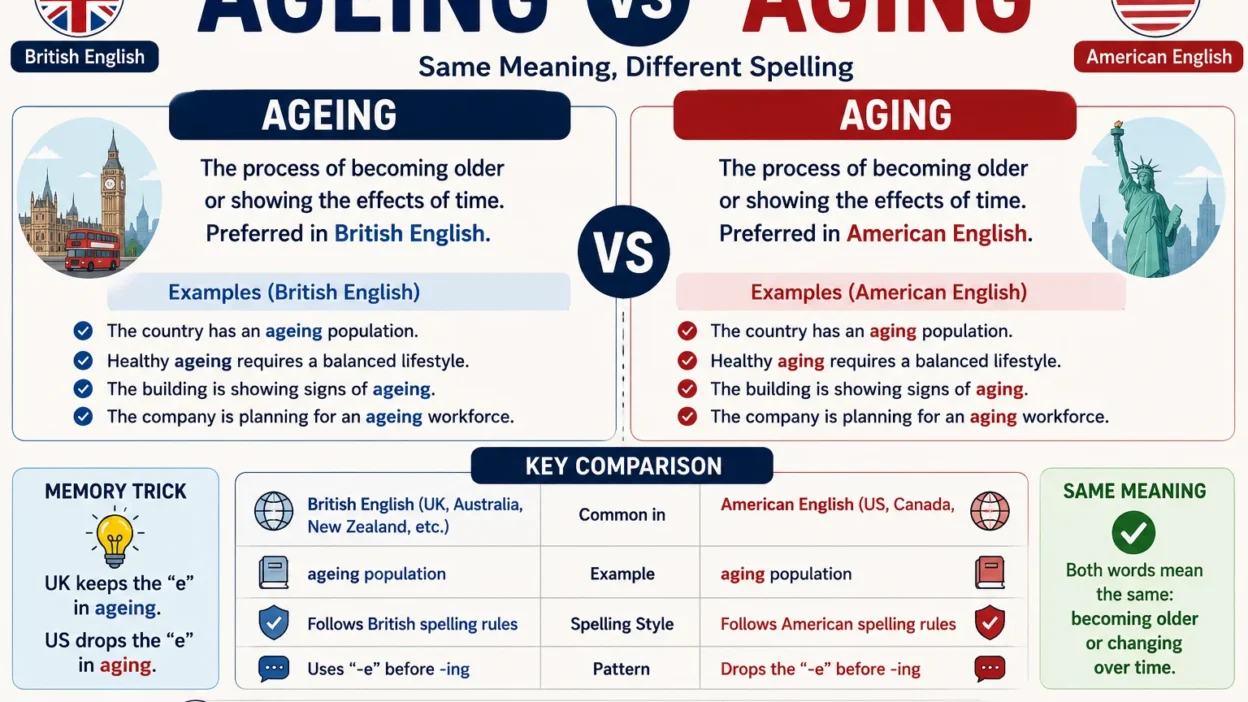
Ageing and aging have the same meaning: the process of growing older or becoming older.
- Ageing is mainly used in British English.
- Aging is mainly used in American English.
Choose one spelling based on your target audience and use it consistently.
What Does “Ageing” Mean?
Ageing means the process of becoming older. It can describe people, animals, populations, materials, products, and even systems.
In British English, ageing is the traditional and widely accepted spelling.
Examples of Ageing
- The company is developing products for an ageing population.
- Regular exercise may support healthy ageing.
- The building is showing signs of ageing.
- Scientists are studying the biological process of ageing.
The word can function as a noun, adjective, or part of a verb phrase depending on the sentence.
What Does “Aging” Mean?
Aging has the same meaning as ageing. The difference is spelling, not meaning.
In American English, aging is the standard and more common form.
Examples of Aging
- The government is preparing for an aging population.
- Researchers are studying healthy aging.
- The car is beginning to show signs of aging.
- The company sells products designed for aging adults.
If you are writing for an American audience, aging is usually the better choice.
Ageing vs Aging: Main Difference
The main difference between ageing vs aging is regional spelling preference.
There is generally no difference in pronunciation or core meaning. Both describe the process of becoming older or showing the effects of time.
| Feature | Ageing | Aging |
|---|---|---|
| Main meaning | The process of becoming older | The process of becoming older |
| Common region | British English | American English |
| Pronunciation | Same | Same |
| Standard in UK writing | Yes | Less common |
| Standard in US writing | Less common | Yes |
| Meaning difference | No | No |
The easiest rule is to match the spelling to your chosen English style.
Why Is It “Ageing” vs “Aging”?
The difference comes from spelling conventions and the treatment of the letter e when adding the suffix -ing.
In many British English words, the final e is sometimes retained in forms like ageing. In American English, the spelling aging drops the e.
This is why you may see both versions in dictionaries, books, websites, and academic publications.
Simple Comparison
| Base Word | British-Style Form | American-Style Form |
|---|---|---|
| Age | Ageing | Aging |
| Ageing process | Ageing | Aging |
| Healthy ageing | Healthy ageing | Healthy aging |
| Population ageing | Population ageing | Population aging |
However, spelling rules in English can vary from word to word, so it is best not to assume that every word ending in e follows exactly the same pattern.
Which Is Correct: Ageing or Aging?
Both ageing and aging are correct.
The correct choice depends on the English variety you are using.
Use “Ageing” When Writing For:
- British audiences
- UK-based publications
- British English academic writing
- Organizations using British spelling
- Documents following UK style guides
Use “Aging” When Writing For:
- American audiences
- US-based publications
- American English academic writing
- US businesses and organizations
- Documents following American spelling rules
The most important rule is consistency. Do not switch randomly between ageing and aging in the same document unless you have a specific reason.
Ageing vs Aging in British and American English
The regional difference is the key to understanding ageing vs aging.
| English Variety | Preferred Spelling | Example |
|---|---|---|
| British English | Ageing | The ageing population is increasing. |
| American English | Aging | The aging population is increasing. |
| Australian English | Often ageing | Healthy ageing is an important topic. |
| Canadian English | Style-dependent | Check the publication style guide. |
| International English | Either, depending on style | Use one spelling consistently. |
Some international organizations may have their own editorial preferences. When writing professionally, always check the relevant style guide.
How “Ageing” and “Aging” Are Used in Grammar
Both spellings can appear in similar grammatical roles.
As a Noun
- Ageing is a natural part of life.
- Aging is a major topic in medical research.
As an Adjective
- An ageing population needs additional services.
- An aging population needs additional services.
In Continuous Verb Forms
- The population is ageing rapidly.
- The population is aging rapidly.
Grammar Forms Table
| Grammar FormAgeing ExampleAging Example | ||
|---|---|---|
| Noun | Ageing affects everyone. | Aging affects everyone. |
| Adjective | An ageing workforce | An aging workforce |
| Present participle | The population is ageing. | The population is aging. |
| Gerund | Ageing can change the body. | Aging can change the body. |
| Compound phrase | Healthy ageing | Healthy aging |
The meaning remains the same. The spelling changes according to the English variety.
Ageing vs Aging in Everyday Examples
Here are simple examples showing how both spellings work.
British English
- My parents are ageing, but they remain active.
- The town has an ageing population.
- Healthy ageing requires attention to lifestyle.
- The house is ageing well despite its old design.
American English
- My parents are aging, but they remain active.
- The town has an aging population.
- Healthy aging requires attention to lifestyle.
- The house is aging well despite its old design.
The sentences have the same meaning. Only the spelling style changes.
Ageing vs Aging in Business
The spelling choice can matter in business communication, especially when a company serves an international market.
For example, a UK company may write:
“We are creating new services for an ageing population.”
A US company would usually write:
“We are creating new services for an aging population.”
Business Usage Table
| Business Context | British English | American English |
|---|---|---|
| Market report | Ageing population | Aging population |
| Workforce analysis | Ageing workforce | Aging workforce |
| Product development | Ageing consumers | Aging consumers |
| Customer research | Healthy ageing market | Healthy aging market |
| Corporate report | Population is ageing | Population is aging |
When writing for a global audience, choose one recognized style and apply it throughout the document.
Ageing vs Aging in Education and Academic Writing
In education, the correct spelling usually depends on the style requirements of the institution or publication.
A British university may prefer ageing, while an American university will generally use aging.
Education Examples
- The essay examines the social effects of an ageing population.
- The research paper examines the social effects of an aging population.
- Students studied theories of healthy ageing.
- Students studied theories of healthy aging.
Always check your teacher’s instructions, university guidelines, or required style guide.
Ageing vs Aging in Science and Research
Both spellings appear in scientific and medical writing. The preferred form often depends on the journal, country, or editorial style.
Common topics include:
- Biological ageing or aging
- Healthy ageing or aging
- Population ageing or aging
- Brain ageing or aging
- Cellular ageing or aging
Science and Research Examples
| Context | British Style | American Style |
|---|---|---|
| Biology | Biological ageing | Biological aging |
| Medicine | Healthy ageing | Healthy aging |
| Neuroscience | Brain ageing | Brain aging |
| Population studies | Population ageing | Population aging |
| Materials science | Ageing materials | Aging materials |
When submitting research, follow the publication’s spelling requirements rather than choosing randomly.
Ageing vs Aging in Professional and Industry Usage
Different industries may use the word in slightly different contexts, but the spelling rule remains the same.
| Industry | Common Context | UK Preference | US Preference |
|---|---|---|---|
| Healthcare | Healthy ageing | Ageing | Aging |
| Government | Ageing population | Ageing | Aging |
| Human resources | Ageing workforce | Ageing | Aging |
| Technology | Ageing equipment | Ageing | Aging |
| Construction | Ageing infrastructure | Ageing | Aging |
| Cosmetics | Anti-ageing products | Anti-aging products | |
| Manufacturing | Ageing materials | Ageing | Aging |
In professional writing, consistency is often more important than which spelling you personally prefer.
Ageing vs Aging in “Anti-Ageing” and “Anti-Aging”
The same regional difference appears in compound expressions.
British English
Anti-ageing
Example:
- The company sells anti-ageing skincare products.
American English
Anti-aging
Example:
- The company sells anti-aging skincare products.
| Expression | British English | American English |
|---|---|---|
| Anti-ageing cream | Correct | Less common |
| Anti-aging cream | Less common | Correct |
| Ageing process | Correct | Less common |
| Aging process | Less common | Correct |
| Healthy ageing | Correct | Less common |
| Healthy aging | Less common | Correct |
For SEO and marketing content, you may see both spellings because businesses often target audiences in multiple countries.
Why Do People Confuse Ageing and Aging?
People confuse these spellings because English spelling rules are not always completely consistent.
Many writers learn that a final e is usually dropped before adding -ing, as in:
- Make → making
- Write → writing
- Drive → driving
This leads some people to assume that aging must always be the only correct spelling.
However, ageing is also an accepted standard spelling, especially in British English. The confusion comes from regional variation rather than a difference in meaning.
Common Mistakes With Ageing vs Aging
The biggest mistake is thinking that one spelling is always wrong.
Incorrect vs Correct Examples
| Incorrect or Inconsistent | Correct | Why |
|---|---|---|
| The UK report discusses aging populations and healthy ageing. | The UK report discusses ageing populations and healthy ageing. | Use British spelling consistently. |
| The US report studies ageing and aging. | The US report studies aging. | Use American spelling consistently. |
| Ageing means becoming older, while aging means becoming weaker. | Both mean becoming older. | There is no basic meaning difference. |
| The aging population is ageing in the same US document. | Use aging throughout. | Avoid unnecessary spelling changes. |
| Ageing is an incorrect spelling. | Ageing is correct in British English. | Both forms are accepted. |
Consistency is the main usage rule.
A Simple Memory Trick
Use this easy memory trick:
British English → Ageing keeps the “e.”
American English → Aging drops the “e.”
You can also remember:
If you know your audience, choosing the correct spelling becomes much easier.
Step-by-Step Guide to Choosing the Right Spelling
Follow this simple process when deciding between the two forms.
| Step | Question | What to Do |
|---|---|---|
| 1 | Who is your audience? | Identify the main region. |
| 2 | Are you using British English? | Choose ageing. |
| 3 | Are you using American English? | Choose aging. |
| 4 | Does a style guide apply? | Follow the required style. |
| 5 | Are both spellings in the document? | Make the spelling consistent. |
Example Process
You are writing a blog for readers in the United States.
Step 1: Main audience: American.
Step 2: Use American spelling.
Result: Choose aging.
If the same article is written specifically for a British audience, choose ageing instead.
Real-Life Examples in Different Contexts
In Business
- The company is adapting to the needs of an ageing workforce.
- The company is adapting to the needs of an aging workforce.
In Education
- Students discussed the challenges of an ageing society.
- Students discussed the challenges of an aging society.
In Science
- Researchers are studying the effects of ageing on cells.
- Researchers are studying the effects of aging on cells.
In Technology
- The organization is replacing ageing computer systems.
- The organization is replacing aging computer systems.
In Everyday Life
- The furniture is ageing beautifully.
- The furniture is aging beautifully.
The intended meaning stays the same in every example.
Similar Words With British and American Spelling Differences
The ageing vs aging difference is part of a larger pattern of regional spelling variation.
| British English | American English |
|---|---|
| Ageing | Aging |
| Colour | Color |
| Favourite | Favorite |
| Organisation | Organization |
| Centre | Center |
| Travelling | Traveling |
| Jewellery | Jewelry |
These differences do not usually change pronunciation or core meaning. They mainly reflect different spelling conventions.
Is One Spelling Better for SEO?
Neither spelling is universally better for SEO.
The best choice depends on the audience you want to reach.
If your website mainly targets readers in the UK, ageing may be more natural. If your audience is mainly in the US, aging is usually the better choice.
For international SEO, you can consider:
- Your target country
- Search intent
- Regional website versions
- Local keyword research
- Consistent language settings
Avoid unnatural keyword repetition. Write for your readers first, then use the relevant spelling naturally.
When Should You Use Both Spellings?
Usually, you should not use both forms in the same piece of writing.
However, there are a few situations where both may appear naturally:
- Comparing British and American English
- Explaining spelling differences
- Discussing international terminology
- Quoting original material that uses a different spelling
For example:
Ageing is preferred in British English, while aging is preferred in American English.
This is correct because the purpose of the sentence is to compare the two spellings.
FAQs About Ageing vs Aging
1. Is ageing or aging correct?
Both are correct. Ageing is mainly British English, while aging is mainly American English.
2. What is the difference between ageing and aging?
There is no major difference in meaning. The main difference is regional spelling preference.
3. Why does British English use “ageing”?
British English commonly retains the e in ageing, making it the standard preferred spelling in many UK contexts.
4. Which spelling should I use in academic writing?
Use the spelling required by your university, instructor, publisher, or style guide. Stay consistent throughout the document.
5. Is “aging” wrong in British English?
Not necessarily, but ageing is generally more traditional and preferred in British English.
6. Is “anti-ageing” or “anti-aging” correct?
Both are correct. Use anti-ageing for British English and anti-aging for American English.
Conclusion
The ageing vs aging difference is mainly a matter of British and American spelling. Both words have the same meaning and refer to the process of becoming older or changing over time.
Ageing is generally preferred in British English, while aging is the standard form in American English.
The simplest rule is to know your audience and follow one spelling style consistently. Use ageing for British-style writing and aging for American-style writing.
if you are writing about people, populations, technology, science, business, or products, the key is to choose the spelling that matches your language style and avoid mixing both forms unnecessarily.