Writing with the right sentence rhythm can completely change how readers experience your content.
One style that often sparks curiosity is the staccato sentence meaning. Many people encounter the term in grammar, literature, or music and wonder what it actually means in writing.
Understanding staccato sentence meaning helps you recognize why some sentences feel fast, dramatic, and powerful.
Although the word staccato originally comes from music, it has become a common literary term describing short, sharp, and punchy sentences.
This guide explains the meaning, usage, examples, common mistakes, and practical tips so you can confidently use staccato sentences in your own writing.
Quick Answer
A staccato sentence is a short, abrupt sentence that creates a quick, dramatic, or forceful rhythm. Writers use it to add emphasis, build suspense, or make important ideas stand out.
What Is a Staccato Sentence?
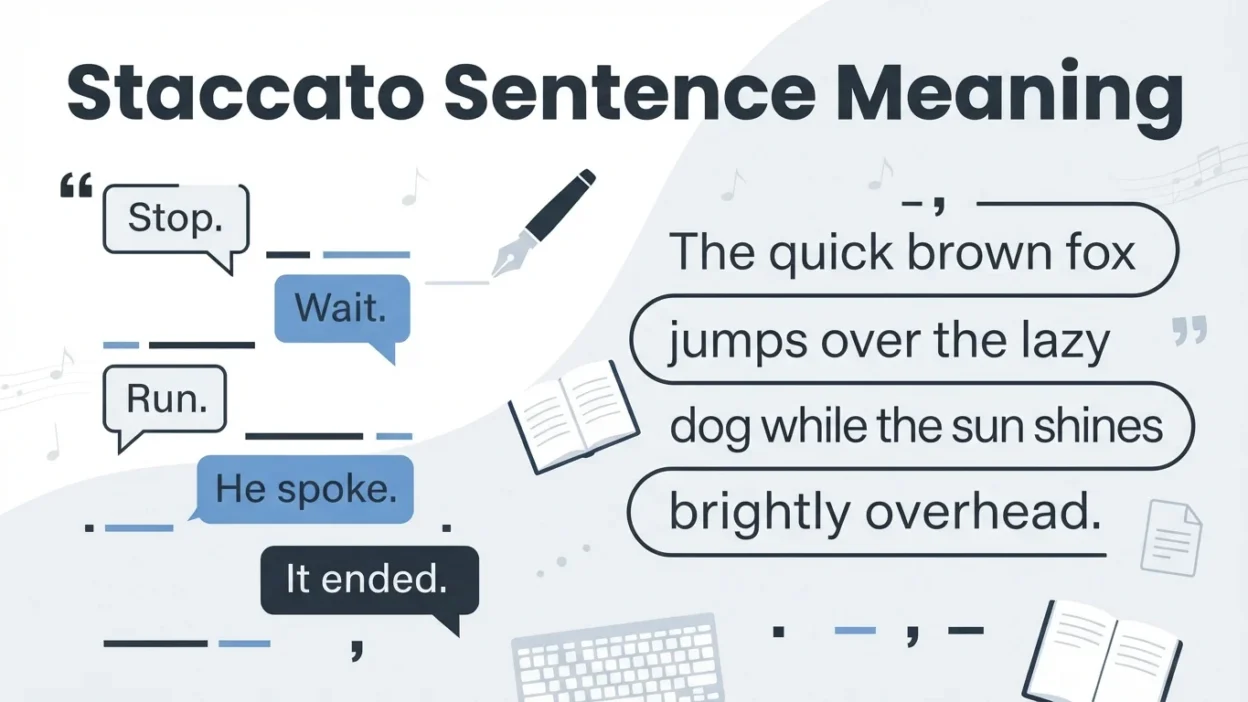
A staccato sentence is a very short sentence written to produce a sharp, quick, and emphatic effect.
The term comes from music, where staccato means notes are played separately rather than smoothly connected. In writing, the same idea applies—sentences are brief and direct instead of long and flowing.
Examples
- He stopped.
- No one moved.
- The room fell silent.
- She waited.
- Then everything changed.
Each sentence is short, creating tension and urgency.
Staccato Sentence Meaning at a Glance
| Feature | Description |
|---|---|
| Meaning | A short, abrupt sentence used for emphasis |
| Origin | Musical term “staccato” |
| Writing Style | Brief and direct |
| Main Purpose | Create impact or suspense |
| Common Use | Fiction, journalism, speeches, advertising |
| Opposite Style | Flowing or periodic sentences |
Why Are Staccato Sentences Used?
Writers use staccato sentences because they:
- Create suspense
- Increase emotional impact
- Speed up the reading pace
- Draw attention to important ideas
- Make dialogue sound realistic
- Add drama
Example
Instead of:
The storm grew stronger, and everyone hurried toward the nearest shelter before the heavy rain reached them.
A staccato version becomes:
The wind howled. People ran. Doors slammed. Rain poured.
The second version feels faster and more dramatic.
Characteristics of Staccato Sentences
| Characteristic | Explanation |
|---|---|
| Short Length | Usually one simple idea |
| Strong Impact | Leaves a lasting impression |
| Direct Language | Few unnecessary words |
| Fast Rhythm | Speeds up reading |
| Dramatic Tone | Creates excitement or tension |
Staccato vs Flowing Sentences
| Feature | Staccato Sentence | Flowing Sentence |
|---|---|---|
| Length | Short | Long |
| Rhythm | Quick | Smooth |
| Tone | Dramatic | Relaxed |
| Reading Speed | Fast | Moderate |
| Best For | Suspense, emphasis | Storytelling, explanation |
Example
Flowing
The child slowly walked through the quiet forest while listening to the birds singing in the trees.
Staccato
The child walked. Silence. Birds sang. Something moved.
When Should You Use Staccato Sentences?
Staccato sentences work best when you want readers to pay attention.
Ideal Situations
- Action scenes
- Horror stories
- Crime novels
- Speeches
- News headlines
- Advertisements
- Social media posts
Real-Life Examples of Staccato Sentences
Business
- Sales increased.
- Costs dropped.
- Profits improved.
Education
- Read carefully.
- Think first.
- Answer confidently.
Science
- The reaction began.
- Pressure increased.
- Results changed.
Marketing
- New design.
- Better quality.
- Lower price.
Sports
- He jumped.
- He landed.
- The crowd cheered.
How to Write Effective Staccato Sentences
| Step | Action |
|---|---|
| 1 | Identify your main idea |
| 2 | Remove unnecessary words |
| 3 | Break long sentences into shorter ones |
| 4 | Use strong verbs |
| 5 | Read aloud to check rhythm |
Example
Long version:
The detective carefully examined every clue before finally realizing who the criminal was.
Staccato version:
The detective searched. Every clue mattered. Then he knew.
Grammar Forms Related to Staccato
Although staccato itself rarely changes form, it functions in different grammatical roles.
| Form | Example |
|---|---|
| Adjective | A staccato sentence |
| Adverb | The actor spoke staccato-like. |
| Noun (Music) | The piece was played in staccato. |
| Literary Use | Staccato writing style |
Professional and Industry Usage
| Industry | How Staccato Sentences Are Used |
|---|---|
| Journalism | Breaking news headlines |
| Marketing | Short promotional messages |
| Literature | Build suspense |
| Screenwriting | Fast-paced dialogue |
| Public Speaking | Memorable statements |
| Copywriting | Strong calls to action |
Common Mistakes When Using Staccato Sentences
Many writers overuse short sentences, making writing feel robotic.
| Mistake | Better Choice |
|---|---|
| Every sentence is short. | Mix short and long sentences. |
| Too many fragments | Use complete thoughts where needed. |
| Weak verbs | Choose powerful action verbs. |
| Repeating the same pattern | Vary sentence structure. |
Correct vs Incorrect Sentences
❌ He ran. He jumped. He stopped. He looked. He walked. He smiled. (Too repetitive)
✅ He ran. He jumped. Then everything became quiet.
❌ The meeting happened. People talked. Coffee came. Everyone left.
✅ The meeting ended. Silence followed.
Why Do People Confuse Staccato Sentence Meaning?
The confusion comes from the word’s musical origin.
Many people think staccato only applies to music. However, writers borrowed the term because short sentences resemble short musical notes.
Others believe every short sentence is automatically staccato. In reality, staccato writing uses multiple brief sentences intentionally to create rhythm and emphasis.
Memory Trick
Remember this simple phrase:
Staccato = Stop and Start
Think of short musical notes.
Short notes.
Short sentences.
Same rhythm.
Advantages and Disadvantages
| Advantages | Disadvantages |
|---|---|
| Builds suspense | Can feel choppy |
| Easy to read | Overuse becomes repetitive |
| Adds emphasis | May reduce detail |
| Improves pacing | Not suitable for every topic |
Examples in Famous Writing Styles
Many famous authors use staccato sentences during exciting moments.
Example:
He waited. Nothing happened. Then the lights went out.
Notice how the short sentences increase tension without needing many descriptive words.
People Also Ask
What is a staccato sentence?
A staccato sentence is a short, direct sentence used to create emphasis, suspense, or dramatic effect.
Where does the word staccato come from?
It comes from music, where staccato means notes are played separately.
Are staccato sentences grammatically correct?
Yes. They are grammatically correct when used intentionally and appropriately.
Can I use staccato sentences in academic writing?
Yes, but only occasionally. Academic writing usually prefers balanced sentence lengths.
What is the opposite of a staccato sentence?
A flowing, periodic, or cumulative sentence with smooth transitions.
FAQs
Why do authors use staccato sentences?
To create excitement, urgency, suspense, or emotional impact.
Are staccato sentences always short?
Generally yes, although their effect depends more on rhythm than exact length.
Can staccato sentences improve SEO writing?
Yes. They improve readability and help highlight important information when used sparingly.
Is a sentence fragment the same as a staccato sentence?
No. A staccato sentence is usually complete, while a fragment may be incomplete.
Should I use staccato sentences in every paragraph?
No. Mixing short and long sentences creates the best reading experience.
Conclusion
Understanding staccato sentence meaning allows you to write with greater rhythm and impact. A staccato sentence is a short, sharp sentence designed to grab attention, increase suspense, and emphasize important ideas. While this style is highly effective in storytelling, journalism, speeches, and marketing, it works best when balanced with longer, flowing sentences. Use staccato sentences thoughtfully, and your writing will become more engaging, memorable, and easier to read.