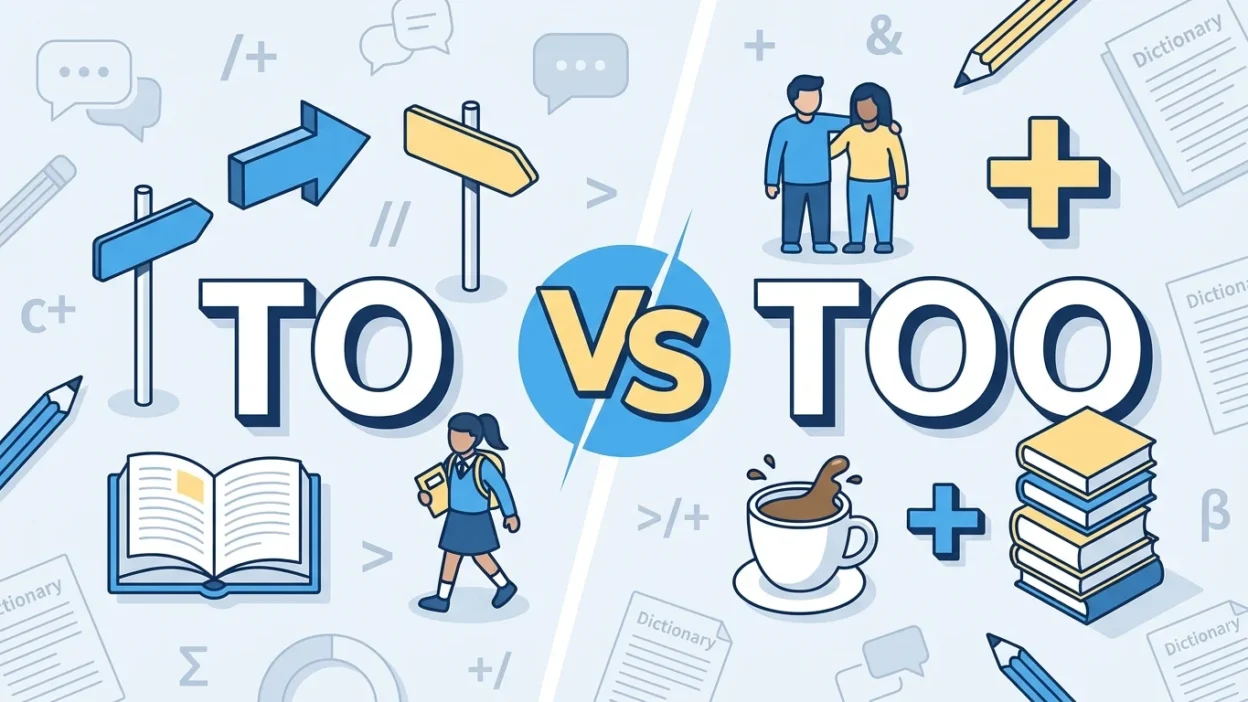
The confusion between too vs to is one of the most common grammar mistakes in English.
Although these two words look similar and sound almost identical, they have completely different meanings and grammatical functions.
Understanding too vs to is essential for writing correctly in school, business, emails, and everyday conversations.
If you’ve ever wondered whether to write “I want to go” or “I want too go,” you’re not alone. Many English learners and even native speakers occasionally mix them up.
This guide explains too vs to with simple definitions, examples, comparison tables, grammar tips, and memory tricks to help you use each word confidently.
Quick Answer
To is usually a preposition or part of an infinitive verb (to eat, to learn).
Too is an adverb meaning also or more than enough.
Remember: Too = also or excessively, while To = direction, purpose, or part of a verb.
Too vs To Comparison Table
| Feature | To | Too |
|---|---|---|
| Part of Speech | Preposition / Infinitive Marker | Adverb |
| Main Meaning | Direction, purpose, or before a verb | Also or excessively |
| Example | I want to study. | I want to study too. |
| Indicates | Movement, relationship, action | Addition or excess |
| Common Usage | Everyday writing | Everyday writing |
What Does “To” Mean?
To is one of the most frequently used words in English. It usually functions as a preposition or as part of an infinitive verb.
Examples
- I am going to school.
- She wants to learn French.
- Send the package to my office.
- We need to finish the project.
Common Uses of “To”
- Showing direction
- Showing destination
- Before the base form of a verb
- Expressing purpose
What Does “Too” Mean?
Too is an adverb that has two primary meanings:
- Also
- More than necessary
Examples
- I want to come too.
- The coffee is too hot.
- She is too tired to work.
- They liked the movie too.
Key Differences Between Too and To
| To | Too |
|---|---|
| Shows direction | Means also |
| Used before verbs | Means excessively |
| Can introduce an infinitive | Never introduces a verb |
| Common in grammar structures | Used for emphasis |
Grammar Forms and Usage
| Word | Grammar Role | Example |
|---|---|---|
| To | Preposition | Go to the store. |
| To | Infinitive Marker | To read is enjoyable. |
| Too | Adverb (also) | I enjoyed it too. |
| Too | Adverb (excessively) | The box is too heavy. |
When to Use “To”
Use to when talking about:
Direction
- Drive to work.
- Walk to the station.
Purpose
- I came to help.
- She studies to improve.
Infinitive Verbs
- To learn
- To write
- To understand
- To travel
When to Use “Too”
Use too when it means also.
Examples:
- I like coffee too.
- She is coming too.
- We enjoyed the concert too.
Use too when something is excessive.
Examples:
- The bag is too heavy.
- The water is too cold.
- You’re driving too fast.
Real-Life Examples
Business
| Sentence | Correct Word |
|---|---|
| Please send the report ___ the manager. | To |
| I would like to attend the meeting ___ . | Too |
| The deadline is ___ short. | Too |
Education
| Sentence | Correct Word |
|---|---|
| Students need ___ complete homework. | To |
| I finished the assignment ___ . | Too |
| The exam was ___ difficult. | Too |
Science
| Sentence | Correct Word |
|---|---|
| Heat transfers ___ cooler objects. | To |
| The temperature is ___ high. | Too |
| Scientists want ___ analyze samples. | To |
Everyday Conversation
- I’m going to the gym.
- She’s coming too.
- The soup is too salty.
- We need to leave early.
Why People Confuse Too vs To
There are several reasons people mix up these words:
- They sound exactly alike.
- They are both short words.
- Spell-check may not catch the mistake.
- Fast typing often causes errors.
- English learners focus on pronunciation rather than spelling.
Common Mistakes
| Incorrect Sentence | Correct Sentence |
|---|---|
| I want too learn. | I want to learn. |
| She went too school. | She went to school. |
| Me too am happy. | I am happy too. |
| It’s to expensive. | It’s too expensive. |
| He wants too eat. | He wants to eat. |
Memory Tricks
Learning too vs to becomes much easier with these simple tricks.
Remember the Extra “O”
Too has an extra O because it means extra or also.
Think of Direction
Whenever you’re talking about going somewhere or introducing a verb, use to.
Quick Rule
- To = Go to
- Too = Also or Extra
Professional Usage
| Industry | Example Using “To” | Example Using “Too” |
|---|---|---|
| Business | Submit the proposal to HR. | The budget is too high. |
| Healthcare | Report to the nurse. | The dosage is too large. |
| Education | Return assignments to students. | The lesson is too long. |
| Technology | Connect to the server. | The file is too large. |
| Marketing | Send emails to customers. | The advertisement is too lengthy. |
Step by Step Guide to Choosing the Correct Word
| Step | Question | Use |
|---|---|---|
| 1 | Is it before a verb? | To |
| 2 | Is it showing direction? | To |
| 3 | Does it mean also? | Too |
| 4 | Does it mean excessively? | Too |
| 5 | Unsure? Replace with “also.” If it works, use Too. | Too |
Practice Examples
Choose the correct word.
| Sentence | Answer |
|---|---|
| I need ___ finish my work. | To |
| She is coming ___ . | Too |
| The weather is ___ cold. | Too |
| We walked ___ the library. | To |
| They want ___ travel abroad. | To |
| I’d like some ice cream ___ . | Too |
Tips for Remembering Too vs To
- Learn the meaning before memorizing the spelling.
- Read English books regularly.
- Practice writing daily.
- Use grammar quizzes.
- Proofread emails and assignments.
- Remember that too always has an extra “O.”
FAQs
What is the main difference between too vs to?
To shows direction or introduces a verb, while too means also or excessively.
Is “too” always an adverb?
Yes. Too functions as an adverb in English.
Can “to” come before every verb?
No. It comes before the base form of a verb when forming an infinitive, but not after modal verbs like can, must, or should.
How do I remember the difference?
Think of the extra O in too as meaning extra or also.
Which word is more common?
To is one of the most frequently used words in English because it has several grammatical functions.
Why do spell checkers miss this mistake?
Because both to and too are correctly spelled words, grammar—not spelling—determines which one is correct.
Conclusion
Understanding too vs to is essential for clear and accurate English writing. While to is used as a preposition or infinitive marker to show direction, purpose, or introduce a verb, too is an adverb meaning also or more than enough.
Remember the simple rule: To points somewhere or introduces an action, while too adds the idea of extra or also.
With regular practice and these memory tricks, you’ll avoid one of the most common English grammar mistakes with confidence.

Julian Wyatt is a passionate researcher and writer who explores symbols, mythology, cultural traditions, and hidden meanings. Through engaging articles, he helps readers uncover the fascinating stories and significance behind symbols worldwide.