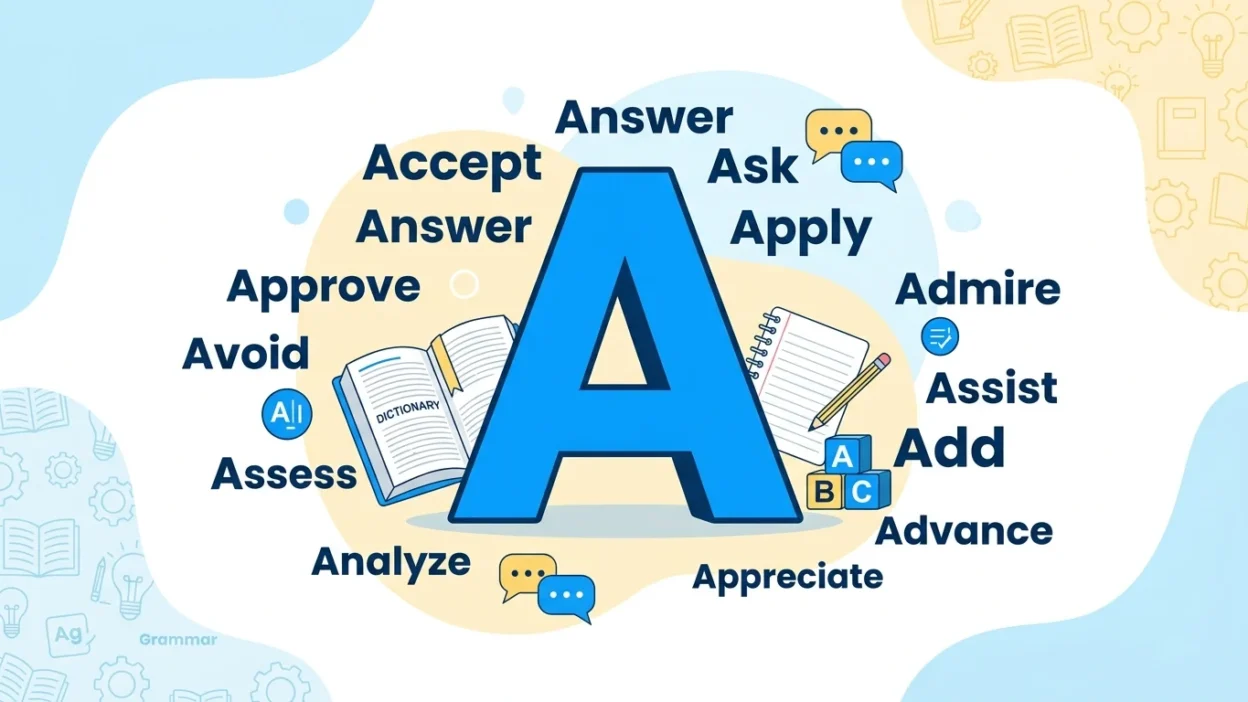
Verbs that start with A are some of the most commonly used action words in the English language.
Whether you are improving your vocabulary, writing essays, preparing for exams, or playing word games, learning verbs that start with A can make your communication stronger and more expressive.
From simple words like ask and add to advanced verbs like advocate and accelerate, these words appear in everyday conversations and professional writing.
Many learners search for verbs that start with A because they want better vocabulary, need action words for creative writing, or are looking for verbs for school assignments.
This guide explains their meanings, usage, grammar, examples, and practical applications with easy to follow tables and examples.
Quick Answer
Verbs that start with A are action words beginning with the letter A. They describe actions, processes, or states, such as accept, achieve, ask, answer, admire, and arrive.
Learning them improves writing, speaking, and vocabulary.
What Are Verbs That Start With A?
A verb is a word that expresses an action, occurrence, or state of being. When a verb begins with the letter A, it is called a verb that starts with A.
Examples include:
- Accept
- Ask
- Answer
- Achieve
- Admire
- Arrive
- Apply
- Approve
- Avoid
- Add
These verbs are widely used in academic, business, and everyday English.
Common Verbs That Start With A
| Verb | Meaning | Example Sentence |
|---|---|---|
| Accept | Receive willingly | She accepted the invitation. |
| Add | Put together | Add sugar to the tea. |
| Ask | Request information | I asked a question. |
| Answer | Reply | He answered politely. |
| Achieve | Reach a goal | She achieved success. |
| Admire | Respect greatly | We admire her courage. |
| Arrive | Reach a place | They arrived early. |
| Apply | Submit or use | Apply for the job. |
| Approve | Agree officially | The manager approved the plan. |
| Avoid | Stay away from | Avoid unnecessary risks. |
Complete List of Verbs That Start With A
Here are over 100 commonly used verbs beginning with A:
| Verb List |
|---|
| Accept |
| Achieve |
| Acquire |
| Act |
| Activate |
| Adapt |
| Add |
| Address |
| Adjust |
| Admire |
| Admit |
| Adopt |
| Adore |
| Advance |
| Advertise |
| Advise |
| Advocate |
| Affect |
| Afford |
| Agree |
| Aid |
| Aim |
| Alarm |
| Alert |
| Allow |
| Alter |
| Amaze |
| Amend |
| Analyze |
| Announce |
| Annoy |
| Answer |
| Anticipate |
| Apologize |
| Appeal |
| Appear |
| Applaud |
| Apply |
| Appreciate |
| Approach |
| Approve |
| Argue |
| Arise |
| Arrange |
| Arrest |
| Arrive |
| Ask |
| Assemble |
| Assert |
| Assess |
| Assign |
| Assist |
| Associate |
| Assume |
| Assure |
| Attach |
| Attack |
| Attempt |
| Attend |
| Attract |
| Audit |
| Authorize |
| Automate |
| Avoid |
| Awake |
| Award |
| Await |
Verbs That Start With A by Category
Everyday Verbs
| Verb | Example |
|---|---|
| Ask | Ask your teacher. |
| Add | Add more water. |
| Accept | Accept the gift. |
| Answer | Answer the phone. |
| Arrive | Arrive on time. |
Academic Verbs
| Verb | Example |
|---|---|
| Analyze | Analyze the data carefully. |
| Assess | Assess student performance. |
| Apply | Apply the formula. |
| Argue | Argue your point logically. |
| Assign | Assign homework. |
Business Verbs
| Verb | Example |
|---|---|
| Approve | Approve the budget. |
| Audit | Audit financial records. |
| Advertise | Advertise the product. |
| Authorize | Authorize payment. |
| Achieve | Achieve company goals. |
Grammar Forms of Common Verbs
| Base Verb | Past Tense | Past Participle | Present Participle |
|---|---|---|---|
| Accept | Accepted | Accepted | Accepting |
| Ask | Asked | Asked | Asking |
| Add | Added | Added | Adding |
| Apply | Applied | Applied | Applying |
| Approve | Approved | Approved | Approving |
| Achieve | Achieved | Achieved | Achieving |
| Arrive | Arrived | Arrived | Arriving |
| Avoid | Avoided | Avoided | Avoiding |
Real-Life Examples of Verbs That Start With A
Business
- The manager approved the proposal.
- Our company achieved record sales.
- We advertised the new product.
Education
- Students answered every question.
- Teachers assigned homework.
- Researchers analyzed the results.
Science
- Scientists assessed the evidence.
- Engineers assembled the machine.
- Researchers applied new techniques.
Daily Life
- I asked my friend for help.
- She accepted the invitation.
- We arrived before noon.
Industry Usage Table
| Industry | Common Verbs That Start With A |
|---|---|
| Education | Analyze, Assess, Assign, Answer |
| Healthcare | Assess, Assist, Administer |
| Business | Approve, Audit, Authorize |
| Marketing | Advertise, Attract, Analyze |
| Technology | Automate, Apply, Assemble |
| Law | Appeal, Arrest, Authorize |
How to Learn Verbs That Start With A
| Step | Description |
|---|---|
| 1 | Learn five new verbs daily. |
| 2 | Write one sentence using each verb. |
| 3 | Practice speaking them aloud. |
| 4 | Review every week. |
| 5 | Use them in emails and conversations. |
Common Mistakes
Many learners make these errors when using verbs that start with A.
| Incorrect | Correct |
|---|---|
| She accept the gift. | She accepts the gift. |
| He ask me yesterday. | He asked me yesterday. |
| We was arrived early. | We arrived early. |
| I am agree. | I agree. |
| Please answered me. | Please answer me. |
Why People Learn Verbs That Start With A
People often search for verbs that start with A because they want to:
- Improve English vocabulary.
- Prepare for spelling tests.
- Write better essays.
- Play word games.
- Improve business communication.
- Expand creative writing vocabulary.
Memory Tricks
Remember these easy patterns:
- Ac- often relates to receiving or reaching (accept, achieve, acquire).
- Ap- often involves using or requesting (apply, appeal, approach).
- Ar- often relates to movement (arrive, arise).
- As- often relates to support or evaluation (assist, assess, assign).
Grouping similar verbs makes them easier to remember.
Comparison Table of Popular Verbs
| Verb | Primary Meaning | Common Context |
|---|---|---|
| Accept | Receive | Daily conversation |
| Achieve | Reach a goal | Education, Business |
| Apply | Submit or use | Jobs, Studies |
| Approve | Give permission | Business |
| Ask | Request | Everyday English |
| Answer | Respond | School, Work |
| Avoid | Stay away | Safety, Health |
| Arrive | Reach destination | Travel |
Tips for Using Verbs That Start With A
- Choose the verb that matches the context.
- Learn both meaning and pronunciation.
- Practice writing complete sentences.
- Memorize common verb forms.
- Read books and articles to see natural usage.
- Review frequently for long-term retention.
FAQs
What are verbs that start with A?
They are action words beginning with the letter A, such as accept, ask, achieve, apply, and arrive.
Why should I learn verbs that start with A?
They improve vocabulary, writing skills, speaking ability, and reading comprehension.
What is the easiest verb that starts with A?
Ask is one of the easiest and most frequently used verbs.
Are verbs that start with A common in English?
Yes. Many everyday conversations include verbs beginning with the letter A.
How can I remember these verbs?
Practice them in sentences, group similar meanings together, and review them regularly.
Can these verbs be used in professional writing?
Yes. Many are commonly used in business, education, science, technology, and formal communication.
Conclusion
Learning verbs that start with A is an excellent way to expand your English vocabulary and improve communication skills.
From everyday verbs like ask and accept to professional terms such as approve, assess, and authorize, these action words are useful in nearly every situation.
Practice them regularly, understand their meanings, and use them in real-life conversations and writing to build confidence and fluency.