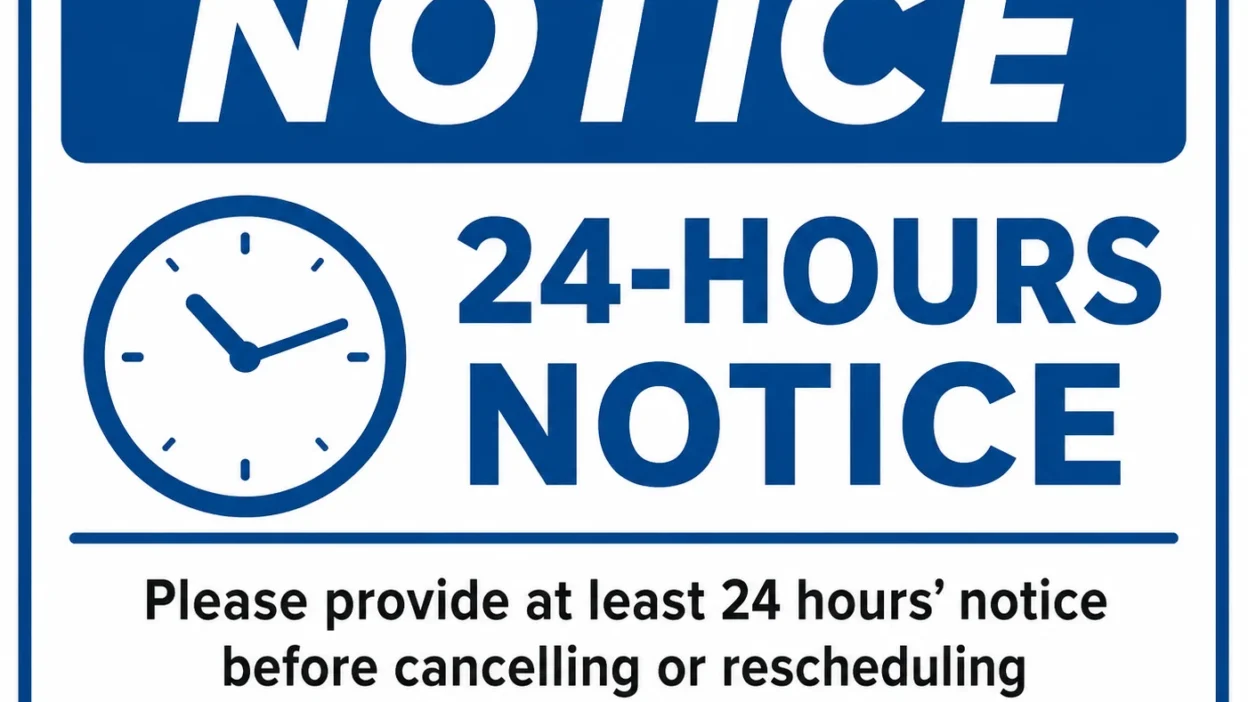
When someone asks for 24 hours notice, they are usually referring to advance notification given at least one full day before an event, action, appointment, or change takes place.
You may see this phrase in rental agreements, appointment rules, school notices, and customer service communications.
Although the meaning seems simple, questions often arise about spelling, grammar, and whether the correct form is 24 hours notice, 24-hour notice, or 24 hours’ notice.
Understanding how to use 24 hours notice correctly can make your writing clearer and more professional.
The correct form often depends on whether the phrase is being used as a possessive expression or as a compound adjective.
This guide explains the meaning, usage, grammar rules, examples, common mistakes, and professional applications of the expression.
Quick Answer
24 hours’ notice means notification given at least 24 hours before something happens.
24-hour notice is used as a compound adjective before a noun, such as a 24-hour notice requirement.
The form 24 hours notice is commonly written informally, but it is often grammatically incomplete because the possessive apostrophe is missing.
What Does 24 Hours’ Notice Mean?
The phrase 24 hours’ notice means that someone must be informed, warned, or notified one full day in advance.
For example:
- Please give me 24 hours’ notice before cancelling the appointment.
- Employees must provide 24 hours’ notice before requesting certain schedule changes.
- The landlord entered the property after giving the tenant 24 hours’ notice.
In this construction, hours’ is plural possessive. The notice belongs to, or is measured by, a period of 24 hours.
A simple way to understand it is:
Notice given 24 hours in advance = 24 hours’ notice
24 Hours Notice vs 24 Hours’ Notice vs 24-Hour Notice
These expressions are closely related, but they are not always used in the same grammatical position.
| Expression | Grammar | Best Use | Example |
|---|---|---|---|
| 24 hours’ notice | Plural possessive noun phrase | Referring to the amount of advance notice | Please give 24 hours’ notice. |
| 24-hour notice | Compound adjective + noun | Describing a notice or requirement | A 24-hour notice period is required. |
| 24 hours notice | Informal/nonstandard in formal writing | Often seen without an apostrophe | Please give 24 hours notice. |
| 24-hour notice requirement | Compound modifier | Policies and formal documents | The company has a 24-hour notice requirement. |
For formal and professional writing, choosing between 24 hours’ notice and 24-hour notice is usually the safest approach.
Why Does “24 Hours’ Notice” Need an Apostrophe?
The apostrophe in 24 hours’ notice shows possession.
This is similar to:
- one day’s work
- two weeks’ vacation
- three months’ experience
- five years’ service
- 24 hours’ notice
The phrase means the notice associated with or measured by 24 hours.
Because hours is plural and ends in s, the apostrophe comes after the s:
24 hours’ notice
Grammar Form Table
| Time Expression | Correct Form | Example |
|---|---|---|
| 1 hour | one hour’s notice | I need one hour’s notice. |
| 2 hours | two hours’ notice | Please provide two hours’ notice. |
| 24 hours | 24 hours’ notice | Give 24 hours’ notice. |
| 1 day | one day’s notice | The policy requires one day’s notice. |
| 3 days | three days’ notice | Employees must give three days’ notice. |
| 2 weeks | two weeks’ notice | She gave two weeks’ notice. |
When Should You Use “24-Hour Notice”?
Use 24-hour when the phrase acts as a compound adjective before a noun.
For example:
- The company has a 24-hour notice policy.
- You must follow the 24-hour cancellation rule.
- The school requires a 24-hour notice period.
- We have a 24-hour notice requirement for reservations.
Notice that hour is singular in a compound adjective.
We say:
a 24-hour notice
Not:
a 24-hours notice
This follows the general rule for compound adjectives involving numbers and units.
Similar Compound Adjective Examples
| Correct | Incorrect |
|---|---|
| a 24-hour notice | a 24-hours notice |
| a two-week vacation | a two-weeks vacation |
| a five-day trip | a five-days trip |
| a three-hour meeting | a three-hours meeting |
| a ten-minute break | a ten-minutes break |
The Main Difference Between 24 Hours’ Notice and 24-Hour Notice
The key difference is grammatical function.
24 hours’ notice functions as a noun phrase describing how much advance notice is required.
24-hour notice uses 24-hour as an adjective to describe another noun or an established requirement.
| Phrase | Main Function | Example |
|---|---|---|
| 24 hours’ notice | Amount of notice | We require 24 hours’ notice. |
| 24-hour notice | Describes a noun | We require a 24-hour notice period. |
| 24 hours notice | Informal wording | Please give 24 hours notice. |
Both correct standard forms communicate a similar idea, but the sentence structure determines which one fits best.
How to Use 24 Hours’ Notice in a Sentence
Here are common examples of correct usage:
At Work
- Please give your manager 24 hours’ notice before changing your shift.
- Employees should provide 24 hours’ notice when requesting certain schedule adjustments.
For Appointments
- We ask customers to give 24 hours’ notice before cancelling an appointment.
- The clinic requires 24 hours’ notice for non-emergency cancellations.
In Rental Situations
- The tenant was given 24 hours’ notice before the scheduled inspection.
- Written notice should be provided at least 24 hours in advance.
At School
- Students must give 24 hours’ notice before rescheduling certain assessments.
- Parents received 24 hours’ notice about the meeting.
For Events
- The organizer requested 24 hours’ notice before making major changes.
- Please notify us with at least 24 hours’ notice if you cannot attend.
How to Use 24-Hour Notice in a Sentence
Use 24-hour notice when you want the entire phrase to describe another noun.
Examples include:
- The hotel has a 24-hour notice cancellation policy.
- The company introduced a 24-hour notice requirement.
- This service requires a 24-hour notice period.
- The contract includes a 24-hour notice clause.
- Staff members must follow the 24-hour notice policy.
The compound adjective 24-hour usually comes immediately before the noun it describes.
Real-Life Examples of 24 Hours’ Notice
The meaning of 24 hours notice can vary slightly depending on the situation, but the basic idea remains the same: notification must happen one day in advance.
Business Example
A business may require customers to cancel appointments at least 24 hours before the scheduled time.
Example:
“Customers must provide 24 hours’ notice to avoid a late cancellation fee.”
Education Example
A school may ask students or parents to notify staff before missing an important event.
Example:
“Please give the teacher 24 hours’ notice if your child cannot attend the presentation.”
Science and Research Example
Researchers may need advance notification before using shared equipment or laboratory space.
Example:
“Researchers must provide 24 hours’ notice before reserving the specialized equipment.”
Healthcare Example
Medical clinics often use advance notice rules for cancellations or schedule changes.
Example:
“The clinic requests 24 hours’ notice for appointment cancellations.”
Hospitality Example
Hotels, restaurants, and event venues may need advance notice for changes to reservations.
Example:
“Large groups must give 24 hours’ notice before changing the number of guests.”
24 Hours Notice in Professional and Industry Usage
The phrase appears in many industries because advance notice helps organizations manage schedules, staff, resources, and costs.
| Industry | Typical Usage | Example |
|---|---|---|
| Business | Schedule changes | 24 hours’ notice is required for changes. |
| Healthcare | Appointment cancellations | Please provide 24 hours’ notice. |
| Education | Absences or meetings | Parents should give 24 hours’ notice. |
| Hospitality | Reservations | A 24-hour notice policy applies. |
| Real Estate | Property access or inspections | Advance notice may be required. |
| Research | Equipment scheduling | A 24-hour booking notice may apply. |
| Customer Service | Service cancellations | Customers need to give advance notice. |
In professional writing, consistency is important. A company should use the same grammatical style throughout its policies and documents.
Common Mistakes With 24 Hours Notice
One of the most common mistakes is forgetting the apostrophe when using the phrase as a possessive noun expression.
Correct vs Incorrect Examples
| Incorrect | Correct | Why |
|---|---|---|
| Please give 24 hours notice. | Please give 24 hours’ notice. | Plural possessive form is needed in formal writing. |
| We require a 24 hours notice. | We require a 24-hour notice. | Compound adjective uses singular hour. |
| Give 24 hour’s notice. | Give 24 hours’ notice. | 24 hours is plural, so the apostrophe follows s. |
| It is a 24-hours policy. | It is a 24-hour policy. | Compound adjectives use singular units. |
| Give a 24 hours’ notice. | Give 24 hours’ notice. | Do not usually add a before this amount expression. |
A Common Confusion
Compare these two correct sentences:
Please give 24 hours’ notice.
Here, 24 hours’ notice is the amount of notice required.
Please follow the 24-hour notice policy.
Here, 24-hour describes notice policy.
The meaning is similar, but the grammar is different.
Why Do People Confuse 24 Hours’ Notice and 24-Hour Notice?
People often confuse these forms because they sound almost identical when spoken.
In everyday conversation, the apostrophe cannot be heard clearly. As a result, many people write 24 hours notice without considering whether the phrase needs a possessive apostrophe.
Another source of confusion is the singular form hour in 24-hour notice. Although the number is 24, compound adjectives normally use the singular form of the unit.
For example:
- a six-month contract
- a four-year degree
- a two-hour delay
- a 24-hour notice period
Remember: the grammar changes according to the job the phrase performs in the sentence.
A Simple Memory Trick
Use this quick rule:
Amount of time + notice = possessive
Examples:
- 24 hours’ notice
- two days’ notice
- three weeks’ notice
Think:
“Notice of 24 hours.”
This can remind you that the time expression is possessive.
For a compound adjective, use:
Number + singular unit + noun
Examples:
- 24-hour policy
- two-day deadline
- three-week course
A simple memory formula is:
24 hours’ notice = how much notice
24-hour notice = what kind of notice
Step-by-Step Guide: Which Form Should You Use?
Use this process when deciding which version is correct.
| Step | Ask Yourself | Use |
|---|---|---|
| 1 | Am I stating the amount of advance notice? | 24 hours’ notice |
| 2 | Is the phrase describing another noun? | 24-hour + noun |
| 3 | Is hour part of a compound adjective? | Use singular hour |
| 4 | Does hours mean a possessive time period? | Add the apostrophe after s |
| 5 | Am I writing formally? | Prefer standard grammatical forms |
Examples Using the Process
Sentence: We need ___ before the meeting.
You are describing the amount of notice.
Correct: We need 24 hours’ notice before the meeting.
Sentence: The company has a ___ policy.
You are describing policy.
Correct: The company has a 24-hour notice policy.
Can “24 Hours Notice” Be Used Informally?
Yes. You will often see 24 hours notice in text messages, advertisements, signs, websites, and informal communication.
For example:
- “Please give 24 hours notice.”
- “We need 24 hours notice for bookings.”
Most readers understand these sentences without difficulty. However, in polished business writing, academic work, legal documents, or professional communication, 24 hours’ notice is generally the more grammatically complete choice when referring to the amount of notice.
The informal version may be common, but common usage does not always follow formal grammar conventions.
Related Expressions and Grammar Patterns
Understanding related time expressions can help you use the correct form naturally.
Possessive Time Expressions
| Expression | Example |
|---|---|
| one hour’s notice | Give one hour’s notice. |
| two hours’ notice | Give two hours’ notice. |
| one day’s notice | Give one day’s notice. |
| two days’ notice | Give two days’ notice. |
| one week’s notice | Give one week’s notice. |
| two weeks’ notice | Give two weeks’ notice. |
Compound Time Adjectives
| Expression | Example |
|---|---|
| one-hour meeting | We attended a one-hour meeting. |
| two-hour meeting | It was a two-hour meeting. |
| one-day event | It is a one-day event. |
| three-day event | They organized a three-day event. |
| 24-hour policy | The company has a 24-hour policy. |
These patterns follow the same basic grammar rule: possessive forms show an amount or duration, while compound adjectives describe a noun.
Is 24 Hours’ Notice the Same as One Day’s Notice?
In most situations, yes. Both expressions generally mean one full day of advance notification.
However, 24 hours’ notice is more precise because it refers to an exact number of hours.
For example, if an appointment is scheduled for 3:00 p.m. tomorrow, a strict 24-hour rule may require notification by 3:00 p.m. today.
A phrase such as one day’s notice may sometimes be interpreted more generally depending on the policy or context.
| Expression | Meaning | Level of Precision |
|---|---|---|
| 24 hours’ notice | One complete 24-hour period | Very precise |
| one day’s notice | Approximately or exactly one day, depending on context | Can be less specific |
| 24-hour notice period | A defined advance-notice requirement | Usually precise |
When exact timing matters, organizations should clearly explain how the notice period is calculated.
Professional Tips for Writing a 24-Hour Notice Policy
If you are writing a business policy, clarity matters as much as grammar.
A good notice policy should explain:
- How much notice is required
- When the notice period begins
- How the person should provide notice
- What happens if the deadline is missed
- Whether exceptions apply
Example Policy Language
“Customers must provide at least 24 hours’ notice to cancel or reschedule an appointment. Changes made after the required notice period may be subject to a cancellation fee.”
This wording clearly explains both the required advance notice and the possible consequence.
Frequently Asked Questions
Is “24 hours notice” grammatically correct?
It is common in informal writing, but 24 hours’ notice is generally preferred when referring to the amount of notice required.
Why is there an apostrophe in “24 hours’ notice”?
The apostrophe shows a plural possessive time expression. The notice is measured by or associated with 24 hours.
Is it “24-hour notice” or “24-hours notice”?
Use 24-hour notice when 24-hour acts as a compound adjective. The unit remains singular in this structure.
Can I say “a 24 hours’ notice”?
Usually, no. Say 24 hours’ notice or use a 24-hour notice period, depending on the sentence.
Is 24 hours’ notice the same as one day’s notice?
Usually, yes. Both refer to advance notification given one day before something happens, although 24 hours’ notice is more exact.
How do I write 48 hours’ notice?
Use 48 hours’ notice because hours is plural possessive. For example: “Please provide 48 hours’ notice.”
Conclusion
The main rule is simple: use 24 hours’ notice when referring to the amount of advance notification someone must give.
Use 24-hour notice when the phrase acts as a compound adjective before another noun, such as 24-hour notice policy or 24-hour notice period.
The form 24 hours notice is common in informal writing, but formal and professional usage is clearer with the correct possessive apostrophe. Remember: plural time amount + notice = hours’ notice, while number + singular time unit + noun = 24-hour notice.
Following this rule will help you write policies, emails, agreements, and everyday messages more accurately and confidently.

Julian Wyatt is a passionate researcher and writer who explores symbols, mythology, cultural traditions, and hidden meanings. Through engaging articles, he helps readers uncover the fascinating stories and significance behind symbols worldwide.