Gluing vs glueing is a spelling question that often confuses English learners, students, writers, and even native speakers.
Since the verb glue ends with the letter e, many people wonder if the correct present participle is gluing or glueing.
Understanding the difference between gluing vs glueing helps you avoid common spelling mistakes and write more confidently.
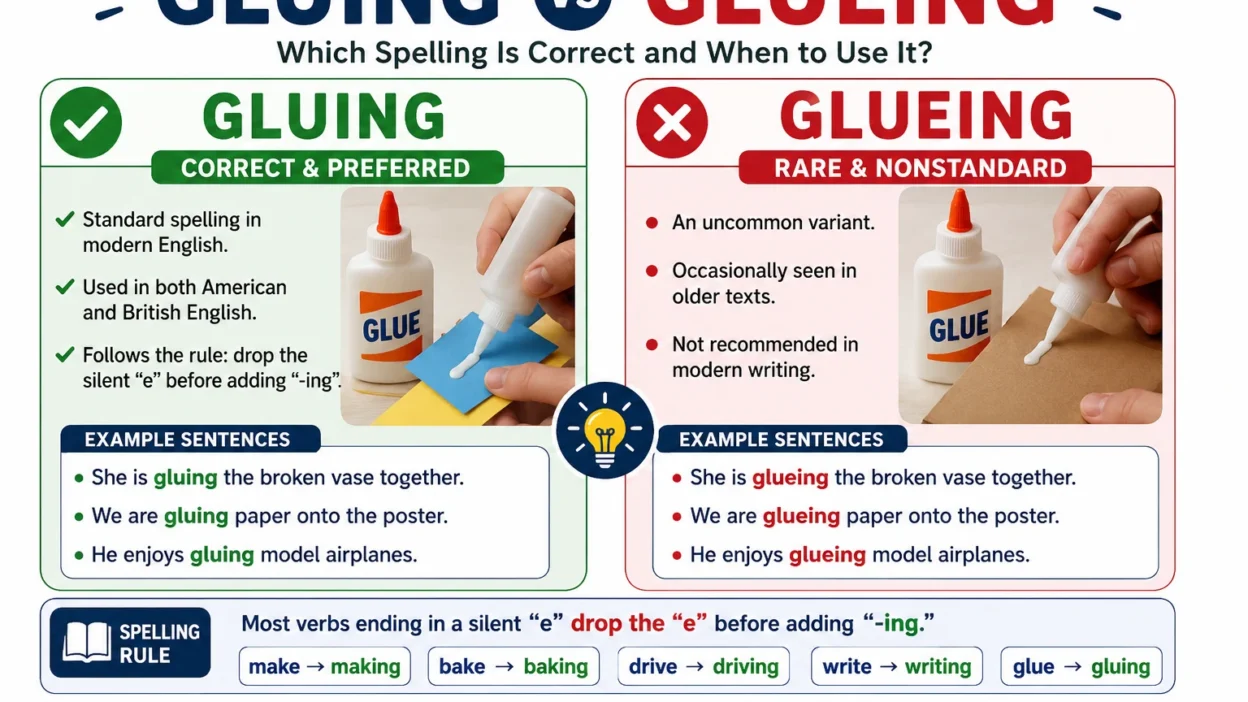
The simple answer is that gluing is the standard and widely accepted spelling in both American and British English.
While glueing occasionally appears in older texts or specialized contexts, it is generally considered a nonstandard variant today.
Knowing the correct usage ensures your writing looks professional and follows modern English spelling rules.
Quick Answer
Gluing is the correct and preferred spelling in modern English.
Glueing is an uncommon variant that is rarely used today. In almost all writing, choose gluing.
Gluing vs Glueing Comparison Table
| Feature | Gluing | Glueing |
|---|---|---|
| Meaning | Attaching with glue | Same meaning |
| Modern Usage | Standard | Rare |
| American English | ✔ Correct | Rarely used |
| British English | ✔ Correct | Occasionally seen but uncommon |
| Dictionaries | Preferred | Listed as a variant in some dictionaries |
| Recommended for Writing | Yes | No |
What Does “Gluing” Mean?
Gluing is the present participle and gerund form of the verb glue, meaning to join or attach objects using an adhesive.
Examples:
- She is gluing the broken vase together.
- We spent the afternoon gluing paper onto the poster.
- He enjoys gluing model airplanes.
What Does “Glueing” Mean?
Glueing has the same meaning as gluing, but it is an uncommon alternative spelling. Most modern dictionaries and style guides recommend using gluing instead.
Examples:
- Some older documents use glueing.
- Modern publishers generally replace glueing with gluing.
Is Gluing or Glueing Correct?
The correct spelling in standard English is gluing.
When a verb ends in -e, English often drops the final e before adding -ing.
Examples:
- Make → Making
- Bake → Baking
- Drive → Driving
- Glue → Gluing
This spelling rule explains why gluing is preferred.
Main Difference Between Gluing and Glueing
| Aspect | Gluing | Glueing |
|---|---|---|
| Correct Modern Spelling | ✔ Yes | Usually No |
| Meaning | Joining with glue | Same |
| Grammar | Present participle | Variant spelling |
| Frequency | Very common | Very rare |
| Recommended | Yes | No |
Why Do People Confuse Gluing and Glueing?
There are several reasons people mix these spellings:
- The base word ends in e.
- Some words keep the e before adding -ing.
- Older books occasionally use glueing.
- Spell checkers sometimes recognize both spellings.
- Writers assume the e should always stay.
Fortunately, modern English has standardized gluing as the preferred form.
English Spelling Rule Behind Gluing
Most verbs ending in silent e drop the e before adding -ing.
| Base Verb | Correct -ing Form |
|---|---|
| Make | Making |
| Bake | Baking |
| Drive | Driving |
| Use | Using |
| Write | Writing |
| Glue | Gluing |
Following this rule helps avoid spelling errors.
Grammar Forms Table
| Form | Word |
|---|---|
| Base Verb | Glue |
| Present Participle | Gluing |
| Gerund | Gluing |
| Past Tense | Glued |
| Past Participle | Glued |
| Third Person Singular | Glues |
When Should You Use Gluing?
Use gluing whenever you describe the action of attaching something with adhesive.
Examples:
- The teacher is gluing pictures into the notebook.
- Workers are gluing wooden panels together.
- She is gluing decorative stones onto the frame.
Real-Life Examples
In Education
Students spend time gluing craft materials onto posters.
Example:
“The children are gluing colored paper to create a collage.”
In Business
Packaging companies use automated machines for gluing cardboard boxes.
Example:
“The factory increased production by improving its gluing process.”
In Construction
Workers use industrial adhesives for gluing flooring materials.
Example:
“They are gluing vinyl tiles to the concrete floor.”
In Science
Researchers often use specialized adhesives when gluing laboratory components.
Example:
“The technician finished gluing the glass parts together.”
Industry Usage Table
| Industry | Example of Gluing |
|---|---|
| Packaging | Gluing cardboard boxes |
| Furniture | Gluing wooden joints |
| Arts & Crafts | Gluing paper and fabric |
| Construction | Gluing flooring materials |
| Manufacturing | Gluing plastic components |
| Education | Gluing classroom projects |
Step-by-Step Gluing Process
| Step | Action |
|---|---|
| 1 | Clean the surfaces |
| 2 | Apply adhesive evenly |
| 3 | Join the pieces |
| 4 | Hold firmly |
| 5 | Let the glue dry |
| 6 | Check the bond |
Common Mistakes
Many writers accidentally choose the wrong spelling.
| Incorrect | Correct |
|---|---|
| She is glueing the photo. | She is gluing the photo. |
| We spent hours glueing paper flowers. | We spent hours gluing paper flowers. |
| They are glueing the broken toy. | They are gluing the broken toy. |
| I like glueing craft sticks together. | I like gluing craft sticks together. |
| The workers were glueing furniture. | The workers were gluing furniture. |
Memory Trick
Remember this easy rule:
Drop the silent “e” before adding “-ing.”
Think of these examples:
- Bake → Baking
- Write → Writing
- Drive → Driving
- Glue → Gluing
If you remember this spelling pattern, you’ll rarely make mistakes.
Examples of Gluing in Sentences
Correct Examples
- She is gluing the pages together.
- We are gluing the broken mug.
- The children enjoy gluing craft materials.
- He spent an hour gluing the model car.
- The company uses robots for gluing product labels.
Rare Variant Examples
Although uncommon, you may occasionally see:
- The manual referred to glueing the panels.
- Older publications sometimes use glueing instead of gluing.
These examples are historically interesting but not recommended for modern writing.
People Also Ask
Is gluing or glueing correct?
Gluing is the standard and preferred spelling.
Why is it gluing instead of glueing?
Because English usually drops the final silent e before adding -ing.
Is glueing ever acceptable?
Some dictionaries recognize it as a rare variant, but modern writing almost always uses gluing.
Is gluing used in British English?
Yes. Both American and British English generally prefer gluing.
Does glueing mean something different?
No. Both words have the same meaning, but gluing is the accepted spelling.
Frequently Asked Questions
Is gluing a verb?
Yes. It is the present participle and gerund form of the verb glue.
Can I use glueing in academic writing?
No. Academic and professional writing should use gluing.
Which spelling do dictionaries recommend?
Most modern dictionaries list gluing as the preferred spelling.
Is gluing correct worldwide?
Yes. It is accepted in both American and British English.
Why do older books use glueing?
Some older publications followed alternative spelling conventions before gluing became the dominant standard.
Conclusion
The gluing vs glueing comparison is straightforward. Both spellings have the same meaning, but gluing is the correct and preferred form in modern English.
It follows the standard spelling rule of dropping the silent e before adding -ing.
While glueing may occasionally appear in older texts or as a rare variant, it is not recommended for everyday, academic, or professional writing. To write clearly and confidently, always choose gluing and use it consistently.