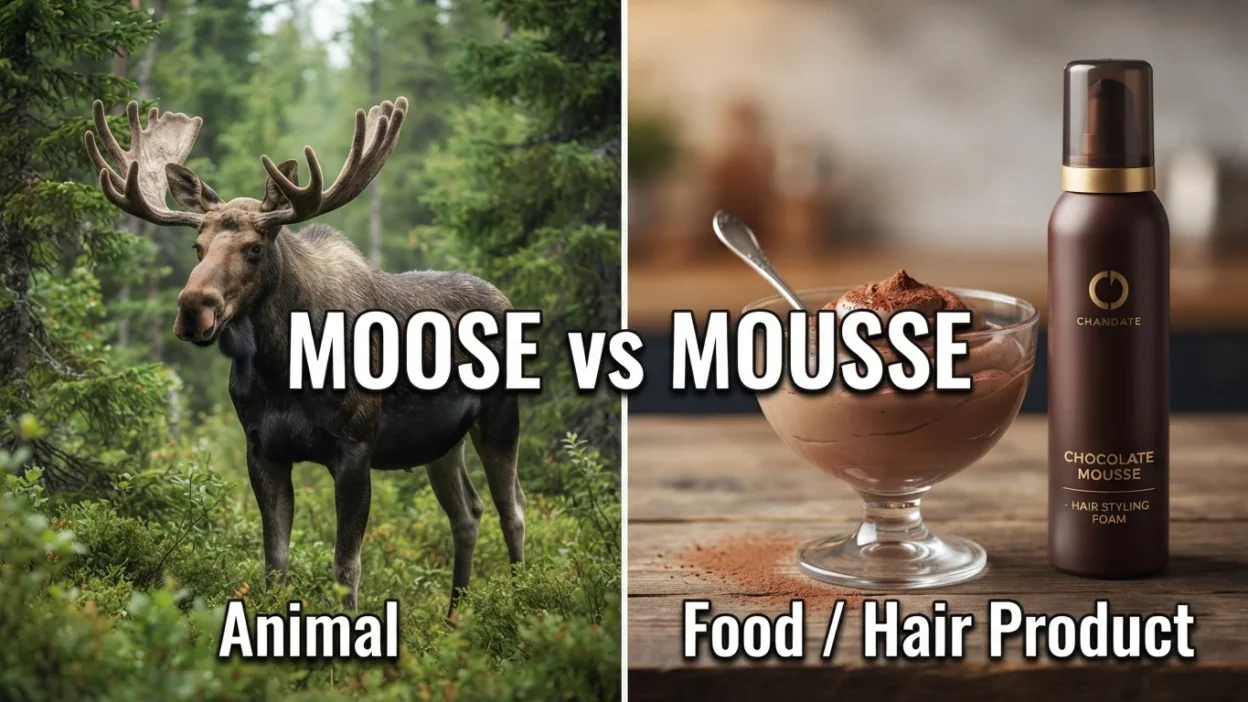
The confusion between moose vs mousse comes from their similar spelling and pronunciation.
Although these two words look and sound almost alike, they have completely different meanings and belong to different areas of vocabulary.
Moose refers to a large animal found mainly in North America, Europe, and parts of Asia, while mousse can refer to a light, airy food or a hair styling product.
Understanding moose vs mousse is useful because using the wrong spelling can completely change the meaning of a sentence.
One word belongs to wildlife and nature, while the other is commonly associated with food, desserts, cosmetics, and hairstyling. In this guide,
we will explain the meaning, difference, pronunciation, grammar, usage, examples, common mistakes, and memory tricks so you can confidently choose the correct word.
Quick Answer: Moose vs Mousse
Moose is a large deer-like animal with antlers, especially common in northern regions.
Mousse is a light, airy food or a styling product used to give hair volume and texture.
Easy rule: Moose = animal; mousse = food or hair product.
What Does Moose Mean?
Moose is a large mammal belonging to the deer family. It is known for its enormous size, long legs, broad antlers in males, and distinctive large nose.
Moose commonly live in forests, wetlands, and cold northern environments. They eat plants, leaves, twigs, aquatic vegetation, and other types of vegetation.
Moose as a Noun
The word moose is primarily used as a noun.
Examples:
- We saw a moose near the lake.
- The moose crossed the road slowly.
- A male moose can have very large antlers.
- The children learned about the moose in science class.
One interesting grammar point is that moose can be singular or plural.
| Number | Correct Form | Example |
|---|---|---|
| Singular | moose | I saw one moose. |
| Plural | moose | We saw five moose. |
| Incorrect plural | mooses | We saw five mooses. |
In standard English, moose generally remains moose when referring to more than one animal.
What Does Mousse Mean?
Mousse is a French-derived word that has several common meanings in English.
The first major meaning is a type of light, airy food. Mousse can be sweet or savory, although chocolate mousse is one of the best-known varieties.
Examples include:
- chocolate mousse
- strawberry mousse
- lemon mousse
- salmon mousse
- cheese mousse
The second common meaning is a hair-styling product. Hair mousse is a lightweight foam used to add volume, definition, texture, or hold.
Mousse as a Food
A mousse dessert usually has a soft, airy, creamy texture.
Example:
The restaurant served chocolate mousse for dessert.
Mousse as a Hair Product
Hair mousse is typically applied to damp hair before styling.
Example:
She applied mousse to her hair before blow-drying it.
Moose vs Mousse: Main Difference
The biggest difference between moose vs mousse is their meaning and context.
| Feature | Moose | Mousse |
|---|---|---|
| Meaning | A large deer-like animal | A light food or hair-styling foam |
| Word type | Noun | Noun |
| Common context | Wildlife and nature | Food, beauty, and hairstyling |
| Example | We saw a moose. | She made chocolate mousse. |
| Plural | moose | mousses |
| Pronunciation | Usually “moos” | Usually “moos” |
| Origin | North American English usage | French |
| Related words | deer, elk, wildlife | dessert, foam, styling |
The words are particularly confusing because their pronunciation is usually very similar, but their meanings are completely different.
Moose vs Mousse Pronunciation
One reason people search for moose vs mousse is that the words are pronounced almost identically in standard English.
Both are generally pronounced like “moos.”
| Word | Approximate Pronunciation | Sound |
|---|---|---|
| moose | /muːs/ | moos |
| mousse | /muːs/ | moos |
Because they are homophones in English, context is extremely important.
For example:
We saw a moose in the forest.
Here, the context clearly indicates an animal.
Compare:
We ordered chocolate mousse.
Here, the context clearly indicates food.
Moose vs Mousse in Real-Life Examples
Understanding these words becomes easier when you see them in different situations.
Wildlife Example
The photographer waited quietly for the moose to come out of the forest.
Here, moose refers to the animal.
Restaurant Example
The chef prepared a rich chocolate mousse for the guests.
Here, mousse refers to a dessert.
Beauty Example
Apply a small amount of hair mousse before styling your curls.
Here, mousse means a hair product.
Education Example
Students researched the habitat and diet of the moose.
The word refers to an animal, making moose correct.
Business Example
The cosmetics company launched a new volumizing mousse.
Here, mousse refers to a hairstyling product.
Grammar Forms of Moose and Mousse
The two words behave differently when forming plurals.
| Word | Singular | Plural | Example |
|---|---|---|---|
| Animal | moose | moose | Three moose crossed the road. |
| Food/product | mousse | mousses | The chef prepared several mousses. |
Important Grammar Rule
Do not normally write mooses as the plural of the animal.
Correct:
We saw several moose near the river.
Incorrect:
We saw several mooses near the river.
For mousse, the standard plural is mousses when referring to multiple varieties or servings.
Example:
The restaurant offers several different mousses.
Moose Usage in Science and Nature
The word moose frequently appears in scientific, environmental, and wildlife-related writing.
Scientists may discuss:
- moose populations
- moose habitats
- moose behavior
- moose migration
- moose diet
- moose conservation
- moose reproduction
Example:
Researchers are studying changes in moose populations caused by environmental conditions.
In educational materials, moose is also commonly used when teaching students about mammals, ecosystems, food chains, and wildlife.
Mousse Usage in Food and Culinary Industries
In the culinary world, mousse describes a preparation with a light, airy texture.
Chocolate mousse is particularly popular, but mousse can be made with many ingredients.
| Type of Mousse | Common Context |
|---|---|
| Chocolate mousse | Dessert |
| Strawberry mousse | Dessert |
| Lemon mousse | Dessert |
| Mango mousse | Dessert |
| Salmon mousse | Savory dish |
| Cheese mousse | Savory dish |
| Vegetable mousse | Culinary preparation |
Example:
The pastry chef decorated the chocolate mousse with fresh berries.
Mousse Usage in Beauty and Hair Care
In the beauty industry, mousse usually refers to a lightweight foaming hair product.
Hair mousse may help:
- add volume
- enhance curls
- provide light hold
- improve texture
- reduce flatness
- make styling easier
Example:
The stylist recommended a volumizing mousse for her fine hair.
The meaning is completely unrelated to the animal moose.
Industry Usage Comparison
The following table makes the difference between their professional uses easy to see.
| Industry | Moose | Mousse |
|---|---|---|
| Wildlife | Common | Rare |
| Zoology | Common | Not applicable |
| Environmental science | Common | Not applicable |
| Education | Common | Common in language/food lessons |
| Restaurants | Rare | Very common |
| Baking | Not applicable | Common |
| Cosmetics | Not applicable | Common |
| Hair care | Not applicable | Very common |
| Tourism | Common in wildlife tourism | Possible in culinary tourism |
This is one of the easiest ways to distinguish them: moose belongs mainly to wildlife, while mousse is associated with food and beauty.
Common Mistakes With Moose and Mousse
Because these words are homophones, spelling mistakes are common.
Mistake 1: Using “mousse” for the animal
Incorrect:
We saw a mousse in the forest.
Correct:
We saw a moose in the forest.
Mistake 2: Using “moose” for dessert
Incorrect:
The waiter brought chocolate moose.
Correct:
The waiter brought chocolate mousse.
Mistake 3: Writing “mooses”
Incorrect:
Several mooses were near the lake.
Correct:
Several moose were near the lake.
Mistake 4: Confusing hair mousse with the animal
Incorrect:
I bought a bottle of moose for my hair.
Correct:
I bought a bottle of mousse for my hair.
Correct vs Incorrect Table
| Incorrect | Correct |
|---|---|
| We saw a mousse in the forest. | We saw a moose in the forest. |
| I ordered chocolate moose. | I ordered chocolate mousse. |
| Three mooses crossed the road. | Three moose crossed the road. |
| She used moose on her hair. | She used mousse on her hair. |
| The zoo has a mousse exhibit. | The zoo has a moose exhibit. |
Why Do People Confuse Moose and Mousse?
There are several reasons people confuse these words.
First, moose and mousse are usually pronounced the same. This makes the difference impossible to hear in ordinary speech.
Second, their spellings are similar. Both begin with m and contain o-o, while their final letters are different.
Third, English contains many homophones where different spellings represent the same sound.
For example:
- sea / see
- flower / flour
- pair / pear
- right / write
- moose / mousse
The best solution is to remember their meanings rather than relying on pronunciation.
Moose vs Mousse Memory Trick
A simple memory trick can help you remember the difference.
Think “Moose = Mammal”
Both moose and mammal begin with M.
So:
Moose → Mammal → Animal
Think “Mousse = Menu or Makeup”
Mousse is commonly found on a menu or in a beauty/haircare context.
So:
Mousse → Menu or hair product
Another useful trick is to remember:
A moose walks; mousse is whipped or foamy.
If the sentence involves a forest, animal, antlers, wildlife, or nature, choose moose.
If it involves dessert, food, hair, styling, or foam, choose mousse.
How to Choose the Correct Word
Use the context to make the correct choice.
| If the sentence mentions… | Use |
|---|---|
| Antlers | moose |
| Forest | moose |
| Wildlife | moose |
| Deer family | moose |
| National park | moose |
| Chocolate | mousse |
| Dessert | mousse |
| Restaurant | mousse |
| Hair styling | mousse |
| Volume or curls | mousse |
Simple Decision Process
- Ask whether you are talking about an animal.
- If yes, use moose.
- If you are talking about food or dessert, use mousse.
- If you are talking about hair styling, use mousse.
- Check the context before choosing the spelling.
This quick process eliminates most mistakes.
Moose vs Mousse in Sentences
Here are additional examples showing the difference naturally.
Examples With Moose
- The moose stood beside the river.
- We photographed a large moose during our trip.
- The guide warned us not to approach the moose.
- A moose can be much larger than many other deer species.
- The documentary focused on moose behavior.
- We saw two moose near the forest edge.
Examples With Mousse
- I ordered chocolate mousse after dinner.
- The bakery sells strawberry mousse.
- She used hair mousse to add volume.
- The chef prepared a lemon mousse.
- This styling mousse works well for curly hair.
- The dessert menu includes several types of mousse.
Moose vs Mousse: Comparison Table
| Category | Moose | Mousse |
|---|---|---|
| Basic meaning | Large deer-like mammal | Light food or hair product |
| Pronunciation | “moos” | “moos” |
| Part of speech | Noun | Noun |
| Common meaning | Animal | Dessert or styling product |
| Singular | moose | mousse |
| Plural | moose | mousses |
| Common setting | Forest | Kitchen, restaurant, bathroom |
| Related vocabulary | antlers, deer, wildlife | dessert, foam, styling |
| Example | A moose crossed the road. | She ordered chocolate mousse. |
Is Moose Singular or Plural?
Yes, moose can be both singular and plural.
For one animal:
I saw one moose.
For multiple animals:
I saw three moose.
The word does not normally change to mooses in standard English.
This is similar to other animal names that have unusual plural forms, although the exact grammatical pattern differs among words.
Is Mousse Countable or Uncountable?
Mousse can be used as a mass noun or as a countable noun depending on the context.
For a general substance or food:
I love chocolate mousse.
When referring to separate varieties or servings:
The chef prepared three different mousses.
For hair products, it is commonly used as an uncountable product name:
I need some hair mousse.
Moose vs Mousse in Writing
In formal writing, correct spelling matters because the surrounding context may not always be enough to fix an error.
Consider:
The researchers observed a mousse population.
This sentence is confusing because mousse normally refers to food or a hair product.
The intended sentence would be:
The researchers observed a moose population.
Likewise:
The chef prepared chocolate moose.
would normally be understood as a spelling mistake for:
The chef prepared chocolate mousse.
Correct spelling improves clarity and credibility, especially in academic, professional, and published writing.
Frequently Asked Questions About Moose vs Mousse
Is moose and mousse the same thing?
No. Moose is a large animal, while mousse is generally a light food preparation or a hair-styling product.
Are moose and mousse pronounced the same?
Yes. In standard English, both are generally pronounced like “moos.”
What is the plural of moose?
The plural of moose is moose.
Example:
One moose, three moose.
What is the plural of mousse?
The plural can be mousses when referring to multiple varieties or separate preparations.
Example:
The chef created several different mousses.
Is chocolate moose or chocolate mousse?
The correct spelling is chocolate mousse. It is a light, airy dessert.
Is hair moose or hair mousse?
The correct term is hair mousse. It is a foamy styling product used to add volume, texture, or hold.
Final Difference Between Moose and Mousse
The easiest way to remember moose vs mousse is to focus on meaning rather than pronunciation. Moose is a large deer-like animal, while mousse is a light food preparation or a hair-styling product.
Although the two words sound almost identical, their spelling and meanings are completely different. Use moose when discussing wildlife, forests, antlers, or animals. Use mousse when discussing desserts, food, hair products, styling, or foam.
Remember: Moose = animal; mousse = food or hair product. Once you connect each spelling with its meaning, choosing the correct word becomes easy.

Julian Wyatt is a passionate researcher and writer who explores symbols, mythology, cultural traditions, and hidden meanings. Through engaging articles, he helps readers uncover the fascinating stories and significance behind symbols worldwide.