If you have ever written dammit vs damnit, you may have wondered which spelling is correct.
Both forms are commonly seen in informal English, especially in conversations, text messages, social media, fiction, and dialogue.
They are used to express annoyance, frustration, anger, disappointment, or surprise.
However, the two spellings do not have exactly the same status in standard English.
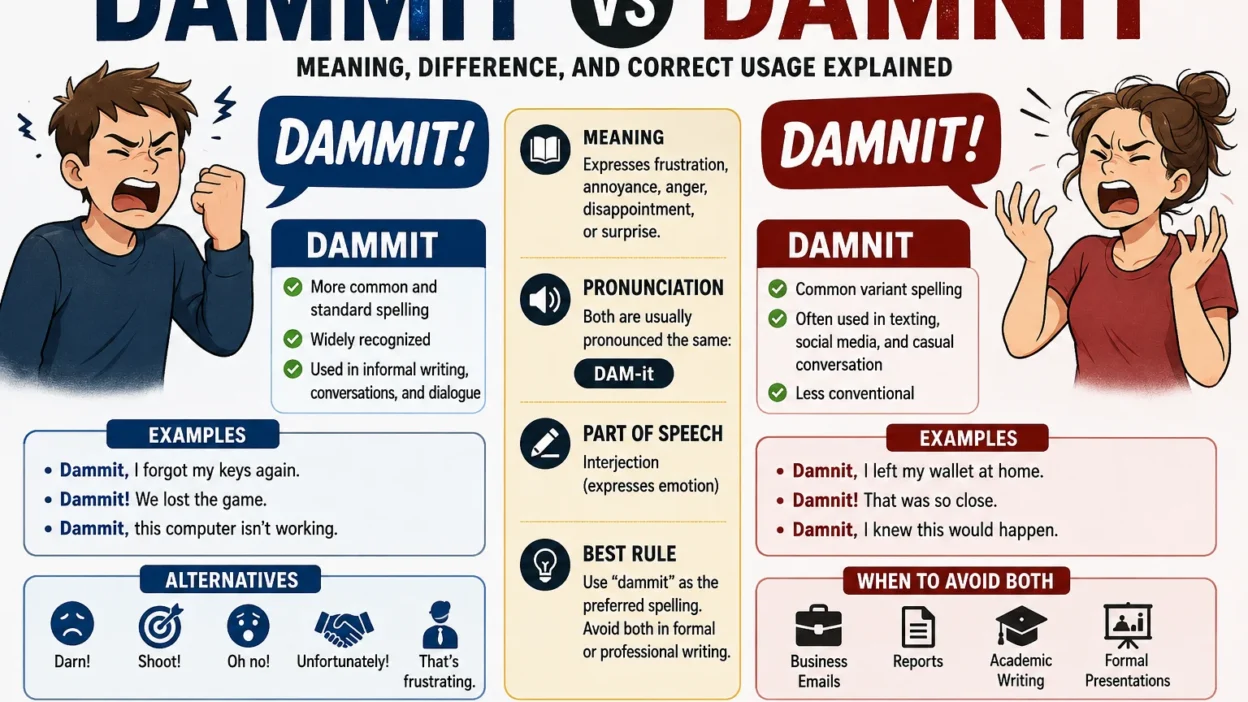
The main difference in dammit vs damnit is that dammit is the more widely recognized and conventional spelling, while damnit is a common informal variant.
Neither form is normally appropriate for formal academic or professional writing because both are mild swear words or emotional exclamations.
Understanding their meaning, pronunciation, spelling, and context can help you decide which version to use and when to avoid both.
Quick Answer: Dammit vs Damnit
Dammit is the more standard and widely accepted spelling of the informal exclamation.
Damnit is a common variant spelling, often written the way the expression sounds.
Both are used to express frustration or annoyance, but dammit is generally the safer choice in informal writing.
What Does Dammit Mean?
Dammit is an informal exclamation used to express frustration, irritation, anger, disappointment, or annoyance.
It is essentially a softened or informal form related to the phrase “damn it.”
For example:
Dammit! I forgot my keys again.
Here, the speaker is expressing frustration about forgetting the keys.
Another example is:
Dammit, we missed the train.
The word does not describe an object or action. Instead, it communicates the speaker’s emotional reaction.
Common Meanings of Dammit
| Meaning | Example |
|---|---|
| Frustration | Dammit! I made the same mistake again. |
| Anger | Dammit, stop doing that! |
| Disappointment | Dammit, we lost the game. |
| Annoyance | Dammit, this computer is frozen. |
| Surprise | Dammit, that was close! |
What Does Damnit Mean?
Damnit is an informal variant spelling of dammit.
It is commonly used because it resembles the way some speakers perceive or pronounce the expression. In casual online communication, texting, dialogue, and informal writing, damnit can be found frequently.
For example:
Damnit! I left my phone at home.
The meaning is the same as:
Dammit! I left my phone at home.
The main difference is spelling rather than meaning.
Dammit vs Damnit: Main Difference
The most important distinction is conventionality.
Dammit is the more established spelling, while damnit is generally treated as an informal variant.
| Feature | Dammit | Damnit |
|---|---|---|
| Part of speech | Interjection | Interjection |
| Meaning | Frustration, anger, annoyance | Frustration, anger, annoyance |
| Pronunciation | Usually the same | Usually the same |
| Standard spelling | More widely recognized | Informal variant |
| Formal writing | Avoid | Avoid |
| Informal writing | Common | Common |
| Texting/social media | Common | Common |
| Fiction/dialogue | Common | Common |
So, when comparing dammit vs damnit, the key point is that they generally communicate the same emotion.
Is Dammit or Damnit Correct?
If you need to choose one spelling, dammit is generally the better choice.
It is more established in dictionaries and general written usage and is immediately recognizable to most English speakers.
Damnit is widely understood, but it is more clearly informal and is often treated as a variant spelling.
Therefore:
Preferred: Dammit
Informal variant: Damnit
For casual messages, either may be understood, but dammit is usually the safer spelling.
Why Do People Confuse Dammit and Damnit?
The confusion happens largely because the expression is informal and often pronounced quickly.
When people hear the word, the final sound can make the spelling feel uncertain. This can lead writers to choose damnit because it appears to represent the pronunciation naturally.
Another reason is that English contains many words whose spelling does not perfectly match their pronunciation.
Online communication also encourages phonetic and alternative spellings. As a result, variants such as damnit can become familiar even when another spelling is more conventional.
Dammit vs Damnit Pronunciation
In ordinary speech, dammit and damnit are generally pronounced the same way or very similarly.
A rough pronunciation is:
DAM-it
The spelling difference does not normally indicate a major pronunciation difference.
| Word | Approximate pronunciation | Meaning |
|---|---|---|
| Dammit | DAM-it | Frustration or annoyance |
| Damnit | DAM-it | Frustration or annoyance |
Because the pronunciation is similar, it is easy to understand why speakers sometimes write the word differently.
Grammar and Word Forms
Unlike ordinary nouns and verbs, dammit does not have many grammatical forms.
It is primarily used as an interjection, meaning a word or expression that communicates a sudden emotion.
| Form | Example |
|---|---|
| Dammit | Dammit! I forgot. |
| Damnit | Damnit! I forgot. |
| Damn it | Damn it! I forgot. |
| Dammed | Different word |
| Damn | Different but related expression |
It is important not to confuse dammit with dammed.
Dammed is the past tense or past participle of dam, as in:
The river was dammed to create a reservoir.
That word has nothing to do with the frustrated exclamation.
Dammit vs Damn It
Another important spelling question is whether to write dammit or damn it.
Both appear in informal English.
Dammit
Dammit! I missed the bus.
Damn it
Damn it! I missed the bus.
Damn it preserves the two-word form, while dammit is a commonly established one-word spelling used as an exclamation.
| Form | Usage |
|---|---|
| Dammit | Informal one-word exclamation |
| Damn it | Informal two-word expression |
| Damnit | Informal variant spelling |
For everyday informal writing, dammit is a familiar and widely recognized choice.
Real-Life Examples of Dammit
In Conversation
“Dammit, I forgot to charge my phone.”
The speaker is frustrated with their mistake.
In Text Messages
“Dammit! I thought the meeting was at 3.”
The word communicates mild anger or disappointment.
In Fiction
“Dammit,” he whispered as the door slammed shut.
Writers may use it to make dialogue sound emotional or natural.
In Sports
“Dammit! That was almost a goal.”
Here, the word expresses disappointment.
Real-Life Examples of Damnit
Because damnit is an informal spelling variant, it can appear in similarly casual situations.
Texting
“Damnit, I left my wallet at home.”
Social Media
“Damnit! I just deleted the whole file.”
Informal Dialogue
“Damnit, we were so close.”
Fiction
“Damnit,” she said after seeing the broken screen.
In each example, damnit has essentially the same emotional meaning as dammit.
Dammit vs Damnit in Business
Both forms should generally be avoided in formal business communication.
For example, an email to a client should not normally say:
Dammit, we missed the deadline.
A professional alternative would be:
Unfortunately, we missed the deadline, and we are working to resolve the issue.
However, the word may appear in fictional business dialogue, private conversations, or informal workplace communication between people who are comfortable with one another.
| Business situation | Recommended usage |
|---|---|
| Formal client email | Avoid |
| Business report | Avoid |
| Company presentation | Avoid |
| Private informal message | Possible, depending on culture |
| Fictional workplace dialogue | Possible |
| Professional publication | Usually avoid |
Dammit vs Damnit in Education
Students should be careful with both spellings in academic writing.
Neither dammit nor damnit is normally appropriate in a formal essay unless the assignment specifically discusses informal language, dialogue, profanity, or linguistic usage.
For example, instead of:
Dammit, the experiment failed.
A formal report could say:
The experiment unfortunately failed.
However, if a literature assignment analyzes a character’s speech, the word may be appropriate when accurately quoting or discussing dialogue.
Dammit vs Damnit in Science
Neither spelling is a scientific or technical term.
You may encounter the word in informal speech among researchers, fictional scientific dialogue, or personal writing, but it should not normally appear in scientific reports.
For example:
Dammit, the sample was contaminated.
This could occur in informal conversation, but a formal scientific report would say:
The sample was contaminated.
The difference is one of register, not scientific meaning.
Professional and Industry Usage
Because dammit and damnit are informal emotional expressions, their suitability depends heavily on context.
| Industry | Formal documents | Informal communication | Fiction/dialogue |
|---|---|---|---|
| Business | Avoid | Sometimes | Common |
| Education | Avoid | Sometimes | Common |
| Journalism | Usually avoid | Depends on style | Possible |
| Entertainment | Possible | Common | Common |
| Literature | Possible in dialogue | Common | Common |
| Science | Avoid | Rare | Possible |
| Marketing | Usually avoid | Depends on brand | Possible |
| Social media | Possible | Common | Common |
The more formal the audience, the stronger the reason to avoid both forms.
Common Mistakes With Dammit and Damnit
Mistake 1: Assuming Damnit Is a Completely Different Word
Incorrect assumption:
Damnit has a different meaning from dammit.
Correct explanation:
Damnit is generally an informal variant of dammit.
Mistake 2: Using Either Form in Formal Writing
Incorrect:
Dammit, the company failed to meet its target.
Better:
Unfortunately, the company failed to meet its target.
Mistake 3: Confusing Dammit With Dammed
These words are unrelated in meaning.
Incorrect:
The river was dammit.
Correct:
The river was dammed.
Mistake 4: Assuming Damnit Is More Correct Because It Sounds Phonetic
The spelling damnit may feel natural because of pronunciation, but dammit is generally the more conventional written form.
Correct vs Incorrect Sentences
| Incorrect or less appropriate | Better version | Reason |
|---|---|---|
| Damnit is a formal business term. | Damnit is an informal exclamation. | Register |
| The river was dammit. | The river was dammed. | Different word |
| Dammit has a completely different meaning from damnit. | Dammit and damnit generally have the same meaning. | Variant spelling |
| Damnit! I forgot again. | Dammit! I forgot again. | More conventional spelling |
| Dammit, according to the scientific report… | The report states that… | Formal register |
Memory Trick for Dammit vs Damnit
A simple memory trick is:
DAMMIT = the more conventional spelling
Think of the phrase “damn it” and the spelling dammit as being closely connected.
If you are unsure, choose dammit.
You can remember:
Dammit = default choice
This is especially useful when writing for a general English-speaking audience.
When Should You Use Dammit?
Use dammit when you intentionally want an informal exclamation showing frustration, annoyance, anger, or disappointment.
Examples include:
Dammit, I forgot the appointment.
Dammit! That was my last chance.
Oh, dammit, I made another mistake.
However, consider your audience before using it. It is not appropriate for every situation.
When Should You Use Damnit?
Use damnit only when an informal or conversational style makes the variant appropriate.
For example:
Damnit, I knew this would happen.
It is easily understood, but if you want the more conventional spelling, choose dammit.
Dammit vs Damnit: Formality Comparison
| Expression | Formality | Typical context |
|---|---|---|
| Dammit | Informal | Conversation, dialogue, texting |
| Damnit | Very informal/variant | Texting, social media, dialogue |
| Damn it | Informal | Conversation, dialogue |
| Unfortunately | Formal/neutral | Business, academic writing |
| I am frustrated | Neutral | Professional communication |
| This is disappointing | Neutral/formal | Professional communication |
How to Choose the Right Form
Use these simple steps:
| Step | Question | Recommendation |
|---|---|---|
| 1 | Is the writing formal? | Avoid both forms |
| 2 | Is it casual? | Either may work |
| 3 | Do you want the conventional spelling? | Choose dammit |
| 4 | Are you writing realistic dialogue? | Either can work |
| 5 | Are you writing for children? | Consider a milder alternative |
| 6 | Are you unsure? | Use dammit or rewrite the sentence |
Alternatives to Dammit
Sometimes you want to express frustration without using profanity or an informal swear word.
Useful alternatives include:
- Oh no!
- Darn!
- Dang!
- Shoot!
- Seriously?
- Unfortunately!
- What a shame!
- That’s frustrating.
- I can’t believe it.
- This is so annoying.
| Situation | Alternative |
|---|---|
| Mild frustration | Darn! |
| Surprise | Oh no! |
| Disappointment | What a shame! |
| Professional setting | Unfortunately |
| Strong frustration | This is extremely frustrating |
| Casual conversation | Seriously? |
These alternatives are often better for professional, academic, family-friendly, or public communication.
Dammit vs Damnit: Comparison Table
| Question | Dammit | Damnit |
|---|---|---|
| Is it an interjection? | Yes | Yes |
| Expresses frustration? | Yes | Yes |
| Expresses annoyance? | Yes | Yes |
| Informal? | Yes | Yes |
| Widely recognized? | Yes | Yes |
| More conventional spelling? | Yes | No |
| Appropriate for formal writing? | Generally no | Generally no |
| Common in dialogue? | Yes | Yes |
| Common in texting? | Yes | Yes |
| Same basic meaning? | Yes | Yes |
FAQs About Dammit vs Damnit
1. Which is correct, dammit or damnit?
Dammit is generally the more conventional spelling. Damnit is a common informal variant.
2. Do dammit and damnit mean the same thing?
Yes. Both are informal exclamations used to express frustration, annoyance, anger, or disappointment.
3. Is damnit a misspelling?
It is often treated as a variant spelling rather than the preferred conventional form. It is widely understood in informal communication.
4. Is dammit a bad word?
Dammit is an informal swear or exclamation derived from “damn it.” Its strength is relatively mild, but it may still be inappropriate in formal or sensitive settings.
5. Can I use dammit in academic writing?
Generally, no. Avoid it unless you are discussing informal language or reproducing relevant dialogue.
6. What is the difference between dammit and damn it?
Dammit is a one-word informal spelling of the expression, while damn it retains the two-word form. Both express frustration or annoyance.
Final Comparison: Dammit vs Damnit
| Category | Best Answer |
|---|---|
| Preferred spelling | Dammit |
| Variant spelling | Damnit |
| Basic meaning | Frustration or annoyance |
| Pronunciation | Usually the same |
| Part of speech | Interjection |
| Formal usage | Generally avoid |
| Informal usage | Common |
| Fictional dialogue | Common |
| Texting | Common |
| Professional alternative | Unfortunately / That’s frustrating |
Conclusion
The main difference in dammit vs damnit is spelling and conventionality, not meaning. Dammit is the more widely recognized and established spelling, while damnit is an informal variant that is commonly understood in casual communication.
Both expressions are used to show frustration, anger, annoyance, disappointment, or surprise. However, neither is ideal for formal academic, professional, or business writing. If you need one spelling for informal writing and are unsure which to choose, dammit is generally the safest option.
The simple rule is: choose “dammit” as the conventional spelling, recognize “damnit” as an informal variant, and avoid both when a formal tone is required.

Julian Wyatt is a passionate researcher and writer who explores symbols, mythology, cultural traditions, and hidden meanings. Through engaging articles, he helps readers uncover the fascinating stories and significance behind symbols worldwide.