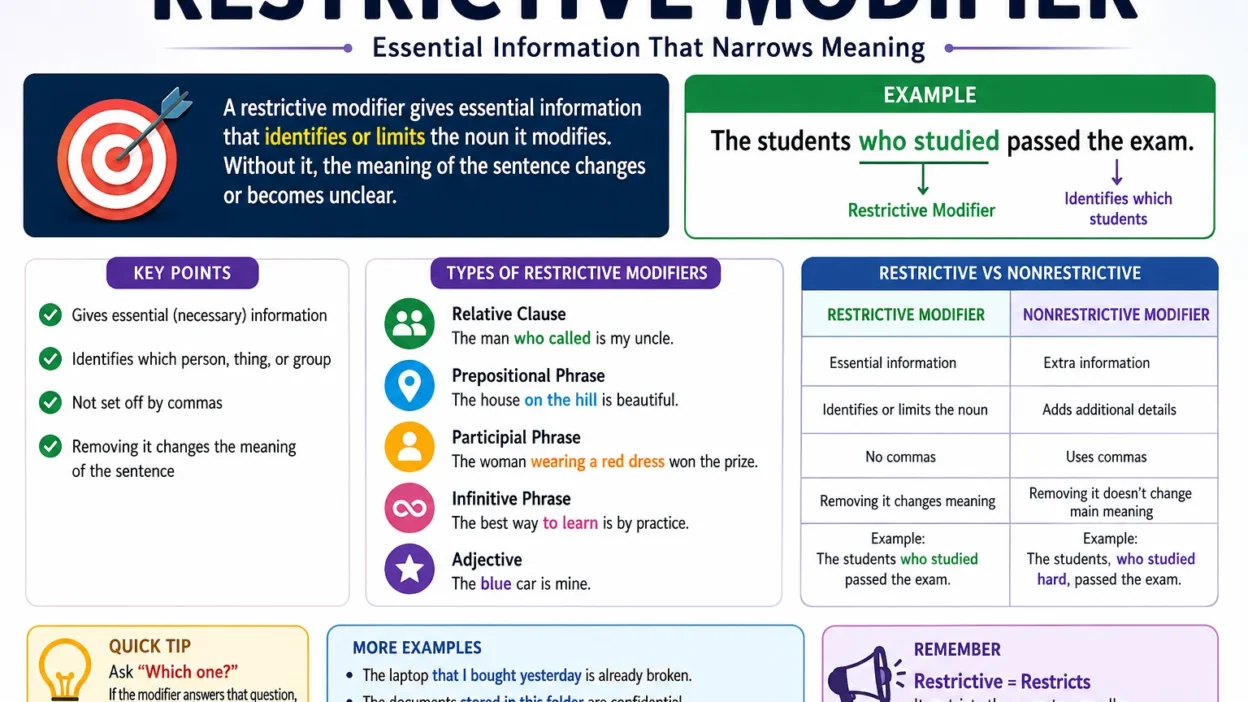
A restrictive modifier is a word, phrase, or clause that provides essential information about a noun or another part of a sentence.
It helps identify exactly which person, thing, or group the writer means. If you remove a restrictive modifier, the sentence may become unclear, change meaning, or refer to a larger group than intended.
Understanding this grammar concept is especially important when using relative clauses and punctuation.
The term restrictive modifier can seem complicated because it is closely related to nonrestrictive modifiers, essential clauses, and comma rules.
In everyday writing, you may already use restrictive modifiers without realizing it.
Learning their meaning, usage, examples, and punctuation rules can make your writing more precise.
This guide explains the restrictive modifier in simple English and shows how to recognize and use it correctly.
Quick Answer
A restrictive modifier gives information that is necessary to identify or define the noun it modifies.
For example: The students who studied passed the exam.
The phrase who studied restricts which students are being discussed. Without it, the meaning changes.
What Is a Restrictive Modifier?
A restrictive modifier is a grammatical element that limits or identifies the meaning of another word, usually a noun.
It answers questions such as:
- Which person?
- Which object?
- Which students?
- Which book?
- Which employees?
Consider this sentence:
The employees who arrived early received breakfast.
The phrase who arrived early tells us which employees received breakfast. It is therefore restrictive.
Without the modifier, the sentence becomes:
The employees received breakfast.
That sentence suggests that all the employees received breakfast, not just the employees who arrived early.
Simple Definition
A restrictive modifier is essential information that narrows the meaning of the word it modifies.
Restrictive Modifier vs. Nonrestrictive Modifier
The easiest way to understand a restrictive modifier is to compare it with a nonrestrictive modifier.
| Feature | Restrictive Modifier | Nonrestrictive Modifier |
|---|---|---|
| Information | Essential | Extra |
| Identifies the noun | Yes | Usually no |
| Meaning changes if removed | Often | Usually not |
| Commas used | No | Yes |
| Common relative words | that, who, which | who, which |
| Example | Students who study succeed. | Maria, who studies hard, succeeds. |
Compare these sentences:
The books that are on the desk belong to me.
Here, that are on the desk identifies which books belong to the speaker.
Now compare:
The books, which are on the desk, belong to me.
The second sentence treats which are on the desk as additional information. The books have already been identified.
How Does a Restrictive Modifier Work?
A restrictive modifier narrows the scope of a noun.
For example:
Cars that use electric motors produce no tailpipe emissions.
The modifier that use electric motors identifies a specific category of cars.
Without it:
Cars produce no tailpipe emissions.
The meaning becomes much broader and potentially inaccurate.
The modifier therefore performs an important grammatical job: it tells readers exactly which members of a larger group are being discussed.
Common Types of Restrictive Modifiers
Restrictive modifiers can appear in several forms.
| Type | Example | Restrictive Element |
|---|---|---|
| Relative clause | The students who studied passed. | who studied |
| Adjective phrase | The house near the river sold quickly. | near the river |
| Prepositional phrase | The documents on the table are important. | on the table |
| Participial phrase | The woman wearing a blue coat is my teacher. | wearing a blue coat |
| Infinitive phrase | The best person to contact is Sarah. | to contact |
| Adjective | The red car is mine. | red |
The key feature is that the modifier narrows or identifies the noun.
Restrictive Relative Clauses
Restrictive relative clauses are one of the most common forms.
A relative clause contains a subject and verb and modifies a noun.
Examples include:
The student who won the scholarship is my cousin.
The laptop that I bought yesterday is already broken.
The restaurant where we ate serves excellent food.
In each sentence, the relative clause provides information needed to identify the noun.
Common Relative Words
| Relative Word | Typical Use | Example |
|---|---|---|
| who | People | The teacher who helped me was kind. |
| that | People or things in restrictive clauses | The book that I borrowed was useful. |
| which | Things | The device which costs less is popular. |
| where | Places | The school where I studied is nearby. |
| when | Times | The year when we moved was difficult. |
| whose | Possession | The student whose phone rang apologized. |
Usage can vary depending on dialect and style guide, especially regarding that and which.
Why Are Restrictive Modifiers Important?
Restrictive modifiers improve precision.
Consider:
The manager spoke to the employees.
This could mean all employees or a particular group.
Now consider:
The manager spoke to the employees working on the project.
The modifier working on the project clearly identifies the group.
This distinction is especially valuable in business, academic, legal, scientific, and technical writing, where small changes in meaning can matter.
Restrictive Modifier Examples in Everyday English
Here are several examples:
- The shoes that I bought yesterday are uncomfortable.
- The woman wearing glasses is my professor.
- The students who completed the assignment received feedback.
- The house on the corner is for sale.
- The phone with the cracked screen belongs to James.
- The restaurant that serves vegan food is popular.
- The documents stored in this folder are confidential.
- The person sitting next to me is a doctor.
In each example, the modifier helps narrow the noun’s meaning.
Restrictive Modifier Examples in Business
Business writing often relies on restrictive modifiers to make instructions and information precise.
| Business Sentence | Restrictive Modifier | Purpose |
|---|---|---|
| Employees who miss the deadline must notify HR. | who miss the deadline | Identifies employees |
| Reports submitted after Friday require approval. | submitted after Friday | Identifies reports |
| Clients who have unpaid invoices will receive reminders. | who have unpaid invoices | Identifies clients |
| Products with damaged packaging must be inspected. | with damaged packaging | Identifies products |
For example:
Employees who work remotely must complete the security training.
The sentence does not necessarily apply to every employee. The modifier identifies remote employees.
Restrictive Modifiers in Education
Teachers and academic writers frequently use restrictive modifiers.
Students who submit their assignments late may lose points.
The phrase who submit their assignments late identifies the relevant students.
Another example:
The chapter that explains photosynthesis is required reading.
The clause that explains photosynthesis identifies the chapter.
Academic Examples
Researchers who use this method must document their results.
The experiment conducted in the laboratory produced consistent results.
The articles published after 2020 were excluded from the study.
These modifiers make academic writing more specific.
Restrictive Modifiers in Science and Technical Writing
Scientific writing depends heavily on precise descriptions.
Consider:
Chemicals that react with water must be stored carefully.
The modifier that react with water identifies a particular category of chemicals.
Another example:
Samples collected from contaminated sites require additional testing.
Here, collected from contaminated sites restricts the noun samples.
| Field | Example |
|---|---|
| Biology | Organisms that produce chlorophyll can perform photosynthesis. |
| Chemistry | Substances that react with oxygen require careful handling. |
| Physics | Objects moving at high speeds behave differently under certain conditions. |
| Medicine | Patients who meet the criteria may participate in the study. |
| Technology | Devices connected to the network require authentication. |
Do Restrictive Modifiers Need Commas?
Generally, restrictive modifiers are not set off with commas.
For example:
The employees who completed the training received certificates.
Do not write:
The employees, who completed the training, received certificates.
The comma version changes the interpretation by suggesting that all the employees completed the training.
Comma Rule
| Modifier Type | Commas? | Example |
|---|---|---|
| Restrictive | No | Students who study regularly improve. |
| Nonrestrictive | Yes | Students, who study regularly, improve. |
However, punctuation depends on intended meaning, so writers should determine whether the information is essential before deciding whether commas belong.
Restrictive Modifier vs. Nonrestrictive Modifier: Detailed Comparison
| Question | Restrictive | Nonrestrictive |
|---|---|---|
| Is the information essential? | Yes | No |
| Does it narrow the noun? | Yes | No |
| Usually uses commas? | No | Yes |
| Can it be removed easily? | Not without changing meaning | Usually |
| Example | The workers who arrived early left first. | John, who arrived early, left first. |
Compare the Meaning
Restrictive:
The players who practiced won the match.
This means the players who practiced won; other players may not have won.
Nonrestrictive:
The players, who practiced, won the match.
This suggests that the players had already been identified and that practicing is additional information.
Restrictive Modifier Grammar Forms
There is no special verb form called a “restrictive modifier.” Instead, restrictive modifiers can take different grammatical forms.
| Form | Example |
|---|---|
| Adjective | The blue car is mine. |
| Prepositional phrase | The car in the garage is mine. |
| Relative clause | The car that I bought is mine. |
| Participial phrase | The car parked outside is mine. |
| Infinitive phrase | The car to repair is outside. |
The common feature is their restrictive function.
A Simple Process for Identifying a Restrictive Modifier
Use these steps:
| Step | Question | Example |
|---|---|---|
| 1 | Find the noun | Employees |
| 2 | Find information modifying it | who arrived early |
| 3 | Ask whether the information identifies the noun | Yes |
| 4 | Remove the modifier mentally | Meaning changes |
| 5 | Treat it as restrictive | No commas |
Example
The students who passed the test received certificates.
Step 1: Find the noun: students
Step 2: Find the modifier: who passed the test
Step 3: Ask: Does it identify which students?
Yes.
Step 4: Remove it:
The students received certificates.
The meaning becomes broader.
Therefore, who passed the test is restrictive.
Common Mistakes With Restrictive Modifiers
Mistake 1: Adding Unnecessary Commas
Incorrect:
The employees, who completed the training, received certificates.
If only employees who completed the training received certificates, the commas are inappropriate.
Correct:
The employees who completed the training received certificates.
Mistake 2: Confusing Essential and Extra Information
Incorrect interpretation:
My brother who lives in London is visiting.
If you have several brothers and the London-based brother is the one visiting, the modifier is restrictive.
If you have only one brother and the London detail is merely additional information, a nonrestrictive construction may be more appropriate:
My brother, who lives in London, is visiting.
Mistake 3: Assuming Every Relative Clause Is Restrictive
Not every relative clause has the same function.
Compare:
The car that has a broken window is mine.
with:
My car, which has a broken window, is outside.
The first clause identifies the car. The second provides additional information about an already identified car.
Correct vs. Incorrect Sentences
| Incorrect | Correct | Reason |
|---|---|---|
| The students, who studied, passed. | The students who studied passed. | If only some students studied |
| The files, stored on the server, are confidential. | The files stored on the server are confidential. | If only certain files are confidential |
| The employee, who works remotely, must attend. | The employee who works remotely must attend. | If the modifier identifies the employee |
| The products, made in Germany, are expensive. | The products made in Germany are expensive. | If only those products are meant |
Remember that the “incorrect” version is not always grammatically impossible. It can be correct when the intended meaning is nonrestrictive. The real issue is whether the punctuation matches the intended meaning.
Why Do People Confuse Restrictive Modifiers?
There are several reasons.
First, speakers do not always hear punctuation in spoken English. A comma is visible in writing but may be represented only by a slight pause in speech.
Second, the distinction is based largely on meaning, not simply on sentence structure.
Third, relative clauses can perform either restrictive or nonrestrictive functions:
The students who studied passed.
The students, who studied, passed.
The grammatical structure looks similar, but the meaning is different.
Finally, style guides can differ in their recommendations for words such as that and which, which can make the subject seem more complicated than it really is.
Memory Trick for Restrictive Modifiers
Use the “Which One?” test.
Ask:
Which one?
If the modifier answers that question, it is probably restrictive.
Example:
The book that is on the table is mine.
Ask:
Which book?
Answer:
The book that is on the table.
Therefore, the modifier is restrictive.
Another useful trick is:
Restrictive = Restricts.
If the modifier restricts the noun to a smaller group, it is restrictive.
Restrictive Modifier Usage in Professional Writing
| Industry | Example | Why It Matters |
|---|---|---|
| Business | Customers who cancel must contact support. | Identifies customers |
| Legal | Documents submitted after the deadline may be rejected. | Defines a category |
| Education | Students who miss the exam must provide documentation. | Specifies students |
| Science | Samples collected from Site A require testing. | Identifies samples |
| Technology | Users who enable two-factor authentication receive additional protection. | Defines users |
| Healthcare | Patients who meet the requirements may enroll. | Defines eligibility |
In professional writing, restrictive modifiers help reduce ambiguity and make rules easier to interpret.
How to Improve Sentences With Restrictive Modifiers
A good restrictive modifier should be close to the noun it modifies.
Weak or confusing:
The manager approved the applications after reviewing them that were complete.
Better:
The manager approved the applications that were complete after reviewing them.
The modifier that were complete should clearly attach to applications.
Avoid Dangling or Misplaced Modifiers
A modifier should clearly describe the word you intend.
Confusing:
Walking through the office, the reports were reviewed.
The reports cannot literally walk through the office.
Better:
Walking through the office, the manager reviewed the reports.
Clear modifier placement improves readability and prevents unintended meanings.
Restrictive Modifier Comparison Table
| Feature | Restrictive Modifier | Nonrestrictive Modifier |
|---|---|---|
| Main function | Identifies or limits | Adds information |
| Essential to meaning | Yes | No |
| Commas | Usually no | Usually yes |
| Answers “which one?” | Yes | Usually no |
| Example | The students who studied passed. | Sarah, who studied, passed. |
| Can omission change meaning? | Yes | Usually |
Quick Examples to Remember
| Sentence | Restrictive? | Why? |
|---|---|---|
| The dog that barked woke me up. | Yes | Identifies which dog |
| The dog, which barked loudly, woke me up. | No | Adds information about an identified dog |
| Employees who work nights receive an allowance. | Yes | Identifies employees |
| Maria, who works nights, receives an allowance. | No | Adds information about Maria |
| The house on the hill is expensive. | Yes | Identifies which house |
| My house, on the hill, is expensive. | Usually nonrestrictive in intended meaning | The house is already identified |
Frequently Asked Questions
What is a restrictive modifier?
A restrictive modifier is a word, phrase, or clause that provides essential information needed to identify or limit the meaning of another word.
Does a restrictive modifier use commas?
Usually, no. Restrictive modifiers are generally written without commas because their information is essential to the intended meaning.
What is an example of a restrictive modifier?
In “The students who studied passed the exam,” the phrase “who studied” is restrictive because it identifies which students passed.
What is the difference between restrictive and nonrestrictive modifiers?
A restrictive modifier identifies or limits the noun, while a nonrestrictive modifier adds information that is not necessary to identify it.
Can “which” be used in a restrictive modifier?
Yes. In many varieties of English, which can introduce a restrictive relative clause, although style preferences vary. The important issue is the intended meaning and appropriate punctuation.
How can I identify a restrictive modifier quickly?
Use the “Which one?” test. If the modifier tells you which person, object, or group you mean, it is likely restrictive.
Conclusion
A restrictive modifier is an essential grammatical element that narrows or identifies the noun it modifies.
It can appear as an adjective, phrase, participial phrase, or relative clause. The most important question to ask is whether the modifier is necessary to understand which person, thing, or group the sentence refers to.
The key usage rule is simple: restrictive information usually does not take commas, while nonrestrictive information usually does.
Compare “The employees who completed the training received certificates” with “The employees, who completed the training, received certificates.”
The first sentence identifies a particular group; the second suggests that the information applies to an already identified group.
Once you learn to apply the “Which one?” test, restrictive modifiers become much easier to recognize and use.
They are especially valuable in professional, academic, scientific, and everyday writing because they make sentences more precise and reduce ambiguity.