The confusion between envision vs invision is common because both words sound nearly identical when spoken. However, only one of them is recognized as a standard English word.
If you’ve seen invision used in writing, you may wonder whether it’s a correct spelling or simply a typo. Understanding the difference can improve your writing and help you avoid common grammar mistakes.
In this guide, you’ll learn everything about envision vs invision, including their meaning, correct usage, grammar, examples, and common errors.
if you’re writing an email, academic paper, business proposal, or social media post, knowing which spelling to use will make your English more accurate and professional.
Quick Answer
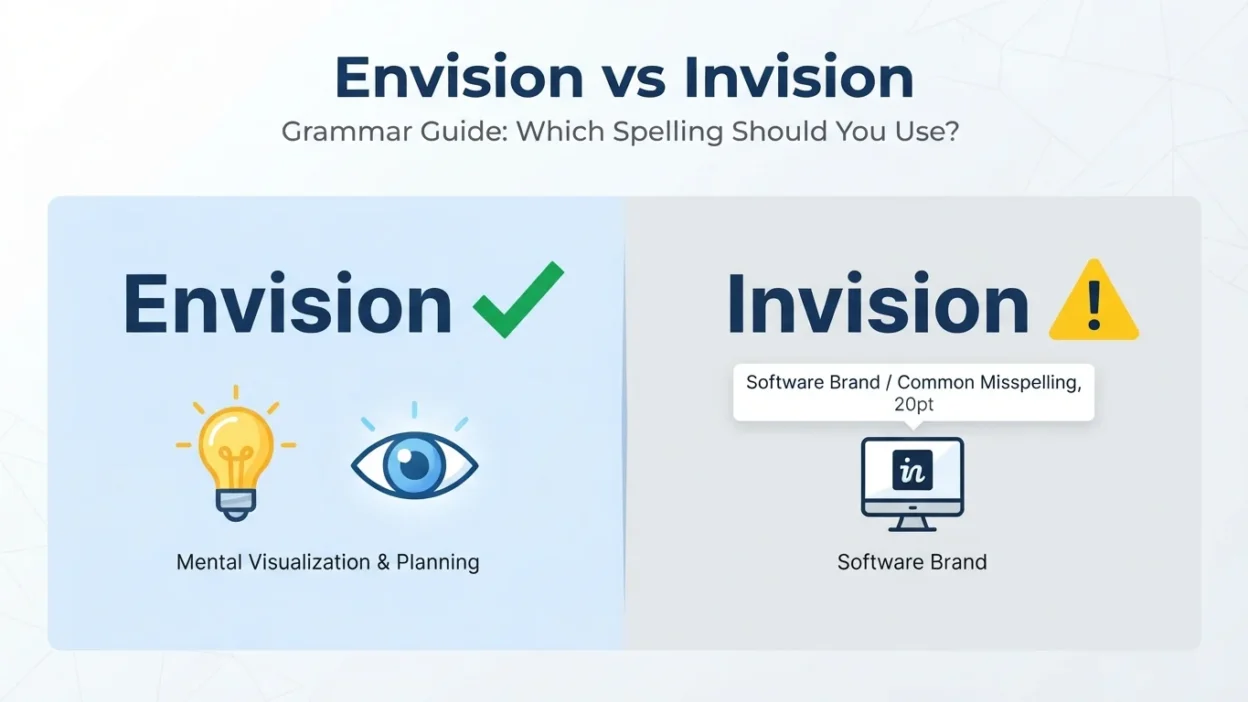
Envision is the correct English word. It means to imagine, visualize, or picture something in the future.
Invision is generally an incorrect spelling of envision. The only exception is when it refers to a brand or proper noun, such as the software company InVision.
Envision vs Invision at a Glance
| Word | Correct? | Meaning | Usage |
|---|---|---|---|
| Envision | ✅ Yes | To imagine or visualize something | Standard English |
| Invision | ❌ Usually No | Misspelling of “envision” | Only correct as a brand name |
What Does “Envision” Mean?
Envision is a verb that means to imagine, foresee, or picture something mentally, especially something that may happen in the future.
It is commonly used when discussing goals, plans, innovation, or possibilities.
Examples
- I envision a successful future for our company.
- She envisioned herself becoming a doctor.
- Scientists envision new technologies that could improve healthcare.
- We envision a world with cleaner energy.
What Does “Invision” Mean?
In standard English, invision is not a dictionary word.
People usually write it by mistake because it sounds similar to envision.
However, InVision (with a capital “I” and “V”) is the name of a well-known digital design and collaboration platform.
Examples
❌ I invision a better future.
✅ I envision a better future.
Brand example:
✅ Our design team uses InVision for prototypes.
Main Difference Between Envision vs Invision
| Feature | Envision | Invision |
|---|---|---|
| Standard English word | Yes | No |
| Dictionary entry | Yes | No |
| Part of speech | Verb | Not applicable |
| Means “imagine” | Yes | No |
| Appropriate in writing | Yes | Only as a brand name |
Why Do People Confuse Envision and Invision?
Several factors contribute to this spelling mistake.
Common Reasons
- They sound almost identical.
- The prefixes en- and in- are often confused.
- English pronunciation does not clearly distinguish the first vowel sound.
- Many people learn the word by hearing it before seeing it written.
Grammar Forms of “Envision”
Envision is a regular verb.
Grammar Forms Table
| Form | Example |
|---|---|
| Base verb | envision |
| Third-person singular | envisions |
| Present participle | envisioning |
| Past tense | envisioned |
| Past participle | envisioned |
Example Sentences
- I envision success.
- She envisions new opportunities.
- They are envisioning a new strategy.
- We envisioned better results.
When Should You Use “Envision”?
Use envision whenever you mean:
- Imagine the future
- Picture an idea
- Think creatively
- Plan long-term goals
- Visualize success
Examples
- We envision expanding internationally.
- Teachers envision student success.
- Engineers envision smarter cities.
- Parents envision bright futures for their children.
Real-Life Examples
Business
- The CEO envisions global growth.
- Investors envision long-term profits.
Education
- Teachers envision classrooms with advanced technology.
- Students envision successful careers.
Science
- Researchers envision new medical treatments.
- Scientists envision sustainable energy solutions.
Technology
- Developers envision AI-powered applications.
- Designers envision better user experiences.
Everyday Conversation
- I envision buying a house someday.
- She envisioned traveling around the world.
- We envision happier lives.
Professional and Industry Usage
| Industry | Example |
|---|---|
| Business | Leaders envision company growth. |
| Education | Educators envision improved learning. |
| Healthcare | Doctors envision better treatments. |
| Engineering | Engineers envision safer infrastructure. |
| Technology | Developers envision innovative software. |
| Marketing | Teams envision successful campaigns. |
Comparison Table
| Situation | Envision | Invision |
|---|---|---|
| Academic writing | ✅ | ❌ |
| Business reports | ✅ | ❌ |
| Professional emails | ✅ | ❌ |
| Creative writing | ✅ | ❌ |
| Software brand name | ❌ | ✅ (InVision) |
Common Mistakes
Many writers accidentally replace envision with invision.
Correct vs Incorrect
| Incorrect | Correct |
|---|---|
| I invision a better future. | I envision a better future. |
| She invisioned success. | She envisioned success. |
| We are invisioning new ideas. | We are envisioning new ideas. |
| They invision growth. | They envision growth. |
| He invisions a solution. | He envisions a solution. |
Memory Trick
A simple way to remember the correct spelling is:
Envision = Enable your imagination.
The prefix en- often means to make or put into, making it easier to remember.
Think:
EN = Imagine the future
Not:
IN = Incorrect spelling
How to Decide Which Word to Use
| Step | Question | Correct Choice |
|---|---|---|
| 1 | Are you talking about imagining something? | Envision |
| 2 | Are you writing formal English? | Envision |
| 3 | Are you referring to the design software? | InVision |
| 4 | Unsure? | Choose Envision |
People Also Ask
Is “invision” a real word?
No. It is not a standard English word.
Is “envision” correct?
Yes. It is the proper spelling and means to imagine or visualize something.
Why do people spell it “invision”?
Because the two words sound very similar in spoken English.
Is “InVision” ever correct?
Yes. It is correct only when referring to the software company or brand.
Can I use “invision” in an essay?
No. Unless you’re referring to the company name, use envision.
Frequently Asked Questions
Is “envision” formal?
Yes. It is suitable for both formal and informal writing.
Is “envision” a verb?
Yes. It is a regular verb meaning to imagine or picture mentally.
What is the opposite of envision?
Depending on context, words like ignore, overlook, or doubt may serve as opposites.
Can “envision” be used in business writing?
Absolutely. It is widely used in strategic planning, leadership, and marketing.
How can I remember the correct spelling?
Remember that envision begins with en-, which is the standard English prefix used in this verb.
Conclusion
When comparing envision vs invision, the answer is straightforward: envision is the correct English word, while invision is generally a misspelling unless it refers to the proper noun InVision, the design software brand.
If you want to express the idea of imagining, visualizing, or planning for the future, always use envision. Keeping this simple rule in mind will help you write more accurately, professionally, and confidently in every context.