If you have ever wondered about which one is you vs which one are you, you are not alone.
Both expressions may sound similar, but they are used differently because the words after which one determine the grammar of the sentence.
The confusion usually comes from the fact that you can refer to a person while is and are have different grammatical roles.
Understanding this small difference can make your English sound much more natural.
The key question is whether which one is functioning as the subject or whether you are asking someone to identify themselves from a group of choices.
In everyday English, “Which one are you?” is generally the natural and standard question when asking a person to identify themselves. “
Which one is you?” can appear in informal speech, but it is usually less natural and is often replaced with “Which one is yours?” or “Which one is you?” depending on the intended meaning.
Quick Answer
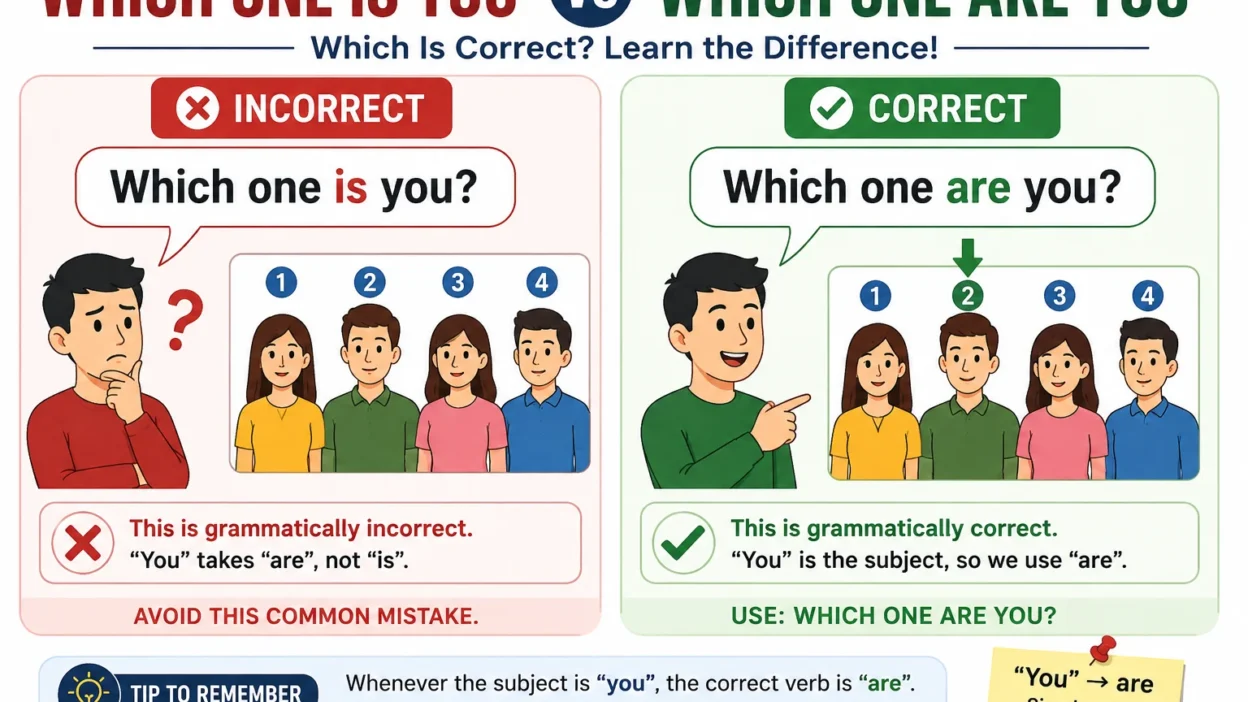
“Which one are you?” is the standard and natural expression when asking a person to identify themselves among several people or choices.
“Which one is you?” is generally considered nonstandard or awkward in standard English, although it may occur in casual speech or specific contexts.
Example: “There are five people in the photo. Which one are you?”
What Does “Which One Are You?” Mean?
“Which one are you?” asks someone to identify themselves from a group, list, photograph, or set of choices.
Here, you is the subject of the sentence, so the verb agrees with you:
Which one are you?
The structure is essentially asking:
Which person is you?
Although that underlying word order sounds unnatural, the normal question form is “Which one are you?”
Examples
- Which one are you in this picture?
- There are three applicants. Which one are you?
- Which one are you on the team?
- I see several people in the photograph. Which one are you?
- Which one are you referring to?
The expression is especially common when a person needs to identify themselves visually or from a group.
What Does “Which One Is You?” Mean?
“Which one is you?” attempts to ask the same basic question, but it does not follow the standard subject-verb agreement pattern used in natural English.
The phrase may still be understood easily:
Which one is you?
However, most speakers would normally say:
Which one are you?
The reason is that you takes are, not is, when it is the subject.
Compare:
- You are a student.
- You are the person in the photo.
- Which one are you?
The verb is agrees with singular third-person subjects such as he, she, or it.
Which One Is You vs Which One Are You: Main Difference
The central difference is subject-verb agreement.
| Expression | Grammar | Naturalness | Recommended? |
|---|---|---|---|
| Which one are you? | Correct agreement with “you” | Very natural | Yes |
| Which one is you? | Nonstandard agreement | Awkward in standard English | Usually no |
| Which one is yours? | Correct possessive construction | Very natural | Yes, when asking about ownership |
| Which person are you? | Correct | Natural | Yes |
The easiest rule is:
Use “are” with “you.”
Therefore:
Which one are you? ✅
is normally preferable to:
Which one is you? ❌
Why Do People Confuse “Is” and “Are”?
The confusion happens because which one looks singular.
The word one is singular, so learners may instinctively think the sentence should use is:
Which one is you?
However, the verb does not necessarily agree with the word one in the way learners might expect. In “Which one are you?”, you is the subject complement, and the verb agrees with you.
Consider this simpler sentence:
You are the winner.
When it becomes a question, the same relationship remains:
Which one are you?
The presence of which one does not change the fact that you requires are.
Grammar Rule: “You” Always Takes “Are”
One of the most useful rules for understanding this expression is that you takes are, whether it refers to one person or multiple people.
| Subject | Correct “be” verb | Example |
|---|---|---|
| I | am | I am ready. |
| You | are | You are ready. |
| He | is | He is ready. |
| She | is | She is ready. |
| It | is | It is ready. |
| We | are | We are ready. |
| They | are | They are ready. |
So, when the sentence contains you, use are in the present tense of the verb to be.
Compare These Examples
- Which one are you?
- Who are you?
- Where are you?
- What are you doing?
- How old are you?
All of these questions use are because the subject is you.
Is “Which One Are You?” Grammatically Correct?
Yes. “Which one are you?” is grammatically correct and widely used in natural English.
It can refer to:
- a person in a photograph
- a person in a group
- a character in a list
- a participant in an activity
- a member of a team
- a choice among several identities or categories
Real-Life Examples
At work:
“There are four people joining the meeting. Which one are you?”
At school:
“I have your class photo. Which one are you?”
At an event:
“I don’t recognize everyone here. Which one are you?”
On social media:
“I saw the group picture. Which one are you?”
During an online game:
“There are six players. Which one are you?”
Is “Which One Is You?” Ever Used?
You may encounter “Which one is you?” in casual conversation, informal writing, learner English, or contexts where the speaker is treating you as though it were the object being identified.
However, it is not the preferred standard construction.
If you want your English to sound polished and natural, choose:
In some contexts, another construction may be even better.
For example, if you are asking which object belongs to someone, say:
Do not confuse identity with possession.
“Which One Are You?” vs “Which One Is Yours?”
These two expressions have different meanings.
“Which one are you?” asks someone to identify themselves.
“Which one is yours?” asks someone to identify something that belongs to them.
| Question | Meaning | Example |
|---|---|---|
| Which one are you? | Identify yourself | Which person are you in the photo? |
| Which one is yours? | Identify your possession | Which bag is yours? |
| Which one do you want? | Identify your choice | Which dessert do you want? |
| Which one did you choose? | Identify your selection | Which option did you choose? |
This distinction is important because replacing are you with is yours changes the meaning.
“Which One Are You?” in Different Contexts
The phrase is flexible and works in many everyday situations.
Business
“We have five candidates scheduled today. Which one are you?”
A more professional alternative could be:
“Could you please tell me which candidate you are?”
Education
“There are twenty students in the class photo. Which one are you?”
Social Situations
“I know your name, but I haven’t met you before. Which one are you?”
Photography
“I found the team picture online. Which one are you?”
Technology
“There are several user profiles on the screen. Which one are you?”
Science
In a scientific or technical context, the expression may be used when identifying a person, sample, participant, or category, although more precise terminology is normally preferred in formal writing.
“Which participant are you?”
is often better than:
“Which one are you?”
Professional and Industry Usage
In professional communication, clarity matters. “Which one are you?” is grammatically correct, but it may sound informal depending on the situation.
| Context | Casual Version | More Professional Version |
|---|---|---|
| Business | Which one are you? | Which candidate are you? |
| Education | Which one are you? | Which student are you? |
| Healthcare | Which one are you? | Which patient are you? |
| Research | Which one are you? | Which participant are you? |
| Customer service | Which one are you? | Could you identify yourself? |
| Events | Which one are you? | Which attendee are you? |
The more specific noun often makes professional communication clearer.
Grammar Forms Related to “Which One Are You?”
Understanding similar structures can help you remember the correct pattern.
| Question | Correct Form | Purpose |
|---|---|---|
| Which one are you? | are + you | Identify a person |
| Which one is he? | is + he | Identify a male person |
| Which one is she? | is + she | Identify a female person |
| Which one is it? | is + it | Identify an object/thing |
| Which ones are you? | are + you | Identify multiple applicable choices |
| Which one is yours? | is + yours | Identify ownership |
Notice how the verb changes according to the subject.
Singular “One” Does Not Always Mean “Is”
A common mistake is to see one and automatically choose is.
For example:
Which one are you?
Here, one identifies a choice or person, while you is the person being identified.
Compare:
Which one is broken?
Here, one is the subject being described, so is is correct.
This gives us an important contrast:
| Sentence | Correct? | Why? |
|---|---|---|
| Which one are you? | ✅ | “You” takes “are.” |
| Which one is broken? | ✅ | “One” is the subject. |
| Which one is yours? | ✅ | “One” is the subject; “yours” is possessive. |
| Which one is you? | Usually ❌ | “You” requires “are” in this construction. |
Common Mistakes: Correct vs Incorrect
Learners frequently make mistakes because they focus on one instead of you.
| Incorrect or Awkward | Correct | Explanation |
|---|---|---|
| Which one is you? | Which one are you? | “You” takes “are.” |
| Which one are yours? | Which one is yours? | “One” is singular. |
| Which one is you in the photo? | Which one are you in the photo? | Use “are” with “you.” |
| Which one are he? | Which one is he? | “He” takes “is.” |
| Which one are she? | Which one is she? | “She” takes “is.” |
More Examples
Incorrect: Which one is you in this picture?
Correct: Which one are you in this picture?
Incorrect: Which one are yours?
Correct: Which one is yours?
Incorrect: Which one are she?
Correct: Which one is she?
The key is to identify the grammatical subject before selecting is or are.
Why “Which One Are You?” Sounds Natural
English question formation often moves the verb before the subject.
Statement:
You are the person in the photo.
Question:
Which one are you?
The verb are comes before you, but the agreement remains with you.
This is similar to:
You are ready.
Are you ready?
and:
You are the winner.
Which one are you?
The question form changes the word order, but it does not change the verb agreement.
Memory Trick for “Which One Are You?”
Use this simple trick:
See “you”? Think “are.”
Whenever the sentence is directly asking about you, remember:
Examples:
- Who are you?
- Where are you?
- Which one are you?
- What are you doing?
- How are you?
You can also remember:
This makes the difference much easier to remember.
“Which One Are You?” vs Similar Questions
Several expressions can be used instead of “Which one are you?”, depending on what you want to know.
| Expression | Meaning |
|---|---|
| Which one are you? | Identify yourself |
| Which person are you? | Identify yourself more specifically |
| Who are you? | Ask someone’s identity |
| Which one is yours? | Ask about ownership |
| Which one do you want? | Ask about preference |
| Which one did you choose? | Ask about a previous choice |
| Which one are you referring to? | Ask which item/person is meant |
Choosing the right question depends on whether you are asking about identity, ownership, preference, or reference.
When Should You Use “Which One Are You?”
Use “Which one are you?” when someone must identify themselves from multiple people or options.
Typical situations include:
- Looking at a group photograph.
- Identifying someone at an event.
- Matching an online profile to a person.
- Identifying a participant in a group.
- Asking which character someone represents.
- Identifying a person among several candidates.
Example Conversation
Alex: “I saw your team picture online.”
Sam: “Really?”
Alex: “Yes. Which one are you?”
Sam: “I’m standing on the left.”
This is completely natural conversational English.
When Should You Avoid “Which One Are You?”
Although the expression is correct, it can occasionally sound too direct.
In formal situations, consider a more polite alternative:
“Could you tell me which person you are in the photograph?”
Or:
“Could you identify yourself in the group photo?”
For customer service, business, healthcare, or official settings, a more specific question may be preferable.
Comparison Table: Which One Is You vs Which One Are You
| Feature | Which One Is You? | Which One Are You? |
|---|---|---|
| Standard English | Usually not preferred | Yes |
| Verb agreement | Awkward | Correct |
| Uses “you” correctly | ❌ | ✅ |
| Natural in conversation | Less natural | Very natural |
| Meaning | Usually understood as identity | Identifies yourself |
| Recommended for learners | No | Yes |
| Professional use | Avoid | Acceptable, depending on context |
Step-by-Step Way to Choose the Correct Form
When you are unsure, follow these steps.
| Step | Question to Ask | Example |
|---|---|---|
| 1 | Are you asking someone to identify themselves? | Yes |
| 2 | Is “you” the person being identified? | Yes |
| 3 | Does “you” take “are”? | Yes |
| 4 | Form the question | Which one are you? |
| 5 | Check the meaning | Identifying a person |
This simple process prevents most mistakes.
Examples in Everyday English
Here are natural examples you can use:
- Which one are you in the group?
- Which one are you in this picture?
- Which one are you on the list?
- Which one are you supposed to be?
- Which one are you referring to?
- Which one are you in the video?
- Which one are you playing?
- Which one are you in the class photo?
The exact meaning changes slightly according to the context, but the grammar remains the same.
Can You Say “Which One Is You” in Casual English?
You may hear “Which one is you?”, particularly in informal speech or from non-native speakers. Because the meaning is usually obvious, listeners can understand it.
However, being understandable does not necessarily make a phrase the best standard-English choice.
For clear, natural English, especially in writing, use:
If you are writing professionally, academically, or for an English-learning audience, this is the safer choice.
Which One Is You vs Which One Are You: Final Rule
The easiest rule is:
Use “which one is…” when one is the subject of the sentence:
Which one is broken?
Use “which one are you?” when you are the person being identified:
Which one are you?
This small distinction will help you avoid one of the most common mistakes involving is and are.
FAQs About “Which One Is You vs Which One Are You?”
1. Is “Which one are you?” correct?
Yes. “Which one are you?” is grammatically correct and natural English when asking someone to identify themselves.
2. Is “Which one is you?” grammatically correct?
It is generally considered nonstandard or awkward in standard English. “Which one are you?” is the preferred form.
3. Why is “are” used in “Which one are you?”
Because you takes the verb are in the present tense of to be. The question structure does not change that agreement.
4. What is the difference between “Which one are you?” and “Which one is yours?”
“Which one are you?” asks about identity. “Which one is yours?” asks about possession or ownership.
5. Can I use “Which one are you?” in professional English?
Yes, but context matters. In formal communication, a more specific phrase such as “Which participant are you?” or “Could you identify yourself?” may sound more professional.
6. What is the easiest way to remember the correct phrase?
Remember: You → are. Therefore, the natural expression is “Which one are you?”
Conclusion
The main difference between which one is you vs which one are you comes down to subject-verb agreement.
When you is the person being identified, the correct and natural form is “Which one are you?” because you takes are.
Although “Which one is you?” may be understood in casual conversation, it is not the preferred standard-English construction.
If you want your English to sound clear, natural, and grammatically correct, choose “Which one are you?”
when asking someone to identify themselves. For ownership, use “Which one is yours?” instead.