The comparison some of whom vs some of who confuses many English learners and even native speakers.
Both phrases look similar, but only one is considered grammatically correct in standard English.
Understanding some of whom vs some of who can help you write more naturally in academic, professional, and everyday situations.
If you have ever wondered if to write some of whom or some of who, you are not alone.
This guide explains the meaning, difference, usage, and examples of each phrase in simple English.
By the end, you’ll know exactly when to use the correct expression with confidence.
Quick Answer
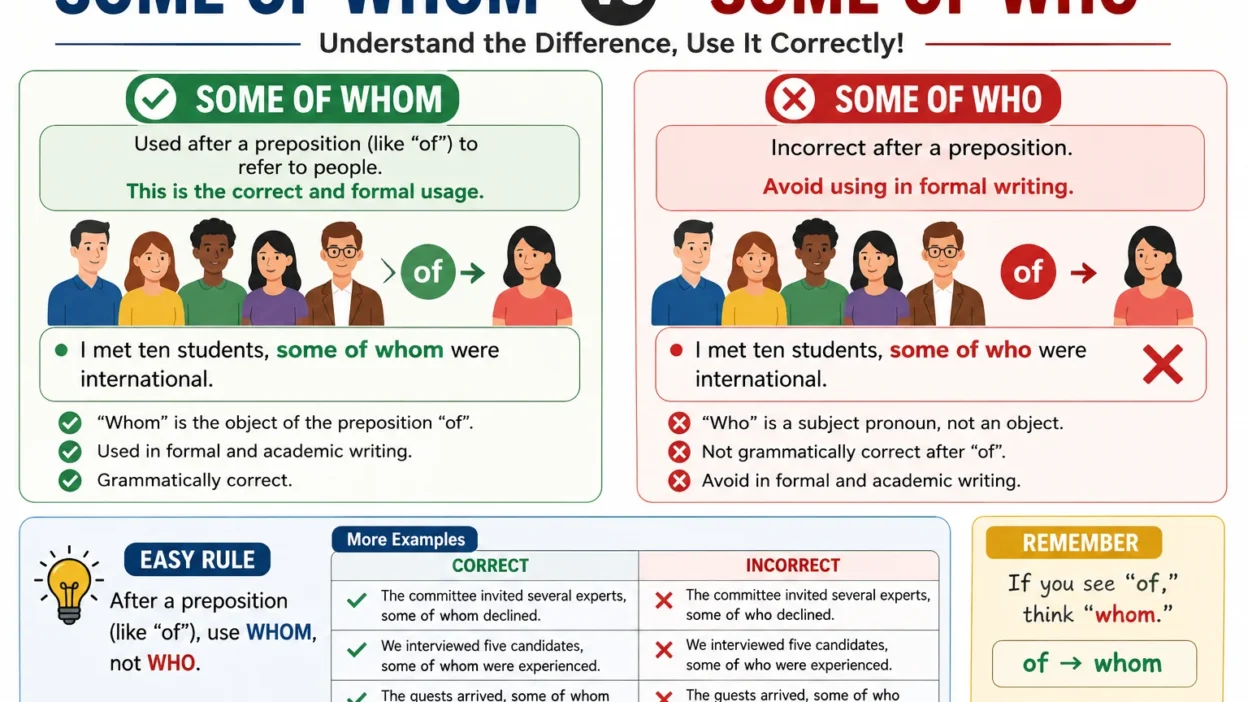
“Some of whom” is the correct grammatical phrase because whom follows the preposition of.
“Some of who” is considered incorrect in standard English and should usually be avoided in formal writing.
Some of Whom vs Some of Who: Comparison Table
| Feature | Some of Whom | Some of Who |
|---|---|---|
| Grammar | Correct | Incorrect in standard English |
| Uses object pronoun | Yes | No |
| Follows a preposition | Yes | No |
| Formal writing | Recommended | Not recommended |
| Academic English | Correct | Incorrect |
| Everyday speech | Common | Occasionally heard but considered nonstandard |
What Does “Some of Whom” Mean?
Some of whom refers to a part of a previously mentioned group of people.
It introduces additional information about those people.
Examples
- I met ten students, some of whom were international.
- She hired five engineers, some of whom had over ten years of experience.
- The committee invited several experts, some of whom declined.
Here, whom acts as the object of the preposition of.
What Does “Some of Who” Mean?
Technically, some of who is not grammatically correct in standard English.
Many people mistakenly replace whom with who because modern English uses who much more often in conversation.
Incorrect Examples
❌ I met ten students, some of who were absent.
❌ She interviewed five candidates, some of who accepted the offer.
Correct Versions
✅ I met ten students, some of whom were absent.
✅ She interviewed five candidates, some of whom accepted the offer.
Main Difference Between Some of Whom and Some of Who
The difference is based on grammar, not meaning.
| Point | Some of Whom | Some of Who |
|---|---|---|
| Object after “of” | Yes | No |
| Standard English | Correct | Incorrect |
| Formal grammar | Preferred | Avoid |
| IELTS/TOEFL | Correct answer | Wrong answer |
The preposition of requires the object form whom, not who.
Why Is “Some of Whom” Correct?
The word of is a preposition.
After prepositions, English traditionally uses object pronouns.
Examples:
- to him
- with her
- for them
- of whom
Just as you wouldn’t say of he, you shouldn’t say of who.
Grammar Rule Explained
The sentence usually has this structure:
Group + comma + some of whom + additional information
Formula
| Structure | Example |
|---|---|
| Noun + some of whom + clause | I interviewed ten applicants, some of whom were experienced. |
| People + some of whom + verb | The guests arrived, some of whom stayed overnight. |
| Group + some of whom + adjective | We met volunteers, some of whom were retired teachers. |
Grammar Forms Table
| Relative Pronoun | Function | Example |
|---|---|---|
| Who | Subject | The teacher who helped us won an award. |
| Whom | Object | The teacher whom we thanked smiled. |
| Whose | Possession | The student whose book was lost cried. |
| Which | Things/animals | The car which broke down was repaired. |
| That | People or things | The movie that I watched was great. |
When Should You Use “Some of Whom”?
Use it whenever:
- You refer to people.
- The phrase follows a comma.
- You mean “a number of those people.”
- The phrase comes after of.
Examples
- We visited several museums, some of whom employed volunteer guides. ❌ (Incorrect because museums are not people.)
Correct:
- We visited several museums, some of which offered free admission.
For people:
- We interviewed twelve doctors, some of whom specialized in surgery.
Real-Life Examples
Business
- The company hired twenty employees, some of whom work remotely.
- Investors attended the meeting, some of whom requested additional reports.
Education
- The professor taught forty students, some of whom published research papers.
- Several graduates, some of whom earned scholarships, attended the ceremony.
Science
- Researchers collected volunteers, some of whom participated twice.
- Scientists interviewed experts, some of whom specialized in genetics.
Healthcare
- Doctors examined patients, some of whom required surgery.
- Nurses cared for elderly residents, some of whom lived independently.
Everyday Conversation
- I invited my cousins, some of whom couldn’t attend.
- We met neighbors, some of whom had recently moved in.
Professional Usage Table
| Industry | Example |
|---|---|
| Business | The board appointed directors, some of whom had international experience. |
| Education | The university admitted students, some of whom received scholarships. |
| Law | The witnesses, some of whom testified twice, appeared in court. |
| Medicine | Patients, some of whom required follow-up care, were discharged. |
| Journalism | Reporters interviewed residents, some of whom witnessed the incident. |
Why Do People Confuse These Phrases?
Several reasons cause this mistake.
| Reason | Explanation |
|---|---|
| “Who” is more common | People naturally use who more often. |
| “Whom” sounds formal | Many avoid it because it feels old-fashioned. |
| Spoken English | Casual speech often ignores formal grammar rules. |
| Lack of grammar knowledge | Many don’t know that “of” requires an object pronoun. |
Memory Trick
Remember this simple rule:
If you see “of,” think “whom.”
Easy reminder:
of → whom
Not:
of → who
This works in nearly every formal sentence involving people.
Common Mistakes
| Incorrect | Correct |
|---|---|
| Some of who attended. | Some of whom attended. |
| Many of who applied were accepted. | Many of whom applied were accepted. |
| Several of who arrived early. | Several of whom arrived early. |
| Two of who won prizes. | Two of whom won prizes. |
| Most of who volunteered stayed late. | Most of whom volunteered stayed late. |
Correct vs Incorrect Sentences
Incorrect
- Some of who were absent received emails.
- Five employees, some of who resigned, were replaced.
- Several teachers, some of who retired, attended.
Correct
- Some of whom were absent received emails.
- Five employees, some of whom resigned, were replaced.
- Several teachers, some of whom retired, attended.
How to Choose the Correct Phrase
| Step | Action |
|---|---|
| 1 | Are you talking about people? |
| 2 | Does the phrase include “of”? |
| 3 | Is it introducing extra information? |
| 4 | Use some of whom. |
Following these steps will help you avoid one of the most common grammar mistakes.
People Also Ask
Is “some of who” ever correct?
No. In standard English grammar, some of whom is the correct expression.
Why do people say “some of who”?
Mostly because who is much more common in everyday speech than whom.
Is “some of whom” formal?
Yes. It is standard in both formal and informal writing, although it appears more frequently in formal English.
Can I replace “whom” with “who”?
Not after the preposition of. In this structure, whom is the grammatically correct choice.
What is the easiest way to remember?
Remember this rule:
After “of,” use “whom” when referring to people.
FAQs
Is “some of whom” always correct?
Yes, when referring to people after a previously mentioned group.
Can I use “some of whom” in business writing?
Absolutely. It is the preferred choice in professional and academic writing.
Does modern English still use “whom”?
Yes, especially after prepositions such as of, to, for, and with.
Is “some of who” acceptable in casual conversation?
Some speakers use it informally, but it is still considered grammatically incorrect in standard English.
Is this question common in English exams?
Yes. Grammar tests often check whether you know to use whom after a preposition.
Conclusion
Understanding some of whom vs some of who is simpler than it first appears.
The key rule is that some of whom is the grammatically correct phrase because whom functions as the object of the preposition of.
While some of who may occasionally appear in casual speech, it is not accepted in standard English and should be avoided in formal writing, academic work, and professional communication.
Remember the easy rule: after “of,” use “whom” when referring to people. Mastering this small grammar point will make your writing clearer, more accurate, and more polished.