
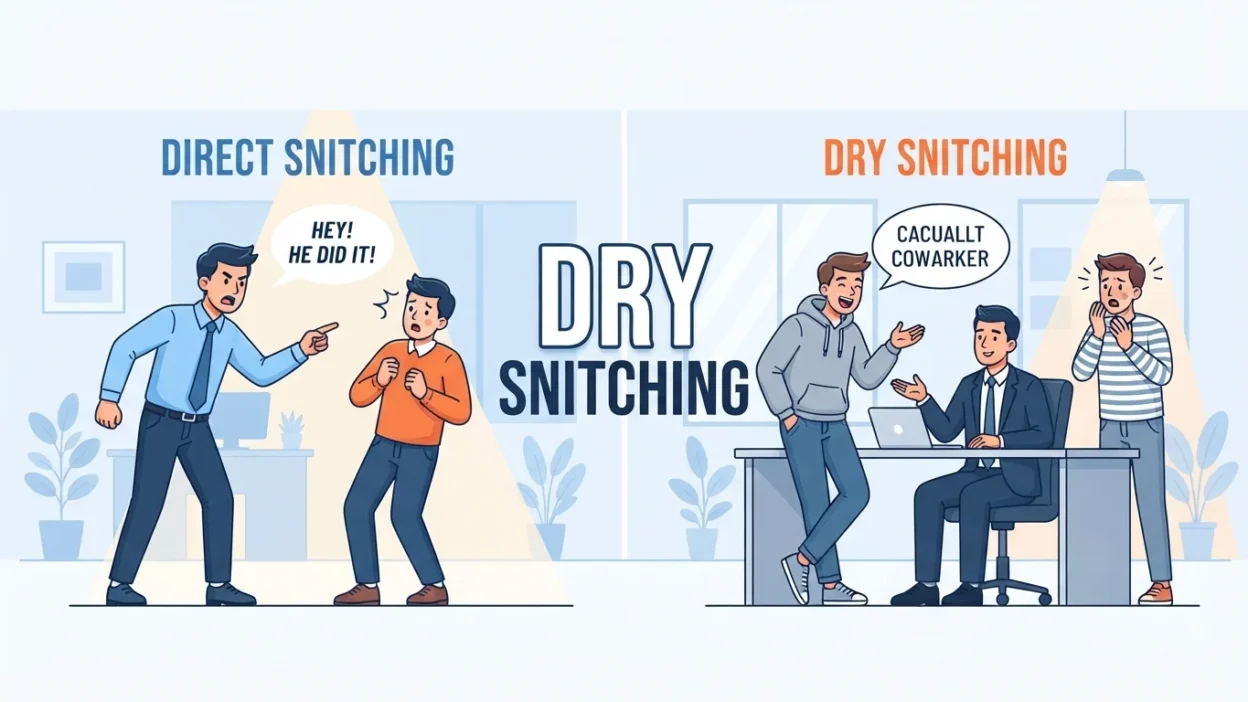
The dry snitching meaning can be confusing because it describes revealing someone’s wrongdoing without directly saying that you are trying to get them in trouble.
The phrase is informal slang and is often used when someone shares unnecessary information about another person’s actions, especially when that information could lead to punishment, embarrassment, or consequences.
Understanding the dry snitching meaning requires looking at both the words and the social situation in which they are used.
In everyday conversations, social media, workplaces, schools, and friendships, people may accuse someone of “dry snitching” when they indirectly expose another person.
The person may not openly report them, but their comments can still reveal enough information for others to figure out what happened.
This article explains the dry snitching meaning, its difference from ordinary reporting, examples, common mistakes, usage, and related slang terms in simple English.
Quick Answer: What Is Dry Snitching?
Dry snitching means indirectly revealing someone else’s wrongdoing or private behavior in a way that may get that person in trouble.
It often involves giving hints, mentioning details, or making comments that expose someone without directly saying, “I am reporting them.”
The term is slang and is usually used negatively.
What Does Dry Snitching Mean?
The simplest dry snitching meaning is indirectly exposing someone by giving information that could cause them trouble.
For example, imagine a student says:
“I wonder who was using their phone during the test. Some people were definitely texting.”
If the speaker knows exactly who was texting but avoids directly naming the person, others might describe this as dry snitching.
The key idea is that the person does not necessarily make a formal report. Instead, they reveal enough information for someone else to identify the person involved.
| Element | Meaning |
|---|---|
| Dry snitching | Indirectly exposing someone’s behavior |
| Direct reporting | Clearly telling an authority what happened |
| Main purpose | Often perceived as getting someone into trouble |
| Tone | Usually negative or critical |
| Register | Informal slang |
| Common settings | Friends, school, work, social media, groups |
Why Is It Called “Dry Snitching”?
The word snitching generally refers to informing someone about another person’s wrongdoing.
The word dry adds the idea that the person is doing it indirectly rather than openly acting as an informant.
Someone might casually mention information while pretending they are simply making conversation. However, if the information exposes another person’s behavior, listeners may interpret it as an attempt to get that person in trouble.
The expression is therefore more about how information is revealed than simply whether information is true.
Dry Snitching vs Snitching: What Is the Difference?
Dry snitching and snitching are closely related, but they are not always used in exactly the same way.
Snitching generally involves directly giving information about another person’s wrongdoing to an authority or another person who can act on it.
Dry snitching is usually more indirect. Instead of formally reporting someone, the person may make a comment, hint, or reveal a detail that exposes them.
| Feature | Dry Snitching | Snitching |
|---|---|---|
| Communication | Usually indirect | Often direct |
| Information | May be hinted or casually revealed | Usually explicitly reported |
| Formal report | Not necessarily | Often possible |
| Intention | May be perceived as intentional or careless | Usually viewed as deliberate reporting |
| Example | “Somebody took the money from the drawer.” | “John took the money from the drawer.” |
| Tone | Informal slang | Common informal term |
Dry Snitching vs Simply Telling the Truth
Not every statement that exposes someone is dry snitching.
Context matters.
Suppose an employee witnesses serious workplace misconduct and reports it through the appropriate channel. Calling that person a “dry snitch” simply because someone faces consequences would be an oversimplification.
Dry snitching is usually associated with unnecessary or indirect exposure, especially when the speaker appears to be trying to reveal another person’s behavior without openly accepting responsibility for reporting it.
| Situation | Likely Description |
|---|---|
| Reporting dangerous misconduct | Responsible reporting |
| Telling a teacher someone cheated | Direct reporting |
| Posting hints that identify someone’s wrongdoing | Could be dry snitching |
| Accidentally revealing private information | Careless disclosure |
| Deliberately giving clues to expose someone | Likely dry snitching |
Examples of Dry Snitching in Everyday Life
Understanding examples makes the dry snitching meaning much easier to recognize.
Example 1: Friends
Someone asks:
“Who ate the cake I saved?”
A friend responds:
“I don’t know, but Alex was in the kitchen for about twenty minutes.”
The friend did not directly accuse Alex, but the comment strongly points toward Alex.
Example 2: School
A teacher asks who was talking during an exam.
A student says:
“I wasn’t talking, but someone sitting behind me was whispering the whole time.”
If everyone knows who was sitting behind that student, the statement may be perceived as dry snitching.
Example 3: Workplace
A manager notices that a report was completed using unauthorized software.
An employee says:
“I’m not naming anyone, but you might want to check the computer in Room 4.”
That indirect clue could expose the employee involved.
Example 4: Social Media
Someone posts:
“Imagine pretending to be sick and then posting pictures from the beach.”
If everyone knows who recently claimed to be sick, the post may indirectly expose them.
Dry Snitching in Business and the Workplace
The phrase can appear in workplace conversations, although it is informal and should generally be avoided in professional documentation.
For example, coworkers might accuse someone of dry snitching after that person makes comments that indirectly reveal another employee’s actions.
However, workplaces often have legitimate reporting procedures for harassment, fraud, safety violations, discrimination, or other serious problems.
| Workplace Situation | Better Description |
|---|---|
| Reporting safety risks | Safety reporting |
| Reporting fraud | Whistleblowing or misconduct reporting |
| Hinting that a coworker broke a rule | Possible dry snitching |
| Sharing confidential information | Confidentiality breach |
| Making an indirect accusation | Indirect disclosure |
In professional communication, use precise terms such as reporting misconduct, disclosing information, or raising a concern instead of relying on slang.
Dry Snitching in Education
Students may use the expression when discussing classmates who reveal information about rule-breaking.
For example:
“Nobody told the teacher directly, but someone mentioned that the students in the back were using their phones.”
Depending on the circumstances, classmates might call this dry snitching.
However, schools also have legitimate reasons for students to report bullying, threats, cheating, or dangerous behavior. The slang term should not automatically be used to discourage someone from seeking help.
Dry Snitching on Social Media
Social media provides many opportunities for indirect exposure.
A person might avoid naming someone while giving enough details for their followers to identify them.
For example:
“Some people really need to stop borrowing things and pretending they returned them.”
If the audience knows exactly who borrowed the item, the post may function as an indirect accusation.
| Social Media Behavior | Possible Interpretation |
|---|---|
| Naming someone directly | Direct accusation |
| Giving identifying clues | Possible dry snitching |
| Sharing private screenshots | Public disclosure |
| Reporting harmful content | Platform reporting |
| Posting a vague complaint | May or may not be dry snitching |
Dry Snitching in Different Industries
The expression is not a formal professional term, but the underlying behavior can appear in many settings.
| Industry | Example | More Professional Term |
|---|---|---|
| Education | Hinting that a student cheated | Reporting or disclosure |
| Business | Indirectly exposing a coworker’s mistake | Reporting misconduct |
| Retail | Revealing who broke a store rule | Incident reporting |
| Healthcare | Sharing confidential patient information | Confidentiality breach |
| Technology | Indirectly exposing unauthorized activity | Security reporting |
| Sports | Hinting that a teammate violated a rule | Reporting a violation |
Professional settings require more precise language because the distinction between gossip, disclosure, and legitimate reporting can be important.
Common Forms and Grammar of Dry Snitching
Because dry snitching is a slang expression, it is most commonly used as a noun phrase or gerund phrase.
| Form | Example |
|---|---|
| Dry snitching | “Dry snitching can cause problems.” |
| Dry snitch | “Don’t dry snitch on your friends.” |
| Dry snitched | “He dry snitched about what happened.” |
| Dry snitching on | “She was dry snitching on her coworker.” |
| Dry snitcher | “They called him a dry snitcher.” |
The exact grammar can vary because slang is flexible, but these forms are common in informal speech.
How to Use Dry Snitching in a Sentence
Here are natural examples of the phrase:
- “Why are you dry snitching on me?”
- “That comment sounded like dry snitching.”
- “He was accused of dry snitching after revealing the details.”
- “Stop dry snitching and just mind your business.”
- “Posting those clues was basically dry snitching.”
- “She didn’t report him directly, but her comment felt like dry snitching.”
The expression is normally used in casual conversations rather than formal writing.
Common Mistakes When Using Dry Snitching
One common mistake is assuming that every form of reporting is dry snitching.
That is not necessarily true. The expression usually carries a negative judgment about indirect exposure.
Incorrect vs Correct Usage
| Incorrect or Misleading | Better Usage |
|---|---|
| “Reporting a dangerous crime is always dry snitching.” | “Reporting a dangerous crime is not necessarily dry snitching.” |
| “Dry snitching means telling the truth.” | “Dry snitching refers to indirectly exposing someone.” |
| “Every complaint is dry snitching.” | “Some indirect complaints may be described as dry snitching.” |
| “The term is formal business English.” | “The term is informal slang.” |
| “Dry snitching always means making a formal report.” | “Dry snitching is generally indirect exposure.” |
Why Do People Confuse Dry Snitching With Snitching?
The confusion exists because both expressions involve revealing information about another person.
The biggest difference is often directness.
Someone who directly tells an authority what another person did may be called a snitch. Someone who gives clues, hints, or supposedly casual details that reveal the same information may be accused of dry snitching.
However, slang is subjective. Different people may use these expressions differently depending on their community, age, region, and situation.
Memory Trick for Dry Snitching
A simple way to remember the phrase is:
Dry = indirect
Snitching = exposing someone
So:
Dry snitching = indirectly exposing someone.
Imagine someone saying, “I’m not saying who did it, but you should check Jordan’s locker.”
They did not directly accuse Jordan, but they gave a clue.
That is the basic idea behind the expression.
When Should You Avoid Using the Term?
Because dry snitching is slang and can sound accusatory, it is not always appropriate.
Avoid using it in formal reports, workplace documentation, academic writing, or official complaints unless you are specifically discussing the slang itself.
Instead, use precise alternatives such as:
- indirect disclosure
- reporting
- revealing information
- sharing confidential information
- making an accusation
- reporting misconduct
- whistleblowing
Choosing a neutral term can prevent unnecessary conflict.
Dry Snitching vs Gossip vs Whistleblowing
These terms overlap in some situations but have different meanings.
| Term | Basic Meaning | Typical Purpose |
|---|---|---|
| Dry snitching | Indirectly exposing someone | Often perceived negatively |
| Gossip | Sharing personal or unofficial information | Conversation or entertainment |
| Snitching | Informing others about wrongdoing | Reporting or exposing |
| Whistleblowing | Reporting serious wrongdoing | Public interest or accountability |
| Disclosure | Revealing information | Neutral term |
The most important distinction is that whistleblowing can involve legitimate reporting of serious wrongdoing, while dry snitching is usually a negative slang label.
Is Dry Snitching Always Intentional?
No.
A person can reveal information without realizing that their comment will identify someone.
For example:
“I wasn’t supposed to mention it, but someone in the marketing department changed the numbers.”
Even if the speaker did not intend to cause trouble, the comment could expose the person involved.
Therefore, the phrase may describe the effect or perception of someone’s statement rather than their proven intention.
How to Respond If Someone Accuses You of Dry Snitching
If someone accuses you of dry snitching, avoid immediately escalating the situation.
You can calmly clarify what you meant:
“I wasn’t trying to get anyone in trouble. I was just explaining what happened.”
Or:
“I didn’t mention anyone’s name or private information.”
The best response depends on the circumstances. If the information involves safety, serious misconduct, or harm, seeking appropriate help is more important than avoiding a slang label.
Frequently Asked Questions About Dry Snitching
What is the dry snitching meaning?
Dry snitching means indirectly revealing someone’s wrongdoing or behavior in a way that may cause them trouble. It often involves hints or unnecessary details rather than a direct report.
Is dry snitching the same as snitching?
Not exactly. Snitching often suggests directly informing someone about another person’s wrongdoing, while dry snitching generally suggests doing so indirectly.
Is dry snitching always bad?
Not necessarily. The phrase is usually negative, but whether someone’s behavior is inappropriate depends on the situation. Reporting serious danger or misconduct can be responsible behavior.
Can dry snitching happen on social media?
Yes. Posting clues, details, or indirect accusations that allow people to identify someone’s behavior can be described as dry snitching.
Is dry snitching formal English?
No. Dry snitching is informal slang. It is better to use more precise language in professional or academic writing.
What is another word for dry snitching?
Depending on the context, alternatives include indirect reporting, indirect disclosure, revealing information, or exposing someone. None is a perfect synonym in every situation.
Final Takeaway: Dry Snitching Meaning
The dry snitching meaning is best understood as indirectly exposing someone’s behavior or wrongdoing, often by giving clues or details that can get that person into trouble.
The main difference between dry snitching and ordinary snitching is directness. Snitching often involves directly reporting information, while dry snitching usually involves indirect comments, hints, or revelations.
Remember the simple rule:
Dry snitching = indirect exposure.
Because the phrase is slang, its meaning can vary depending on the community and context.
It is also important not to confuse the term with legitimate reporting of serious misconduct, danger, or abuse.
In formal situations, neutral terms such as reporting misconduct or disclosing information are usually more appropriate.

Julian Wyatt is a passionate researcher and writer who explores symbols, mythology, cultural traditions, and hidden meanings. Through engaging articles, he helps readers uncover the fascinating stories and significance behind symbols worldwide.