The debate over a hilarious vs an hilarious is a common grammar question among English learners and even native speakers.
Many people assume that words beginning with the letter H always require an, while others always use a. The correct choice actually depends on how the word is pronounced, not simply how it is spelled.
Understanding a hilarious vs an hilarious will help you write and speak more naturally.
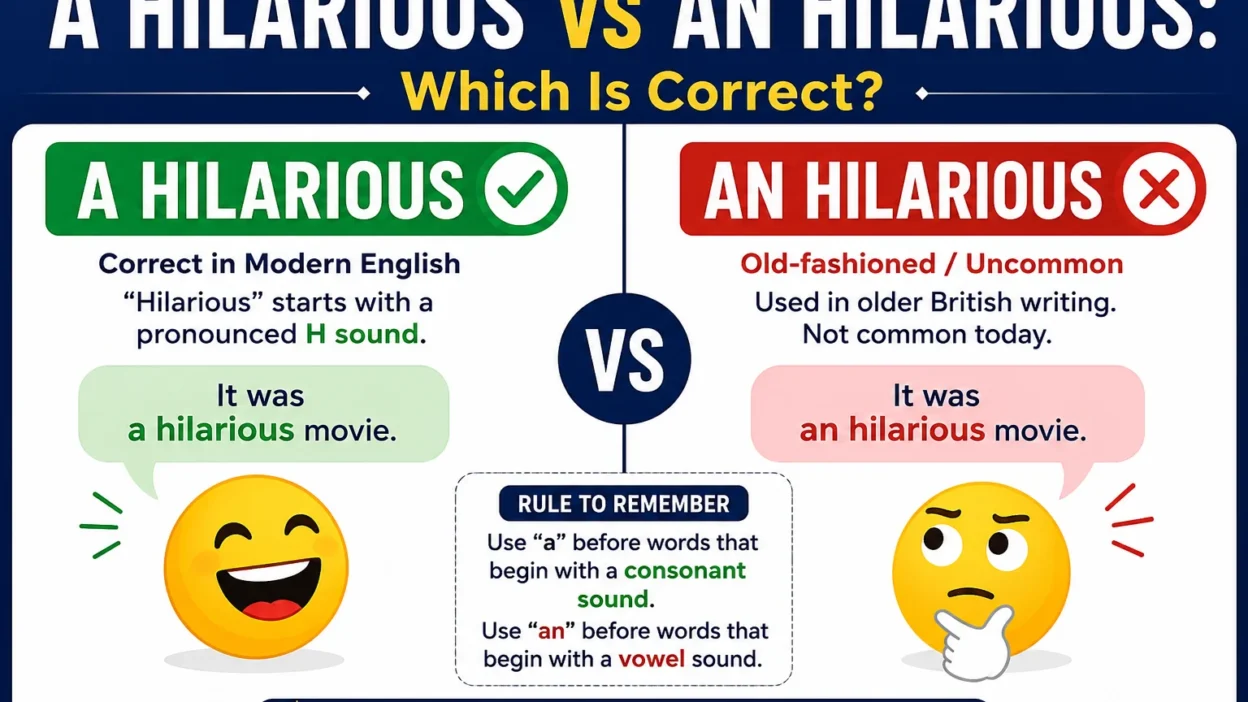
In modern English, a hilarious is the standard and widely accepted form because hilarious begins with a pronounced H sound.
Although an hilarious may appear in older texts or certain British styles, it is uncommon today. This guide explains the meaning, pronunciation, grammar rules, examples, and usage differences to help you choose the correct article every time.
Quick Answer
A hilarious is the correct and standard expression in modern English.
An hilarious is considered old-fashioned or rare because the H in hilarious is pronounced.
A Hilarious vs An Hilarious Comparison Table
| Feature | A Hilarious | An Hilarious |
|---|---|---|
| Grammatically accepted today | ✅ Yes | ⚠ Rare |
| Modern English | Yes | Rarely |
| American English | Preferred | Almost never |
| British English | Preferred | Occasionally seen in older writing |
| Based on pronunciation | Yes | Historical usage |
| Recommended for writing | Yes | No |
What Does “A Hilarious” Mean?
A hilarious is used before a singular noun when hilarious describes that noun.
Examples
- It was a hilarious movie.
- She told a hilarious joke.
- We had a hilarious conversation.
- That was a hilarious performance.
Because hilarious starts with the pronounced h sound (/hɪˈleəriəs/), the correct article is a.
What Does “An Hilarious” Mean?
An hilarious has the same meaning but is an older or less common usage.
Some older British writers used an before words beginning with h when the first syllable was weak or unstressed. Today, this style is rarely used in modern English.
Example
- It was an hilarious incident. (Old-fashioned and uncommon)
Most grammar guides now recommend:
✅ It was a hilarious incident.
Main Difference Between A Hilarious vs An Hilarious
| Aspect | A Hilarious | An Hilarious |
|---|---|---|
| Modern correctness | ✅ Correct | ⚠ Rare |
| Pronunciation rule | Follows rule | Historical exception |
| Everyday conversation | Common | Uncommon |
| Academic writing | Preferred | Avoid |
| Professional writing | Recommended | Not recommended |
The difference is based on pronunciation rather than meaning.
Why Is “A Hilarious” Correct?
The rule for a and an depends on sound, not spelling.
Use a before words beginning with a consonant sound.
Use an before words beginning with a vowel sound.
Since hilarious begins with the pronounced H sound, it starts with a consonant sound.
Examples:
- a happy child
- a history lesson
- a hotel room
- a hilarious story
Grammar Rule for A vs An
| Word | Correct Article | Reason |
|---|---|---|
| hilarious | a | Pronounced H |
| happy | a | Pronounced H |
| house | a | Pronounced H |
| honest | an | Silent H |
| hour | an | Silent H |
| honor | an | Silent H |
The pronunciation—not the first letter—determines the correct article.
Real-Life Examples
Business
The presenter shared a hilarious story to engage the audience.
Education
The teacher read a hilarious children’s book.
Entertainment
The comedian delivered a hilarious performance.
Marketing
The company released a hilarious advertisement that went viral.
Social Media
Everyone commented on a hilarious meme.
Family Conversation
My uncle told a hilarious joke during dinner.
Industry Usage Table
| Industry | Preferred Phrase |
|---|---|
| Journalism | A hilarious |
| Publishing | A hilarious |
| Education | A hilarious |
| Business | A hilarious |
| Marketing | A hilarious |
| Entertainment | A hilarious |
Common Words Following the Same Rule
| Correct | Incorrect |
|---|---|
| a hilarious movie | an hilarious movie |
| a happy family | an happy family |
| a historic building* | an historic building* |
| a hotel | an hotel |
*Some British publications still use an historic, but a historic is now more common worldwide.
Why Do People Confuse A Hilarious and An Hilarious?
There are several reasons:
- They think all words beginning with H use an.
- They have seen older British writing.
- They confuse spelling with pronunciation.
- Some grammar myths continue online.
- Older books sometimes use an hilarious.
Memory Trick
Remember this simple rule:
Listen to the first sound, not the first letter.
If you hear a strong H sound:
➡ Use a
If the H is silent:
➡ Use an
Examples:
- a hilarious joke ✅
- a hotel ✅
- a history class ✅
- an hour ✅
- an honest person ✅
- an honor ✅
Common Mistakes
| Incorrect Sentence | Correct Sentence |
|---|---|
| It was an hilarious movie. | It was a hilarious movie. |
| She told an hilarious joke. | She told a hilarious joke. |
| We watched an hilarious show. | We watched a hilarious show. |
| He shared an hilarious story. | He shared a hilarious story. |
Tips for Professional Writing
Always use a hilarious in:
- business reports
- academic essays
- blogs
- emails
- news articles
- marketing content
- books
- presentations
Using the modern form makes your writing sound more natural and professional.
Similar Grammar Examples
| Correct | Reason |
|---|---|
| a university | Starts with “yoo” sound |
| an umbrella | Starts with vowel sound |
| a European city | Starts with “yoo” sound |
| an MBA graduate | Starts with vowel sound (“em”) |
| a hilarious comedy | Pronounced H |
Frequently Asked Questions
Is “a hilarious” correct?
Yes. It is the standard and correct form in modern English.
Is “an hilarious” wrong?
It is not completely wrong, but it is old-fashioned and rarely used today.
Why do we use “a” before hilarious?
Because hilarious begins with a pronounced H sound, which is a consonant sound.
Is “an hilarious” used in British English?
Occasionally in older or very formal British writing, but a hilarious is now much more common.
Does the rule depend on spelling?
No. It depends on pronunciation.
What other words follow this rule?
Words like happy, history, hotel, and house all take a because their H is pronounced.
Conclusion
Understanding a hilarious vs an hilarious becomes simple once you remember that English articles depend on pronunciation rather than spelling. Since hilarious begins with a clearly pronounced H sound, a hilarious is the correct and recommended choice in modern English.
While an hilarious may appear in older British texts or historical writing, it is uncommon today. For everyday conversation, academic work, business communication, and professional writing, always use a hilarious to ensure your English sounds natural, accurate, and grammatically correct.