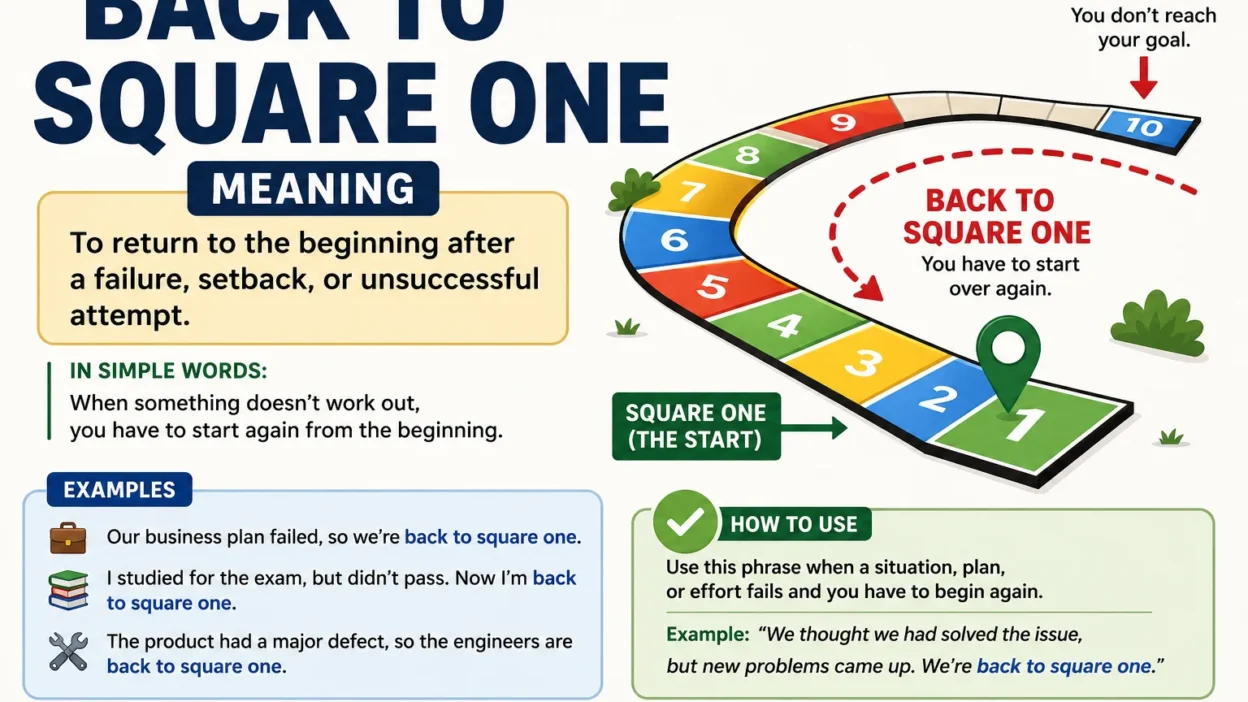
The phrase “back to square one” means returning to the beginning of a process after an attempt has failed or a situation has not worked out as expected.
If you have spent weeks working on a project, only to discover that the entire plan needs to be , you may feel like you are back to square one.
The expression is common in everyday English, business, education, problem-solving, and personal situations.
Understanding the back to square one meaning is useful because the phrase is sometimes confused with simply “starting over.”
Although the two ideas are closely related, back to square one usually suggests that progress has been lost and you must return to the starting point.
This guide explains the back to square one meaning, its usage, examples, origin theories, grammar, common mistakes, and practical ways to remember it.
Quick Answer
“Back to square one” means returning to the beginning after an unsuccessful attempt or setback.
Example: Our first business plan failed, so we are back to square one.
It often suggests that previous progress has been lost and a new approach is needed.
What Is the Back to Square One Meaning?
The back to square one meaning is essentially returning to the starting point after a failure, problem, or setback.
The phrase can describe a physical beginning, but it is usually used figuratively. Someone may be working on a project, solving a problem, making a decision, or developing a plan. If their approach fails and they have to begin again, they are “back to square one.”
For example:
The software update caused even more problems, so the development team is back to square one.
This does not necessarily mean that every piece of previous work has disappeared. It means the current strategy has failed badly enough that the person or group needs to reconsider the problem from the beginning.
Back to Square One vs. Starting Over
These expressions are similar, but there is a subtle difference.
| Expression | Meaning | Typical feeling |
|---|---|---|
| Back to square one | Return to the beginning after a setback | Frustration or disappointment |
| Starting over | Begin again | Neutral or negative |
| Start from scratch | Create something again from the beginning | Often implies little or no usable previous work |
| Back to the drawing board | Return to planning because an idea failed | Focuses on redesigning a plan |
| Begin again | Start another attempt | Neutral |
Back to square one often emphasizes lost progress.
For example:
- We have to start over. — We need another attempt.
- We are back to square one. — Our current progress or approach has failed, so we have returned to the beginning.
How to Use “Back to Square One” in a Sentence
The phrase is generally used after a setback.
Common sentence patterns include:
Subject + be + back to square one
- We are back to square one.
- The company is back to square one.
- She is back to square one.
It can also appear with verbs such as put, leave, or send, depending on context.
- The failed experiment put the researchers back to square one.
- The legal dispute sent the project back to square one.
The phrase normally functions as an idiomatic expression rather than a literal description of a square.
Grammar Forms and Sentence Patterns
“Back to square one” is an idiomatic phrase, so it does not change form according to tense. The surrounding verb changes instead.
| Tense | Example |
|---|---|
| Present | We are back to square one. |
| Past | We were back to square one. |
| Future | We may be back to square one. |
| Present perfect | We have gone back to square one. |
| Past perfect | We had gone back to square one. |
| Modal | We could be back to square one. |
Notice that square one itself remains unchanged.
You would not normally write “back to squares one” because the expression is fixed.
Real-Life Examples of Back to Square One
The phrase appears in many areas of life.
Business Example
A company may spend months developing a new product before discovering that customers do not want it.
The market research showed that customers disliked the product, so the company was back to square one.
Education Example
A student may study one method for solving a difficult problem but discover that the method does not work.
My first approach to the math problem failed, so I was back to square one.
Science Example
Researchers often test theories repeatedly. If an experiment disproves their main hypothesis, they may need to reconsider their original assumptions.
The experiment produced unexpected results, sending the researchers back to square one.
Technology Example
A software team might discover a major flaw in a new system.
The security problem forced the developers back to square one.
Personal Life Example
The expression can also describe relationships, plans, or personal goals.
After our travel plans were canceled, we were back to square one.
These examples demonstrate that back to square one is useful whenever a setback causes someone to return to an earlier stage of a process.
Back to Square One in Business and Professional English
The expression is especially common in professional communication.
| Situation | Example |
|---|---|
| Product development | The prototype failed, putting the team back to square one. |
| Marketing | The campaign produced poor results, so we are back to square one. |
| Hiring | Our preferred candidate declined, leaving us back to square one. |
| Negotiations | The two sides could not agree, sending negotiations back to square one. |
| Project planning | The budget was rejected, putting the project back to square one. |
Although the phrase is an idiom, it is not overly informal. It can be used in conversations, articles, presentations, emails, and many professional settings.
For highly formal writing, alternatives such as “return to the initial stage” or “reconsider the original approach” may sometimes be more precise.
Back to Square One in Problem-Solving
Problem-solving is one of the most natural contexts for this expression.
Imagine trying to repair a machine:
- You identify what you believe is the problem.
- You replace a component.
- The machine still does not work.
- Further testing shows that your original diagnosis was wrong.
- You need to investigate the problem again.
At this point, you may say:
We thought we had identified the problem, but the machine still does not work. We’re back to square one.
The phrase emphasizes that the previous approach did not solve the problem.
Back to Square One vs. Back to the Drawing Board
These expressions are closely related but not identical.
Back to square one means returning to the beginning.
Back to the drawing board usually means returning to the planning or design stage because an idea or plan did not work.
| Phrase | Main idea | Example |
|---|---|---|
| Back to square one | Return to the beginning | The entire plan failed, so we’re back to square one. |
| Back to the drawing board | Redesign or rethink a plan | The prototype failed, so we’re back to the drawing board. |
A project can be back to the drawing board without being completely back to square one.
For example, a team may keep its research and goals but redesign the product. In that situation, “back to the drawing board” is often more precise.
Why Do People Confuse the Phrase?
People sometimes misunderstand the back to square one meaning because the expression sounds literal.
Someone unfamiliar with the idiom may imagine an actual board divided into numbered squares. However, in ordinary English, the phrase is usually figurative.
Another reason for confusion is that starting over, starting from scratch, and back to square one overlap in meaning.
The important distinction is that back to square one normally carries the idea of a setback or failure.
Common Mistakes With “Back to Square One”
Here are some common errors and better alternatives.
| Incorrect | Correct | Why |
|---|---|---|
| We are back at square one. | We are back to square one. | “Back to” is the standard expression. |
| We are back on square one. | We are back to square one. | The fixed idiom uses “to.” |
| We went back into square one. | We went back to square one. | “To” is the normal preposition. |
| We are back to squares one. | We are back to square one. | “Square one” is a fixed phrase. |
| I am back to the square one. | I am back to square one. | The idiom normally omits “the.” |
Correct vs. Incorrect Sentences
Incorrect:
After the negotiations failed, we were back at square one.
Better:
After the negotiations failed, we were back to square one.
Incorrect:
The failed experiment put us back on square one.
Better:
The failed experiment put us back to square one.
Correct:
The new evidence sent the investigation back to square one.
Can “Back to Square One” Be Positive?
Yes, depending on the context.
Although the phrase usually suggests frustration, returning to the beginning can sometimes be beneficial.
For example:
The first plan was not working, so going back to square one gave us a chance to develop a much better strategy.
Here, the phrase still indicates a setback, but the speaker sees the setback as an opportunity to improve.
So the expression is usually negative or frustrating, but not always completely negative.
Is “Back to Square One” Formal or Informal?
“Back to square one” is a common idiom that works in both everyday and many professional contexts.
| Context | Suitability |
|---|---|
| Casual conversation | Excellent |
| Excellent | |
| Business presentation | Good |
| News writing | Good |
| Academic writing | Acceptable, but alternatives may be more precise |
| Highly technical report | Sometimes better to use a literal description |
In formal academic writing, you might replace it with:
- return to the initial stage
- reconsider the original approach
- restart the process
- return to the starting point
Origin of “Back to Square One”
The exact origin of back to square one is uncertain, and several explanations have been proposed.
One popular theory connects the phrase with sports or games involving numbered squares.
Another theory links it to early radio or broadcasting descriptions of football commentary, where listeners could mentally follow positions on a numbered field.
The expression became established in English during the twentieth century. Today, its literal origin is less important than its established figurative meaning: returning to the beginning after a setback.
Because the precise origin is disputed, it is better not to present one explanation as unquestionably proven.
Memory Trick for Remembering the Meaning
A simple way to remember the phrase is:
Square one = starting point.
Then think:
Back + to + square one = go back to the starting point.
Imagine a board game where you have reached square ten but then lose your progress and have to return to square one.
That mental picture makes the meaning easy to remember:
Common Synonyms and Related Expressions
Several expressions can communicate a similar idea.
| Expression | Meaning |
|---|---|
| Start over | Begin again |
| Start from scratch | Begin with little or nothing from the previous attempt |
| Return to the beginning | Go back to the starting stage |
| Back to the drawing board | Rethink or redesign a failed plan |
| Begin again | Make another attempt |
| Reconsider the approach | Think about a different method |
These expressions are related, but they are not always interchangeable.
For example, start from scratch can imply that previous work is unusable, while back to square one can simply mean that your current approach has failed.
Back to Square One: Comparison Table
| Feature | Back to Square One | Start Over | Start From Scratch | Back to the Drawing Board |
|---|---|---|---|---|
| Indicates a setback | Yes | Sometimes | Often | Usually |
| Means returning to beginning | Yes | Yes | Yes | Not necessarily |
| Implies previous progress was lost | Often | Sometimes | Usually | Sometimes |
| Focuses on planning | Not necessarily | No | No | Yes |
| Common in business | Yes | Yes | Yes | Yes |
| Common in conversation | Very common | Very common | Very common | Common |
How to Use “Back to Square One” Naturally
Follow these steps when deciding whether to use the phrase:
| Step | Question |
|---|---|
| 1 | Did an attempt fail or encounter a major setback? |
| 2 | Do you now need to return to an earlier stage? |
| 3 | Has your previous progress or approach become unusable? |
| 4 | Would “back to the beginning” make sense? |
| 5 | If yes, “back to square one” may be appropriate. |
For example:
Our original supplier canceled the contract, so we’re back to square one.
The phrase works because the cancellation has created a major setback and the company needs to restart its search.
More Example Sentences
Here are additional examples showing natural usage:
- The negotiations collapsed, putting both sides back to square one.
- If this solution doesn’t work, we’ll be back to square one.
- The failed test sent the engineers back to square one.
- After losing the funding, the organization was back to square one.
- The first design had a major flaw, so the team went back to square one.
- We thought we had solved the issue, but we’re back to square one.
- The cancellation left us back to square one with only two weeks remaining.
- The investigation has returned to square one after the new evidence.
Frequently Asked Questions
What does “back to square one” mean?
It means returning to the beginning after a failure, setback, or unsuccessful attempt.
Is “back to square one” negative?
Usually, yes. It often expresses frustration because progress has been lost. However, it can sometimes describe a fresh opportunity to try a better approach.
Is it “back at square one” or “back to square one”?
“Back to square one” is the standard form of the idiom.
What is another word for “back to square one”?
Depending on the context, alternatives include start over, start from scratch, return to the beginning, and rethink the approach.
Is “back to square one” an idiom?
Yes. It is an English idiom meaning to return to the starting point after a setback or failure.
What is the difference between “back to square one” and “back to the drawing board”?
“Back to square one” emphasizes returning to the beginning, while “back to the drawing board” emphasizes redesigning or reconsidering a plan.
Conclusion
The back to square one meaning is simple: to return to the starting point after a setback, failure, or unsuccessful attempt.
It is one of the most common English idioms for describing lost progress or the need to begin again.
Remember the basic rule: square one represents the beginning, and going back to square one means returning there.
Use the phrase when a failed plan, unexpected problem, or major setback forces someone to reconsider their approach or restart a process.
if you are discussing business, education, science, technology, or everyday life, back to square one is a natural and useful expression.