The adamance meaning is often confusing because adamance is an uncommon English noun that looks similar to words such as adamant, admanency, or adament.
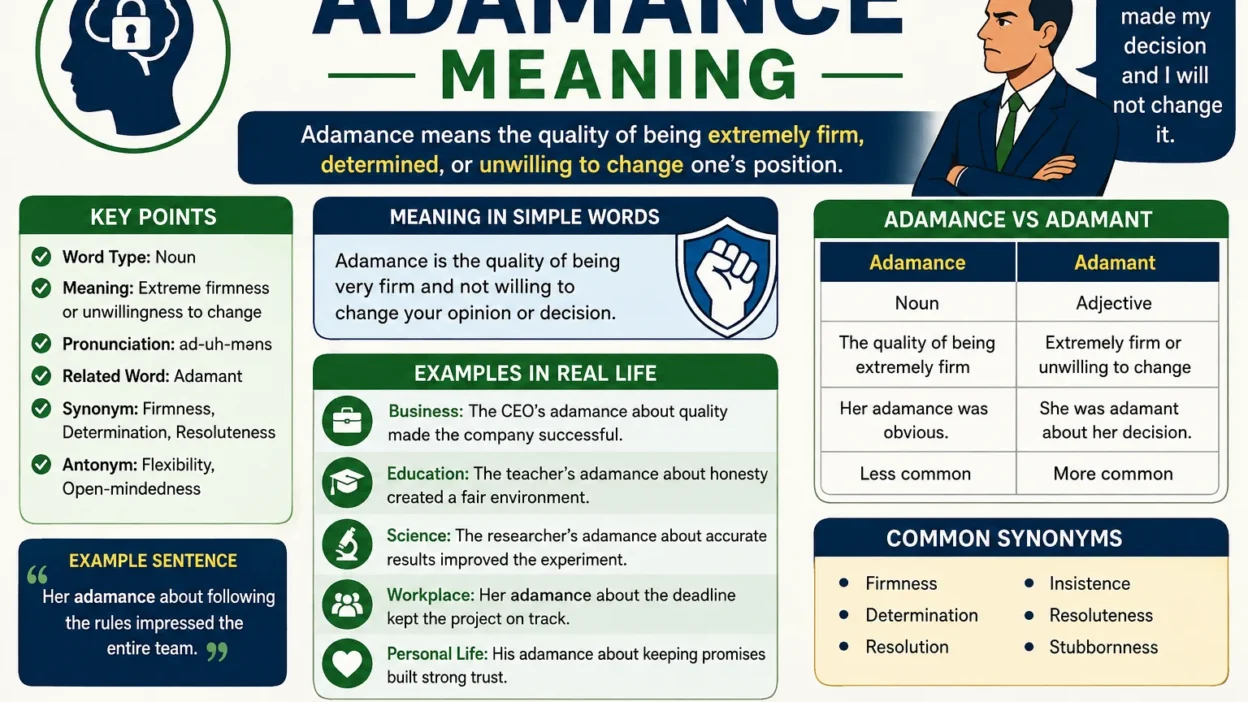
In simple terms, adamance means the quality of being extremely firm, determined, or unwilling to change your opinion or decision.
It describes strong persistence or stubborn firmness, especially when someone refuses to compromise.
Understanding adamance meaning can help you recognize the word in formal writing, literature, journalism, and discussions about strong opinions. Although the word is grammatically correct, it is much less common than adamancy or the phrase being adamant. Because of this, readers may wonder whether adamance is a spelling mistake or a legitimate word.
This guide explains its definition, pronunciation, usage, examples, related forms, and the difference between adamance and more familiar alternatives.
Quick Answer: What Does Adamance Mean?
Adamance means extreme firmness, determination, or refusal to change one’s position.
For example: Her adamance about following the safety rules impressed the entire team.
The word is correct but relatively uncommon; adamancy and being adamant are more common choices.
Adamance Meaning in Simple English
In simple English, adamance describes a person’s strong and unwavering attitude.
Someone showing adamance does not easily change their mind. They may strongly defend an opinion, decision, rule, or demand even when others disagree.
| Word | Simple meaning |
|---|---|
| Adamance | Strong firmness or determination |
| Adamant | Extremely firm or unwilling to change |
| Adamancy | The quality of being adamant |
| Stubbornness | Refusal to change, often negatively viewed |
| Determination | Strong commitment to achieving something |
The key idea behind adamance is firmness that is difficult to change.
What Is the Definition of Adamance?
The definition of adamance is the quality or state of being adamant.
It refers to an unwavering attitude in which a person strongly maintains a position, decision, belief, or demand.
A dictionary-style definition would be:
Adamance: the quality of being extremely firm, resolute, or unwilling to change one’s position.
For example:
Her adamance surprised everyone at the meeting.
This means that she remained extremely firm about her position.
Adamance vs Adamant: What Is the Difference?
One of the easiest ways to understand adamance meaning is to compare it with adamant.
Adamant is primarily an adjective, while adamance is a noun.
| Word | Part of speech | Meaning | Example |
|---|---|---|---|
| Adamance | Noun | Extreme firmness | His adamance was obvious. |
| Adamant | Adjective | Extremely firm | He was adamant about his decision. |
| Adamancy | Noun | The quality of being adamant | Her adamancy caused disagreement. |
Compare these sentences:
- She was adamant about leaving.
- Her adamance about leaving surprised us.
The first sentence describes her attitude. The second names the quality of that attitude.
Adamance vs Adamancy
The words adamance and adamancy have essentially the same basic meaning.
Both can refer to extreme firmness or determination.
However, adamancy is generally more familiar and commonly used in modern English. Adamance is legitimate but relatively uncommon.
| Feature | Adamance | Adamancy |
|---|---|---|
| Meaning | Extreme firmness | Extreme firmness |
| Part of speech | Noun | Noun |
| Commonness | Less common | More common |
| Formal usage | Possible | Commonly accepted |
| Everyday usage | Rare | Uncommon but recognizable |
| Related adjective | Adamant | Adamant |
If you want the most natural wording in everyday writing, adamancy or being adamant will often sound more familiar.
How to Use Adamance in a Sentence
Adamance usually functions as a noun.
It can appear after possessive words such as his, her, their, or the.
Examples include:
- His adamance about the policy surprised his colleagues.
- Her adamance prevented the team from reaching an agreement.
- The manager’s adamance about quality standards was well known.
- Their adamance eventually forced the company to reconsider its proposal.
- The student’s adamance about completing the project independently impressed the teacher.
The noun commonly refers to a person’s attitude toward a particular matter.
Real-Life Examples of Adamance
The word can describe firmness in many situations.
Business Example
The CEO’s adamance about maintaining product quality prevented the company from using cheaper materials.
Here, adamance describes the CEO’s unwillingness to compromise on quality.
Education Example
The professor’s adamance about academic honesty helped create a fair classroom environment.
The professor remains firmly committed to the rule.
Science Example
The researcher’s adamance about verifying the results led the team to repeat the experiment.
In this context, the firmness is connected to careful scientific standards.
Workplace Example
Her adamance about meeting the deadline kept the project moving forward.
The person refuses to abandon the agreed schedule.
Personal Life Example
His adamance about keeping the promise showed how seriously he valued trust.
The word emphasizes strong commitment.
Adamance in Professional and Industry Usage
Although adamance is not one of the most frequently used English nouns, it can appear in formal contexts.
| Industry | Example | Meaning |
|---|---|---|
| Business | His adamance about quality was clear. | Strong commitment |
| Education | Her adamance about fairness was respected. | Firm position |
| Law | The witness showed adamance in maintaining the statement. | Unwavering position |
| Science | Their adamance about accurate testing was beneficial. | Firm commitment to accuracy |
| Management | His adamance about deadlines affected the project. | Strong insistence |
| Politics | The leader’s adamance created disagreement. | Unwillingness to compromise |
In professional writing, however, firmness, determination, insistence, or adamancy may sometimes sound more natural.
Grammar Forms Related to Adamance
Understanding the related forms makes the word easier to use.
| Word | Part of speech | Example |
|---|---|---|
| Adamant | Adjective | She is adamant about the decision. |
| Adamance | Noun | Her adamance was noticeable. |
| Adamancy | Noun | His adamancy caused tension. |
| Adamantly | Adverb | He adamantly refused the offer. |
There is no commonly used verb adamance.
Instead, English normally uses phrases such as remain adamant, insist, or refuse to compromise.
Adamance Pronunciation
Adamance is generally pronounced approximately as:
AD-uh-məns
It can be broken into three parts:
- AD
- uh
- mance
The pronunciation is closely related to adamant, but the noun ending changes the sound.
Why Do People Confuse Adamance?
People may hesitate over adamance for several reasons.
First, adamant is much more familiar. Most English speakers encounter phrases such as she was adamant far more often than her adamance.
Second, adamancy is another noun formed from adamant, and it is more commonly recognized than adamance.
Third, the spelling can look unusual. Readers may wonder whether adamance is a typo.
| Common confusion | Correct understanding |
|---|---|
| Adamance is a typo | It is a valid noun |
| Adamance and adamant are interchangeable | They have different grammatical roles |
| Adamance means simple confidence | It implies strong firmness |
| Adamance always means positive determination | It can have a negative sense of stubbornness |
| Adamancy and adamance are completely different | They have essentially the same meaning |
Common Mistakes With Adamance
Because adamance is uncommon, it is easy to use it incorrectly.
Mistake 1: Using Adamance as an Adjective
❌ She is very adamance about the issue.
✅ She is very adamant about the issue.
Adamance is a noun, while adamant is an adjective.
Mistake 2: Using Adamance Instead of Adamantly
❌ He adamance refused the proposal.
✅ He adamantly refused the proposal.
The adverb is adamantly.
Mistake 3: Assuming It Means Confidence
❌ Her adamance means she feels confident about her abilities.
This may not accurately express the intended idea.
✅ Her adamance means she refuses to change her position.
Adamance focuses on firmness or unwillingness to change, not simply self-confidence.
Mistake 4: Overusing the Word
Because adamance is uncommon, using it repeatedly can make writing sound unnatural.
Instead, choose the word that best fits the context.
| If you mean… | Better choice |
|---|---|
| Strong refusal to change | Adamance / adamancy |
| Extremely firm | Adamant |
| Firm commitment | Determination |
| Strong demand | Insistence |
| Unreasonable refusal to change | Stubbornness |
Adamance: Positive or Negative Meaning?
Adamance can have either a positive or negative tone depending on the context.
It can suggest admirable determination:
Her adamance about protecting the environment inspired the organization.
But it can also suggest stubbornness:
His adamance prevented the two sides from reaching an agreement.
The surrounding context determines whether the firmness is viewed as admirable or unreasonable.
Adamance vs Determination
These words are related but not identical.
Determination usually emphasizes a person’s commitment to achieving a goal.
Adamance emphasizes firmness in a position, opinion, demand, or decision.
| Adamance | Determination |
|---|---|
| Firmness of position | Commitment to a goal |
| Often involves refusing to change | Often involves continuing despite difficulty |
| Can sound stubborn | Usually positive |
| Focuses on attitude | Focuses on persistence |
For example:
Her determination helped her finish the marathon.
But:
Her adamance about the route caused an argument.
Adamance vs Stubbornness
Adamance and stubbornness can overlap, but they have different tones.
Adamance is more formal and neutral. Stubbornness usually has a stronger negative meaning.
| Word | Typical tone | Main idea |
|---|---|---|
| Adamance | Neutral/formal | Extreme firmness |
| Stubbornness | Negative | Refusal to change |
| Determination | Positive | Persistence toward a goal |
| Insistence | Neutral | Strong demand or position |
For formal writing, adamance can sometimes describe firmness without directly accusing someone of being unreasonable.
A Simple Memory Trick for Adamance
Use this memory trick:
Adamance = Adamant + -ance
Think of:
Adamant → Adamance
The adjective adamant describes someone who is extremely firm.
The noun adamance names that quality.
For example:
He is adamant. → His adamance is obvious.
This simple transformation makes the word easier to remember.
Comparison Table: Adamance and Related Words
| Word | Grammar | Meaning | Example |
|---|---|---|---|
| Adamance | Noun | Extreme firmness | Her adamance was clear. |
| Adamancy | Noun | Extreme firmness | His adamancy caused conflict. |
| Adamant | Adjective | Extremely firm | He was adamant about it. |
| Adamantly | Adverb | In an extremely firm way | She adamantly refused. |
| Determination | Noun | Strong commitment | His determination helped him succeed. |
| Stubbornness | Noun | Refusal to change | Her stubbornness caused problems. |
| Insistence | Noun | Strong demand | His insistence was unusual. |
When Should You Use Adamance?
Use adamance when you specifically need a noun describing extreme firmness or an unwillingness to change.
It is most suitable in formal, analytical, literary, or descriptive writing.
For everyday conversation, however, phrases such as being adamant, strong determination, or firm insistence may sound more natural.
Practical Usage Guide
| Situation | Recommended wording |
|---|---|
| Everyday conversation | Being adamant |
| Formal writing | Adamance / adamancy |
| Describing an attitude | Adamance |
| Describing a person | Adamant |
| Describing an action | Adamantly |
| Describing positive persistence | Determination |
| Describing unreasonable firmness | Stubbornness |
10 Example Sentences With Adamance
Here are natural examples showing the adamance meaning in context:
- Her adamance about workplace safety earned everyone’s respect.
- His adamance made negotiations difficult.
- The teacher’s adamance about punctuality was well known.
- Their adamance about the original plan delayed the project.
- The manager admired her adamance when defending the team.
- His adamance about following the rules prevented a serious mistake.
- The politician’s adamance divided public opinion.
- Her adamance about completing the experiment carefully proved valuable.
- The customer’s adamance about receiving a refund frustrated the staff.
- Despite criticism, his adamance about the principle never changed.
How to Replace Adamance With More Common Words
Sometimes a simpler synonym produces more natural English.
| Original | Alternative |
|---|---|
| His adamance was surprising. | His firmness was surprising. |
| Her adamance caused problems. | Her stubbornness caused problems. |
| Their adamance about quality was admirable. | Their determination to maintain quality was admirable. |
| His adamance delayed negotiations. | His refusal to compromise delayed negotiations. |
Choosing the alternative depends on the exact meaning and tone you want.
Is Adamance a Correct English Word?
Yes. Adamance is a valid English noun meaning extreme firmness or the quality of being adamant.
However, its relative rarity can make it sound unusual to some readers.
If your goal is natural modern English, adamancy or being adamant may often be preferable. If you encounter adamance in formal or literary writing, it should not automatically be treated as a spelling error.
FAQs About Adamance Meaning
What does adamance mean?
Adamance means extreme firmness, determination, or unwillingness to change one’s position or decision.
Is adamance a real word?
Yes. Adamance is a valid noun, although it is less common than adamancy and adamant.
Is adamance the same as adamancy?
They have essentially the same meaning. Adamancy is generally the more familiar and commonly used noun.
What is the adjective form of adamance?
The related adjective is adamant, meaning extremely firm or unwilling to change.
Is adamance positive or negative?
It can be either. It may describe admirable determination or unreasonable stubbornness depending on the context.
What is a simple synonym for adamance?
Depending on context, synonyms include firmness, determination, insistence, resoluteness, and stubbornness.
Conclusion: Adamance Meaning and Usage Rule
The simplest adamance meaning is extreme firmness or the quality of being unwilling to change a position. It is the noun related to adamant, while adamantly is the adverb.
Although adamance is correct, it is relatively uncommon in everyday English.
Adamancy and the phrase being adamant are often more familiar choices. Use adamance when you need a formal noun describing someone’s unwavering firmness, and choose alternatives such as determination, insistence, or stubbornness when they express your intended meaning more precisely.