The confusion between checkup vs check up is common because these forms look almost identical but serve different grammatical purposes.
One is generally a noun referring to an examination or routine evaluation, while the other is a phrasal verb meaning to examine, inspect, or verify something.
Understanding the difference makes your writing clearer and helps you avoid common spelling and grammar mistakes.
In everyday English, checkup vs check up depends mainly on how the expression functions in a sentence.
You may schedule a medical checkup, but you may also ask a doctor to check up on a patient.
The distinction becomes especially useful in professional, medical, educational, and everyday communication.
This guide explains the meaning, usage, examples, grammar, common mistakes, and practical rules for choosing the correct form.
Quick Answer
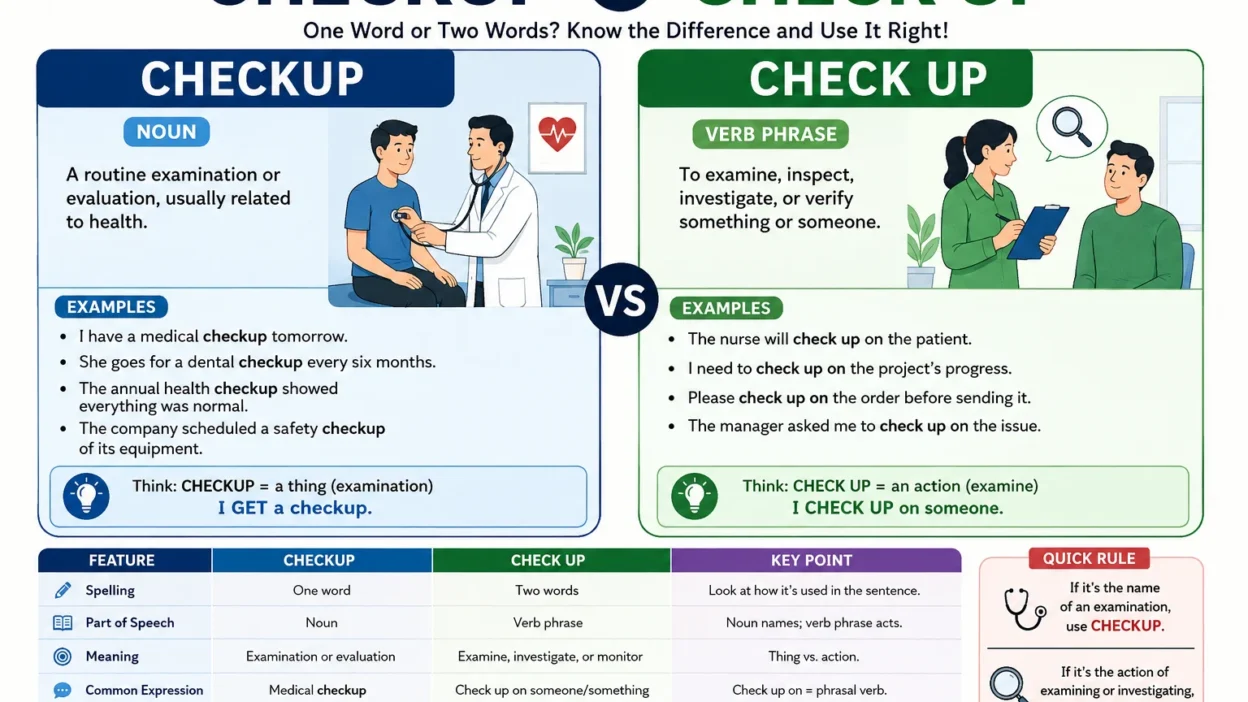
Checkup is usually a noun meaning a routine examination or evaluation.
Check up is usually part of a verb phrase, meaning to examine, inspect, or verify something.
- I have a medical checkup tomorrow.
- The doctor will check up on the patient tomorrow.
Checkup Meaning
Checkup is a noun that means a routine examination or inspection, especially one related to health.
The most common use is medical checkup, which refers to a routine visit to a doctor to assess someone’s health.
Examples
- I have a checkup with my doctor tomorrow.
- She goes for a dental checkup every six months.
- The annual health checkup showed that everything was normal.
- The company scheduled a safety checkup of its equipment.
The word can sometimes be used more broadly for a routine inspection or evaluation.
Check Up Meaning
Check up functions as a verb phrase. It means to examine, investigate, verify, or make sure that something is correct or functioning properly.
It is often followed by on when referring to examining a person or situation.
Examples
- The nurse will check up on the patient.
- I need to check up on the project’s progress.
- Please check up on the order before sending it.
- The manager asked me to check up on the issue.
A useful related form is check up on, which means to investigate or monitor someone or something.
Checkup vs Check Up: Main Difference
The simplest way to remember the difference is grammatical:
| Form | Part of Speech | Meaning | Example |
|---|---|---|---|
| checkup | Noun | Routine examination | I have a checkup tomorrow. |
| check up | Verb phrase | Examine or investigate | I need to check up on him. |
| check up on | Phrasal verb | Investigate or monitor | She checked up on the patient. |
The important distinction is that checkup names an examination, while check up describes an action.
Checkup vs Check Up in Sentences
Compare these sentences:
I went to the doctor for a checkup.
Here, checkup is a noun. It names the medical examination.
The doctor will check up on me later.
Here, check up on is a verb phrase. It describes what the doctor will do.
Side-by-Side Examples
| Checkup | Check Up |
|---|---|
| I need a checkup. | I need to check up on the results. |
| Her checkup was routine. | The doctor checked up on her. |
| He scheduled a checkup. | Please check up on the patient. |
| My annual checkup is next week. | The nurse will check up on him. |
Is Checkup One Word?
Yes. Checkup is commonly written as one word when it is used as a noun.
For example:
- I have a doctor’s checkup tomorrow.
- She needs a routine checkup.
- His annual checkup went well.
However, when the expression functions as a verb, use two words:
- The doctor will check up on him.
- I need to check up on the report.
This noun-versus-verb distinction is the key to choosing between the two forms.
Is Check Up Two Words?
Yes. Check up is written as two words when it functions as a verb phrase.
It is especially common in the expression check up on.
Correct Examples
- I will check up on the situation.
- She went to check up on her children.
- The supervisor asked him to check up on the equipment.
- We should check up on the latest information.
Do not automatically use check up simply because the sentence describes an examination. Look at the grammatical role of the expression.
Grammar Forms of Checkup and Check Up
Understanding the grammatical forms makes the difference easier to remember.
| Form | Function | Example |
|---|---|---|
| checkup | Noun | The checkup was successful. |
| checkups | Plural noun | She has regular checkups. |
| check up | Verb phrase | I need to check up on this. |
| checks up | Present-tense verb | He checks up on the patients. |
| checked up | Past form | She checked up on the report. |
| checking up | -ing form | They are checking up on the problem. |
Important Note
The noun checkup can be pluralized:
The clinic offers annual checkups.
The verb phrase changes according to tense:
She checked up on the patient.
Medical Usage of Checkup vs Check Up
Healthcare is where checkup is especially common.
A checkup usually refers to a routine medical examination.
Medical Examples
- I have a doctor’s checkup on Friday.
- The child needs a routine checkup.
- My annual health checkup is coming up.
- The dentist recommended a regular dental checkup.
By contrast, check up on refers to the action of examining or monitoring someone.
- The doctor will check up on the patient later.
- The nurse checked up on the referring patient.
- The physician asked the staff to check up on him.
Business and Workplace Usage
Both forms can appear in professional settings, although their meanings remain different.
Checkup in Business
A company might conduct a routine evaluation or inspection.
- The manager scheduled a financial checkup.
- The system needs a regular security checkup.
- We completed a safety checkup of the office.
Check Up in Business
The verb phrase describes investigating or verifying something.
- Please check up on the supplier.
- I will check up on the shipment.
- The manager asked me to check up on the complaint.
| Context | Checkup Example | Check Up Example |
|---|---|---|
| Business | A financial checkup | Check up on the supplier |
| Healthcare | A medical checkup | Check up on the patient |
| Technology | A system checkup | Check up on the server |
| Education | A progress checkup | Check up on the student’s work |
| Safety | A safety checkup | Check up on the equipment |
Education and School Examples
In education, checkup can describe a routine evaluation or review.
- The teacher conducted a progress checkup.
- Students received a learning checkup.
- The school completed a safety checkup.
Check up can describe the action of investigating or verifying something.
- The teacher will check up on the students.
- The principal asked the staff to check up on the issue.
- I need to check up on my assignment status.
Science and Technical Usage
Technical fields often use words such as inspection, assessment, diagnostic check, and evaluation, but checkup can still appear in less formal contexts.
Examples
- The machine needs a routine checkup.
- Engineers performed a safety checkup.
- The technician will check up on the equipment.
- Researchers checked up on the test results.
In highly technical writing, more precise terms such as inspection, diagnostic assessment, or system evaluation may be preferable depending on the context.
Common Mistakes With Checkup vs Check Up
Because the forms sound the same, writers sometimes use the wrong spelling.
Mistake 1: Using “check up” as a noun
❌ I have a medical check up tomorrow.
✅ I have a medical checkup tomorrow.
Here, the expression is a noun, so checkup is normally written as one word.
Mistake 2: Using “checkup” as a verb
❌ I need to checkup on the patient.
✅ I need to check up on the patient.
Here, the expression is a verb phrase, so it is written as separate words.
Mistake 3: Confusing “checkup” with “check up on”
❌ The doctor scheduled a check up on Monday.
✅ The doctor scheduled a checkup on Monday.
But:
✅ The doctor will check up on the patient on Monday.
Correct vs Incorrect Sentences
| Incorrect | Correct |
|---|---|
| I need a check up. | I need a checkup. |
| She had a medical check up. | She had a medical checkup. |
| I will checkup on him. | I will check up on him. |
| The doctor checked up the patient. | The doctor checked up on the patient. |
| He scheduled a routine check up. | He scheduled a routine checkup. |
Why Do People Confuse Checkup and Check Up?
The confusion happens because the two forms have identical pronunciation and closely related meanings.
Both are connected with the idea of examining or verifying something. English also frequently changes compound phrases between open, hyphenated, and closed forms as their usage develops.
The easiest solution is to focus on the grammatical role rather than pronunciation.
Ask yourself:
Am I naming an examination?
If yes, checkup is usually correct.
Am I describing an action of examining or investigating?
If yes, use check up, often followed by on.
Memory Trick for Checkup vs Check Up
Use this simple trick:
Checkup = a thing.
Check up = an action.
Think:
Another quick memory rule is:
One word = noun.
Two words = verb phrase.
This is not a universal rule for every English compound, but it works very well for this pair.
Checkup vs Check Up Comparison Table
| Feature | Checkup | Check Up |
|---|---|---|
| Spelling | One word | Two words |
| Main role | Noun | Verb phrase |
| Basic meaning | Examination | Examine/investigate |
| Common expression | Medical checkup | Check up on someone |
| Plural | Checkups | Not applicable as a noun |
| Past form | Not applicable | Checked up |
| -ing form | Not applicable | Checking up |
| Example | I need a checkup. | I need to check up on him. |
Professional and Industry Usage
Different industries use these expressions in slightly different ways.
| Industry | Checkup Usage | Check Up Usage |
|---|---|---|
| Medicine | Routine medical checkup | Check up on a patient |
| Dentistry | Dental checkup | Check up on a patient’s condition |
| Business | Financial checkup | Check up on a client |
| Technology | System checkup | Check up on a server |
| Education | Student progress checkup | Check up on student work |
| Maintenance | Equipment checkup | Check up on equipment |
| Safety | Safety checkup | Check up on safety conditions |
In formal professional documents, always choose the wording that communicates the exact process. Terms such as inspection, audit, assessment, or evaluation may be more precise than checkup in some contexts.
Checkup vs Check Up: Practical Usage Guide
Use this decision process when you are unsure.
| Step | Question | Choice |
|---|---|---|
| 1 | Is it the name of an examination? | Checkup |
| 2 | Does it describe an action? | Check up |
| 3 | Is it followed by “on” and means monitor/investigate? | Check up on |
| 4 | Can you replace it with “examination”? | Usually checkup |
| 5 | Can you replace it with “investigate” or “monitor”? | Usually check up on |
Real-Life Examples
At the Doctor
I have a checkup with my doctor tomorrow.
The word names the medical appointment or examination.
The doctor will check up on me after the procedure.
Here, the phrase describes the doctor’s action.
At Work
Our equipment needs a regular checkup.
This refers to an inspection.
I will check up on the equipment before the meeting.
This describes an action.
At School
The students had a progress checkup.
The word refers to an evaluation.
The teacher will check up on their assignments.
The phrase describes an action of monitoring or verifying.
Checkup vs Check Up in American and British English
Both American and British English use checkup as a noun and check up as a verb phrase.
You may also encounter check-up, particularly in British English or older usage, especially as a noun.
For example:
She went for a medical check-up.
However, checkup is widely accepted, especially in American English.
When writing for a particular publication, organization, or audience, follow its preferred style guide consistently.
Can Checkup Be Used as a Verb?
In standard modern English, checkup is normally treated as a noun rather than the standard spelling of the verb phrase.
Use:
The doctor will check up on the patient.
rather than:
The doctor will checkup on the patient.
The two-word form is the safer and standard choice for the verb.
Is “Check Up” Always Followed by “On”?
Not always, although check up on is especially common.
When check up means investigate or verify information, the exact construction can depend on the sentence.
For example:
I need to check up on the report.
However, in many everyday situations involving a person, check up on is the natural expression.
FAQs About Checkup vs Check Up
Is checkup one word or two?
Checkup is normally one word when used as a noun meaning an examination or routine evaluation.
Is “medical checkup” correct?
Yes. Medical checkup is a standard expression for a routine medical examination.
Is “check up on” correct?
Yes. Check up on is a phrasal verb meaning to investigate, monitor, or make sure that someone or something is okay.
Which is correct: “checkup” or “check up”?
Both can be correct, depending on grammar. Use checkup as a noun and check up as a verb phrase.
Can I write “doctor check up”?
Usually, doctor’s checkup or medical checkup is more natural when referring to the examination.
What is the easiest way to remember the difference?
Remember: checkup = thing/examination, while check up = action.
Final Comparison: Checkup vs Check Up
The difference between checkup vs check up is mainly grammatical. Checkup is a noun that refers to an examination, inspection, or routine evaluation. Check up is a verb phrase describing the action of examining, investigating, or monitoring something, especially in the expression check up on.
The easiest rule is simple: if you can use the word as the name of an examination, choose checkup. If you are describing someone examining or investigating something, choose check up.
For example, you can have a checkup, but you check up on someone. Once you remember this noun-versus-verb distinction, choosing the correct form becomes much easier.

Julian Wyatt is a passionate researcher and writer who explores symbols, mythology, cultural traditions, and hidden meanings. Through engaging articles, he helps readers uncover the fascinating stories and significance behind symbols worldwide.