Understanding verb root meaning is one of the easiest ways to improve your English grammar and vocabulary.
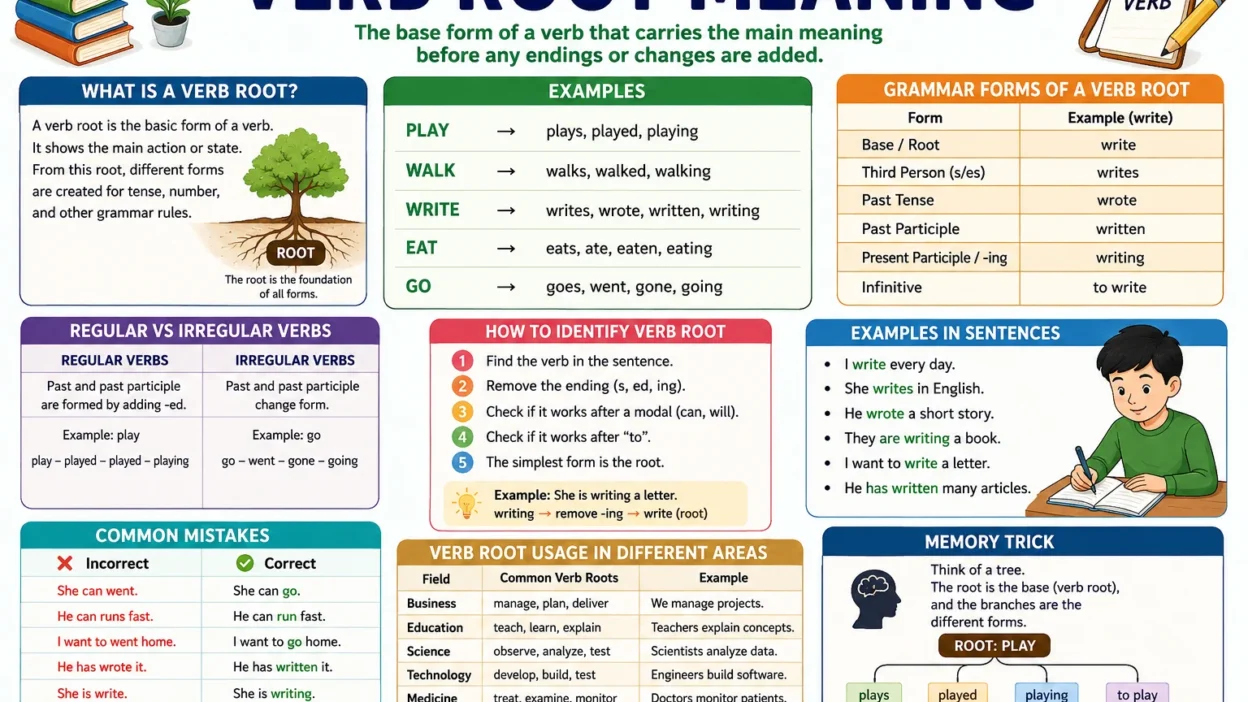
A verb root is the basic form of a verb before endings, prefixes, or tense markers are added. For example, play is the root of plays, played, and playing.
However, learners often confuse the root verb with the infinitive, base form, or conjugated form, especially when studying English verb forms.
The verb root meaning becomes especially useful when learning irregular verbs, forming different tenses, understanding word families, and analyzing how verbs change in sentences.
Once you know the root, it becomes easier to recognize related forms and understand how a verb functions.
In this guide, we will explain the meaning, differences, examples, grammar forms, common mistakes, and practical usage of verb roots in simple English.
Quick Answer: What Is Verb Root Meaning?
Verb root meaning refers to the basic meaning and original form of a verb before grammatical endings or other changes are added.
For example:
- walk → walks, walked, walking
- write → writes, wrote, written, writing
- eat → eats, ate, eaten, eating
The root generally carries the central meaning of the action or state.
What Is a Verb Root?
A verb root is the fundamental part of a verb that carries its core lexical meaning. It is the starting point from which different grammatical forms can develop.
For example, consider the verb help:
- help
- helps
- helped
- helping
The word help represents the basic verb form and carries the main idea of providing assistance.
In many English-learning contexts, people use “verb root” to refer to the simplest form of a verb. Technically, the concept of a root can be more complex because some English words contain prefixes, suffixes, or historical roots.
Simple Definition
A verb root is the basic element that expresses the main meaning of a verb.
Understanding this definition makes it easier to recognize different forms of the same verb.
Verb Root Meaning vs Base Form
The terms verb root and base form are closely related, but they are not always exactly the same in linguistic analysis.
In everyday English grammar teaching, the two terms are often used interchangeably. The base form is the form listed in a dictionary and is commonly used without tense endings.
For example:
| Verb | Common Base Form | Other Forms |
|---|---|---|
| work | work | works, worked, working |
| talk | talk | talks, talked, talking |
| run | run | runs, ran, running |
| write | write | writes, wrote, written |
| see | see | sees, saw, seen |
The important point is that the base form usually represents the simplest grammatical form of the verb.
Verb Root vs Infinitive
Another common source of confusion is the difference between a verb root and an infinitive.
An infinitive often consists of to + base verb:
- to walk
- to read
- to write
- to understand
The word after to is the base form of the verb.
| Form | Example | Explanation |
|---|---|---|
| Root/Base | walk | Basic verb form |
| Infinitive | to walk | “To” + base verb |
| Present | walks | Third-person singular |
| Past | walked | Past tense |
| -ing form | walking | Present participle/gerund |
Therefore, to walk is an infinitive, while walk is the base form commonly associated with the verb root.
How Does a Verb Root Work?
A verb root provides the central meaning from which other forms are created.
Take play:
play → plays → played → playing
Although the endings change, the central idea of the verb remains connected to the root play.
Another example is talk:
talk → talks → talked → talking
The grammatical form changes according to tense, subject, or function, but the basic meaning remains related to communication through speech.
Basic Verb Formation Process
| Step | Form | Example |
|---|---|---|
| 1 | Root/Base | play |
| 2 | Third-person form | plays |
| 3 | Past form | played |
| 4 | -ing form | playing |
| 5 | Infinitive | to play |
This pattern is particularly easy to see with regular verbs.
Verb Root Meaning With Regular Verbs
Regular verbs generally form their past tense and past participle by adding -ed or a related spelling variation.
For example:
- walk → walked
- clean → cleaned
- open → opened
- call → called
- jump → jumped
The root or base form remains easy to identify.
| Root/Base Verb | Past | Past Participle | -ing Form |
|---|---|---|---|
| walk | walked | walked | walking |
| clean | cleaned | cleaned | cleaning |
| open | opened | opened | opening |
| call | called | called | calling |
| jump | jumped | jumped | jumping |
Example Sentences
Walk:
I walk to school every morning.
Walked:
I walked to school yesterday.
Walking:
She is walking to school now.
All three forms are connected to the same central verb meaning.
Verb Root Meaning With Irregular Verbs
Irregular verbs are more challenging because their past forms do not consistently use -ed.
Consider go:
- go
- goes
- went
- gone
- going
The past form went looks completely different from go. Nevertheless, these forms belong to the same verb.
| Root/Base | Past | Past Participle | -ing Form |
|---|---|---|---|
| go | went | gone | going |
| eat | ate | eaten | eating |
| write | wrote | written | writing |
| see | saw | seen | seeing |
| take | took | taken | taking |
This is why learning verb roots is particularly useful when memorizing irregular verbs.
Verb Root Meaning in Different Grammar Forms
A single verb can appear in several grammatical forms.
For example, the verb write can appear as:
- write
- writes
- wrote
- written
- writing
- to write
The meaning is connected, but the grammatical function changes.
Grammar Forms Table
| Grammar Form | Example | Sentence |
|---|---|---|
| Base/root | write | I write every day. |
| Third-person singular | writes | She writes every day. |
| Simple past | wrote | He wrote a letter. |
| Past participle | written | The letter was written yesterday. |
| Present participle | writing | She is writing now. |
| Infinitive | to write | I want to write. |
Learning these forms as a group can make English grammar much easier.
Verb Root Examples in Everyday English
Verb roots appear in almost every English sentence because verbs express actions, events, conditions, and states.
Here are some everyday examples:
Eat
Root: eat
- I eat breakfast early.
- She eats breakfast at seven.
- We ate breakfast together.
- They are eating breakfast.
Drive
Root: drive
- I drive to work.
- He drives carefully.
- She drove home.
- They are driving to the office.
Read
Root: read
- I read books.
- She reads every night.
- He read the report.
- They are reading the article.
Build
Root: build
- They build houses.
- The company builds software.
- Workers built the bridge.
- Engineers are building a new system.
Verb Root Meaning in Business and Professional English
Understanding verb roots is useful in professional writing because many business verbs appear in multiple forms.
For example, manage can become:
- manages
- managed
- managing
- to manage
Consider these examples:
Base/root:
Managers need to manage resources effectively.
Third person:
She manages the sales team.
Past:
He managed the project last year.
-ing form:
They are managing several projects.
| Business Verb Root | Example Usage |
|---|---|
| manage | manage a team |
| develop | develop a strategy |
| analyze | analyze data |
| create | create a plan |
| improve | improve performance |
| negotiate | negotiate a contract |
| deliver | deliver results |
Knowing the root makes it easier to recognize these verbs across different professional contexts.
Verb Root Meaning in Education
Verb roots are also important in education because students must understand how verbs change according to tense and sentence structure.
For example:
learn → learns → learned → learning
Examples:
- Students learn new concepts.
- She learns quickly.
- They learned the lesson yesterday.
- The students are learning grammar.
Teachers often introduce verbs using the base form first because it is easier to identify the connection between different forms.
Verb Root Meaning in Science
Scientific writing frequently uses verbs in different grammatical forms.
Consider the root observe:
- Scientists observe changes.
- The researcher observed the reaction.
- The team is observing the experiment.
- The results were observed carefully.
Other common scientific verb roots include:
| Verb Root | Scientific Example |
|---|---|
| measure | Scientists measure temperature. |
| observe | Researchers observe behavior. |
| analyze | Scientists analyze samples. |
| test | Researchers test the hypothesis. |
| compare | Scientists compare results. |
| calculate | Engineers calculate the value. |
Recognizing the root makes scientific vocabulary easier to understand.
Common Verb Root Mistakes
Learners sometimes make mistakes because they use the wrong verb form after auxiliary verbs or modal verbs.
Mistake 1: Using the Past Form After a Modal
Incorrect:
She can went to the store.
Correct:
She can go to the store.
After a modal such as can, use the base/root form.
Mistake 2: Using “-s” After a Modal
Incorrect:
He can runs fast.
Correct:
He can run fast.
Mistake 3: Using the Wrong Form After “to”
Incorrect:
I want to went home.
Correct:
I want to go home.
Mistake 4: Confusing Past and P
Common Mistakes Table
| Incorrect | Correct | Reason |
|---|---|---|
| He can goes. | He can go. | Modal + base verb |
| She will went. | She will go. | “Will” + base verb |
| I want to went. | I want to go. | “To” + base verb |
| He has wrote it. | He has written it. | Have + past participle |
| She is write. | She is writing. | Be + -ing form |
Why Do People Confuse Verb Roots and Other Forms?
People often confuse verb roots because English verbs can have several forms that look similar but perform different grammatical functions.
For example:
write → writes → wrote → written → writing
A learner may know the meaning of write but struggle to identify which form is needed in a particular sentence.
Another reason is that irregular verbs do not always preserve the same spelling.
For example:
go → went → gone
The relationship is obvious to native speakers but can be difficult for English learners.
The best approach is to learn verbs as complete families rather than memorizing one form in isolation.
A Simple Way to Identify the Verb Root
You can usually identify the root or base form by asking:
- What is the simplest form of the verb?
- Can the verb follow a modal such as can?
- Can it follow to in an infinitive?
- What form appears in a dictionary?
- Which part carries the main lexical meaning?
For example:
She can write.
The verb after can is write, which is the base form.
I want to write.
The verb after to is write, again showing the base form.
Identification Process
| Step | Question | Example |
|---|---|---|
| 1 | Find the verb | She writes quickly. |
| 2 | Remove grammatical ending | write |
| 3 | Check the basic meaning | Produce written words |
| 4 | Compare related forms | wrote, written, writing |
| 5 | Identify the base/root | write |
Memory Trick for Verb Roots
A simple memory trick is:
Think of a tree.
The root is the foundation, while the branches represent different grammatical forms.
For example:
ROOT: PLAY
Branches:
- plays
- played
- playing
- to play
Another useful trick is:
For many regular verbs, removing endings such as -s, -ed, or -ing can help you recognize the basic form.
However, this trick does not always work perfectly with spelling changes or irregular verbs.
Verb Root vs Base Verb vs Main Verb
These terms are related but should not always be treated as identical.
| Term | Meaning | Example |
|---|---|---|
| Verb root | Core lexical element | play |
| Base verb | Basic grammatical form | play |
| Main verb | Verb carrying the main action/state | play |
| Infinitive | to + base verb | to play |
| Conjugated verb | Verb changed for grammar | plays |
In ordinary English-learning materials, root verb and base verb are often used in similar ways. In more advanced linguistics, however, “root” can refer to a deeper morphological element.
Verb Root Meaning and Auxiliary Verbs
Auxiliary verbs can help determine which form of a verb should be used.
After modal auxiliaries, use the base form:
- can go
- will work
- should study
- must leave
- may arrive
After have, use the past participle:
- has gone
- have written
- had eaten
- has finished
After forms of be for continuous tenses, use the -ing form:
- is working
- are studying
- was running
- were talking
Auxiliary Verb Pattern Table
| Auxiliary | Verb Form | Example |
|---|---|---|
| can | Base | can go |
| will | Base | will work |
| should | Base | should study |
| have | Past participle | have eaten |
| has | Past participle | has written |
| had | Past participle | had gone |
| is | -ing | is working |
| are | -ing | are studying |
| was | -ing | was running |
This is one of the most practical reasons to understand verb roots and verb forms.
Verb Root Usage in Different Industries
Verb roots are not limited to classroom grammar. They are used throughout professional communication.
| Industry | Common Verb Roots | Example |
|---|---|---|
| Business | manage, sell, plan | We plan the project. |
| Technology | develop, build, test | Engineers test the software. |
| Medicine | examine, treat, monitor | Doctors monitor patients. |
| Education | teach, learn, explain | Teachers explain concepts. |
| Science | observe, measure, analyze | Researchers analyze data. |
| Finance | invest, calculate, report | Analysts calculate costs. |
| Marketing | promote, target, create | Teams create campaigns. |
Using the correct verb form is especially important in reports, emails, presentations, and technical documents.
Real-Life Examples of Verb Roots
Example 1: Workplace
Root: manage
Sarah manages the customer service department.
The root/base form is manage, while manages is the third-person singular form.
Example 2: Education
Root: study
The central verb is study, but the grammatical form changes.
Example 3: Technology
Root: develop
Example 4: Science
Root: analyze
These examples show how the same root can appear in different forms depending on the sentence.
Verb Root Comparison Table
| Verb Root | Present | Past | Past Participle | -ing |
|---|---|---|---|---|
| work | works | worked | worked | working |
| go | goes | went | gone | going |
| eat | eats | ate | eaten | eating |
| write | writes | wrote | written | writing |
| speak | speaks | spoke | spoken | speaking |
| take | takes | took | taken | taking |
| see | sees | saw | seen | seeing |
| make | makes | made | made | making |
This table demonstrates why identifying the basic form is useful when learning verb families.
How to Learn Verb Roots Effectively
If you are learning English, avoid memorizing only one form of an irregular verb.
Instead, learn the major forms together.
For example:
take – took – taken – taking
Then create simple sentences:
- I take the bus.
- I took the bus yesterday.
- I have taken the bus before.
- I am taking the bus now.
This method connects vocabulary with grammar and makes the forms easier to remember.
Recommended Learning Process
| Step | What to Do |
|---|---|
| 1 | Learn the base/root |
| 2 | Learn the past form |
| 3 | Learn the past participle |
| 4 | Learn the -ing form |
| 5 | Create example sentences |
| 6 | Practice in different tenses |
| 7 | Review regularly |
Verb Root Meaning in Dictionaries
When you look up a verb in an English dictionary, you generally see its basic or citation form.
For example:
write
go
eat
speak
run
The dictionary entry normally represents the form from which learners can study the other forms.
This makes dictionary skills another useful part of learning verb roots.
Can a Verb Root Change Its Meaning?
The basic meaning of a verb can change or become more specific when prefixes, particles, or other elements are added.
For example:
- write
- rewrite
- underwrite
Similarly:
- take
- retake
- undertake
These words may be related historically or morphologically, but the resulting words can have different meanings.
Therefore, knowing the root helps you recognize relationships between words, but you should not automatically assume that every derived word has exactly the same meaning as its root.
Verb Roots and Phrasal Verbs
Phrasal verbs are another important area where the basic verb combines with another word.
For example:
look
- look up
- look after
- look into
- look for
- look at
The verb look has its own meaning, but the complete phrasal verb can have a different meaning.
Examples:
Understanding the basic verb can help learners recognize these expressions more easily.
Common Questions About Verb Root Meaning
Is the verb root the same as the base form?
In everyday English grammar, the terms are often used interchangeably. However, in advanced linguistics, a root can refer to a smaller lexical element than the grammatical base form.
What is the root of “walking”?
The base form is walk, and the -ing ending creates walking.
What is the root of “went”?
Went is the past-tense form of go. Because it is an irregular verb, the relationship is not visible from spelling alone.
What is the root verb of “written”?
The basic verb is write. Its major forms include write, wrote, written, and writing.
Why is knowing the verb root important?
It helps you understand verb forms, tenses, vocabulary families, sentence construction, and irregular verbs.
Is “to run” a verb root?
No. Run is the base form, while to run is the infinitive.
Verb Root Meaning: Key Rules to Remember
Keep these rules in mind:
- The verb root represents the central meaning of a verb.
- The base form is commonly used as the simplest grammatical form.
- The infinitive usually uses to + base verb.
- Modal verbs are followed by the base form.
- Perfect tenses use the past participle.
- Continuous tenses use the -ing form.
- Irregular verbs may change significantly in the past tense.
- Learning verb families is more effective than memorizing isolated forms.
Conclusion
Understanding verb root meaning makes English grammar easier because it helps you recognize the connection between different forms of the same verb.
A verb root or base form carries the central meaning, while endings and grammatical structures show tense, number, aspect, or function.
For example, write, writes, wrote, written, and writing are different forms connected to the same basic verb.
Regular verbs are often easier to identify, while irregular verbs require memorization and practice.
The simplest rule is: learn the basic verb first, then learn how its form changes in different grammatical situations.
Once you understand verb roots, you can build stronger vocabulary, use tenses more accurately, and write clearer English in everyday, academic, and professional situations.