If you have ever wondered about unorganized vs disorganized, you are not alone.
Both words describe a lack of order, structure, or arrangement, so they can seem interchangeable at first.
However, there is a subtle difference in how they are commonly used. Understanding that difference can help you choose the more natural word in writing and conversation.
Unorganized vs disorganized often depends on whether something simply lacks organization or if it is actively messy, chaotic, or poorly arranged. “Unorganized” usually describes something that has not been organized, while “disorganized” more strongly suggests that an existing system, arrangement, or process is ineffective or chaotic.
Knowing the context makes it easier to select the right word.
Quick Answer: Unorganized vs Disorganized
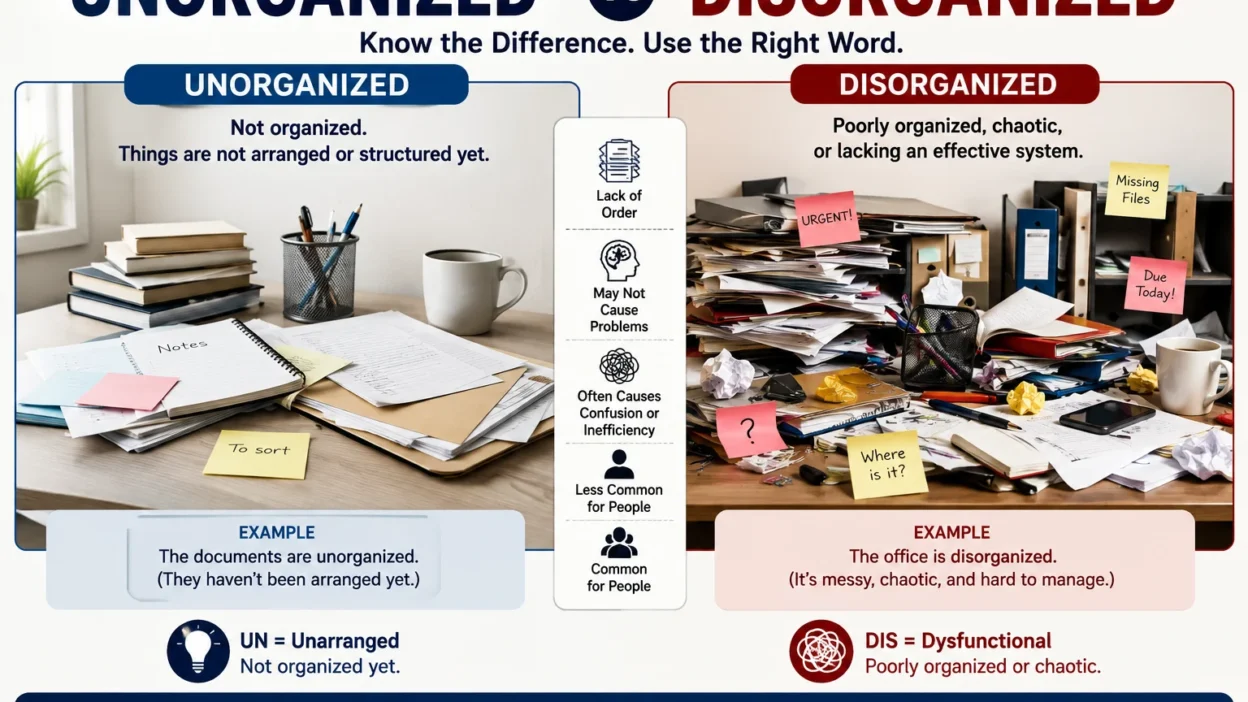
Unorganized generally means lacking organization or not having been arranged systematically.
Disorganized usually means poorly organized, chaotic, or lacking an effective system.
Both can be correct, but disorganized is often more natural when describing a person, workplace, process, or situation that is messy or inefficient.
What Does Unorganized Mean?
Unorganized means not organized, arranged, classified, or structured in a systematic way.
The word is formed from the prefix un- and the adjective organized. It can describe something that simply has not been put into order.
For example:
- The files are unorganized.
- The information remains unorganized.
- We received an unorganized collection of documents.
- The notes were completely unorganized.
The word does not necessarily imply that something is chaotic. It can simply mean that no organization has been applied yet.
Unorganized in a Sentence
The research data was unorganized, so the team created categories before analyzing it.
Here, unorganized means that the data had not yet been systematically arranged.
What Does Disorganized Mean?
Disorganized means poorly organized, chaotic, untidy, or lacking an effective system.
It can describe physical objects, people, schedules, businesses, projects, information, or processes.
Examples include:
- She is very disorganized at work.
- His desk is disorganized.
- The meeting was disorganized.
- The company has a disorganized management system.
- Their project became disorganized after the deadline changed.
Unlike unorganized, disorganized often suggests that the lack of organization causes problems or makes something difficult to manage.
Unorganized vs Disorganized: Main Difference
The easiest way to understand the difference is to think about absence versus poor organization.
Unorganized can mean something has not been organized.
Disorganized often means something is organized poorly or has become chaotic.
| Feature | Unorganized | Disorganized |
|---|---|---|
| Basic meaning | Not organized | Poorly organized |
| Suggests chaos | Not necessarily | Often |
| Suggests inefficiency | Sometimes | Frequently |
| Can describe people | Less common | Very common |
| Can describe objects | Yes | Yes |
| Can describe systems | Yes | Yes |
| Tone | Neutral | Often more negative |
| Example | Unorganized files | Disorganized office |
Simple Rule
This is a useful distinction, although the two words can overlap in everyday English.
Unorganized vs Disorganized Examples
Seeing the words in different contexts makes their difference clearer.
Example 1: Documents
Unorganized:
The documents were unorganized when we received them.
This means nobody had arranged them properly.
Disorganized:
The documents were disorganized, with duplicate files and missing records.
This suggests a messy or inefficient arrangement.
Example 2: A Desk
Unorganized:
My desk is unorganized because I have not sorted the papers yet.
Disorganized:
My desk is so disorganized that I cannot find anything.
The second sentence suggests that the lack of organization is causing a practical problem.
Example 3: A Meeting
Unorganized:
The meeting materials were unorganized.
Disorganized:
The meeting was disorganized and nobody knew what to discuss next.
The second example describes a broader failure of planning and coordination.
Unorganized vs Disorganized in Business
Both terms can appear in professional communication, but disorganized is usually more common when discussing management, employees, projects, and operations.
| Business Context | Natural Example |
|---|---|
| Files | The files were unorganized. |
| Management | The department was disorganized. |
| Project | The project became disorganized. |
| Records | The records were unorganized. |
| Workflow | The workflow was disorganized. |
| Employee | He is disorganized with deadlines. |
| Meeting | The meeting was disorganized. |
For professional writing, choose disorganized when you want to emphasize poor planning or inefficiency.
For example:
The department has a disorganized workflow that causes unnecessary delays.
Unorganized vs Disorganized in Education
Students, notes, assignments, classrooms, and study materials can all be described using these words.
Unorganized
Her study notes were unorganized, so she sorted them by subject.
Disorganized
His study routine is disorganized, and he frequently misses deadlines.
In the first example, the notes simply lack structure. In the second, the person’s system is ineffective.
Teachers might also say:
The research material is unorganized.
But:
The student’s project is disorganized.
The second statement often implies that the project needs significant improvement.
Unorganized vs Disorganized in Science and Research
Scientific writing often requires precise organization of data and information.
Unorganized data may simply be raw information that has not yet been categorized.
For example:
The researchers collected unorganized observations from several locations.
Once researchers attempt to structure that information but do so poorly, disorganized data may be an appropriate description.
| Situation | Better Choice |
|---|---|
| Raw information | Unorganized |
| Untagged observations | Unorganized |
| Poorly structured database | Disorganized |
| Confusing research process | Disorganized |
| Unsorted measurements | Unorganized |
| Inefficient laboratory workflow | Disorganized |
In technical contexts, the exact terminology can depend on the field, so terms such as unstructured, unordered, or poorly organized may sometimes be more precise.
Unorganized vs Disorganized for People
When describing a person’s habits or behavior, disorganized is generally the more natural choice.
For example:
Sarah is disorganized and often forgets appointments.
It would be less natural to say:
Sarah is unorganized and often forgets appointments.
Although unorganized is understandable, disorganized is the standard everyday choice for a person who struggles with planning, scheduling, or keeping things in order.
Common Expressions
- a disorganized person
- a disorganized employee
- a disorganized manager
- a disorganized student
- a disorganized household
- a disorganized schedule
Grammar Forms of Unorganized and Disorganized
Both words function primarily as adjectives.
| Word | Part of Speech | Example |
|---|---|---|
| organize | Verb | We organize the files. |
| organized | Adjective | The files are organized. |
| organizing | Present participle | She is organizing the files. |
| organization | Noun | The organization of the files helped. |
| unorganized | Adjective | The files are unorganized. |
| disorganized | Adjective | The files are disorganized. |
| disorganize | Verb | Poor planning can disorganize the team. |
| disorganization | Noun | Disorganization caused delays. |
Unorganized
The basic pattern is:
un- + organized = unorganized
Examples:
- unorganized information
- unorganized records
- unorganized materials
- unorganized notes
Disorganized
The pattern is:
dis- + organized = disorganized
Examples:
- disorganized employee
- disorganized office
- disorganized schedule
- disorganized process
When Should You Use Unorganized?
Use unorganized when you primarily mean that something has not been organized.
It works especially well when the thing is waiting to be sorted, classified, or arranged.
Examples:
- The papers are still unorganized.
- We have an unorganized list of customer names.
- The data was unorganized when the researchers received it.
- The photographs remain unorganized.
- His notes were unorganized but complete.
The focus is on the absence of organization.
When Should You Use Disorganized?
Use disorganized when you want to suggest that something is poorly arranged, chaotic, inefficient, or difficult to manage.
Examples:
- The office is disorganized.
- The manager is disorganized.
- Their schedule is disorganized.
- The project became disorganized.
- The company’s operations are disorganized.
The focus is on poor organization and its consequences.
Common Mistakes: Unorganized vs Disorganized
Because the meanings overlap, learners sometimes use these words in contexts where another choice sounds more natural.
| Incorrect or Less Natural | Better | Reason |
|---|---|---|
| She is very unorganized at work. | She is very disorganized at work. | Describes a person’s habits. |
| The meeting was unorganized and chaotic. | The meeting was disorganized and chaotic. | “Disorganized” fits chaos better. |
| My files are unorganized because I haven’t sorted them. | My files are unorganized because I haven’t sorted them. | This sentence is correct. |
| The raw data was disorganized before analysis. | The raw data was unorganized before analysis. | “Unorganized” can emphasize that it has not been arranged. |
| His schedule is unorganized and inefficient. | His schedule is disorganized and inefficient. | Poor functioning is emphasized. |
Mistake 1: Assuming They Are Always Identical
Although the words overlap, they can carry different shades of meaning.
Unorganized often describes a state.
Disorganized often describes a problematic state.
Mistake 2: Always Using “Unorganized”
For a person who cannot manage time or tasks effectively, disorganized is usually the better word.
She is disorganized.
This sounds more natural than:
She is unorganized.
Mistake 3: Treating “Disorganized” as Only Physical Mess
Disorganized can describe much more than a messy room.
It can refer to:
- thoughts
- schedules
- businesses
- projects
- meetings
- systems
- processes
- teams
- records
Why Do People Confuse Unorganized and Disorganized?
The confusion exists because both words contain organized, and both indicate a lack of effective organization.
The prefixes un- and dis- can also have similar negative meanings in some English words.
For example:
- organized → unorganized
- organized → disorganized
However, English prefixes do not always produce identical meanings. Un- commonly indicates the absence or opposite of a quality, while dis- can suggest reversal, separation, or a negative condition.
Therefore, the practical distinction is based largely on normal usage and context rather than simply translating the prefixes.
Memory Trick for Unorganized vs Disorganized
Use this simple memory trick:
UN = Unarranged
Think:
The organization may simply be missing.
DIS = Dysfunctional Organization
Think:
Something may be messy, chaotic, confusing, or inefficient.
| Memory Word | Meaning |
|---|---|
| UN = Unarranged | Not organized |
| DIS = Dysfunctional | Poorly organized |
This is not a strict dictionary rule for every sentence, but it is a useful way to remember the typical distinction.
Professional and Industry Usage
Different industries may favor one word depending on what they are describing.
| Industry | Common Context | Preferred Word |
|---|---|---|
| Business | Poor management | Disorganized |
| Education | Untidy notes | Unorganized |
| Project Management | Poor coordination | Disorganized |
| Research | Raw information | Unorganized |
| Administration | Inefficient procedures | Disorganized |
| Personal Productivity | Poor time management | Disorganized |
| Data Management | Unsorted data | Unorganized |
| Events | Poor planning | Disorganized |
In professional writing, clarity matters more than forcing a distinction between the two words.
If the meaning is simply “not arranged,” use unorganized.
If the meaning is “poorly arranged or chaotic,” use disorganized.
Comparison Table: Unorganized vs Disorganized
Here is a quick reference for the main differences.
| Question | Unorganized | Disorganized |
|---|---|---|
| Does it mean not organized? | Yes | Yes |
| Does it imply chaos? | Not necessarily | Often |
| Does it imply poor planning? | Sometimes | Often |
| Common for people? | Less common | Very common |
| Common for documents? | Yes | Yes |
| Common for systems? | Yes | Yes |
| Can it describe a messy situation? | Yes | Yes |
| Usually more negative? | Less so | More so |
| Best basic interpretation | Not arranged | Poorly arranged |
Step-by-Step Guide to Choosing the Right Word
When deciding between unorganized vs disorganized, ask these questions.
| Step | Question | If Yes |
|---|---|---|
| 1 | Has it simply not been arranged? | Use unorganized |
| 2 | Is the arrangement poor or ineffective? | Use disorganized |
| 3 | Are you describing a person’s habits? | Usually use disorganized |
| 4 | Is there confusion or chaos? | Usually use disorganized |
| 5 | Is something merely waiting to be sorted? | Usually use unorganized |
Example
Suppose you have 500 photographs in one folder.
If nobody has sorted them:
The photographs are unorganized.
If they are scattered across several folders with duplicates and confusing names:
The photographs are disorganized.
The distinction becomes clearer when you focus on the reason for the lack of order.
Are Unorganized and Disorganized Synonyms?
They can be synonyms in many contexts, but they are not always equally natural.
For example:
The files are unorganized.
and
The files are disorganized.
Both can mean that the files lack proper organization.
However, the second sentence may suggest that the filing system is messy or inefficient.
Similarly:
He is disorganized.
is much more idiomatic than:
He is unorganized.
when describing someone’s personal habits.
Unorganized vs Disorganized in Everyday English
In casual conversation, native speakers may use disorganized more frequently when discussing people and situations.
For example:
My room is disorganized.
I have a disorganized schedule.
The whole event was disorganized.
Unorganized is particularly useful when emphasizing that something has not yet been organized.
The information is still unorganized.
We received an unorganized collection of files.
This distinction is useful, but context always matters.
Frequently Asked Questions
Is unorganized or disorganized correct?
Both are correct words. Unorganized usually means not organized, while disorganized often means poorly organized, chaotic, or inefficient.
Is “unorganized” a real word?
Yes. Unorganized is a standard English adjective meaning not organized or not arranged systematically.
Is “disorganized” better than “unorganized”?
Not always. Use disorganized when describing poor or chaotic organization. Use unorganized when emphasizing that something simply has not been organized.
Can you describe a person as unorganized?
Yes, but disorganized is generally more natural when describing someone who has poor planning, time-management, or organizational habits.
What is the difference between unorganized and disorganized data?
Unorganized data can mean data that has not yet been sorted or structured. Disorganized data often suggests that the data is poorly arranged, confusing, or difficult to manage.
Are unorganized and disorganized interchangeable?
Sometimes. They overlap significantly, especially when describing objects or information. However, disorganized usually carries a stronger sense of poor organization or disorder.
Final Conclusion: Unorganized vs Disorganized
The main difference in unorganized vs disorganized is the degree and nature of the lack of organization.
Unorganized generally means that something has not been organized or arranged yet. Disorganized usually means that something is poorly organized, chaotic, confusing, or inefficient.
A simple rule is to remember “unorganized = not organized” and “disorganized = poorly organized.”
When describing a person’s habits, schedule, workplace, meeting, or management style, disorganized is usually the more natural choice.
When describing raw, unsorted, or not-yet-arranged material, unorganized often fits better.
Both words are grammatically correct, so the final choice depends on the context and the exact meaning you want to communicate.