
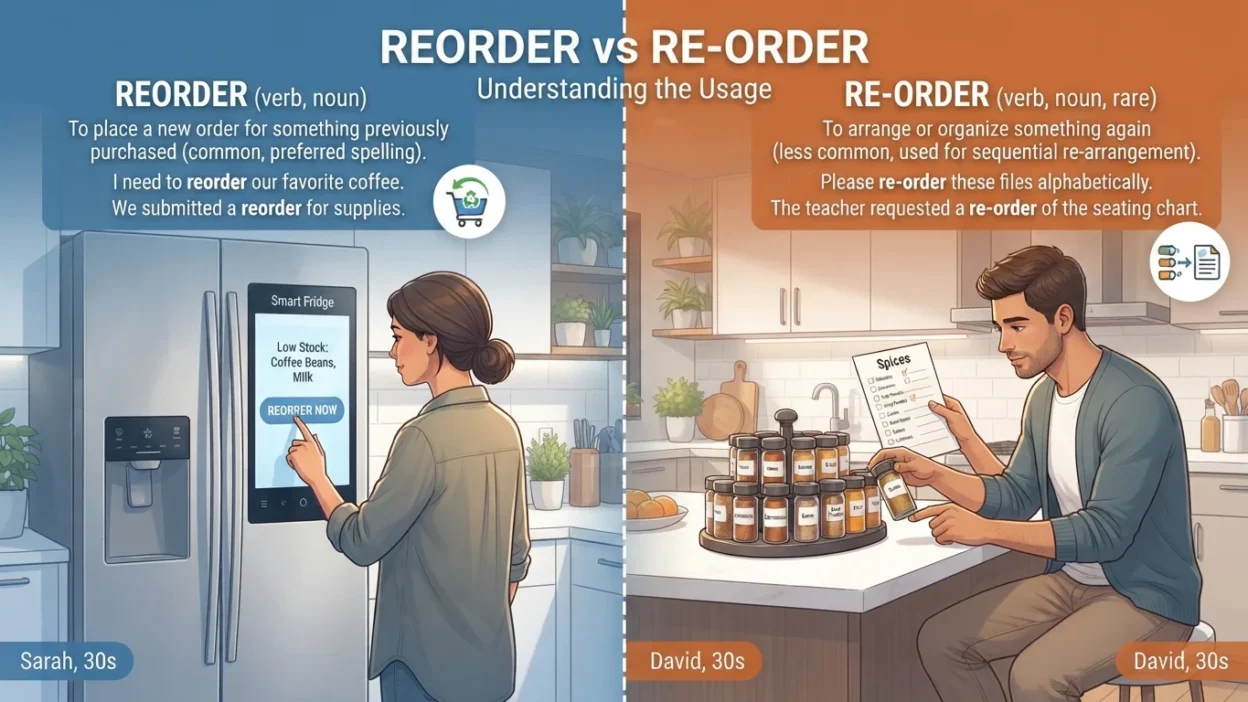
The reorder vs re order question often confuses English learners, writers, and professionals because both forms appear online.
However, only one spelling is considered standard in modern English in most situations. Understanding the difference helps you write more accurately in emails, business documents, academic papers, and everyday conversations.
If you’ve ever wondered whether to write reorder or re order, you’re not alone. This guide explains the reorder vs re order difference, their meaning, correct usage, grammar rules, real-life examples, and common mistakes. By the end, you’ll know exactly which form to use and why.
Quick Answer
Reorder is the standard and correct spelling in modern English when referring to ordering again or arranging something differently.
Re order is usually considered incorrect unless re is intentionally separated for stylistic or highly specialized editorial reasons.
What Does Reorder Mean?
Reorder is a verb that means:
- To order something again
- To arrange something in a different order
- To place another order for an item
It combines the prefix re- (meaning “again”) with the verb order.
Examples
- I need to reorder printer paper.
- The teacher asked students to reorder the paragraphs.
- We must reorder the product before it sells out.
What Does Re Order Mean?
Re order is generally not the standard spelling in modern English.
Most dictionaries and style guides recommend writing the word as one word: reorder.
Occasionally, someone may separate the prefix for emphasis or because of formatting rules, but this is uncommon.
Example (Rare)
- Please re order the files. (Generally better written as “reorder.”)
Reorder vs Re Order: Main Difference
| Feature | Reorder | Re Order |
|---|---|---|
| Standard spelling | ✅ Yes | ❌ Usually no |
| Dictionary entry | Yes | No |
| Business writing | Recommended | Not recommended |
| Academic writing | Recommended | Avoid |
| Everyday English | Correct | Rare |
| Professional communication | Preferred | Usually incorrect |
Why Do People Confuse Reorder and Re Order?
Several reasons cause confusion.
| Reason | Explanation |
|---|---|
| Prefix misunderstanding | Some people think re should always be separate. |
| Similar words | Words like “re-enter” contain a hyphen, creating confusion. |
| Online inconsistency | Some websites use non-standard spellings. |
| Auto-corrections | Certain editors may not immediately flag spacing errors. |
Grammar Rule Behind Reorder
The prefix re- usually joins directly to the base word.
Examples include:
| Prefix Word | Correct Form |
|---|---|
| Rewrite | ✅ One word |
| Rebuild | ✅ One word |
| Reorganize | ✅ One word |
| Reinstall | ✅ One word |
| Reorder | ✅ One word |
Only in special situations involving awkward pronunciation or ambiguity do writers use a hyphen.
Examples:
- re-enter
- re-elect
- re-examine
Since reorder creates no pronunciation problem, no space or hyphen is needed.
Grammar Forms of Reorder
| Form | Example |
|---|---|
| Base verb | reorder |
| Third person | reorders |
| Present participle | reordering |
| Past tense | reordered |
| Past participle | reordered |
| Noun | reorder |
| Adjective | reordered |
Example Sentences
- She reorders inventory weekly.
- We are reordering supplies.
- They reordered the seating arrangement.
- The books have been reordered alphabetically.
Reorder in Different Contexts
Business
Businesses frequently reorder inventory.
Example:
- The manager will reorder office supplies tomorrow.
Education
Teachers ask students to reorder information.
Example:
- Reorder the events from oldest to newest.
Science
Researchers may reorder data.
Example:
- The scientist reordered the variables for analysis.
Technology
Developers reorder menu items or code.
Example:
- Please reorder the navigation buttons.
Daily Life
People reorder products online.
Example:
- I’ll reorder my favorite coffee beans.
Industry Usage Table
| Industry | Example Usage |
|---|---|
| Retail | Reorder inventory |
| Healthcare | Reorder medication supplies |
| Manufacturing | Reorder raw materials |
| Education | Reorder lesson content |
| Software | Reorder menu options |
| Logistics | Reorder shipment priorities |
| Publishing | Reorder chapters |
| Banking | Reorder checkbooks |
Reordering Process
| Step | Action |
|---|---|
| 1 | Check current stock or arrangement |
| 2 | Decide what needs changing |
| 3 | Place another order or rearrange items |
| 4 | Confirm changes |
| 5 | Receive products or review new order |
Real-Life Examples of Reorder
Business
- We need to reorder printer cartridges before Friday.
- The warehouse automatically reorders popular products.
School
- Students should reorder these historical events.
- Please reorder the paragraphs logically.
Shopping
- I forgot to reorder my vitamins.
- Customers can reorder previous purchases with one click.
Healthcare
- The pharmacy will reorder the medicine tomorrow.
- Nurses reorder supplies every week.
Technology
- You can reorder the apps on your phone.
- Drag items to reorder the list.
Common Mistakes
Many writers incorrectly separate the prefix.
| Incorrect | Correct |
|---|---|
| Re order the files. | Reorder the files. |
| I need to re order coffee. | I need to reorder coffee. |
| We will re order supplies. | We will reorder supplies. |
| Please re order these paragraphs. | Please reorder these paragraphs. |
Correct vs Incorrect Sentences
Correct
- Please reorder the books.
- I need to reorder my prescription.
- They reordered the classroom seating.
Incorrect
- Please re order the books.
- I need to re order my prescription.
- They re ordered the classroom seating.
Memory Trick
Remember this simple rule:
If re- simply means again and creates no awkward pronunciation, write it as one word.
Think of these examples:
- Rewrite
- Rebuild
- Repaint
- Reinstall
- Reorder
If all these are one word, reorder should be too.
Reorder vs Re Order Comparison Table
| Question | Answer |
|---|---|
| Which spelling is correct? | Reorder |
| Which is standard English? | Reorder |
| Which appears in dictionaries? | Reorder |
| Which should you use in business writing? | Reorder |
| Is “re order” usually wrong? | Yes |
| Can “re order” ever appear? | Rarely, for special stylistic purposes |
Tips for Using Reorder Correctly
- Write reorder as one word.
- Don’t separate re and order.
- Use it for ordering again or arranging differently.
- Follow dictionary spelling.
- Proofread documents for spacing mistakes.
Frequently Asked Questions
Is reorder one word or two?
Reorder is one word and is the standard spelling.
Is re order ever correct?
Only in very rare editorial or stylistic situations. In normal writing, use reorder.
What does reorder mean?
It means to order again or arrange something into a different order.
Is reorder used in business English?
Yes. It is commonly used in inventory management, purchasing, logistics, and customer service.
How do I remember the correct spelling?
Think of similar words like rewrite, rebuild, and repaint. They all stay together, just like reorder.
People Also Ask
Is reorder a real word?
Yes. It is a recognized English word found in major dictionaries.
Can reorder be a noun?
Yes. In business, reorder can refer to a repeat purchase.
Example:
- The customer placed a reorder for the same product.
Does reorder only mean buying again?
No. It can also mean rearranging objects, information, or sequences into a different order.
Is “re-order” with a hyphen correct?
Generally, no. The preferred modern spelling is reorder without a hyphen.
Conclusion
Understanding reorder vs re order is simple once you know the grammar rule. Reorder is the correct and widely accepted spelling in modern English. It means either to order something again or arrange something differently. The separated form re order is generally considered incorrect and should be avoided in professional, academic, and everyday writing.
Whenever you’re unsure, remember that the prefix re- usually joins directly to the base word when no Cissue exists. Choosing reorder will keep your writing clear, accurate, and grammatically correct.