If you have ever wondered about say your peace vs say your piece, you are not alone.
These expressions sound exactly or nearly exactly alike in many accents, but only one is the standard idiom when you mean “express your opinion.”
The confusion comes from the homophones peace and piece. Although they have completely different meanings, they can be difficult to distinguish in spoken English.
This makes the phrase especially easy to misspell in texts, emails, social media posts, and casual writing.
Understanding say your peace vs say your piece is useful because choosing the wrong spelling can change the meaning or make an otherwise natural sentence look incorrect.
Say your piece is the established expression meaning to state your opinion, make your argument, or express what you want to say.
Say your peace is generally considered a mistaken spelling of that idiom, although the literal word “peace” has its own meanings.
In this guide, you’ll learn the difference, usage, examples, grammar, common mistakes, and an easy memory trick.
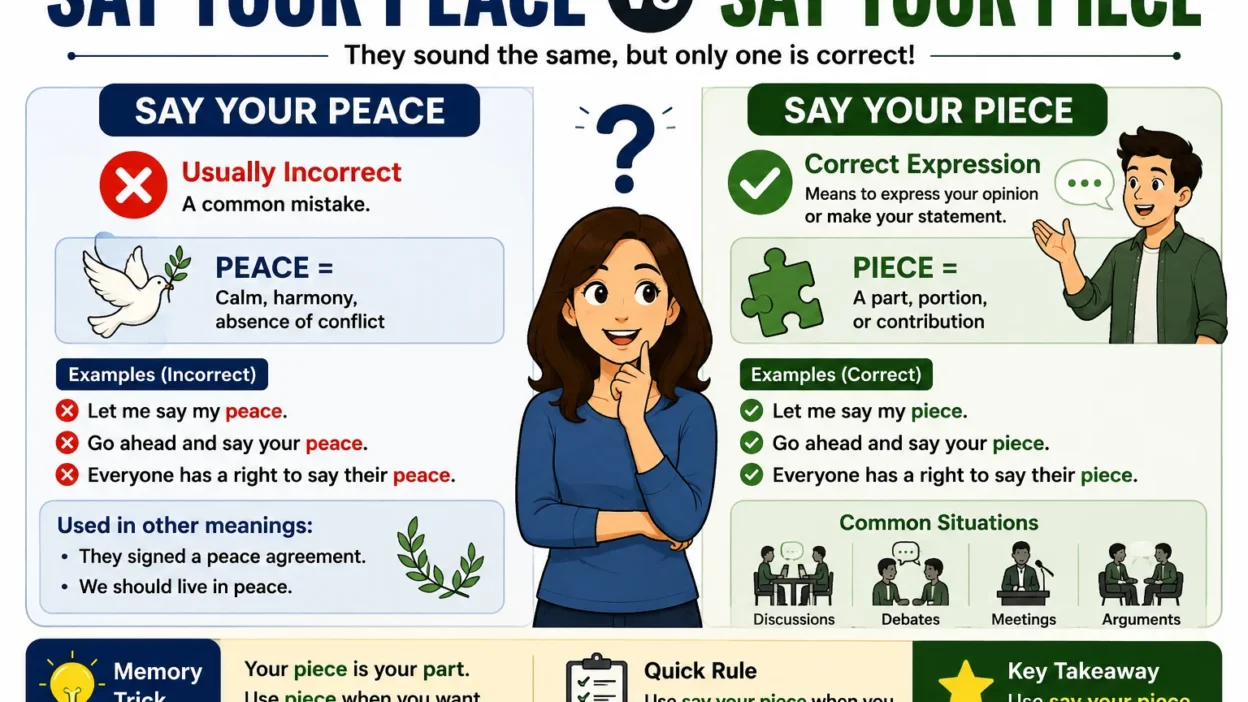
Quick Answer: Say Your Peace vs Say Your Piece
Say your piece is the correct expression when you mean “express your opinion” or “have your chance to speak.”
Say your peace is usually a misspelling caused by confusing the homophones peace and piece.
Memory trick: Your piece is the part of the conversation that you have to say.
What Does “Say Your Piece” Mean?
Say your piece is an idiomatic expression meaning to express your opinion, make your argument, or say what you want to say.
The phrase often suggests that someone has been given an opportunity to speak, particularly about an issue or disagreement.
For example:
Go ahead and say your piece. I’m listening.
This means, “Tell me what you think” or “Express your opinion.”
The phrase can be neutral, friendly, serious, or slightly impatient depending on the context and tone.
Examples of “Say Your Piece”
- I listened carefully while she said her piece.
- He wanted to say his piece before the meeting ended.
- You’ve had a chance to say your piece.
- Let me say my piece before you make a decision.
- She finally said her piece and left the room.
What Does “Say Your Peace” Mean?
Say your peace is generally not the standard form of the idiom meaning “express your opinion.”
The correct expression in that context is say your piece.
The confusion occurs because peace and piece are pronounced the same in standard English, even though they have different meanings.
Peace refers to concepts such as calm, harmony, or the absence of conflict.
Piece can mean a part, portion, or individual item. In say your piece, it is used idiomatically to mean your particular contribution, opinion, or statement.
Therefore:
Correct: Say your piece.
Usually incorrect: Say your peace.
Say Your Peace vs Say Your Piece: Main Difference
The main difference is simple:
| Expression | Correct? | Meaning |
|---|---|---|
| Say your piece | Yes | Express your opinion or make your statement |
| Say your peace | Usually no | Common misspelling of “say your piece” |
| Make peace | Yes | Resolve or avoid conflict |
| Keep the peace | Yes | Maintain calm or harmony |
If you are telling someone that they have an opportunity to express their thoughts, use piece.
Example
You disagree with the proposal? Fine. Say your piece.
Here, piece is correct because the speaker means “state your opinion.”
Why Do People Confuse Peace and Piece?
The words peace and piece are homophones. They have different spellings and meanings but are pronounced the same in standard English.
| Word | Meaning | Example |
|---|---|---|
| Peace | Calm, harmony, or absence of conflict | The two countries signed a peace agreement. |
| Piece | A part, portion, or item | She ate a piece of cake. |
Because pronunciation cannot tell you which spelling to use, you must rely on context.
This is exactly why say your peace vs say your piece is such a common spelling question.
What Does “Piece” Mean in “Say Your Piece”?
The word piece does not literally mean a physical object in this idiom.
Instead, your piece refers figuratively to your contribution to a discussion—the particular opinion, argument, or statement you want to express.
Think of a conversation as something made up of different contributions. Your piece is the part you contribute.
For example:
Everyone had an opportunity to say their piece.
This means everyone had an opportunity to express their views.
When Should You Use “Say Your Piece”?
Use say your piece when someone is expressing an opinion, complaint, argument, explanation, or personal view.
It is particularly appropriate when:
- Someone wants to defend themselves.
- Someone has an opinion about a disagreement.
- A person needs an opportunity to explain their position.
- Someone is being asked to speak openly.
- A discussion involves different viewpoints.
Real-Life Examples
At work:
Before we vote on the proposal, everyone should have a chance to say their piece.
During an argument:
I know you’re upset, so go ahead and say your piece.
At school:
The teacher allowed each student to say their piece during the discussion.
In a family conversation:
Let me say my piece before we decide what to do.
Say Your Piece in Professional English
The expression say your piece is grammatically correct, but it is generally conversational rather than highly formal.
In professional communication, it may sound natural among colleagues, but a more formal phrase may be preferable in official documents or business correspondence.
| Informal/Conversational | More Formal |
|---|---|
| Say your piece. | State your opinion. |
| Let me say my piece. | Let me explain my position. |
| She said her piece. | She expressed her views. |
| Everyone had a chance to say their piece. | Everyone had an opportunity to present their perspective. |
| He wanted to say his piece. | He wanted to present his argument. |
For a casual workplace conversation, say your piece is perfectly natural.
For a formal report, state your position or express your views may be more appropriate.
Say Your Piece in Education
Students often need to express opinions, arguments, and perspectives in classrooms.
For example:
Each student was given time to say their piece during the debate.
Here, piece refers to each student’s contribution to the discussion.
Other examples include:
- The students were encouraged to say their piece during the debate.
- Before grading the project, the teacher let everyone say their piece.
- She wanted to say her piece about the school policy.
In formal academic writing, however, alternatives such as state your argument, present your view, or express your opinion are usually more appropriate.
Say Your Piece in Business and Workplace Conversations
In workplace conversations, the phrase can be useful when discussing disagreements or giving employees a chance to speak.
Examples
The manager gave everyone a chance to say their piece.
I want to say my piece before we finalize the plan.
Let him say his piece before we respond.
The expression emphasizes that someone deserves an opportunity to communicate their perspective.
Industry Usage Table
| Context | Example | Formal Alternative |
|---|---|---|
| Business meeting | Everyone can say their piece. | Everyone can state their position. |
| Workplace disagreement | Let her say her piece. | Let her explain her perspective. |
| Education | Students said their piece. | Students presented their views. |
| Legal discussion | He wanted to say his piece. | He wanted to present his argument. |
| Family discussion | Let me say my piece. | Let me explain my position. |
| Casual conversation | Go ahead and say your piece. | Please tell me what you think. |
Grammar Forms of “Say Your Piece”
The expression changes according to the subject and tense.
| Grammar | Example |
|---|---|
| Present | I say my piece. |
| Present, third person | She says her piece. |
| Past | He said his piece. |
| Past, plural | They said their piece. |
| Infinitive | I want to say my piece. |
| Imperative | Say your piece. |
| Modal | You should say your piece. |
| Gerund | After saying her piece, she left. |
Notice that the possessive pronoun changes according to the person.
- I → my piece
- You → your piece
- He → his piece
- She → her piece
- We → our piece
- They → their piece
Common Mistakes With Say Your Peace and Say Your Piece
The most common mistake is using peace when the intended meaning is “opinion.”
Incorrect:
Let me say my peace.
Correct:
Let me say my piece.
The speaker is talking about expressing an opinion, so piece is the correct word.
More Examples
| Incorrect | Correct | Reason |
|---|---|---|
| Let me say my peace. | Let me say my piece. | Expression of opinion |
| She said her peace. | She said her piece. | She expressed her opinion |
| Go ahead and say your peace. | Go ahead and say your piece. | Opportunity to speak |
| He wants to say his peace. | He wants to say his piece. | He wants to state his view |
| Everyone said their peace. | Everyone said their piece. | Everyone expressed an opinion |
“Say Your Peace” vs Literal Uses of Peace
Although say your peace is normally considered incorrect when intended as the idiom, peace itself can naturally occur with the verb say in other constructions.
For example:
He said that he wanted peace.
Here, peace is a normal noun meaning harmony or the absence of conflict.
You might also see:
She spoke about peace.
He called for peace.
They prayed for peace.
These are completely correct because peace has its normal meaning.
The problem occurs specifically when someone uses say your peace to mean express your opinion.
How to Remember Say Your Piece
The easiest memory trick is:
Your piece = your part.
When you say your piece, you are giving your part of the conversation.
You can also remember:
Piece = part.
Your opinion is your part of the discussion.
By contrast:
Peace = no conflict.
So:
- Say your piece → express your opinion.
- Make peace → resolve conflict.
- Keep the peace → maintain harmony.
This simple association makes the spelling much easier to remember.
Say Your Piece vs Speak Your Mind
Say your piece and speak your mind are similar expressions, but they are not always identical.
Speak your mind means to express your honest opinion openly.
Say your piece emphasizes having an opportunity to state your position or argument.
| Expression | Meaning | Example |
|---|---|---|
| Say your piece | State your opinion or position | Go ahead and say your piece. |
| Speak your mind | Express your honest opinion | She always speaks her mind. |
| Give your opinion | State what you think | He gave his opinion. |
| State your position | Explain your stance | She stated her position clearly. |
All four can be useful, but say your piece often appears in situations involving disagreement or discussion.
Say Your Piece vs Have Your Say
Another closely related expression is have your say.
Have your say means to have an opportunity to express your opinion.
For example:
Everyone should have their say before the decision is made.
Similarly:
Everyone should be able to say their piece before the decision is made.
Both sentences communicate the idea that everyone should have an opportunity to speak.
Comparison Table
| Expression | Main Meaning |
|---|---|
| Say your piece | Express your opinion or argument |
| Have your say | Have an opportunity to express an opinion |
| Speak your mind | Express your honest opinion |
| State your case | Present an argument or explanation |
Say Your Piece in Different Situations
The expression can have different emotional tones depending on how it is delivered.
Friendly
Go ahead and say your piece. I really want to understand your point of view.
This sounds supportive.
Neutral
Everyone had a chance to say their piece.
This simply describes an opportunity to speak.
Impatient
Fine, say your piece, and then let’s move on.
Here, the speaker may be suggesting that the discussion has gone on long enough.
Defensive
I just want to say my piece before everyone blames me.
This suggests the speaker wants an opportunity to defend themselves.
A Simple Process for Choosing Peace or Piece
When you are unsure which word to use, follow these steps.
| Step | Question | Correct Choice |
|---|---|---|
| 1 | Do you mean an opinion or statement? | Piece |
| 2 | Do you mean a part or portion? | Piece |
| 3 | Do you mean calm or harmony? | Peace |
| 4 | Do you mean absence of conflict? | Peace |
| 5 | Are you using the idiom about expressing an opinion? | Say your piece |
This context-based method works better than trying to remember the spelling by sound.
Say Your Peace vs Say Your Piece: Quick Comparison
| Feature | Say Your Piece | Say Your Peace |
|---|---|---|
| Standard idiom? | Yes | No, in this intended meaning |
| Meaning | Express your opinion | Usually a misspelling of “say your piece” |
| Key word | Piece = part/contribution | Peace = harmony |
| Used in arguments? | Yes | Not normally |
| Used for opinions? | Yes | No |
| Pronunciation | Same as “peace” | Same as “piece” |
| Best choice | Use this | Avoid this for the idiom |
Real-World Examples: Correct Usage
Example 1: Workplace Meeting
The manager asked everyone to say their piece before making a final decision.
The employees were being invited to express their opinions.
Example 2: Family Argument
I listened to everyone else, so now I want to say my piece.
The speaker wants to express their side of the disagreement.
Example 3: Classroom Debate
Each student had five minutes to say their piece.
Each student was given an opportunity to present their viewpoint.
Example 4: Online Discussion
You’ve made your argument, and I’ve said my piece. Let’s move on.
The speaker has expressed their opinion and wants to end the discussion.
Example 5: Personal Conversation
Let me say my piece before you decide I’m wrong.
The speaker wants to explain their position.
Why “Piece” Is Correct in the Idiom
The expression is traditionally understood figuratively: your piece is your share or contribution to the discussion.
English contains many expressions where piece refers metaphorically to a contribution or portion.
For example:
- a piece of advice
- a piece of information
- a piece of evidence
- a piece of the puzzle
In say your piece, your “piece” is essentially the contribution you make by stating your opinion.
Frequently Asked Questions
Is “say your piece” or “say your peace” correct?
Say your piece is the standard expression when you mean “express your opinion.” Say your peace is generally a misspelling caused by the words being homophones.
What does “say your piece” mean?
It means to express your opinion, argument, complaint, or point of view, especially when someone is given an opportunity to speak.
Why do people write “say your peace”?
Because peace and piece sound alike. People may know the expression from speech but not know which spelling is correct.
Is “say your piece” formal?
It is grammatically correct but generally conversational. In formal writing, alternatives such as state your opinion, present your position, or express your views may sound more appropriate.
What is the difference between peace and piece?
Peace means calm, harmony, or freedom from conflict. Piece means a part, portion, or item. In the idiom say your piece, piece means your contribution or statement.
Is “say your piece” the same as “speak your mind”?
They are similar, but speak your mind emphasizes expressing your honest opinion, while say your piece often emphasizes getting an opportunity to state your position.
Final Conclusion: Say Your Peace vs Say Your Piece
The correct choice in the idiom is say your piece, not say your peace. The expression say your piece means to express your opinion, argument, complaint, or side of a discussion.
The confusion happens because peace and piece are homophones. Peace relates to harmony and the absence of conflict, while piece means a part, portion, or contribution. In the expression, your piece is figuratively your contribution to the conversation.
The easiest rule is: Piece = part, so say your piece when you want to say your part. Peace = harmony, so use it for calm and the absence of conflict.
Once you remember “your piece is your part,” you will know which spelling to use whenever you mean “express your opinion.”

Julian Wyatt is a passionate researcher and writer who explores symbols, mythology, cultural traditions, and hidden meanings. Through engaging articles, he helps readers uncover the fascinating stories and significance behind symbols worldwide.