When comparing stay in touch vs keep in touch, many English learners wonder whether these phrases have different meanings or simply offer two ways to express the same idea.
Both expressions are common in everyday English and are used when people want to continue communicating with each other after meeting, working together, moving away, or ending a conversation.
The difference is subtle rather than dramatic, which makes the phrases easy to confuse.
In most situations, stay in touch vs keep in touch can be used interchangeably. Both mean to continue communicating or maintaining contact with someone.
However, their sentence structure and conversational tone can be slightly different.
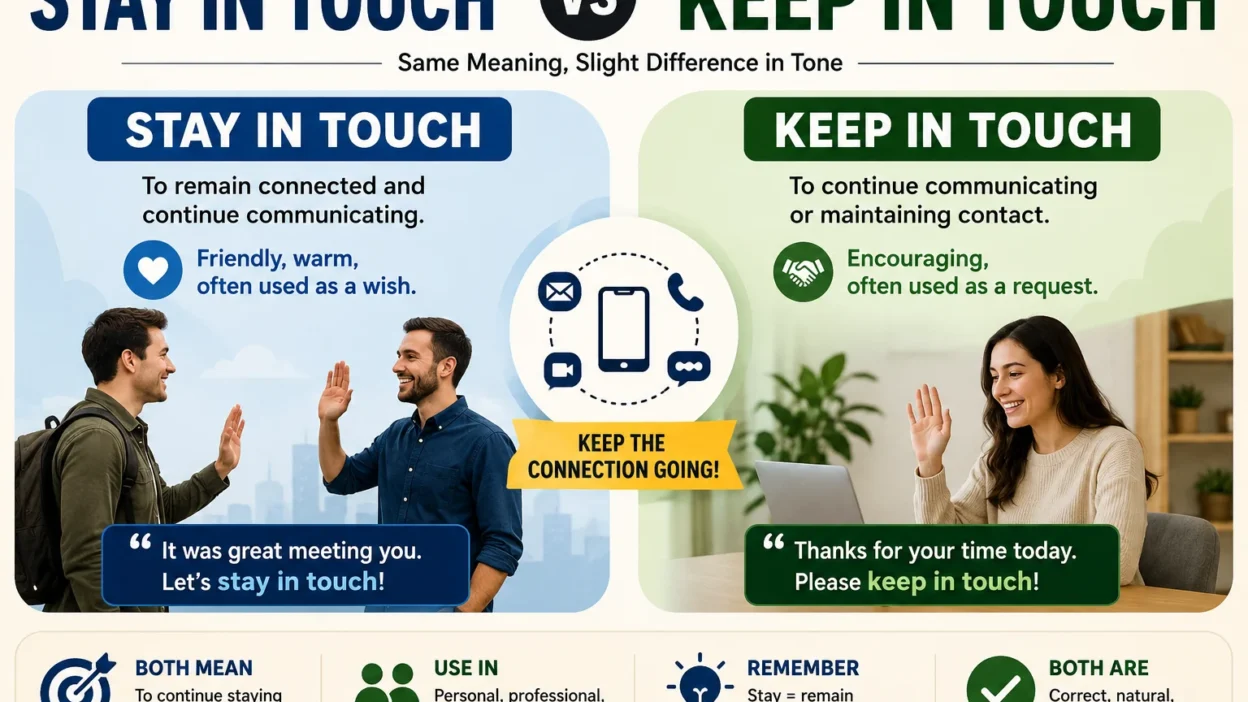
Stay in touch often sounds like a friendly suggestion or wish, while keep in touch can sound like an encouragement or request.
Understanding this small difference helps you choose the most natural expression in emails, conversations, professional communication, and personal messages.
Quick Answer: Stay in Touch vs Keep in Touch
Stay in touch and keep in touch both mean to continue communicating with someone.
- Stay in touch often sounds like a friendly wish or suggestion.
- Keep in touch often sounds like an encouragement or request.
- In everyday English, they are usually interchangeable.
What Does “Stay in Touch” Mean?
Stay in touch means to continue communicating with someone over time.
The phrase can refer to communication through phone calls, text messages, emails, social media, video calls, or face-to-face meetings.
For example:
We live in different cities now, but let’s stay in touch.
The speaker wants the relationship or communication to continue.
Examples of “Stay in Touch”
- It was great meeting you. Let’s stay in touch.
- We should stay in touch after graduation.
- Please stay in touch while you’re abroad.
- I hope we can stay in touch after you move.
- She stayed in touch with her former classmates.
The expression is especially natural when saying goodbye.
What Does “Keep in Touch” Mean?
Keep in touch also means to continue communicating with someone.
For example:
Thanks for everything. Keep in touch!
This tells the other person that you would like them to continue communicating with you.
Examples of “Keep in Touch”
- It was wonderful working with you. Keep in touch!
- We should keep in touch after the conference.
- Please keep in touch and let me know how things go.
- They kept in touch despite living in different countries.
- I promised to keep in touch with my old teacher.
Like stay in touch, the phrase works in both personal and professional situations.
Stay in Touch vs Keep in Touch: Main Difference
The central point in stay in touch vs keep in touch is that there is no major difference in basic meaning.
Both phrases describe maintaining communication.
However, there can be a small difference in emphasis:
| Phrase | Basic Meaning | Common Tone | Typical Use |
|---|---|---|---|
| Stay in touch | Continue communicating | Friendly, warm | Goodbye, suggestion, relationship |
| Keep in touch | Continue communicating | Friendly, encouraging | Goodbye, request, reminder |
| Stay in touch with | Maintain contact with someone | Neutral/friendly | Ongoing relationships |
| Keep in touch with | Maintain contact with someone | Neutral/friendly | Ongoing relationships |
These differences are not strict grammar rules. Native speakers frequently use the two expressions in the same situations.
Stay in Touch vs Keep in Touch Examples
Consider these two sentences:
Let’s stay in touch after you move.
Let’s keep in touch after you move.
Both sentences are natural and mean essentially the same thing.
Another pair:
Please stay in touch and tell me how your new job goes.
Please keep in touch and tell me how your new job goes.
Again, both are correct.
The choice usually depends on personal preference, regional habits, and the tone the speaker wants to create.
When Should You Use “Stay in Touch”?
Use stay in touch when you want to emphasize continuing a connection.
It is particularly common when people are separating or expect to be physically apart.
Common situations
| Situation | Example |
|---|---|
| Saying goodbye | Let’s stay in touch. |
| Moving away | We should stay in touch after you move. |
| Graduation | I hope we all stay in touch. |
| Changing jobs | Let’s stay in touch after I leave the company. |
| Traveling | Stay in touch while you’re overseas. |
| Friendship | We still stay in touch regularly. |
Stay in touch can sound especially warm when used as a farewell.
When Should You Use “Keep in Touch”?
Use keep in touch when you want to encourage someone to continue communicating.
It is very common in farewell conversations, professional relationships, and informal messages.
Common situations
| Situation | Example |
|---|---|
| Farewell | Keep in touch! |
| Former colleague | Let’s keep in touch after you leave. |
| Business contact | Please keep in touch regarding future opportunities. |
| Old friend | We should keep in touch more often. |
| Networking | Let’s keep in touch after the event. |
| Family | Keep in touch while you’re away. |
The phrase can sometimes feel slightly more like a request than stay in touch, although the difference is very small.
Are “Stay in Touch” and “Keep in Touch” Interchangeable?
Yes, in most everyday situations.
For example:
Let’s stay in touch.
and
Let’s keep in touch.
are both natural ways to express the same idea.
Similarly:
We stayed in touch after college.
and
We kept in touch after college.
both mean that the people continued communicating after college.
The important thing is to understand that stay and keep are being used as part of fixed expressions. You should not interpret them too literally.
Grammar Forms of Stay in Touch and Keep in Touch
Both expressions can appear in several grammatical structures.
| Grammar Form | Stay in Touch | Keep in Touch |
|---|---|---|
| Base phrase | stay in touch | keep in touch |
| Present | I stay in touch | I keep in touch |
| Past | I stayed in touch | I kept in touch |
| Present perfect | I have stayed in touch | I have kept in touch |
| With “with” | stay in touch with her | keep in touch with her |
| Imperative | Stay in touch! | Keep in touch! |
| Future | We will stay in touch | We will keep in touch |
Examples
Present:
I still stay in touch with my college friends.
I still keep in touch with my college friends.
Past:
We stayed in touch after graduation.
We kept in touch after graduation.
Present perfect:
They have stayed in touch for years.
They have kept in touch for years.
All of these forms are grammatically possible.
Stay in Touch vs Keep in Touch in Professional English
Both phrases can be used professionally, but the choice depends on the level of formality.
In a friendly business relationship, either phrase works well:
It was a pleasure working with you. Let’s stay in touch.
Or:
It was a pleasure working with you. Let’s keep in touch.
For highly formal business emails, alternatives such as I look forward to staying in contact or I hope we can remain in contact may sound more polished.
Professional Usage Table
| Professional Situation | Natural Expression | Formal Alternative |
|---|---|---|
| Leaving a company | Let’s stay in touch. | I hope we can remain in contact. |
| Networking | Let’s keep in touch. | I look forward to staying in contact. |
| Client relationship | Please stay in touch. | Please feel free to remain in contact. |
| Conference | Let’s keep in touch. | I hope we can continue our professional communication. |
| Former colleague | Stay in touch! | I hope we can remain connected. |
Stay in Touch vs Keep in Touch in Emails
Both expressions work naturally in emails, especially when ending a friendly or professional message.
Friendly email
It was great catching up with you. Let’s stay in touch!
Professional email
It was a pleasure meeting you at the conference. Let’s keep in touch regarding future opportunities.
More formal version
It was a pleasure speaking with you. I hope we can remain in contact.
The more formal alternatives may be preferable when communicating with senior executives, clients, or people you do not know well.
Stay in Touch vs Keep in Touch in Education
Students and teachers commonly use these expressions when someone graduates, transfers schools, or moves away.
Examples
We should stay in touch after graduation.
Let’s keep in touch when you start university.
The students stayed in touch with their former teacher.
Several classmates kept in touch after leaving school.
Both phrases are completely natural in educational contexts.
Stay in Touch vs Keep in Touch in Business and Networking
Maintaining relationships is important in business, so both expressions are common in networking.
For example:
It was great speaking with you at the conference. Let’s stay in touch.
Or:
Thanks for sharing your ideas. Let’s keep in touch.
The expressions communicate openness to future communication without necessarily making a specific commitment.
Networking Examples
| Context | Example |
|---|---|
| Meeting a potential client | Let’s stay in touch. |
| Meeting another professional | Let’s keep in touch. |
| Leaving a company | I hope we can stay in touch. |
| After an interview | I hope to keep in touch with your team. |
| Conference follow-up | Let’s stay in touch about future projects. |
Common Mistakes With Stay in Touch and Keep in Touch
Because these are idiomatic expressions, learners sometimes use incorrect prepositions or structures.
Mistake 1: Using “on touch”
Incorrect:
Let’s stay on touch.
Correct:
Let’s stay in touch.
The fixed expression uses in, not on.
Mistake 2: Saying “keep on touch”
Incorrect:
Please keep on touch.
Correct:
Please keep in touch.
Mistake 3: Using “stay touch”
Incorrect:
Let’s stay touch.
Correct:
Let’s stay in touch.
Mistake 4: Using “keep touching” for communication
Incorrect:
Let’s keep touching after graduation.
Correct:
Let’s keep in touch after graduation.
“Keep touching” has a different literal meaning and should not be used as a substitute for the idiom.
Common Mistakes Table
| Incorrect | Correct | Explanation |
|---|---|---|
| Stay on touch | Stay in touch | Fixed preposition |
| Keep on touch | Keep in touch | Fixed expression |
| Stay touch | Stay in touch | “In” is required |
| Keep touching | Keep in touch | Different meaning |
| Stay in the touch | Stay in touch | Usually no “the” |
Why Do People Confuse Stay in Touch and Keep in Touch?
The confusion exists because both expressions have almost exactly the same meaning.
They also share the same final phrase: in touch.
The only major difference is the verb:
- stay means continue to be in a particular state or condition.
- keep can mean continue or maintain something.
Therefore, both verbs naturally fit the idea of maintaining communication.
This is why native speakers can often switch between the phrases without changing the intended message.
A Simple Memory Trick
You do not need a complicated rule to remember the difference.
Think of:
Stay = remain
Keep = continue
Therefore:
Stay in touch = remain in contact.
Keep in touch = continue contact.
Both lead to the same basic idea: continue communicating.
Another useful trick is to remember that both expressions contain the exact same phrase in touch. The verbs stay and keep simply provide slightly different ways of expressing continuity.
Which One Sounds More Natural?
Both sound natural.
However, stay in touch is extremely common as a friendly farewell:
It was great seeing you. Stay in touch!
Keep in touch is equally common:
It was great seeing you. Keep in touch!
Neither is grammatically better.
The choice often depends on personal preference and the conversational style of the speaker.
Comparison Table: Stay in Touch vs Keep in Touch
| Feature | Stay in Touch | Keep in Touch |
|---|---|---|
| Meaning | Continue communicating | Continue communicating |
| Grammar | Verb + in touch | Verb + in touch |
| Tone | Friendly and warm | Friendly and encouraging |
| Farewells | Very common | Very common |
| Business | Common | Common |
| Education | Common | Common |
| Friendships | Very common | Very common |
| Formal writing | Acceptable | Acceptable |
| Main difference | Slight emphasis on remaining connected | Slight emphasis on continuing contact |
Real-Life Examples
Example 1: Friends
I’m moving to another city, but let’s stay in touch.
This means the speaker wants the friendship to continue despite the distance.
Example 2: Former Colleagues
It was great working with you. Keep in touch!
The speaker is encouraging the former colleague to continue communicating.
Example 3: Students
We all went to different universities but stayed in touch.
The students continued communicating after separating.
Example 4: Business
Thank you for your time today. Let’s keep in touch about the project.
The phrase suggests that future communication would be useful.
Example 5: Family
I’ll be away for several months, so let’s stay in touch.
The speaker wants regular communication during the period apart.
Stay in Touch vs Keep in Touch: Which Is Better?
Neither expression is universally better.
Choose stay in touch when you want to emphasize remaining connected.
Choose keep in touch when you want to emphasize continuing communication.
In many situations, however, the difference is so small that either phrase is perfectly natural.
| If You Want To Say… | Best Natural Choice |
|---|---|
| “Let’s remain connected.” | Stay in touch |
| “Please continue contacting me.” | Keep in touch |
| Friendly goodbye | Either |
| Business networking | Either |
| Talking about an existing relationship | Either |
| Asking someone to contact you later | Keep in touch |
Frequently Asked Questions
Is “stay in touch” the same as “keep in touch”?
Yes. Both normally mean to continue communicating with someone. The difference is mainly a slight difference in emphasis or tone.
Which is more polite: “stay in touch” or “keep in touch”?
Neither is inherently more polite. Both are friendly and polite expressions. The surrounding sentence determines the overall tone.
Can I use “stay in touch” in a professional email?
Yes. It is common in professional communication, particularly with colleagues, clients, business contacts, and networking connections.
Can I say “keep in touch with someone”?
Yes. For example: “I still keep in touch with my former classmates.”
What is the opposite of “stay in touch”?
A natural opposite is lose touch or lose contact.
For example:
We lost touch after college.
Is “stay in touch” grammatically correct?
Yes. Stay in touch is a standard English expression meaning to continue communicating with someone.
Final Conclusion: Stay in Touch vs Keep in Touch
The key difference in stay in touch vs keep in touch is very small because both expressions mean to continue communicating with someone. They can usually be used interchangeably in conversations, emails, friendships, education, business, and professional networking.
Stay in touch can slightly emphasize remaining connected, while keep in touch can slightly emphasize continuing communication. However, these distinctions are flexible rather than strict grammar rules.
The easiest usage rule is simple: use stay in touch or keep in touch when you want communication or a relationship to continue. Both are natural, correct, and widely understood expressions.