Many English learners wonder about in front vs infront because both spellings appear online.
However, only one is grammatically correct in standard English. Knowing the right form helps you write more accurately in school, business, and everyday communication.
If you’ve ever typed infront instead of in front, you’re not alone. This mistake is common because many compound expressions eventually become single words in English.
In this guide, you’ll learn the difference between in front vs infront, when to use the correct expression, common mistakes to avoid, and practical examples from different situations.
Quick Answer
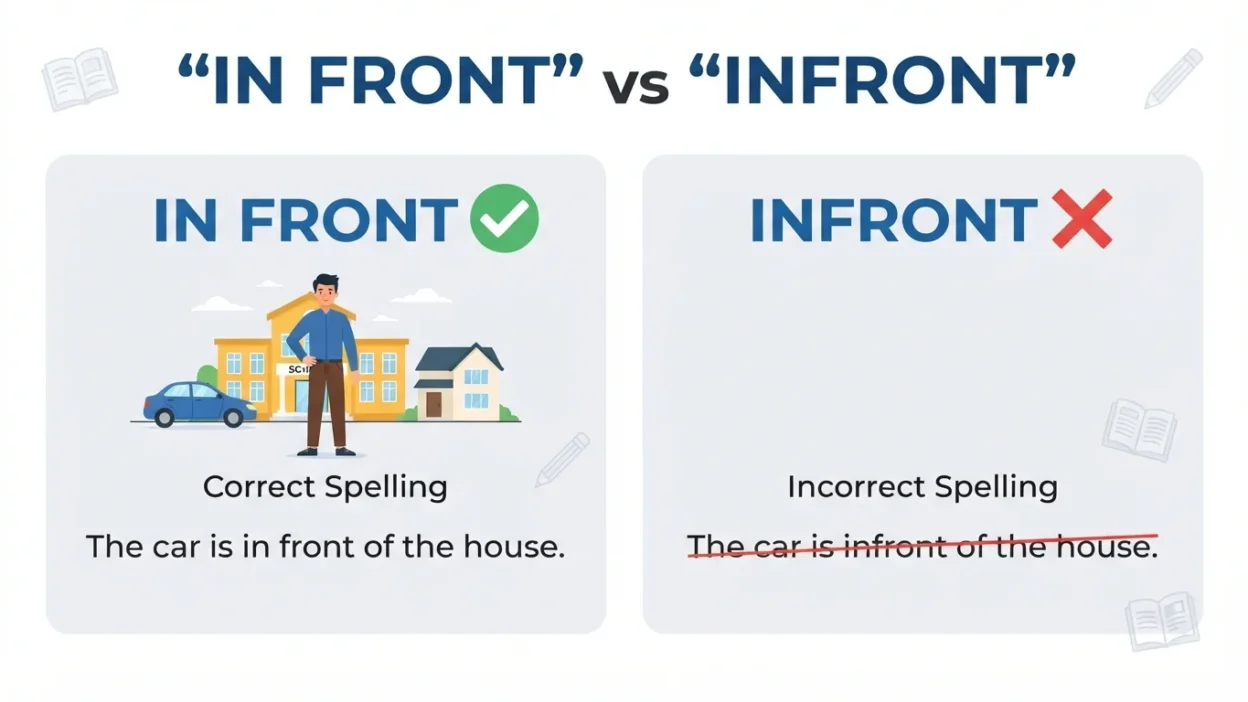
In front is the correct English expression.
Infront is an incorrect spelling in standard English and should not be used in formal or informal writing.
In Front vs Infront: Main Comparison Table
| Feature | In Front | Infront |
|---|---|---|
| Correct spelling | ✅ Yes | ❌ No |
| Part of speech | Prepositional phrase | Not a standard English word |
| Dictionary entry | Yes | No |
| Used in formal writing | Yes | No |
| Used in academic writing | Yes | No |
| Meaning | Ahead of or facing something | InCorrect spelling |
What Does “In Front” Mean?
In front is a prepositional phrase that means ahead of, before, or facing another person, object, or place.
It describes the position of one thing relative to another.
Examples
- The car is parked in front of the house.
- She stood in front of the class.
- Please wait in front of the building.
- The teacher wrote on the board in front of the students.
What Does “Infront” Mean?
Infront is not a correct English word.
Although many people type it as one word, dictionaries and grammar guides recognize only in front as the correct form.
Incorrect Examples
❌ Please stand infront of the door.
❌ He parked infront of the office.
Correct Versions
✅ Please stand in front of the door.
✅ He parked in front of the office.
In Front vs Infront: Key Differences
| Point | In Front | Infront |
|---|---|---|
| Correct English | Yes | No |
| Standard spelling | Yes | No |
| Accepted in dictionaries | Yes | No |
| Suitable for exams | Yes | No |
| Professional writing | Yes | No |
Why Do People Confuse In Front and Infront?
There are several reasons this spelling mistake is common.
1. Compound Word Confusion
Many English words, such as inside and outside, are written as one word. People assume in front follows the same pattern.
2. Fast Typing
Typing quickly often causes writers to remove the space.
3. Informal Internet Usage
Social media posts and text messages sometimes use infront, leading others to believe it is correct.
4. Autocorrect Limitations
Some devices may not immediately flag infront as incorrect.
Grammar of “In Front”
In front is a prepositional phrase.
It usually appears before a noun and often follows the word of.
Structure
In front + of + noun
Examples:
- in front of the school
- in front of the office
- in front of my friends
- in front of the audience
Grammar Forms Table
| Grammar Item | Example |
|---|---|
| Prepositional phrase | in front |
| Common pattern | in front of + noun |
| Example | in front of the building |
| Incorrect form | infront |
When Should You Use “In Front”?
Use in front whenever describing someone’s or something’s position ahead of another object or person.
Everyday Examples
- My bicycle is in front of the garage.
- The children stood in front of their parents.
- We met in front of the restaurant.
Examples in Different Contexts
Business
The visitors waited in front of the reception desk.
Education
The student gave a presentation in front of the class.
Science
The microscope was placed in front of the light source.
Healthcare
Patients lined up in front of the registration counter.
Sports
The goalkeeper stood in front of the goal.
Technology
The camera is positioned in front of the monitor.
Industry Usage Table
| Industry | Correct Example |
|---|---|
| Business | Meet me in front of the office. |
| Education | Stand in front of the whiteboard. |
| Healthcare | Wait in front of Room 12. |
| Retail | Customers gathered in front of the store. |
| Hospitality | The taxi stopped in front of the hotel. |
| Construction | Workers assembled in front of the site office. |
Common Mistakes
Many writers mistakenly combine the two words.
Correct vs Incorrect Sentences
| Incorrect | Correct |
|---|---|
| She stood infront of me. | She stood in front of me. |
| Park infront of the mall. | Park in front of the mall. |
| He waited infront of school. | He waited in front of the school. |
| The bus stopped infront of us. | The bus stopped in front of us. |
| They met infront of the station. | They met in front of the station. |
In Front vs Infront in Professional Writing
Professional documents should always use in front.
Examples include:
- Business emails
- Academic essays
- Reports
- Legal documents
- Job applications
- Research papers
- News articles
Using infront may be viewed as a spelling mistake and reduce the professionalism of your writing.
Memory Trick to Remember the Correct Spelling
Think of this simple rule:
If you can say “of” after it, write two words.
Example:
In front of the house
Because it is followed by of, you should always write in front as two separate words.
Another easy trick:
Front is a separate noun, so keep “in” and “front” separate.
Step-by-Step Guide to Avoid the Mistake
| Step | Action |
|---|---|
| 1 | Think about whether you mean a position. |
| 2 | Use the phrase “in front of.” |
| 3 | Keep a space between “in” and “front.” |
| 4 | Read your sentence before submitting it. |
| 5 | Use spell check if you’re unsure. |
Similar Expressions
| Expression | Meaning |
|---|---|
| In front of | Ahead of something |
| Before | Earlier or ahead |
| Ahead of | Further forward |
| Opposite | Facing another object |
| Next to | Beside something |
Tips for Using “In Front” Correctly
- Always write it as two words.
- Follow it with of when introducing a noun.
- Never combine the words into infront.
- Proofread professional writing.
- Remember that dictionaries only recognize in front.
Frequently Asked Questions
Is “infront” a real English word?
No. Infront is not a standard English word. The correct form is in front.
Which is correct: in front or infront?
In front is always the correct spelling.
Why do people write “infront”?
People often assume it is a compound word because many English expressions become single words over time.
Is “in front of” a preposition?
It is a prepositional phrase used to describe position or location.
Can I use “infront” in formal writing?
No. Always use in front in essays, emails, reports, and professional communication.
How can I remember the correct spelling?
Remember this rule: If you can add “of” after it, write “in front” as two words.
Conclusion
Understanding in front vs infront is easy once you know the rule. In front is the only correct expression in standard English and is used to describe the position of one person or object ahead of another.
Infront is simply a common misspelling and should never appear in formal or professional writing.
By remembering that front remains a separate noun in the phrase in front of, you can avoid this mistake and write with confidence every time.