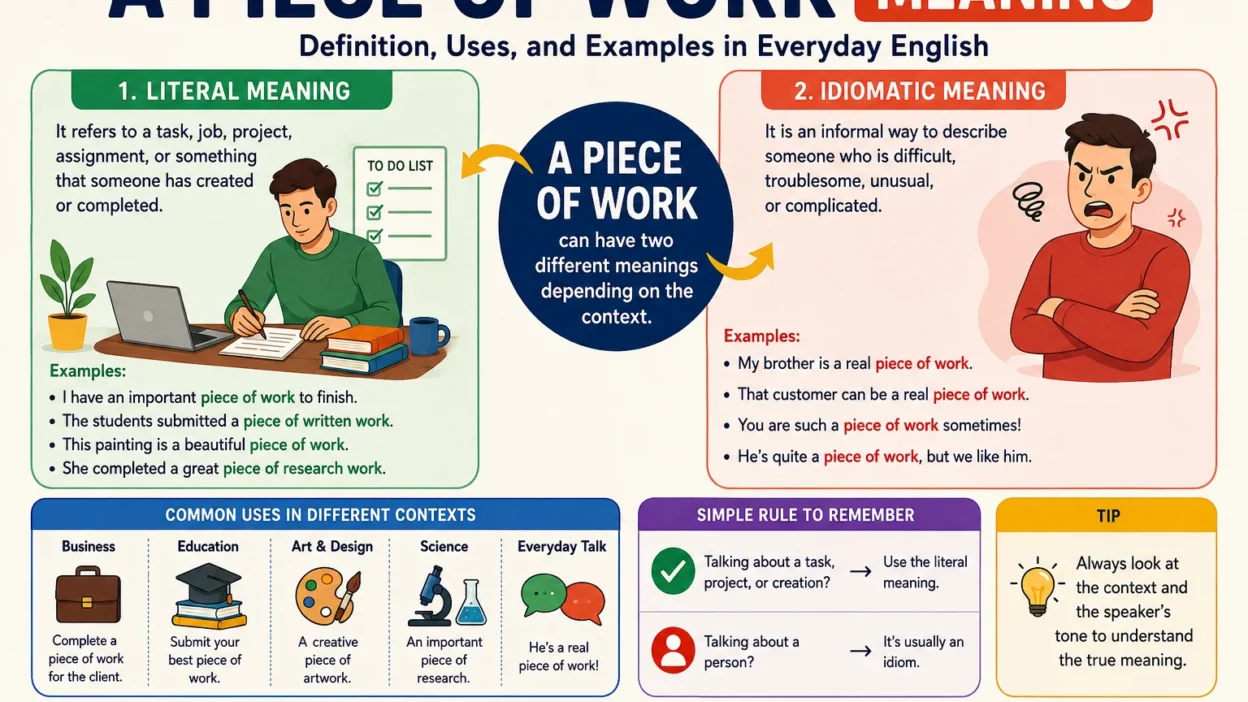
Understanding the a piece of work meaning is useful because this common English expression can have more than one meaning depending on the context.
In its most basic sense, it refers to a task, job, assignment, project, or other unit of work that someone has completed or needs to complete.
However, when people say that someone is “a real piece of work,” the meaning changes completely.
This difference can create confusion for English learners and even native speakers.
The phrase a piece of work may describe something productive, such as a report or painting, or it may be used idiomatically to describe a difficult, unusual, or troublesome person.
This guide explains the a piece of work meaning, usage, grammar, examples, common mistakes, and the important difference between its literal and idiomatic meanings.
Quick Answer: What Does “A Piece of Work” Mean?
A piece of work literally means a task, project, assignment, or item someone has worked on.
Informally, calling a person “a piece of work” usually means they are difficult, troublesome, unusual, or sometimes impressive, depending on the tone and context.
What Does “A Piece of Work” Mean?
The literal meaning of a piece of work is simple: it refers to one particular task, job, project, or creation.
For example:
- “I finished a piece of work before lunch.”
- “This painting is an impressive piece of work.”
- “The students submitted a piece of written work.”
In these examples, the phrase refers to something that has been done, created, produced, or assigned.
The idiomatic meaning is more informal. When someone says, “He’s a real piece of work,” they are usually describing a person’s character or behavior.
Depending on the situation, it can mean the person is:
- Difficult to deal with
- Troublesome
- Strange or unusual
- Annoying
- Complicated
- Remarkable in an unexpected way
The speaker’s tone is especially important when understanding the meaning.
Literal vs Idiomatic Meaning of “A Piece of Work”
The phrase has two main uses: a literal use and an idiomatic use.
| Usage | Meaning | Example |
|---|---|---|
| Literal | A task, project, or creation | “This report is an important piece of work.” |
| Literal | Something produced by effort or skill | “The sculpture is a beautiful piece of work.” |
| Idiomatic | A difficult or troublesome person | “My neighbor can be a real piece of work.” |
| Idiomatic | A surprising or unusual person | “You are certainly a piece of work!” |
| Idiomatic | A complicated person, sometimes said humorously | “Her brother is quite a piece of work.” |
The context tells you which meaning is intended.
For example, “The research paper is an excellent piece of work” clearly refers to the paper. But “Your manager is a real piece of work” refers to the manager’s personality.
“A Piece of Work” Meaning When Describing a Person
When a piece of work describes a person, it is usually an idiom rather than a literal description.
Consider this example:
“After changing the rules three times and blaming everyone else, he proved that he was a real piece of work.”
Here, the speaker means that the person is difficult, frustrating, or troublesome.
The phrase can also be used humorously:
“My little brother ate the last slice of pizza and then blamed the dog. He’s a piece of work.”
In this situation, the speaker may be annoyed, but the expression can also sound playful.
Is “A Piece of Work” an Insult?
Often, yes—but not always.
It can sound insulting when used with a negative tone:
- “That dishonest salesman is a real piece of work.”
However, friends or family members may use it jokingly:
- “You planned a surprise party for yourself? You’re a piece of work!”
The relationship between the speakers and the tone of voice determine how negative the expression sounds.
How “A Piece of Work” Is Used in Everyday English
The phrase appears in both formal and informal English, but its meaning changes according to the situation.
| Context | Typical Meaning | Example |
|---|---|---|
| Workplace | A task or project | “This is a complex piece of work.” |
| Education | An assignment or student creation | “Please submit your best piece of work.” |
| Art | A creative creation | “The museum displayed a rare piece of work.” |
| Science | Research or academic output | “The study is an influential piece of work.” |
| Casual conversation | A difficult or unusual person | “That guy is a real piece of work.” |
| Family conversation | A troublesome but often humorous person | “Your uncle is quite a piece of work.” |
Because the phrase is flexible, you should always look at the surrounding words.
Real-Life Examples of “A Piece of Work”
Business Examples
In professional settings, the literal meaning is common.
- “The team completed an important piece of work for the client.”
- “This proposal is a strong piece of work.”
- “Each employee was assigned a different piece of work.”
When talking about a person, the phrase becomes more informal:
- “The new supervisor is a real piece of work.”
This second example would usually be inappropriate in a formal report because it expresses a personal opinion.
Education Examples
Teachers and students often use the phrase to discuss assignments.
- “Your essay is an excellent piece of work.”
- “Every student must submit a piece of written work.”
- “This project represents months of hard work.”
A teacher might use piece of work to describe an individual assignment, essay, presentation, or creative project.
Science and Research Examples
In academic and scientific contexts, the phrase may refer to research or scholarly output.
- “The experiment resulted in an important piece of work.”
- “Her published study is a valuable piece of research work.”
- “The laboratory produced a groundbreaking piece of scientific work.”
In formal academic writing, more specific words such as study, paper, research, or publication may often be clearer.
Art and Creative Examples
A painting, sculpture, novel, film, or design can also be called a piece of work.
- “The painting is a remarkable piece of work.”
- “Her latest novel is a powerful piece of work.”
- “The designer created an original piece of work.”
In these cases, the phrase highlights the result of someone’s effort, creativity, or skill.
A Piece of Work vs Work: What Is the Difference?
Work is generally an uncountable noun when it refers to labor, tasks, or employment. A piece of work refers to one specific unit, task, or product.
| Expression | Meaning | Example |
|---|---|---|
| Work | Labor or tasks in general | “I have a lot of work today.” |
| A piece of work | One specific task or creation | “I need to finish one piece of work.” |
| Some work | An unspecified amount of work | “I still have some work to do.” |
| Works | Products or creations, especially art or literature | “The artist’s works are famous.” |
Compare These Sentences
General:
- “I have a lot of work.”
This means you have many tasks or a large amount of labor to complete.
Specific:
- “I have an important piece of work to finish.”
This refers to one particular task, project, or item.
This distinction is helpful because English often uses piece of to count something that is normally uncountable.
Grammar Forms and Sentence Patterns
The phrase can appear in several grammatical patterns.
| Grammar Form | Pattern | Example |
|---|---|---|
| Singular | a piece of work | “She completed a piece of work.” |
| Plural | pieces of work | “The artist displayed several pieces of work.” |
| With adjective | an + adjective + piece of work | “It was an excellent piece of work.” |
| Idiomatic description | be + a piece of work | “He is a piece of work.” |
| Stronger idiom | be + a real piece of work | “She is a real piece of work.” |
| Informal variation | be + quite a piece of work | “He is quite a piece of work.” |
Can You Say “Pieces of Work”?
Yes. Pieces of work is grammatically correct when you are talking about multiple separate tasks, projects, or creations.
Examples:
- “The students submitted three pieces of work.”
- “These pieces of work show great improvement.”
- “The exhibition includes several pieces of work by local artists.”
However, in everyday English, more specific nouns may sound more natural:
- tasks
- assignments
- projects
- reports
- artworks
- documents
For example, instead of saying “three pieces of work,” you might say “three assignments” if you know exactly what they are.
Why Do People Confuse the Meaning?
The main confusion happens because the same words have both a literal meaning and an idiomatic meaning.
Look at these sentences:
- “That sculpture is a beautiful piece of work.”
- “That politician is a real piece of work.”
The first sentence describes an object or creation. The second describes a person.
Another source of confusion is tone. The idiomatic version can range from mildly humorous to strongly negative.
| Speaker’s Tone | Possible Meaning |
|---|---|
| Angry | Difficult, annoying, or terrible person |
| Sarcastic | Ridiculous or unbelievable person |
| Amused | Funny, unusual, or mischievous person |
| Neutral admiration | Remarkable or extraordinary person, though this use is less common |
When you hear the phrase about a person, pay attention to facial expression, voice, and the situation.
Professional and Industry Usage
The literal phrase is useful across many professional fields.
| Industry | Common Usage | Example |
|---|---|---|
| Business | Task or deliverable | “The consultant completed the piece of work on time.” |
| Education | Assignment or student output | “This is her strongest piece of work.” |
| Construction | A specific job or task | “The crew completed another piece of work.” |
| Technology | A completed task or project | “The developer delivered a complex piece of work.” |
| Publishing | Written or creative content | “The editor reviewed the piece of work.” |
| Art and Design | A creative creation | “The gallery acquired the artist’s latest piece of work.” |
| Research | Study or scholarly output | “The team produced an important piece of work.” |
Professional Usage Tip
In formal business communication, use a more specific word whenever possible.
Instead of:
- “Please finish this piece of work.”
You might write:
- “Please finish this report.”
- “Please complete this task.”
- “Please submit the project.”
Specific language is usually clearer and more professional.
Common Expressions Related to “A Piece of Work”
Several expressions use the word work in different ways.
| Expression | Meaning | Example |
|---|---|---|
| A piece of work | A task, creation, or difficult person | “He’s a real piece of work.” |
| Work of art | Something artistically beautiful | “That building is a work of art.” |
| Work in progress | Something not yet finished | “The report is still a work in progress.” |
| Make short work of | Finish something quickly | “She made short work of the assignment.” |
| All in a day’s work | A normal part of someone’s job | “Handling emergencies is all in a day’s work.” |
| Put in the work | Make the necessary effort | “You need to put in the work to improve.” |
These expressions should not be confused with the specific idiom a piece of work.
Common Mistakes and Correct Usage
Learners sometimes make mistakes with articles, plural forms, or the idiomatic meaning.
| Incorrect | Correct | Why |
|---|---|---|
| “I finished piece of work.” | “I finished a piece of work.” | Singular countable phrase needs an article. |
| “He is a piece of works.” | “He is a piece of work.” | The idiom uses singular work. |
| “She has many work.” | “She has a lot of work.” | Work is usually uncountable in this meaning. |
| “He is piece of work.” | “He is a piece of work.” | The singular phrase needs a. |
| “I have three work.” | “I have three pieces of work.” | Use a counting expression for separate items. |
| “The task is a real piece of work.” | “The task is a difficult piece of work.” | A real piece of work usually describes a person idiomatically. |
More Correct vs Incorrect Examples
Incorrect: “She is difficult piece of work.”
Correct: “She is a difficult person.”
Correct idiom: “She is a real piece of work.”
Incorrect: “I completed a work yesterday.”
More natural: “I completed a piece of work yesterday.”
Best if specific: “I completed the report yesterday.”
The most natural choice often depends on whether you are talking about general work or one identifiable task.
How to Remember the Meaning
A simple memory trick can help you understand the phrase.
Think: “Piece = One Part”
When piece means one individual item or unit, a piece of work means:
One specific task, project, or creation.
For example:
- one task
- one report
- one painting
- one assignment
Think: “Person = Personality”
When someone says:
“He’s a real piece of work.”
Remember that the phrase is no longer talking about a task. It is commenting on the person’s personality or behavior.
Quick Memory Formula
| Situation | Easy Memory Rule |
|---|---|
| Talking about a task or creation | “Piece” means one unit of work |
| Talking about a person | It is usually an idiom |
| Positive description | Check whether it means a high-quality creation |
| Negative or humorous description | Check whether the person is being called difficult or unusual |
This simple context check can help you choose the correct meaning quickly.
How to Use “A Piece of Work” Correctly: Simple Process
Use this quick process before choosing the phrase.
| Step | Question to Ask | What to Do |
|---|---|---|
| 1 | Am I describing a task or creation? | Use the literal meaning. |
| 2 | Am I describing a person? | Consider the idiomatic meaning. |
| 3 | Is the tone negative or humorous? | “A real piece of work” may fit. |
| 4 | Is the situation formal? | Choose a more specific word if possible. |
| 5 | Could the listener misunderstand? | Use task, project, report, or assignment instead. |
For example:
Situation: You are praising a student’s essay.
Best choice:
“This is an excellent piece of work.”
Situation: You are frustrated with someone’s behavior.
Possible informal choice:
“He’s a real piece of work.”
Situation: You are writing a formal company report.
Clearer choice:
“The team completed the project successfully.”
Examples in Different Contexts
At Work
- “This analysis is an excellent piece of work.”
- “I need to complete one more piece of work before leaving.”
- “That new client is a real piece of work.”
The first two are literal. The third is idiomatic.
At School
- “Please submit your final piece of work by Friday.”
- “Her essay was the best piece of work in the class.”
- “The teacher asked students to revise their written work.”
In Art
- “This sculpture is a beautiful piece of work.”
- “Every piece of work in the gallery is unique.”
- “The artist spent years developing this piece of work.”
In Casual Conversation
- “My cousin is a real piece of work sometimes.”
- “You forgot your own birthday? You’re a piece of work!”
- “That guy is quite a piece of work.”
These examples are usually informal and depend heavily on tone.
Is “A Piece of Work” Positive or Negative?
The answer is: it can be either, depending on the context.
Positive Literal Use
When describing a task, creation, or achievement, it can be positive:
- “This is a fantastic piece of work.”
- “The documentary is an impressive piece of work.”
Negative Idiomatic Use
When describing a person, it often has a negative meaning:
- “The dishonest contractor is a real piece of work.”
Humorous Use
Sometimes it is teasing rather than seriously insulting:
- “You wore pajamas to the meeting? You’re quite a piece of work!”
The safest way to understand the phrase is to identify whether it describes a thing or a person.
Alternatives to “A Piece of Work”
The best alternative depends on the intended meaning.
| If You Mean | Possible Alternatives |
|---|---|
| A task | task, job, assignment |
| A project | project, undertaking |
| A written item | report, paper, article |
| A creative creation | artwork, creation, masterpiece |
| A difficult person | troublemaker, difficult person, character |
| An unusual person | character, unusual person |
| An impressive result | achievement, excellent work, fine creation |
Be careful with character when describing a person. Like a piece of work, it can sometimes have a humorous or slightly critical tone.
Frequently Asked Questions About “A Piece of Work”
What does “a piece of work” mean?
Literally, it means a specific task, project, or creation. Idiomatically, it can describe a difficult, unusual, or troublesome person.
Is “a piece of work” an idiom?
Yes, when it describes a person, it is usually an idiomatic expression. When it describes a task or creation, it has a more literal meaning.
Is calling someone “a piece of work” rude?
It can be rude because it often suggests that the person is difficult or annoying. However, friends may also use it jokingly.
What does “a real piece of work” mean?
It usually emphasizes the idiomatic meaning and suggests that someone is especially difficult, troublesome, unusual, or unbelievable.
Can I say “pieces of work”?
Yes. Pieces of work is grammatically correct when referring to multiple tasks, assignments, or creations.
What is the difference between “work” and “a piece of work”?
Work refers to labor or tasks in general, while a piece of work refers to one specific task, project, or completed creation.
Conclusion
The a piece of work meaning depends on context. Literally, it refers to one specific task, project, assignment, or creation.
Idiomatically, when used about a person, it usually means that the person is difficult, troublesome, unusual, or sometimes amusingly complicated.
The easiest usage rule is simple: if you are talking about something someone has done or created, the phrase is usually literal.
If you are talking about a person’s behavior or personality, it is usually an idiom. Pay attention to context and tone, especially when someone says, “He’s a real piece of work,” because the expression may sound humorous, sarcastic, or insulting.