If you have searched for delve into meaning, you may have noticed that the phrase appears frequently in books, articles, academic writing, news reports, and professional communication.
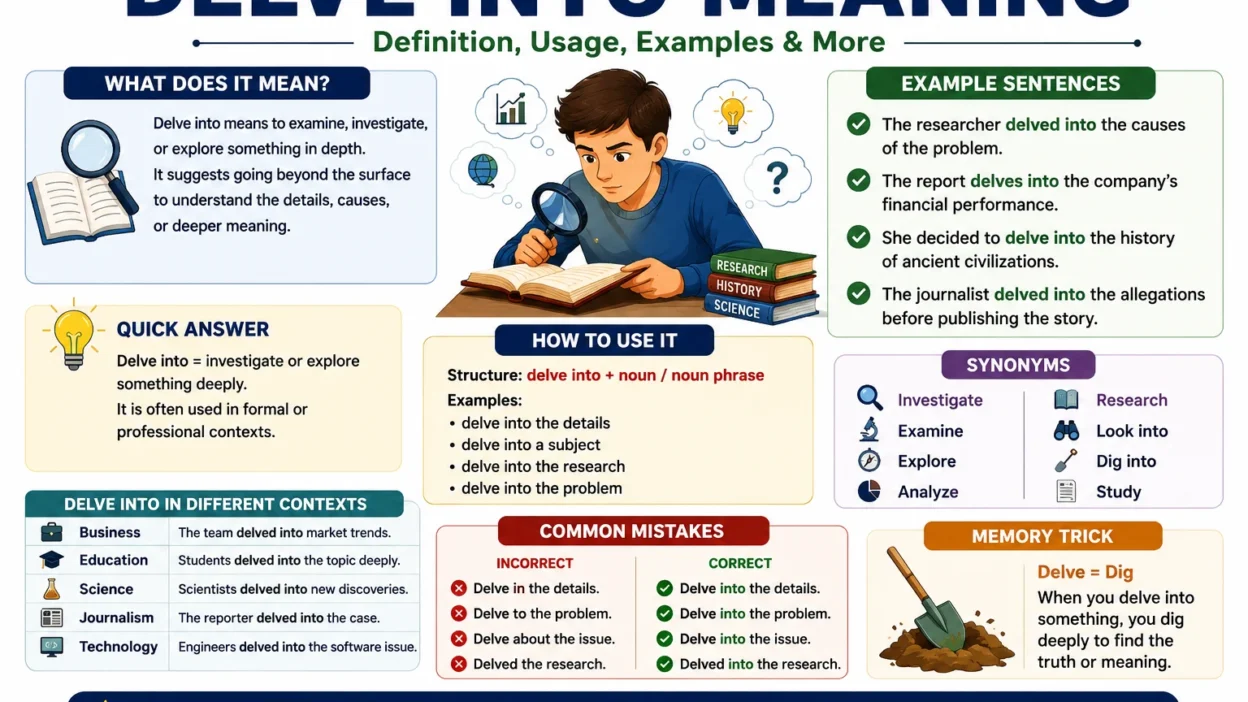
The expression delve into means to examine, investigate, or explore something carefully and in detail.
It suggests going beyond a surface-level understanding to discover more information, details, causes, or ideas.
For example, a researcher may delve into a complex scientific question, while a student may delve into a historical topic.
Understanding delve into meaning is useful because the phrase can sound more formal than simple alternatives such as “look into,” “explore,” or “investigate.”
It is commonly used when someone wants to emphasize thorough examination.
Although delve into is often associated with serious or detailed subjects, it can be used in everyday contexts as well.
This guide explains its definition, grammar, synonyms, examples, common mistakes, professional usage, and practical ways to use it naturally.
Quick Answer: Delve Into Meaning
Delve into means to examine, investigate, or explore something deeply and carefully.
It is commonly used with topics, subjects, problems, questions, causes, research, and information.
Example: The researcher decided to delve into the causes of the problem.
What Does “Delve Into” Mean?
The phrase delve into means to investigate or examine something thoroughly.
When someone delves into a subject, they do more than simply look at it. They try to understand its details, background, causes, evidence, or deeper meaning.
For example:
The journalist decided to delve into the company’s financial records.
This means the journalist investigated the records carefully to discover important information.
Another example is:
The book delves into the history of ancient civilizations.
Here, the book explores the subject in considerable detail.
Simple Definition
Delve into = explore or investigate something deeply.
| Phrase | Simple Meaning |
|---|---|
| Delve into | Investigate deeply |
| Look into | Investigate |
| Explore | Examine or discover |
| Examine | Study carefully |
| Research | Gather and study information |
What Is the Origin of “Delve”?
The verb delve originally had a more literal meaning connected with digging.
Historically, delve was associated with digging or excavating. Over time, the word developed a figurative meaning: digging deeply into a subject or idea.
That figurative meaning is what we commonly see today.
You can think of the expression this way:
Physical digging → digging into information → investigating deeply
This connection makes the meaning easier to remember.
Delve Into Meaning in Simple English
In simple English, delve into means:
- to look at something deeply
- to investigate something carefully
- to study something in detail
- to explore a subject thoroughly
- to find out more about something
For example:
She delved into the research before writing her report.
In simpler language, this means:
She studied the research carefully before writing her report.
The two sentences communicate essentially the same idea, but delved into sounds more formal and emphasizes depth.
How to Use “Delve Into” in a Sentence
The normal structure is:
delve into + noun/noun phrase
Examples:
- delve into the problem
- delve into the details
- delve into the evidence
- delve into the history
- delve into the research
- delve into the causes
- delve into the subject
- delve into the issue
Sentence Structure Table
| Structure | Example |
|---|---|
| Delve into + topic | She delved into the topic. |
| Delve into + problem | We need to delve into the problem. |
| Delve into + details | The report delves into the details. |
| Delve into + history | The documentary delves into the history. |
| Delve into + research | Scientists delved into the research. |
| Delve into + causes | The study delves into the causes of the disease. |
The preposition into is an important part of the expression.
Is “Delve Into” Formal or Informal?
Delve into is generally considered a neutral-to-formal expression.
It is especially common in:
- academic writing
- journalism
- business reports
- research papers
- professional presentations
- books
- documentaries
- serious discussions
In casual conversation, people may prefer simpler expressions such as look into, dig into, or explore.
Formality Comparison
| Expression | Formality | Example |
|---|---|---|
| Delve into | Formal/neutral | The report delves into the issue. |
| Investigate | Formal/neutral | The team investigated the issue. |
| Examine | Formal/neutral | Researchers examined the evidence. |
| Explore | Neutral | We explored several possibilities. |
| Look into | Neutral/informal | I’ll look into the problem. |
| Dig into | Informal/neutral | Let’s dig into the data. |
Delve Into vs Look Into
Delve into and look into are similar, but they can carry different levels of depth.
Look into usually means to investigate or check something.
Delve into often suggests a more detailed or thorough investigation.
Compare:
I’ll look into the complaint.
This means the speaker will investigate it.
The report delves into the causes of the complaint.
This suggests a deeper examination of the causes.
| Expression | Main Idea | Depth |
|---|---|---|
| Look into | Investigate/check | Moderate |
| Delve into | Explore thoroughly | Deep |
| Investigate | Systematically examine | Moderate to deep |
| Examine | Study carefully | Depends on context |
Neither phrase is incorrect. The best choice depends on the level of investigation you want to communicate.
Delve Into vs Explore
Explore means to investigate, consider, or discover something.
Delve into is often more strongly associated with detailed examination.
For example:
The course explores modern literature.
This simply tells us that modern literature is examined as part of the course.
The course delves into the themes of modern literature.
This suggests a more detailed examination of those themes.
Key Difference
Explore can be broad.
Delve into often suggests depth.
However, the words can overlap considerably.
Delve Into vs Dig Into
Dig into has both literal and figurative meanings.
Literally:
The workers dug into the soil.
Figuratively:
The analyst dug into the company’s sales data.
Delve into is more formal:
The analyst delved into the company’s sales data.
Both sentences mean that the analyst examined the data carefully, but delved into sounds more polished and formal.
Grammar Forms of “Delve”
The verb delve changes normally according to tense and subject.
| Form | Example |
|---|---|
| Base form | delve |
| Third-person singular | delves |
| Present participle | delving |
| Past tense | delved |
| Past participle | delved |
Examples
Present:
Researchers delve into complex questions.
Third person:
The report delves into the causes of the problem.
Past:
The historian delved into old documents.
Present participle:
She is delving into the available evidence.
Present perfect:
The team has delved into several possible explanations.
Can You Say “Delve Into” With a Person?
Usually, delve into is used with a subject, topic, issue, question, problem, information, or other thing that can be examined.
For example:
The researcher delved into the subject.
It is less natural to use delve into directly with a person when you mean “investigate the person.”
Instead, you might say:
The journalist investigated the politician.
or:
The journalist delved into the politician’s background.
The second sentence works because background is the subject being investigated.
Real-World Examples of “Delve Into”
The expression appears in many different fields.
Business
The consultant delved into the company’s financial records.
The consultant examined the records in detail.
Education
Students were encouraged to delve into the historical context of the novel.
The students were expected to study the context deeply.
Science
Researchers are delving into the causes of climate-related changes.
The researchers are investigating the causes carefully.
Journalism
The reporter delved into the allegations before publishing the story.
The reporter conducted a detailed investigation.
Technology
Engineers delved into the source of the software problem.
They investigated the technical cause.
Literature
The novel delves into themes of identity and belonging.
The novel explores those themes deeply.
Professional and Industry Usage
The phrase is particularly useful in professional writing because it communicates depth without requiring a long explanation.
| Industry | Example |
|---|---|
| Business | The report delves into quarterly sales trends. |
| Finance | Analysts delved into the company’s financial statements. |
| Science | Researchers delve into the underlying mechanisms. |
| Education | The course delves into major historical developments. |
| Technology | Engineers delved into the source of the error. |
| Journalism | The investigation delves into the allegations. |
| Healthcare | Researchers are delving into potential causes. |
| Law | The report delves into the legal background of the case. |
| Literature | The novel delves into questions of identity. |
“Delve Into” in Academic Writing
Delve into is particularly common in academic contexts.
Students, researchers, professors, and authors may use it to describe detailed investigation or discussion.
Examples include:
This study delves into the relationship between language and culture.
The paper delves into the historical development of the theory.
The researcher delved into previously unpublished documents.
It can make writing sound precise and sophisticated without being unnecessarily complicated.
However, it should not be used simply to make writing sound academic. If examine, study, or investigate communicates the idea more clearly, those words may be better.
“Delve Into” in Business Communication
In business communication, the phrase often appears in reports, presentations, proposals, and analytical documents.
Examples:
This report delves into the company’s customer retention strategy.
The presentation delves into recent market trends.
Our analysis delves into the factors affecting employee productivity.
Business Usage Table
| Business Situation | Example |
|---|---|
| Market research | The study delves into customer preferences. |
| Financial analysis | The report delves into revenue trends. |
| Strategy | The presentation delves into growth opportunities. |
| Management | The review delves into employee performance. |
| Marketing | The analysis delves into consumer behavior. |
Common Mistakes With “Delve Into”
Although delve into is straightforward, several mistakes occur.
Mistake 1: Using “Delve In”
Incorrect:
The researcher delved in the subject.
Correct:
The researcher delved into the subject.
The preposition into is normally required when introducing the subject being examined.
Mistake 2: Using “Delve To”
Incorrect:
The report delves to the causes of the problem.
Correct:
The report delves into the causes of the problem.
Mistake 3: Using “Delve About”
Incorrect:
The study delves about the issue.
Correct:
The study delves into the issue.
Common Mistakes Table
| Incorrect | Correct | Reason |
|---|---|---|
| Delve in the issue | Delve into the issue | Correct preposition |
| Delve to the problem | Delve into the problem | Correct preposition |
| Delve about the topic | Delve into the topic | Correct preposition |
| Delve the subject | Delve into the subject | “Into” is needed |
| Delved in the details | Delved into the details | Fixed construction |
Why Do People Use “Delve Into”?
People use delve into when they want to communicate more than simple examination.
The phrase often suggests:
- A subject has depth.
- The person wants to understand it thoroughly.
- The investigation involves details or complexity.
- The process may reveal information that is not immediately obvious.
For example:
We looked at the problem.
This is simple and general.
We delved into the problem.
This suggests a deeper investigation.
A Simple Process for Using “Delve Into”
If you are unsure whether delve into fits your sentence, use this simple process.
| Step | Question | Action |
|---|---|---|
| 1 | Are you talking about investigation or exploration? | Consider “delve into.” |
| 2 | Does the subject require detailed examination? | “Delve into” is a strong choice. |
| 3 | Is your writing formal or professional? | “Delve into” may fit well. |
| 4 | Is the conversation extremely casual? | Consider “look into” or “explore.” |
| 5 | Are you introducing the object? | Use delve into + noun. |
Synonyms for “Delve Into”
There are many alternatives depending on context.
| Synonym | Meaning | Example |
|---|---|---|
| Investigate | Examine systematically | They investigated the problem. |
| Examine | Study carefully | She examined the evidence. |
| Explore | Investigate or consider | We explored several options. |
| Analyze | Study components or relationships | They analyzed the data. |
| Research | Study information | He researched the topic. |
| Study | Examine carefully | She studied the issue. |
| Look into | Investigate | We will look into the complaint. |
| Dig into | Investigate deeply | The team dug into the data. |
| Probe | Investigate closely | Journalists probed the allegations. |
The best synonym depends on the context and desired tone.
Antonyms of “Delve Into”
The opposite of delving deeply into something would involve only a superficial or limited examination.
Possible contrasting expressions include:
- skim
- glance at
- overlook
- ignore
- brush aside
- barely examine
For example:
Instead of delving into the evidence, he only glanced at it.
This contrast highlights the depth associated with delve into.
Is “Delve Into” Always About Research?
No.
Although delve into is common in research and academic writing, it can describe many types of detailed exploration.
You can delve into:
- a problem
- a conversation
- a person’s background
- a historical event
- a book
- an idea
- a question
- a mystery
- a topic
- a dataset
- a report
- a subject
- a story
For example:
The documentary delves into the lives of several artists.
This is not necessarily academic research. It simply means the documentary explores their lives in depth.
Delve Into Meaning in Different Contexts
| Context | Meaning | Example |
|---|---|---|
| Academic | Study deeply | The paper delves into the theory. |
| Business | Analyze carefully | The report delves into sales data. |
| Science | Investigate causes/mechanisms | Scientists delve into the process. |
| Journalism | Investigate thoroughly | The reporter delved into the allegations. |
| Literature | Explore themes | The novel delves into identity. |
| Technology | Investigate a technical issue | Engineers delved into the error. |
| Everyday use | Explore in detail | Let’s delve into the question. |
“Delve Into” vs “Dive Into”
Dive into and delve into can both describe entering a subject deeply, but they have different tones.
Dive into often sounds more energetic and conversational.
Delve into usually sounds more formal and analytical.
Compare:
Let’s dive into the details.
This sounds energetic and conversational.
The report delves into the details.
This sounds more formal and analytical.
| Phrase | Tone | Common Context |
|---|---|---|
| Delve into | Formal, analytical | Reports, research |
| Dive into | Energetic, conversational | Meetings, presentations |
| Look into | Neutral | Everyday investigation |
| Dig into | Informal/neutral | Data and problems |
Frequently Asked Questions
What is the simple meaning of “delve into”?
Delve into means to investigate, study, or explore something deeply and carefully.
Is “delve into” grammatically correct?
Yes. The standard construction is delve into + noun or noun phrase, such as “delve into the details.”
Is “delve into” formal?
It is generally neutral to formal and is especially common in academic, professional, journalistic, and analytical writing.
What is a synonym for “delve into”?
Common synonyms include investigate, examine, explore, analyze, research, look into, and dig into. The best choice depends on the context.
Can “delve into” be used in everyday English?
Yes. It can be used in conversation, although simpler expressions such as look into or explore may sound more natural in very casual situations.
What is the difference between “delve into” and “look into”?
Both can mean investigate, but delve into often emphasizes a deeper or more detailed examination, while look into is broader and more neutral.
Final Conclusion: Delve Into Meaning
The phrase delve into means to explore, investigate, or examine something deeply and carefully. It is a useful expression when you want to emphasize that someone is going beyond a basic or superficial examination.
The standard grammatical pattern is delve into + noun or noun phrase, as in “delve into the details,” “delve into the research,” or “delve into the problem.”
The expression is especially common in academic, professional, scientific, journalistic, and analytical writing.
The easiest way to remember the delve into meaning is to think of the word’s historical connection with digging. Just as someone digs deeply into the ground, someone who delves into a subject digs deeply into its information and details.
If you need a formal alternative, use investigate, examine, explore, analyze, or research, depending on the context. In everyday English, look into and dig into can also work.

Julian Wyatt is a passionate researcher and writer who explores symbols, mythology, cultural traditions, and hidden meanings. Through engaging articles, he helps readers uncover the fascinating stories and significance behind symbols worldwide.