
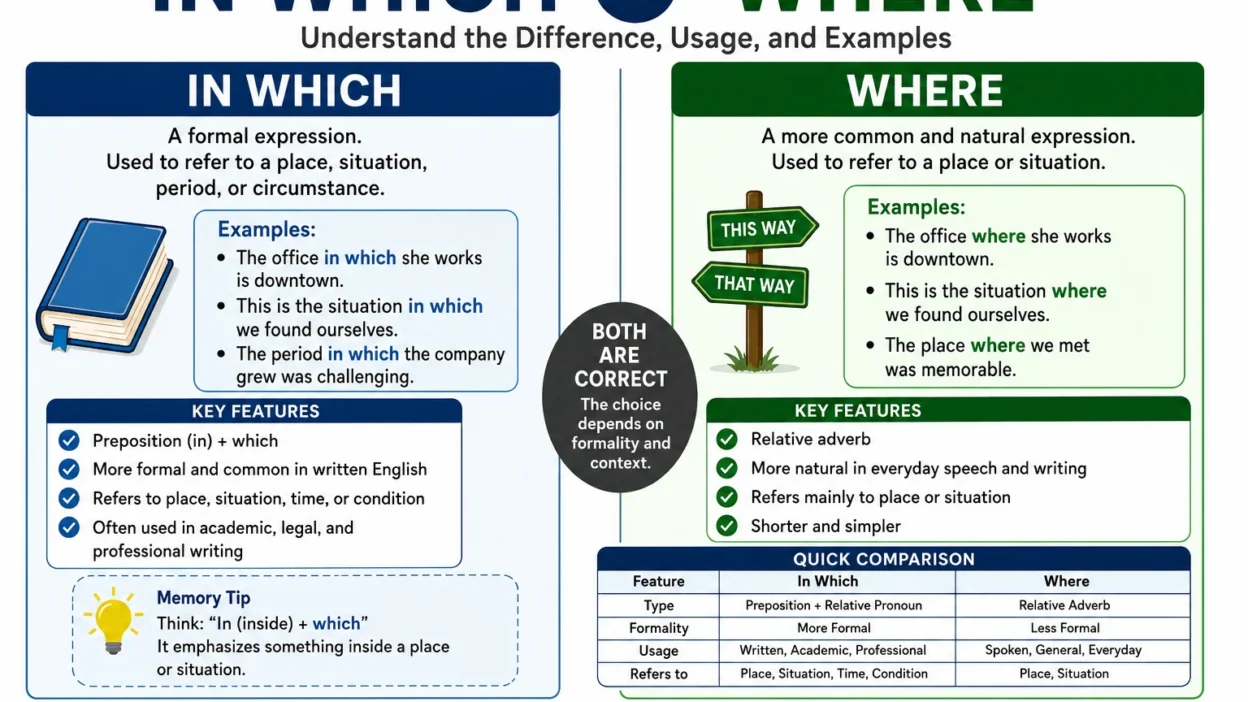
Understanding in which vs where can be confusing because both expressions can introduce a clause that describes a place, situation, or circumstance.
In many sentences, they appear to have almost the same meaning, which makes it difficult to know which one sounds more natural or grammatically appropriate.
However, there is an important difference in structure and style. In which is a prepositional relative expression, while where is a relative adverb commonly used when referring to a place or situation.
The choice between in which vs where often depends on the noun being described, the preposition required by the sentence, and the level of formality.
Where is usually shorter and more natural in everyday English, while in which is often preferred in formal, academic, legal, and professional writing. Learning when to use each expression can make your writing clearer, more precise, and more natural.
Quick Answer
Where usually refers to a place or situation and is more natural in everyday English.
In which is more formal and emphasizes the relationship between a noun and the preposition in.
For example: “This is the room where we met” and “This is the room in which we met” are both correct.
What Does “Where” Mean?
Where is a relative adverb used to refer to a place, location, or sometimes a situation.
It can connect a noun with additional information about what happens there.
Examples of “Where”
- This is the house where I grew up.
- We visited the school where she teaches.
- That is the restaurant where they had dinner.
- I remember the situation where everyone became confused.
In everyday English, where is often the easiest and most natural choice when the meaning is “in which place” or “at which place.”
What Does “In Which” Mean?
In which consists of the preposition in and the relative pronoun which.
It is commonly used to refer to a place, object, situation, process, or period. It is especially common in formal or written English.
Examples of “In Which”
- This is the house in which I grew up.
- The office in which she works is downtown.
- We entered a period in which prices increased rapidly.
- The report describes a situation in which several problems occurred.
Because in which sounds more formal, it is frequently found in academic papers, reports, contracts, and official documents.
In Which vs Where: Main Difference
The basic difference is grammatical structure and style.
Where functions as a relative adverb, while in which combines a preposition with a relative pronoun.
| Feature | Where | In Which |
|---|---|---|
| Grammar | Relative adverb | Preposition + relative pronoun |
| Main meaning | In/at a place or situation | In a place, situation, object, or period |
| Style | Natural and conversational | More formal |
| Common in speech | Very common | Less common |
| Common in academic writing | Common | Very common |
| Can refer to situations? | Yes | Yes |
| Can refer to abstract concepts? | Sometimes | Often |
| Example | The room where we met | The room in which we met |
Simple Rule
If you can naturally replace where with in which, both may be grammatically possible.
This is the building where I work.
This is the building in which I work.
The first sounds more conversational. The second sounds more formal.
In Which vs Where Examples
Seeing the expressions in complete sentences makes the difference easier to understand.
| Sentence with “Where” | Sentence with “In Which” |
|---|---|
| This is the city where I was born. | This is the city in which I was born. |
| That is the office where she works. | That is the office in which she works. |
| This is the room where we met. | This is the room in which we met. |
| We entered a period where things changed. | We entered a period in which things changed. |
| This is the situation where mistakes happen. | This is the situation in which mistakes happen. |
The where versions generally sound more natural in conversation, while the in which versions can sound more polished or formal.
When Should You Use “Where”?
Use where when you are talking about a physical or identifiable location.
Examples
- This is the park where we played.
- I know a restaurant where you can get excellent food.
- That is the university where my brother studied.
- Do you remember the hotel where we stayed?
Where is particularly useful when the sentence focuses on the location rather than the grammatical relationship created by the preposition.
Everyday Usage
This is the place where I bought my laptop.
This sounds completely natural in ordinary conversation.
When Should You Use “In Which”?
Use in which when you want a more formal construction or when the noun represents a situation, process, period, system, or context.
Examples
- The study examined the conditions in which employees worked.
- The company entered a phase in which rapid expansion occurred.
- The document explains the circumstances in which the decision was made.
- The experiment created an environment in which bacteria could grow.
Here, in which can sound more precise than where, particularly in formal writing.
Can “Where” Refer to a Situation?
Yes. Where is not limited strictly to physical locations.
English speakers sometimes use where to introduce a clause describing a situation, circumstance, or condition.
Examples
- We reached a point where we had to make a decision.
- She found herself in a situation where she had no choice.
- There are cases where this method does not work.
These sentences are common and natural.
However, in highly formal writing, in which may be preferred:
There are cases in which this method does not work.
Both constructions can be acceptable, but the second has a more formal tone.
In Which vs Where in Formal Writing
Formal writing often favors in which because it makes the grammatical relationship explicit.
Compare:
Informal or conversational:
This is the situation where the problem occurred.
More formal:
This is the situation in which the problem occurred.
Both communicate essentially the same idea.
In academic, legal, scientific, and technical writing, in which can provide a more formal and precise tone.
In Which vs Where in Academic Writing
Academic writers frequently use in which when describing conditions, stages, circumstances, or processes.
Examples
- The researchers created an environment in which the samples could be tested.
- The study identified several circumstances in which the treatment was effective.
- The experiment involved a stage in which the temperature was gradually increased.
Why Academic Writers Prefer “In Which”
Academic writing often aims for precision and formal structure. In which can clearly show that something happens within a particular condition, system, or context.
| Context | Natural Choice |
|---|---|
| Casual conversation | Where |
| Personal writing | Where |
| General business writing | Either |
| Academic papers | In which |
| Scientific reports | In which |
| Legal documents | In which |
| Formal reports | In which |
In Which vs Where in Business English
Both expressions appear in business communication, but the best choice depends on the tone.
“Where” in Business
We need an environment where employees can communicate freely.
This is concise and natural.
“In Which” in Business
We need an environment in which employees can communicate freely.
This sounds more formal and may be better suited to a business report or official document.
| Business Context | Recommended Expression |
|---|---|
| Where | |
| Conversation | Where |
| Presentation | Where |
| Internal report | Either |
| Formal proposal | In which |
| Corporate policy | In which |
| Legal agreement | In which |
In Which vs Where in Science
Scientific writing often favors in which because scientific descriptions frequently involve conditions, systems, environments, and processes.
Examples
- The researchers created conditions in which the reaction could occur.
- The experiment used a chamber in which the pressure was controlled.
- The study examined the environment in which microorganisms developed.
In everyday speech, where may still be used:
The researchers created conditions where the reaction could occur.
However, in which generally fits better with a formal scientific register.
Grammar Forms and Related Structures
Understanding the grammar behind these expressions makes the difference easier to remember.
| Structure | Function | Example |
|---|---|---|
| Where + clause | Refers to a place/situation | The house where I live |
| In which + clause | Formal relative structure | The house in which I live |
| At which + clause | Refers to a specific point/place | The point at which it stopped |
| On which + clause | Refers to something located on a surface/date/topic | The day on which we met |
| For which + clause | Expresses purpose/reason | The reason for which it happened |
| From which + clause | Shows origin/source | The city from which he came |
This shows why in which should not be treated as simply a longer version of where in every situation. The preposition can change according to the intended relationship.
Where vs In Which: When They Are Not Interchangeable
Although where and in which can often replace one another, they are not always interchangeable.
Consider:
The day on which we met was unforgettable.
You cannot normally replace on which with where:
The day where we met was unforgettable.
The second sentence is sometimes heard informally, but on which is the standard formal construction.
Similarly:
The reason for which he left was unclear.
Using where here would change the grammatical structure and is not the best standard choice.
The Key Point
The correct preposition depends on the relationship expressed by the sentence.
Common Mistakes With In Which and Where
Many mistakes happen because writers assume where can replace every prepositional relative construction.
Mistake 1
❌ The day where we met was special.
✅ The day when we met was special.
✅ The day on which we met was special.
Mistake 2
❌ The reason where he left is unknown.
✅ The reason why he left is unknown.
✅ The reason for which he left is unclear.
Mistake 3
❌ The method where the data was collected was unusual.
✅ The method by which the data was collected was unusual.
The important lesson is that where specifically relates to location or, in broader usage, situations. It should not automatically replace every preposition + relative pronoun structure.
Correct vs Incorrect Sentences
| Incorrect | Correct | Reason |
|---|---|---|
| The day where we met | The day when we met | Use “when” for time |
| The reason where he left | The reason why he left | Use “why” for reason |
| The method where data was collected | The method by which data was collected | “By which” expresses method |
| The place in where I live | The place where I live | “In where” is generally unnecessary |
| The room where we met | The room in which we met | Both can be correct |
Why Do People Confuse In Which and Where?
There are several reasons for the confusion.
First, both expressions can describe a location:
The house where she lives.
The house in which she lives.
Second, both can sometimes describe abstract situations:
A situation where mistakes can happen.
A situation in which mistakes can happen.
Third, where is shorter and more flexible in modern English, while in which is strongly associated with formal writing.
Finally, learners may incorrectly assume that every noun describing a place must be followed by where, or that in which is always more grammatically correct. Neither assumption is true.
A Simple Memory Trick
Use this simple rule:
WHERE = place or situation
IN WHICH = in + noun relationship, usually more formal
Think of where as the shorter, everyday option.
Think of in which as the formal option that explicitly means something happens inside or within the stated context.
Memory Examples
The building where I work.
The building in which I work.
The situation where we met.
The situation in which we met.
When the meaning is clearly “in that place/context,” in which is often a formal alternative to where.
In Which vs Where Comparison Table
| Question | Where | In Which |
|---|---|---|
| Is it grammatically correct? | Yes | Yes |
| Is it natural in conversation? | Very | Less common |
| Is it formal? | Neutral | Formal |
| Can it refer to places? | Yes | Yes |
| Can it refer to situations? | Yes | Yes |
| Is it common in academic writing? | Yes | Very common |
| Is it useful in legal writing? | Sometimes | Very common |
| Does it require a preposition? | No | Yes, “in” |
| Main advantage | Simplicity | Precision/formality |
Real-Life Examples of Where
Business
This is the department where new employees receive training.
Education
That is the classroom where we study English.
Travel
This is the hotel where we stayed last summer.
Science
The laboratory where the experiment was conducted is closed.
Technology
The platform where users upload their files has been updated.
Everyday Conversation
Do you remember the café where we first met?
These examples show how natural where is in ordinary English.
Real-Life Examples of In Which
Business
The company entered a period in which profits increased significantly.
Education
The course provides an environment in which students can develop critical-thinking skills.
Science
The researchers created conditions in which the reaction could occur.
Law
The agreement specifies the circumstances in which either party may terminate the contract.
Technology
The system operates within an environment in which all user data is encrypted.
Formal Writing
The report describes the circumstances in which the decision was reached.
Which Is More Natural: Where or In Which?
In everyday English, where is usually more natural.
For example:
This is the place where I work.
Most speakers would naturally choose this sentence in conversation.
However:
This is the place in which I work.
is grammatically correct and has a more formal tone.
Therefore, neither expression is universally “better.” The choice depends on context, tone, and the grammatical relationship being expressed.
A Practical Decision-Making Guide
Use this quick process when choosing between the two.
| Step | Question | Choice |
|---|---|---|
| 1 | Am I referring to a place? | Consider “where” |
| 2 | Am I referring to a situation or context? | Either may work |
| 3 | Is the writing formal? | Consider “in which” |
| 4 | Does another preposition fit better? | Use that preposition |
| 5 | Does the sentence sound natural with “where”? | Prefer “where” in casual writing |
Example
Start with:
This is the environment ___ employees work.
Because employees work in an environment, you can write:
This is the environment in which employees work.
Or, more naturally in everyday English:
This is the environment where employees work.
Professional and Industry Usage
Different fields may favor different structures.
| Industry | Common Preference | Example |
|---|---|---|
| Business | Either | The market where we operate |
| Academia | In which | The context in which the study occurred |
| Science | In which | Conditions in which reactions occur |
| Law | In which | Circumstances in which the agreement applies |
| Journalism | Where | The location where the event happened |
| Everyday English | Where | The place where I live |
| Technical writing | In which | The system in which the process operates |
The more formal and technical the writing, the more likely you are to encounter in which.
Is “In Which” More Correct Than “Where”?
No. In which is not automatically more correct.
When where correctly refers to a place or situation, it is perfectly grammatical.
Compare:
This is the office where I work.
This is the office in which I work.
Both are correct.
The main difference is style and structure. Where is generally more concise and conversational, while in which is more formal.
Can You Replace “In Which” With “Where”?
Sometimes, but not always.
You can often replace:
The room in which we met.
with:
The room where we met.
But you cannot automatically replace every relative construction involving which with where.
For example:
The method by which the machine works.
Changing this to:
The method where the machine works.
does not preserve the same grammatical meaning.
Always consider what the preposition is doing before choosing where.
In Which vs Where in a Sentence: Final Examples
Example 1
Where:
I remember the house where I grew up.
In which:
I remember the house in which I grew up.
Example 2
Where:
We need a situation where everyone can contribute.
In which:
We need a situation in which everyone can contribute.
Example 3
Where:
This is the university where she studied.
In which:
This is the university in which she studied.
Example 4
Where:
They created a space where children could learn.
In which:
They created a space in which children could learn.
In each pair, the second sentence is generally more formal.
FAQs About In Which vs Where
Is “in which” the same as “where”?
Not always, but they can have the same meaning when referring to something that happens in a particular place or situation.
Which is more formal, “where” or “in which”?
In which is generally more formal. It is common in academic, scientific, legal, and professional writing.
Can “where” refer to a situation?
Yes. For example, “We reached a point where we had to decide” is natural English.
Is “the place in which I live” correct?
Yes. It is grammatically correct, although “the place where I live” is usually more natural in everyday English.
Can I use “where” for time?
Usually, use when or a suitable preposition such as on which for time. For example, “the day when we met” is standard.
Is “in where” correct?
Usually not. Use where or in which, depending on the sentence. For example, “the house where I live” or “the house in which I live.”
Conclusion
The main difference between in which vs where is grammar, style, and context.
Where is a relative adverb commonly used for places and situations, and it is usually the more natural choice in everyday English.
In which combines the preposition in with the relative pronoun which and is often preferred in formal, academic, scientific, and professional writing.
The easiest rule is to use where for natural, conversational descriptions of places or situations.
Choose in which when you want a more formal tone or when the sentence specifically requires the relationship expressed by in.
Remember that where cannot replace every prepositional relative expression, so always consider if another preposition, such as on, at, by, or for, is required.