Many English learners wonder about swept vs sweeped because both seem like they could be the past tense of the verb sweep.
Since many English verbs simply add ed to form the past tense, it’s easy to assume that sweeped is correct.
However, English contains many irregular verbs, making this comparison confusing.
Understanding swept vs sweeped is important for writing, speaking, school assignments, business communication, and exams.
In this guide, you’ll learn the meaning of each word, why one is correct, how to remember the difference, grammar rules, practical examples, common mistakes, and professional usage.
Quick Answer
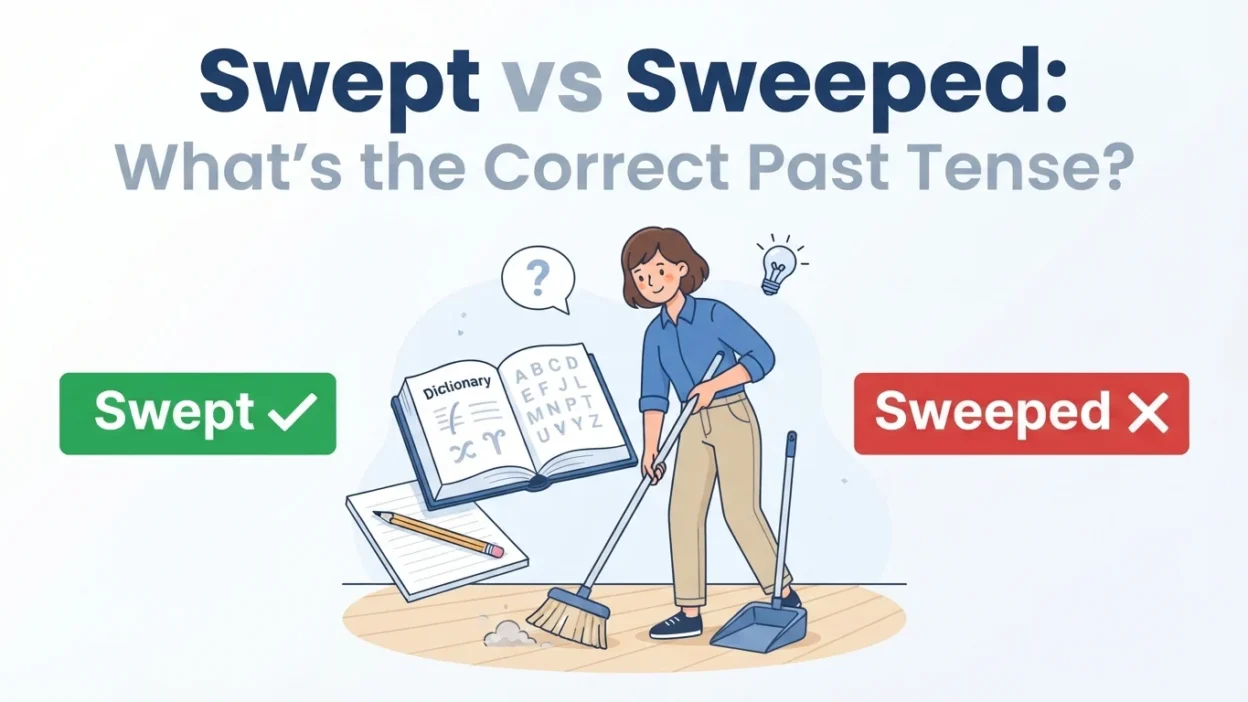
Swept is the correct past tense and past participle of sweep.
Sweeped is not a standard English word and should not be used in formal or informal writing.
Swept vs Sweeped: Main Comparison Table
| Feature | Swept | Sweeped |
|---|---|---|
| Meaning | Past tense of sweep | Incorrect form |
| Grammar | Correct | Incorrect |
| Dictionary Word | Yes | No |
| Used in English | Yes | No |
| Suitable for Exams | Yes | No |
| Suitable for Professional Writing | Yes | No |
What Does “Sweep” Mean?
The verb sweep means to clean a surface by moving dirt away with a broom or brush. It can also mean to move smoothly across an area or to win every contest in a series.
Examples:
- I sweep the kitchen every morning.
- Birds sweep across the sky.
- The team hopes to sweep the championship.
What Does “Swept” Mean?
Swept is the correct past tense and past participle of sweep.
It describes an action that already happened.
Examples:
- She swept the floor yesterday.
- The wind swept through the village.
- The company swept all major industry awards.
- He had swept the classroom before lunch.
What Does “Sweeped” Mean?
Sweeped is not accepted in modern standard English.
People often create it by mistakenly applying the regular -ed rule to an irregular verb.
Example:
❌ She sweeped the room.
Correct version:
✅ She swept the room.
Why Is “Swept” Correct Instead of “Sweeped”?
English contains many irregular verbs that do not simply add -ed.
Instead, they change their spelling completely.
Examples include:
| Base Verb | Past Tense | Past Participle |
|---|---|---|
| Sweep | Swept | Swept |
| Sleep | Slept | Slept |
| Keep | Kept | Kept |
| Feel | Felt | Felt |
| Leave | Left | Left |
Since sweep belongs to this irregular group, its past tense becomes swept, not sweeped.
Grammar Forms of Sweep
| Verb Form | Word |
|---|---|
| Base Form | Sweep |
| Third Person | Sweeps |
| Present Participle | Sweeping |
| Past Tense | Swept |
| Past Participle | Swept |
Examples
Present:
- She sweeps every afternoon.
Present Continuous:
- She is sweeping the floor.
Past:
- She swept the floor yesterday.
Present Perfect:
- She has swept the office.
Past Perfect:
- She had swept the classroom before the students arrived.
Swept vs Sweeped: Key Differences
| Feature | Swept | Sweeped |
|---|---|---|
| Correct English | ✔ | ✘ |
| Appears in Dictionaries | ✔ | ✘ |
| Used by Native Speakers | ✔ | ✘ |
| Grammar Rule | Irregular verb | Incorrect regular form |
| Recommended Usage | Always | Never |
Real-Life Examples
Business
- The cleaning staff swept the office before employees arrived.
- The company swept the market with its innovative product.
Education
- The janitor swept every classroom after school.
- Students swept the laboratory before leaving.
Science
- Powerful winds swept across the research station.
- Dust swept into the observatory during the storm.
Sports
- The team swept the finals in three straight games.
- They swept every award at the tournament.
Daily Life
- Mom swept the kitchen after dinner.
- Leaves swept across the driveway during autumn.
Professional and Industry Usage
| Industry | Example Using “Swept” |
|---|---|
| Cleaning Services | Workers swept every hallway. |
| Construction | Employees swept debris from the site. |
| Hospitality | Staff swept hotel entrances. |
| Education | Custodians swept classrooms daily. |
| Sports | The team swept the championship series. |
| News Reporting | Storms swept across the coastline. |
When Should You Use “Swept”?
Use swept whenever you’re talking about a completed sweeping action.
Examples
- She swept the porch.
- They swept the warehouse.
- The wind swept through the valley.
- Our team swept the competition.
Why Do People Confuse Swept vs Sweeped?
Several reasons explain the confusion.
- Many English verbs end with -ed in the past tense.
- English learners expect regular grammar patterns.
- Irregular verbs require memorization.
- Similar verbs create false expectations.
For example:
- Walk → Walked
- Jump → Jumped
- Talk → Talked
But:
- Sweep → Swept
Memory Trick
Remember this simple phrase:
Keep, Sleep, Sweep → Kept, Slept, Swept
Notice that all three follow a similar irregular pattern.
Another trick:
“If it sounds like kept, it becomes swept, not sweeped.”
Common Mistakes
| Incorrect Sentence | Correct Sentence |
|---|---|
| She sweeped the floor. | She swept the floor. |
| We have sweeped the room. | We have swept the room. |
| He sweeped yesterday. | He swept yesterday. |
| They sweeped the office. | They swept the office. |
| The wind sweeped across town. | The wind swept across town. |
Step-by-Step Guide to Choosing the Correct Word
| Step | Action |
|---|---|
| 1 | Identify the verb as sweep. |
| 2 | Decide whether the action happened in the past. |
| 3 | Remember that sweep is irregular. |
| 4 | Replace sweep with swept. |
| 5 | Never use sweeped. |
Examples in Different Tenses
| Tense | Example |
|---|---|
| Present | I sweep every morning. |
| Past | I swept yesterday. |
| Future | I will sweep tomorrow. |
| Present Perfect | I have swept the floor. |
| Past Perfect | I had swept before guests arrived. |
| Future Perfect | I will have swept before noon. |
Similar Irregular Verbs
Learning similar verbs makes remembering swept easier.
| Base Verb | Past Tense |
|---|---|
| Sweep | Swept |
| Sleep | Slept |
| Keep | Kept |
| Feel | Felt |
| Leave | Left |
| Meet | Met |
| Build | Built |
| Buy | Bought |
Tips to Avoid the Mistake
- Learn common irregular verbs.
- Read books and articles written by native speakers.
- Practice writing complete sentences.
- Use grammar-checking tools.
- Remember that sweep does not take -ed.
Frequently Asked Questions
Is “sweeped” a real English word?
No. Sweeped is considered incorrect in standard English.
What is the correct past tense of “sweep”?
The correct past tense is swept.
Is “swept” also the past participle?
Yes. Both the past tense and past participle are swept.
Why isn’t it “sweeped”?
Because sweep is an irregular verb that changes to swept instead of adding -ed.
Can I use “sweeped” in informal writing?
No. Even in casual writing, native English speakers use swept.
How can I remember the correct form?
Think of the pattern:
Keep → Kept
Sleep → Slept
Sweep → Swept
Conclusion
The difference between swept vs sweeped is simple once you know the grammar rule.
Swept is the only correct past tense and past participle of sweep, while sweeped is not recognized in standard English.
Because sweep is an irregular verb, it follows a unique pattern that must be memorized.