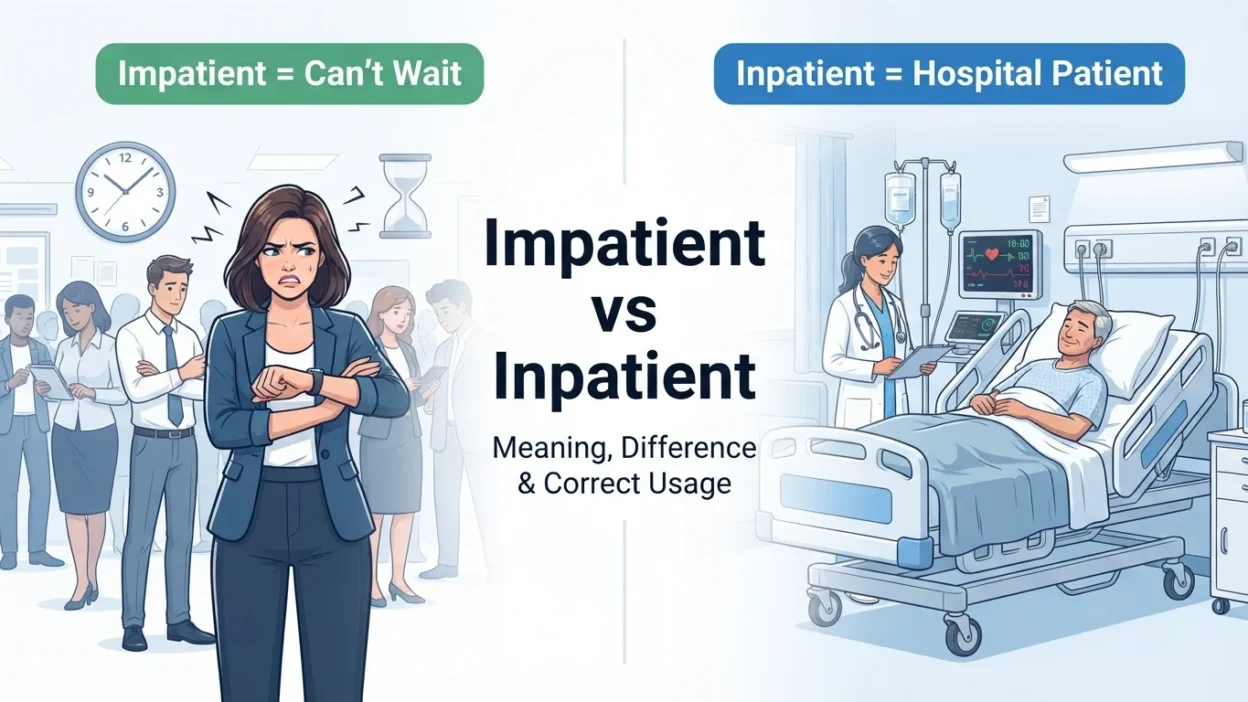
Many English learners confuse impatient vs inpatient because the two words look almost identical but have completely different meanings.
While they differ by only one letter, using the wrong one can change the meaning of an entire sentence.
Understanding impatient vs inpatient is essential for writing and speaking correctly.
In this guide, you’ll learn the meaning, difference, grammar, pronunciation, examples, and correct usage of impatient vs inpatient.
If you’re writing an email, reading medical documents, or improving your English vocabulary, this article will help you use both words confidently.
Quick Answer
Impatient describes a person who cannot wait calmly or becomes easily annoyed by delays.
Inpatient is a noun or adjective used in healthcare to describe a patient who stays in a hospital for treatment.
Impatient vs Inpatient at a Glance
| Feature | Impatient | Inpatient |
|---|---|---|
| Part of Speech | Adjective | Noun, Adjective |
| Meaning | Unable to wait calmly | A patient admitted to a hospital |
| Common Context | Emotions, behavior | Healthcare, hospitals |
| Opposite | Patient | Outpatient |
| Example | She became impatient. | The inpatient stayed overnight. |
What Does Impatient Mean?
Impatient is an adjective that describes someone who becomes annoyed, restless, or frustrated when waiting or facing delays.
Definition
Someone who is impatient wants things to happen quickly and dislikes waiting.
Examples
- The children became impatient while waiting for lunch.
- He was impatient with the slow internet.
- Sarah grew impatient after standing in line for an hour.
- Investors became impatient with the company’s slow progress.
Common Situations
| Situation | Example |
|---|---|
| Waiting | I became impatient after waiting 30 minutes. |
| Work | My manager is impatient with missed deadlines. |
| School | Students grew impatient during the long lecture. |
| Travel | Travelers became impatient because of the delayed flight. |
What Does Inpatient Mean?
Inpatient refers to a person who is admitted to a hospital and stays there for medical treatment.
It can be used as both a noun and an adjective.
Examples
- The doctor examined the inpatient this morning.
- She remained an inpatient for five days.
- The hospital expanded its inpatient services.
- Inpatient care provides continuous medical supervision.
Main Difference Between Impatient and Inpatient
The biggest difference is that impatient describes a person’s attitude, while inpatient refers to medical care or a hospital patient.
| Aspect | Impatient | Inpatient |
|---|---|---|
| Refers To | Emotion or behavior | Medical patient |
| Used In | Everyday English | Healthcare |
| Related To | Waiting, frustration | Hospital admission |
| Word Type | Adjective | Noun and adjective |
Grammar Forms of Impatient and Inpatient
Grammar Table
| Word | Part of Speech | Example |
|---|---|---|
| Impatient | Adjective | She became impatient. |
| Impatience | Noun | His impatience was obvious. |
| Impatiently | Adverb | They waited impatiently. |
| Inpatient | Noun | The inpatient recovered quickly. |
| Inpatient | Adjective | The hospital offers inpatient treatment. |
When Should You Use Impatient?
Use impatient whenever you’re describing someone’s feelings or behavior related to waiting.
Correct Examples
- Don’t be impatient.
- We became impatient with the delays.
- She looked impatient during the meeting.
- Customers are becoming impatient for updates.
When Should You Use Inpatient?
Use inpatient only in medical or healthcare situations.
Correct Examples
- The inpatient received daily treatment.
- The hospital admitted twenty new inpatients.
- Inpatient surgery requires hospital admission.
- Insurance covers inpatient care differently.
Real-Life Examples of Impatient vs Inpatient
Business
| Word | Example |
|---|---|
| Impatient | Customers became impatient because delivery was late. |
| Inpatient | The company’s insurance covers inpatient treatment. |
Education
| Word | Example |
|---|---|
| Impatient | Students grew impatient before the exam results. |
| Inpatient | Medical students visited the inpatient ward. |
Healthcare
| Word | Example |
|---|---|
| Impatient | Family members became impatient during long waiting times. |
| Inpatient | The inpatient received around-the-clock nursing care. |
Science and Research
| Word | Example |
|---|---|
| Impatient | Researchers became impatient awaiting funding approval. |
| Inpatient | The clinical trial included inpatient participants. |
Professional and Industry Usage
| Industry | Impatient | Inpatient |
|---|---|---|
| Healthcare | Describes family emotions | Hospital patient |
| Business | Customer behavior | Employee health insurance |
| Education | Student attitude | Medical education |
| Customer Service | Waiting frustrations | Rarely used |
| Insurance | Claims delays | Hospital coverage |
Why Do People Confuse Impatient and Inpatient?
Several reasons make these words confusing.
- They differ by only one letter.
- They sound somewhat similar.
- Both are common English words.
- Fast reading can make them look identical.
- Spell-check may not catch the mistake because both words are correctly spelled.
Memory Trick to Remember the Difference
Here’s an easy way to remember them.
| Word | Memory Trick |
|---|---|
| Impatient | Think “I’m tired of waiting.” |
| Inpatient | Think “In the hospital.” |
The word inpatient literally starts with in, helping you remember someone who stays in a hospital.
Common Mistakes and How to Avoid Them
Incorrect vs Correct
| Incorrect | Correct |
|---|---|
| She became inpatient with the delay. | She became impatient with the delay. |
| The impatient stayed in the hospital. | The inpatient stayed in the hospital. |
| He is an inpatient person. | He is an impatient person. |
| The doctor treated many impatients. | The doctor treated many inpatients. |
Tips
- If you’re talking about emotions, use impatient.
- If you’re talking about hospitals, use inpatient.
- Read the sentence carefully before choosing the word.
Step-by-Step Guide to Choosing the Correct Word
| Step | Question | Correct Word |
|---|---|---|
| 1 | Is someone frustrated by waiting? | Impatient |
| 2 | Is it about a hospital patient? | Inpatient |
| 3 | Is healthcare being discussed? | Inpatient |
| 4 | Is behavior or attitude described? | Impatient |
Practice Sentences
Choose the correct word.
- The children became ______ while waiting.
- Answer: impatient
- The doctor examined the ______ this morning.
- Answer: inpatient
- She grew ______ after several delays.
- Answer: impatient
- The hospital opened a new ______ unit.
- Answer: inpatient
Frequently Asked Questions
Is impatient the opposite of patient?
Yes. Impatient means unable to wait calmly, while patient means calm and willing to wait.
Is inpatient one word or two?
Inpatient is one word in modern English.
Can inpatient be an adjective?
Yes. For example: The hospital provides inpatient treatment.
Is impatient ever used in medicine?
Not usually. It describes emotions rather than medical care.
What is the opposite of inpatient?
The opposite is outpatient, which refers to a patient who receives treatment without staying overnight in a hospital.
People Also Ask
Why are impatient and inpatient commonly confused?
Because they differ by only one letter and have similar spelling, even though their meanings are completely different.
How can I remember the difference?
Remember that inpatient contains “in,” meaning a patient staying in a hospital. Impatient relates to feelings about waiting.
Which word is more common in everyday conversation?
Impatient is much more common because people frequently describe emotions and behavior, while inpatient is mostly used in healthcare settings.
Conclusion
Understanding impatient vs inpatient is easier once you remember what each word represents. Impatient describes someone who is frustrated or unable to wait calmly, while inpatient refers to a person admitted to a hospital for treatment. Although they look very similar, they belong to different contexts and should never be used interchangeably. When discussing emotions, choose impatient.
When discussing hospitals or medical care, choose inpatient. Mastering this simple distinction will improve your writing, speaking, and overall English accuracy.

Julian Wyatt is a passionate researcher and writer who explores symbols, mythology, cultural traditions, and hidden meanings. Through engaging articles, he helps readers uncover the fascinating stories and significance behind symbols worldwide.