Have you ever wondered whether you should write “mom” or “mum” when talking about your mother?
If so, you are not alone. The words mom vs mum often confuse English learners because both words have exactly the same basic meaning, but their spelling depends mainly on where English is spoken.
One version is especially common in American English, while the other is preferred in British English and several other varieties.
Understanding mom vs mum is useful when writing messages, school assignments, social media posts, emails, or professional content for an international audience.
Neither word is wrong. The important thing is choosing the spelling that matches your variety of English and keeping that choice consistent.
This guide explains the meaning, difference, pronunciation, grammar, examples, regional usage, common mistakes, and easy memory tricks for choosing the right word.
Quick Answer: Mom vs Mum
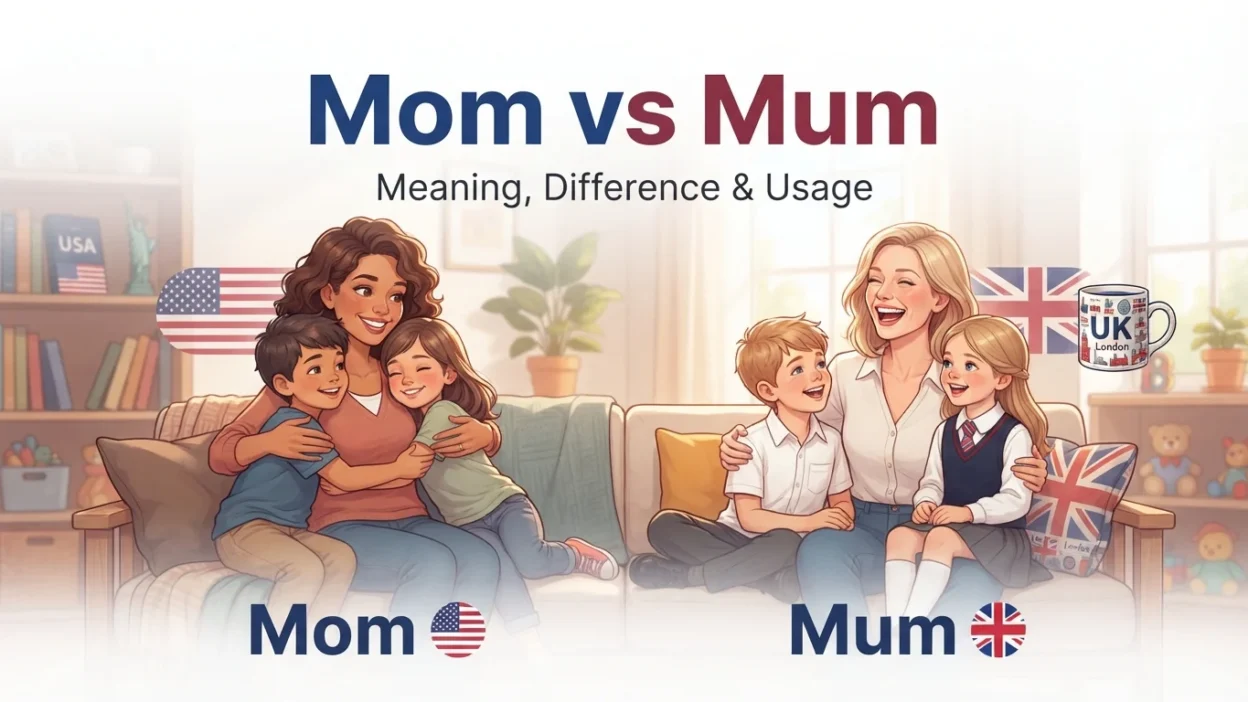
Mom and mum both mean “mother.”
- Mom is mainly used in American English.
- Mum is mainly used in British English, including common usage in the UK and many Commonwealth varieties.
- Both are informal terms for mother.
- Neither spelling is more correct universally; the best choice depends on your regional English.
What Does “Mom” Mean?
Mom is an informal word for a mother and is particularly common in American English.
It is used in everyday conversations, texts, social media, books, television, and informal writing. For example, an American English speaker might say, “My mom is picking me up after school.”
The word is generally warm, familiar, and affectionate. It is not normally used as a formal replacement for “mother” in official writing.
Examples of “Mom”
- “My mom makes the best cookies.”
- “I called my mom after work.”
- “Mom, can you help me with this?”
- “My mom lives in Chicago.”
- “I bought a birthday present for my mom.”
What Does “Mum” Mean?
Mum is also an informal word meaning mother, but it is strongly associated with British English.
You will commonly see mum in the UK, and it is also widely used in other English-speaking regions influenced by British English.
For example:
- “My mum is coming home soon.”
- “I called my mum this morning.”
- “Mum, where are my keys?”
- “My mum taught me how to cook.”
Just like mom, the word can express familiarity, affection, and closeness.
Mom vs Mum: Main Difference
The biggest difference between mom and mum is regional spelling, not meaning.
| Feature | Mom | Mum |
|---|---|---|
| Meaning | Mother | Mother |
| Main variety | American English | British English |
| Usage | Informal | Informal |
| Common in | United States | United Kingdom |
| Formal equivalent | Mother | Mother |
| Example | “My mom called.” | “My mum called.” |
| Meaning difference | None | None |
In other words, mom vs mum is mostly a question of British vs American English.
Mom vs Mum: Regional Usage
Regional English varieties often use different spellings and vocabulary. This is one of the easiest examples of how English changes across countries.
| Country/Region | Common Form |
|---|---|
| United States | Mom |
| United Kingdom | Mum |
| Canada | Mom is common, but usage varies |
| Australia | Mum |
| New Zealand | Mum |
| Ireland | Mum is common |
| South Africa | Mum is common |
| Other regions | Usage may vary |
There can also be regional differences within a country. Language is influenced by family habits, local communities, media, and cultural exposure.
Why Do People Confuse Mom and Mum?
People often confuse these words because they have the same meaning and nearly identical pronunciation.
The spelling difference becomes more noticeable when someone reads content from another country. An American reader may see “mum” and wonder whether it is a different word, while a British reader may notice “mom” and recognize it as American English.
Global communication has made this even more common. Movies, social media, websites, video games, and international education expose people to multiple varieties of English every day.
Mom vs Mum in American English
In American English, mom is the standard informal term.
You will commonly encounter it in:
- Family conversations
- Text messages
- School writing
- Social media
- American television
- Newspapers and websites
- Everyday speech
American English Examples
| Situation | Example |
|---|---|
| Family | “My mom is making dinner.” |
| School | “My mom signed the permission form.” |
| Texting | “I’ll ask my mom.” |
| Social media | “Happy birthday to my amazing mom!” |
| Conversation | “My mom told me to call you.” |
Mum in British English
In British English, mum is the normal informal term.
It appears in everyday speech and writing throughout the UK.
British English Examples
| Situation | Example |
|---|---|
| Family | “My mum is making dinner.” |
| School | “My mum signed the form.” |
| Texting | “I’ll ask my mum.” |
| Social media | “Happy birthday to my amazing mum!” |
| Conversation | “My mum told me to call you.” |
The grammar and meaning remain essentially identical. Only the preferred regional spelling changes.
Mom vs Mum in Different Contexts
Both words can appear in many everyday contexts. The key is to match the spelling with the English variety being used.
Business Context
Professional documents usually use mother rather than mom or mum when referring to a person formally.
For example:
Informal:
“My mom will attend the event.”
More formal:
“My mother will attend the event.”
The same principle applies to mum.
| Context | Recommended Word |
|---|---|
| Formal business letter | Mother |
| Casual workplace conversation | Mom/Mum |
| Personal email | Mom/Mum |
| Official form | Mother |
| Family message | Mom/Mum |
Education
Students may encounter either spelling depending on their school, teacher, textbook, or country.
An American student might write:
“My mom helped me complete my project.”
A British student might write:
“My mum helped me complete my project.”
Both sentences are grammatically correct within their respective varieties.
Social Media
Social media is less formal, so both forms are very common.
Examples include:
- “Love you, Mom! ❤️”
- “Best mum in the world! 💕”
- “Happy Mother’s Day, Mom!”
- “Happy Mother’s Day to my wonderful mum!”
The correct choice depends on the writer’s preferred variety of English.
Mom vs Mum: Grammar Forms
Although mom and mum are informal nouns, they can be used in several grammatical structures.
| Form | Mom | Mum |
|---|---|---|
| Singular | mom | mum |
| Possessive | mom’s | mum’s |
| Plural | moms | mums |
| Possessive plural | moms’ | mums’ |
| Formal equivalent | mother | mother |
Examples
Singular:
“My mom is here.”
Possessive:
“My mom’s car is outside.”
Plural:
“The moms waited outside the school.”
The British version works in exactly the same way:
Singular:
“My mum is here.”
Possessive:
“My mum’s car is outside.”
Plural:
“The mums waited outside the school.”
Mom vs Mum: Pronunciation
Despite the spelling difference, mom and mum are pronounced differently depending on the speaker’s accent.
In many American accents, mom has a vowel sound similar to the vowel in “hot” or “father,” although exact pronunciation varies by region.
In British English, mum commonly uses the same short vowel sound heard in words such as “cup” and “come.”
So, although the words have the same meaning, the pronunciation can reflect regional English as well.
Professional and Industry Usage
In professional or technical contexts, mother is usually more appropriate than either mom or mum.
This is especially true in:
- Medical documents
- Legal documents
- Government forms
- Academic research
- Scientific writing
- Business reports
- Official applications
| Industry | Common Formal Term | Informal Term |
|---|---|---|
| Medicine | Mother | Mom/Mum |
| Law | Mother | Mom/Mum |
| Education | Mother | Mom/Mum |
| Science | Mother | Mom/Mum |
| Business | Mother | Mom/Mum |
| Personal communication | Mom/Mum | Mom/Mum |
For example, a medical report would normally say “the patient’s mother”, not “the patient’s mom.”
Common Mistakes With Mom and Mum
One of the most common mistakes is assuming that one spelling is universally correct.
Mistake 1: Mixing Regional Styles
Inconsistent:
“My mom lives in London, and my mum visits her every weekend.”
This sentence is not grammatically wrong, but if the writer is following one regional variety consistently, switching between forms can look unusual.
Better:
“My mum lives in London, and my mum visits her every weekend.”
Or, in American English:
Better:
“My mom lives in London, and my mom visits her every weekend.”
Mistake 2: Using “Mom” in British-Style Writing
If you are deliberately writing in British English, mum is generally the better choice.
Less suitable for British English:
“My mom is coming tomorrow.”
British English:
“My mum is coming tomorrow.”
Mistake 3: Assuming “Mum” Means Something Different
Incorrect idea:
“Mom” and “mum” refer to different types of mothers.
Correct:
They have the same basic meaning. The main difference is regional usage.
Mistake 4: Using Informal Terms in Formal Documents
Less formal:
“My mom works as a doctor.”
More formal:
“My mother works as a doctor.”
The same applies to mum.
Correct vs Incorrect Sentences
| Incorrect/Unnatural | Better Version |
|---|---|
| “My mom and mum are the same word.” | “Mom and mum have the same meaning.” |
| “My mother is called mom in British English.” | “My mother is commonly called mum in British English.” |
| “I wrote mum in an American English assignment.” | “I used mom in an American English assignment.” |
| “My mom’s birthday is tomorrow.” | Correct in American English |
| “My mum’s birthday is tomorrow.” | Correct in British English |
Remember that incorrect does not always mean grammatically wrong. A spelling can simply be less appropriate for the regional variety you are using.
Mom vs Mum: Easy Memory Trick
Here is a simple way to remember the difference:
Mom = American English 🇺🇸
Mum = British English 🇬🇧
Think of the “o” in mom as a quick reminder of American English.
If you are writing for a British audience, choose mum.
If you are writing for an American audience, choose mom.
For international websites, either can work, but consistency is important.
Mom vs Mum vs Mother
It is also useful to understand the difference between these three words.
| Word | Meaning | Formality | Typical Usage |
|---|---|---|---|
| Mom | Mother | Informal | American English |
| Mum | Mother | Informal | British English |
| Mother | Female parent | Neutral/Formal | International/formal English |
Mother is the safest option when you need formal or internationally neutral English.
Mom and mum are more personal and conversational.
Real-Life Examples of Mom vs Mum
Example 1: Text Message
American:
“Hey Mom, I’ll be home at 7.”
British:
“Hey Mum, I’ll be home at 7.”
Example 2: Birthday Post
American:
“Happy birthday to the best mom ever!”
British:
“Happy birthday to the best mum ever!”
Example 3: School Assignment
American:
“My mom encouraged me to study harder.”
British:
“My mum encouraged me to study harder.”
Example 4: Casual Conversation
American:
“I need to call my mom.”
British:
“I need to call my mum.”
The sentence structure does not change. Only the regional word choice does.
When Should You Use Mom?
Use mom when:
- You are writing in American English.
- Your audience is primarily American.
- You are creating American-style social media content.
- You are texting or speaking casually with American English speakers.
- Your school or workplace follows American English conventions.
Example
“My mom always gives me great advice.”
When Should You Use Mum?
Use mum when:
- You are writing in British English.
- Your audience is primarily British.
- You are targeting UK readers.
- You are following British spelling conventions.
- Your school or organization uses British English.
Example
“My mum always gives me great advice.”
Which One Is More Correct?
Neither mom nor mum is universally more correct.
The correct choice depends on the variety of English you are using.
If you are writing for an American audience, choose mom. If you are writing for a British audience, choose mum.
If the context is formal and regional style does not matter, mother is often the safest choice.
Mom vs Mum: Quick Decision Table
| If You Are Writing For… | Choose |
|---|---|
| American readers | Mom |
| British readers | Mum |
| Australian readers | Mum |
| New Zealand readers | Mum |
| Formal international audience | Mother |
| Casual American conversation | Mom |
| Casual British conversation | Mum |
| Medical/legal document | Mother |
Frequently Asked Questions
Is “mom” or “mum” correct?
Both are correct. Mom is mainly associated with American English, while mum is mainly associated with British English.
Is mum British or American?
Mum is primarily associated with British English. It is also widely used in countries and regions influenced by British English.
Do mom and mum mean the same thing?
Yes. Both are informal words meaning mother. The main difference is regional usage and spelling.
Is “mom” formal or informal?
Mom is informal. In formal writing, mother is generally more appropriate.
Which is better for SEO: mom or mum?
Neither is automatically better. Use the version that matches your target audience and keyword intent. For a US audience, use mom; for a UK audience, mum may be more appropriate.
Can I use both mom and mum in the same article?
You can, especially when discussing the differences between American and British English. However, if you are targeting one regional audience, consistent usage usually creates a cleaner reading experience.
Final Thoughts on Mom vs Mum
The difference between mom vs mum is simple: both words mean “mother,” but they belong to different regional varieties of English. Mom is the standard informal form in American English, while mum is the common informal form in British English and several other varieties.
When choosing between them, think about your audience first. Use mom for American English and mum for British English. In formal, academic, legal, medical, or professional writing, mother is usually the better choice.
Once you remember the regional difference, choosing the right word becomes easy. The important rule is not that one spelling is right and the other is wrong—it is that your spelling should match your intended English variety and remain consistent throughout your writing.