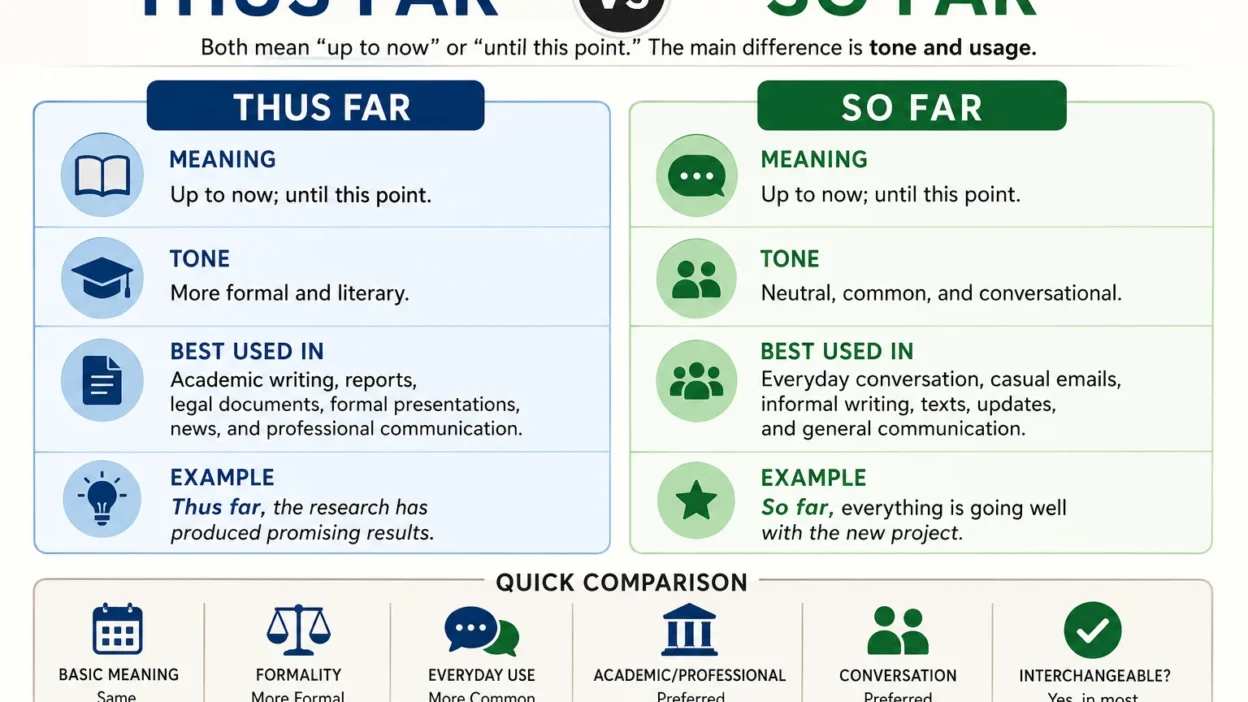
Thus far vs so far is a common usage question because both expressions communicate the idea of something continuing or being true up to a particular point in time.
In many sentences, they can be used interchangeably without changing the basic meaning.
However, they differ slightly in tone, formality, and typical context. Understanding this small can help you sound natural in everyday conversations as well as more polished in academic and writing.
The main difference in thus far vs so far is not usually the meaning but the style. So far is much more common in everyday English and works naturally in conversations, emails, and casual writing.
Thus far is more formal and often appears in academic papers, reports, journalism, legal writing, and formal presentations.
Both generally mean “up to this point” or “until now,” but choosing the right expression depends on your audience and context.
Quick Answer: Thus Far vs So Far
Thus far and so far generally mean the same thing: up to this point, until now, or up to the present time.
- So far is more common and natural in everyday English.
- Thus far sounds more formal and is common in academic and professional writing.
- In most sentences, either expression can be grammatically correct.
What Does “So Far” Mean?
So far means up to now, until this point, or up to the present time.
It is one of the most common expressions used to describe something that has happened, developed, or remained true from a starting point until now.
For example:
“The project has gone well so far.”
This means the project has gone well up to the present time.
Another example is:
“So far, we have received 200 applications.”
Here, so far tells us that 200 applications have been received up to now.
Common meanings of “So Far”
| Meaning | Example |
|---|---|
| Up to now | So far, everything is fine. |
| Until this point | The plan has worked so far. |
| Up to the present | So far, we have completed three tasks. |
| To the current stage | The investigation has progressed well so far. |
Because it is natural and flexible, so far is widely used in spoken and written English.
What Does “Thus Far” Mean?
Thus far also means up to now, until now, or up to this point.
The expression has essentially the same basic meaning as so far, but it has a more formal tone.
For example:
“Thus far, the evidence supports the original theory.”
This means:
“Up to this point, the evidence supports the original theory.”
You may see thus far in academic research, formal reports, professional documents, news articles, and other situations where a more formal style is preferred.
Common Meanings of “Thus Far”
| Meaning | Example |
|---|---|
| Up to now | Thus far, no problems have been reported. |
| Until this point | Thus far, the experiment has produced consistent results. |
| Up to the present | Thus far, the company has exceeded expectations. |
| To this stage | Thus far, the research has produced useful findings. |
Thus Far vs So Far: Main Difference
The primary difference between thus far vs so far is register, not meaning.
So far is neutral, common, and conversational. Thus far is more formal and literary.
| Feature | So Far | Thus Far |
|---|---|---|
| Basic meaning | Up to now | Up to now |
| Formality | Neutral | Formal |
| Everyday conversation | Very common | Less common |
| Academic writing | Common | Very common |
| Business writing | Common | Appropriate |
| Casual emails | Natural | Can sound formal |
| Legal/formal documents | Possible | Common |
| Meaning difference | Usually none | Usually none |
For most everyday situations, so far is the safer and more natural choice.
Thus Far vs So Far: Are They Interchangeable?
Yes, in many situations.
Consider these sentences:
“So far, the results have been positive.”
“Thus far, the results have been positive.”
Both sentences mean that the results have been positive up to now.
The difference is mainly stylistic. The first sentence sounds more natural in everyday communication, while the second sounds more formal.
Interchangeable Examples
| With “So Far” | With “Thus Far” |
|---|---|
| So far, everything is going well. | Thus far, everything is going well. |
| We have completed five tasks so far. | We have completed five tasks thus far. |
| So far, no one has complained. | Thus far, no one has complained. |
| The results have been encouraging so far. | The results have been encouraging thus far. |
The meaning remains almost identical in each pair.
When Should You Use “So Far”?
Use so far when you want natural, straightforward English.
It is especially appropriate for:
- Everyday conversations
- Casual emails
- Text messages
- General websites
- Customer communication
- Informal business discussions
- Personal writing
Examples
“How is your new job going so far?”
“So far, I really like the new software.”
“We haven’t had any problems so far.”
“The movie is pretty good so far.”
These sentences sound natural because so far is the standard everyday expression.
When Should You Use “Thus Far”?
Use thus far when you want a more formal, professional, or academic tone.
It works especially well in:
- Academic papers
- Research reports
- Business reports
- Legal documents
- Formal presentations
- Journalism
- Analytical writing
Examples
“Thus far, the study has produced promising results.”
“The company has thus far avoided significant financial losses.”
“Thus far, no evidence has been found to support the claim.”
The expression can make formal writing sound more polished, although it should not be used simply to make ordinary writing sound complicated.
Thus Far vs So Far in Business English
Both expressions are acceptable in business communication, but the choice depends on the tone.
So far is usually better for friendly workplace communication:
“So far, the new system is working well.”
Thus far can work better in a formal report:
“Thus far, the implementation process has proceeded according to plan.”
Business Usage Table
| Business Situation | Better Choice | Example |
|---|---|---|
| Casual team chat | So far | So far, we’re on schedule. |
| Customer email | So far | So far, we haven’t received any complaints. |
| Formal report | Thus far | Thus far, the project has met its objectives. |
| Executive presentation | Either | Thus far, performance has exceeded expectations. |
| Internal discussion | So far | So far, the strategy seems effective. |
Thus Far vs So Far in Academic Writing
Academic writing often favors thus far because it has a more formal tone.
For example:
“Thus far, researchers have identified three major factors.”
This sounds appropriate in a research paper.
However, so far is not grammatically wrong:
“So far, researchers have identified three major factors.”
The second sentence is perfectly understandable and grammatical. It simply sounds less formal.
Academic Examples
“Thus far, the research has focused primarily on environmental factors.”
“Thus far, no reliable explanation has been established.”
“The available evidence has thus far been inconclusive.”
In academic writing, thus far can be especially useful when discussing the current state of research.
Thus Far vs So Far in Science
Scientific writing frequently uses thus far when discussing research findings that have accumulated up to the present point.
For example:
“Thus far, the experiment has produced consistent results.”
The sentence emphasizes the current status of the experiment.
So far is also possible:
“So far, the experiment has produced consistent results.”
This sounds less formal but remains correct.
| Scientific Context | Example |
|---|---|
| Research results | Thus far, the results have been consistent. |
| Experimental progress | So far, the experiment has proceeded normally. |
| Published evidence | Thus far, published studies have found limited evidence. |
| Laboratory discussion | So far, everything looks normal. |
Thus Far vs So Far in Everyday English
In everyday English, so far is overwhelmingly more natural.
Imagine someone asking:
“How’s your vacation going?”
A natural response would be:
“It’s been great so far.”
You could say:
“It’s been great thus far.”
But this sounds unusually formal for an ordinary conversation.
Therefore, when speaking with friends, family, or coworkers in casual situations, so far is generally the best choice.
Grammar and Sentence Structure
Both thus far and so far are adverbial expressions. They commonly modify a verb or an entire clause by showing that something is true up to the present point.
They can appear at the beginning or end of a sentence.
Grammar Forms Table
| Position | Example |
|---|---|
| Beginning | So far, the plan has worked. |
| Beginning | Thus far, the evidence is convincing. |
| End | The plan has worked so far. |
| End | The evidence has been convincing thus far. |
| With present perfect | We have completed three stages so far. |
| With present perfect | We have completed three stages thus far. |
Both expressions frequently appear with the present perfect tense because the action or situation began in the past and continues to have relevance now.
“So Far” With the Present Perfect
The present perfect is particularly common with so far.
Examples:
“We have sold 500 tickets so far.”
“She has completed four chapters so far.”
“They haven’t found a solution so far.”
The expression connects past activity with the present situation.
Common Patterns
| Pattern | Example |
|---|---|
| have/has + past participle + so far | We have finished three tasks so far. |
| haven’t/hasn’t + past participle + so far | We haven’t received a response so far. |
| So far + present perfect | So far, she has performed well. |
“Thus Far” With the Present Perfect
Thus far can be used in exactly the same grammatical patterns.
Examples:
“We have completed three stages thus far.”
“She has achieved excellent results thus far.”
“Thus far, no major problems have occurred.”
The grammar does not change simply because you replace so far with thus far.
Real-Life Examples of “So Far”
In Education
“I have completed six chapters so far.”
At Work
“So far, the project is on schedule.”
In Travel
“We have visited three cities so far.”
In Sports
“The team has won four games so far.”
In Personal Life
“So far, this has been a great experience.”
In Technology
“The new app has received positive reviews so far.”
These examples demonstrate how naturally so far fits into everyday communication.
Real-Life Examples of “Thus Far”
In Business
“Thus far, the company has exceeded its sales targets.”
In Education
“Thus far, the study has identified several important trends.”
In Science
“Thus far, the experiment has generated consistent data.”
In Law
“Thus far, the investigation has revealed no evidence of wrongdoing.”
In Journalism
“Thus far, officials have declined to comment.”
In Formal Reports
“Thus far, the project has remained within its approved budget.”
These contexts favor thus far because of its formal register.
Common Mistakes With Thus Far and So Far
Although both expressions are simple, learners sometimes use them awkwardly or choose one when another expression would sound more natural.
Mistake 1: Using “Thus Far” in Casual Conversation
Less natural:
“How is your new phone working thus far?”
More natural:
“How is your new phone working so far?”
“Thus far” is grammatically correct, but it may sound overly formal.
Mistake 2: Thinking “Thus Far” Is More Correct
Incorrect idea:
“Thus far is correct, while so far is incorrect.”
This is false.
Both expressions are correct. The main distinction is formality and style.
Mistake 3: Assuming They Always Have Different Meanings
Incorrect idea:
“So far means recently, while thus far means in the past.”
In this usage, both generally mean up to now.
Correct vs Incorrect Usage
| Incorrect or Awkward | Better |
|---|---|
| How are you doing thus far? | How are you doing so far? |
| Thus far, the movie is fun. | So far, the movie is fun. |
| So far, the formal report indicates… | Thus far, the formal report indicates… |
| Thus far means something completely different. | Thus far is mainly a formal alternative to so far. |
Why Do People Confuse “Thus Far” and “So Far”?
People confuse these expressions because their meanings overlap almost completely.
Both contain an idea of time progressing toward the present.
The word so in “so far” does not mean “very” in this expression. Instead, so far functions as a fixed phrase meaning up to now.
Similarly, thus far means approximately up to this point.
The main distinction is therefore stylistic rather than semantic.
A Simple Memory Trick
Use this simple rule:
SO FAR = everyday English
THUS FAR = formal English
Think of so far as the conversational choice and thus far as the report-writing choice.
For example:
“So far, everything is fine.”
Sounds natural in conversation.
“Thus far, the findings have been inconclusive.”
Sounds natural in a formal research report.
Remembering “so far = simple and common” and “thus far = formal and polished” makes the choice easy.
Comparison Table: Thus Far vs So Far
| Category | Thus Far | So Far |
|---|---|---|
| Meaning | Up to now | Up to now |
| Formality | More formal | Neutral |
| Frequency | Less common | More common |
| Conversation | Possible but formal | Preferred |
| Academic writing | Excellent | Acceptable |
| Business writing | Excellent | Excellent |
| Casual writing | Sometimes awkward | Preferred |
| Professional reports | Very suitable | Suitable |
| Legal writing | Common | Less formal |
| Journalism | Common | Common |
| Grammar | Adverbial phrase | Adverbial phrase |
Industry Usage Comparison
| Industry | Preferred Expression | Example |
|---|---|---|
| Academic research | Thus far | Thus far, the evidence remains limited. |
| Science | Thus far | Thus far, the experiment has been successful. |
| Business | Both | Sales have increased so far. |
| Legal | Thus far | Thus far, no evidence has emerged. |
| Journalism | Both | Officials have thus far remained silent. |
| Education | Both | So far, students have performed well. |
| Casual conversation | So far | So far, I’m enjoying the course. |
| Technology | Both | The update has worked well so far. |
When “So Far” Is Better Than “Thus Far”
Choose so far when your goal is natural, direct communication.
For example:
“So far, I haven’t had any problems.”
This sounds completely natural.
Replacing it with:
“Thus far, I haven’t had any problems.”
is grammatically correct, but it sounds more formal than necessary.
For ordinary communication, simplicity is usually better.
When “Thus Far” Is Better Than “So Far”
Choose thus far when the surrounding writing is formal and analytical.
For example:
“Thus far, the available evidence has failed to establish a clear relationship between the two variables.”
The formal style of thus far fits the academic language surrounding it.
However, don’t force thus far into every formal sentence. Good writing depends on clarity and naturalness, not simply on using sophisticated vocabulary.
Can “Thus Far” and “So Far” Start a Sentence?
Yes.
Both can appear at the beginning of a sentence.
With “So Far”
“So far, the results have been encouraging.”
With “Thus Far”
“Thus far, the results have been encouraging.”
A comma usually follows the introductory expression when it appears at the beginning of the sentence.
Can They Appear at the End of a Sentence?
Yes.
Examples:
“The project has been successful so far.”
“The project has been successful thus far.”
Both are grammatically acceptable.
However, so far is considerably more natural in everyday writing and speech.
“Thus Far” vs “So Far” vs “Until Now”
All three can refer to a period extending from the past to the present.
| Expression | Meaning | Tone |
|---|---|---|
| So far | Up to now | Neutral |
| Thus far | Up to now | Formal |
| Until now | Up to the present | Neutral, sometimes emphasizes change |
For example:
“So far, everything has worked.”
“Thus far, everything has worked.”
“Until now, everything has worked.”
The third sentence can sometimes suggest that something has changed or may change after the present point.
“Thus Far” vs “So Far” vs “To Date”
To date is another formal alternative that can mean up to the present time.
| Expression | Example | Tone |
|---|---|---|
| So far | We have sold 1,000 units so far. | Neutral |
| Thus far | We have sold 1,000 units thus far. | Formal |
| To date | We have sold 1,000 units to date. | Formal/business |
In business reports, to date can sound especially natural when reporting numbers or measurable progress.
Practical Decision Guide
Use this quick process when choosing between the two expressions:
| Step | Question | Choice |
|---|---|---|
| 1 | Are you talking casually? | So far |
| 2 | Are you writing an academic paper? | Thus far |
| 3 | Are you writing a formal report? | Thus far |
| 4 | Are you sending a casual email? | So far |
| 5 | Are both grammatically possible? | Choose based on tone |
| 6 | Are you unsure? | So far is usually safest |
Frequently Asked Questions
Is “thus far” the same as “so far”?
Yes. In most contexts, thus far and so far mean “up to now” or “until this point.” The major difference is tone: thus far is more formal.
Which is more common, “thus far” or “so far”?
So far is much more common in everyday English, conversation, and general writing.
Is “thus far” formal?
Yes. Thus far has a more formal, literary, or academic tone than so far.
Can I use “so far” in academic writing?
Yes. So far is grammatically correct in academic writing, although thus far may fit better when a highly formal tone is desired.
Is “thus far” grammatically correct?
Yes. Thus far is a standard English adverbial expression meaning “up to now” or “until this point.”
Which should I use in everyday conversation?
Use so far. It is natural, common, and easily understood in everyday speech.
Final Comparison: Thus Far vs So Far
The simplest way to understand thus far vs so far is to focus on style rather than meaning. Both expressions generally mean “up to now,” “until now,” or “up to this point.”
So far is the more common and natural choice for everyday English. It works well in conversations, casual emails, general writing, and most ordinary situations.
Thus far communicates essentially the same idea but sounds more formal. It is especially useful in academic papers, research reports, professional documents, legal writing, and formal presentations.
When in doubt, choose so far for natural everyday English. Choose thus far when the surrounding context calls for a more formal tone.
Conclusion
The key difference in thus far vs so far is formality, not basic meaning. Both expressions describe something that has happened or remained true up to the present point.
Use so far when you want simple, natural, everyday English. Use thus far when you want a more formal or academic style.
Neither expression is inherently more correct than the other.
The easiest rule to remember is: “so far” is common and conversational, while “thus far” is formal and polished.
Once you understand this distinction, choosing between them becomes straightforward.