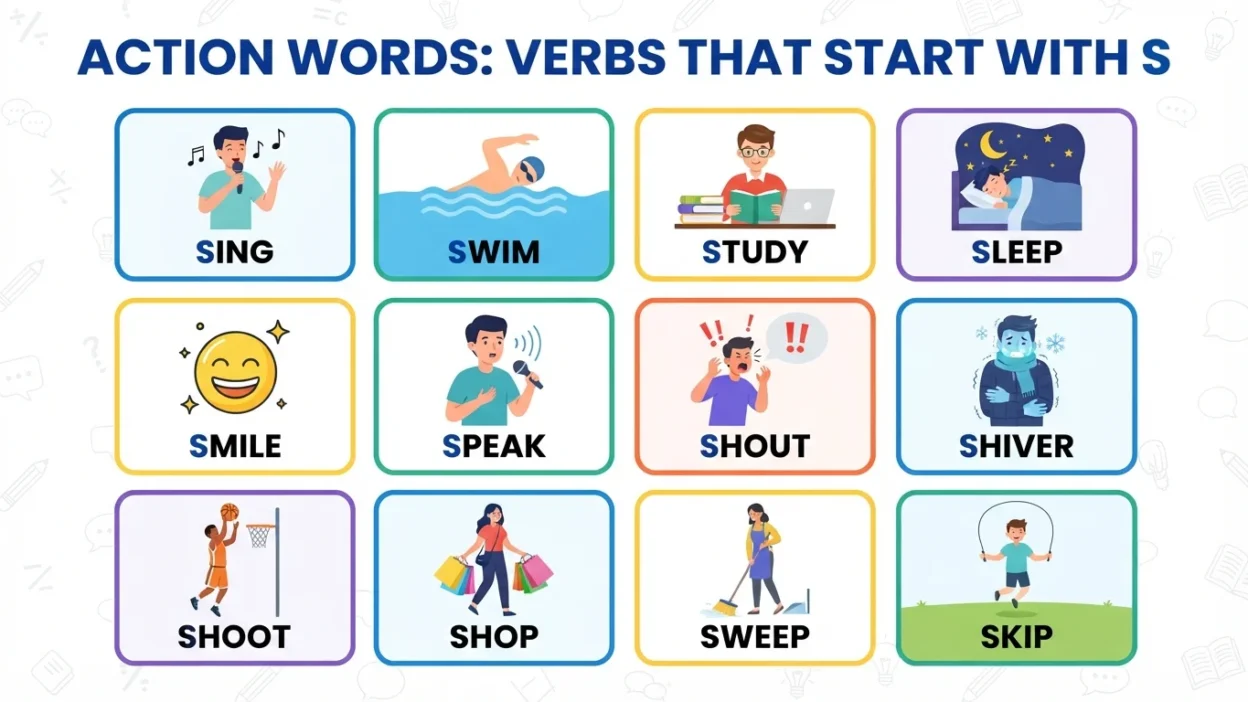
Verbs that start with S are some of the most useful action words in the English language.
If you’re writing an essay, improving your vocabulary, preparing for exams, or creating professional content, learning verbs that start with S helps you communicate more clearly and confidently.
These verbs describe actions, processes, feelings, and states that appear in everyday conversations, business writing, education, and science.
From simple verbs like say and see to advanced words like synthesize and speculate, there are hundreds of useful options.
This guide explains the meanings, usage, grammar forms, examples, and common mistakes related to verbs that start with S, making it easy for learners of every level.
Quick Answer
Verbs that start with S are action or state words beginning with the letter S. Examples include see, speak, smile, solve, study, support, simplify, strengthen, and succeed. They are commonly used in daily conversation, academic writing, business communication, and professional fields.
What Are Verbs That Start With S?
A verb is a word that expresses an action, occurrence, or state of being. When a verb begins with the letter S, it is called a verb that starts with S.
Examples include:
- Say
- See
- Smile
- Speak
- Study
- Support
- Save
- Search
- Solve
- Share
These verbs help describe actions in nearly every type of writing.
Main Table of Verbs That Start With S
| Verb | Meaning | Example |
|---|---|---|
| Say | Speak words | She said hello. |
| See | Notice with the eyes | I see the mountains. |
| Smile | Show happiness | He smiled politely. |
| Speak | Communicate verbally | Please speak clearly. |
| Study | Learn carefully | Students study daily. |
| Save | Keep safe | Save your files. |
| Search | Look for something | We searched online. |
| Solve | Find an answer | She solved the puzzle. |
| Support | Help someone | Friends support each other. |
| Share | Give part of something | Share your ideas. |
| Send | Transfer something | Send the email today. |
| Show | Display | Show your work. |
| Start | Begin | Let’s start now. |
| Stop | End movement | Stop talking. |
| Succeed | Achieve success | She succeeded quickly. |
Why Learn Verbs That Start With S?
Learning these verbs improves both spoken and written English.
Benefits include:
- Expands vocabulary
- Improves writing skills
- Makes communication clearer
- Helps in competitive exams
- Enhances business communication
- Builds confidence in speaking English
250+ Common Verbs That Start With S
Everyday Verbs
- Say
- See
- Sit
- Stand
- Smile
- Speak
- Sleep
- Sing
- Swim
- Study
- Stop
- Start
- Save
- Share
- Search
- Sell
- Send
- Show
- Shake
- Shut
- Skip
- Stretch
- Scream
- Smell
- Sneak
- Spin
- Slide
- Sweep
- Serve
- Shop
- Sign
- Shine
- Scratch
- Snap
- Speed
- Spray
- Spill
- Split
- Stir
- Suffer
Academic Verbs
- Solve
- Summarize
- Simplify
- Suggest
- Support
- Structure
- Specify
- Separate
- Select
- Survey
- Scrutinize
- Synthesize
- Substitute
- Standardize
- Sequence
- Sketch
- Strengthen
- Sort
- State
- Score
Business Verbs
- Sell
- Ship
- Secure
- Schedule
- Supply
- Sponsor
- Supervise
- Strategize
- Stabilize
- Streamline
- Sustain
- Scale
- Save
- Sign
- Service
- Source
- Simplify
- Support
- Scan
- Screen
Science Verbs
- Separate
- Solidify
- Suspend
- Sample
- Sterilize
- Stimulate
- Synthesize
- Sequence
- Scan
- Store
- Stabilize
- Solve
- Survey
- Study
- Screen
Categories of Verbs That Start With S
| Category | Examples |
|---|---|
| Communication | Say, Speak, Shout, Suggest |
| Movement | Swim, Slide, Skip, Sprint |
| Learning | Study, Summarize, Solve |
| Business | Sell, Ship, Schedule |
| Technology | Scan, Save, Search |
| Science | Synthesize, Separate, Sterilize |
| Emotions | Smile, Suffer, Surprise |
| Daily Life | Sit, Stand, Sleep |
Grammar Forms of Common S Verbs
| Base Verb | Past | Past Participle | Present Participle |
|---|---|---|---|
| Say | Said | Said | Saying |
| See | Saw | Seen | Seeing |
| Speak | Spoke | Spoken | Speaking |
| Study | Studied | Studied | Studying |
| Smile | Smiled | Smiled | Smiling |
| Save | Saved | Saved | Saving |
| Solve | Solved | Solved | Solving |
| Search | Searched | Searched | Searching |
| Send | Sent | Sent | Sending |
| Show | Showed | Shown | Showing |
How to Use Verbs That Start With S
Using these verbs correctly depends on context.
Everyday Conversation
- I see your point.
- She smiled at everyone.
- Please sit here.
- They started early.
Academic Writing
- Researchers studied the results.
- Students summarized the article.
- Scientists solved the equation.
Business Communication
- We scheduled the meeting.
- Please send the report.
- The company supports innovation.
Science
- The researchers synthesized the compound.
- Scientists separated the samples.
- Engineers stabilized the system.
Real-Life Examples
| Field | Example Sentence |
|---|---|
| Education | Students study every evening. |
| Business | The manager signed the agreement. |
| Technology | Save the document before closing it. |
| Healthcare | Doctors sterilized the equipment. |
| Science | Researchers synthesized new materials. |
| Sports | Athletes sprint toward the finish line. |
| Marketing | Companies share updates online. |
Industry Usage Table
| Industry | Frequently Used S Verbs |
|---|---|
| Education | Study, Summarize, Solve |
| Finance | Save, Spend, Secure |
| Marketing | Share, Sell, Support |
| Healthcare | Sterilize, Scan, Stabilize |
| Engineering | Strengthen, Structure, Solve |
| Information Technology | Save, Search, Scan, Synchronize |
| Customer Service | Support, Solve, Serve |
Choosing the Right Verb
| Situation | Best Verb |
|---|---|
| Giving information | Say |
| Looking with eyes | See |
| Learning | Study |
| Helping | Support |
| Finding an answer | Solve |
| Beginning something | Start |
| Ending an action | Stop |
| Sending information | Send |
Common Mistakes
Many learners confuse similar verbs.
| Incorrect | Correct |
|---|---|
| She say hello. | She says hello. |
| I seen him yesterday. | I saw him yesterday. |
| He speaked loudly. | He spoke loudly. |
| They studys English. | They study English. |
| Please sended the file. | Please sent the file. (Better: Please send the file.) |
Correct vs Incorrect Sentences
Incorrect
- He speaked very well.
- I seen the movie.
- She say goodbye.
- We startted early.
Correct
- He spoke very well.
- I saw the movie.
- She says goodbye.
- We started early.
Memory Tricks
Remember these simple tips:
- Say uses said, not “sayed.”
- See → Saw → Seen follows an irregular pattern.
- Most regular S verbs simply add -ed in the past tense.
- If the verb ends in y, change y to i before adding -ed (study → studied).
Tips for Expanding Your Vocabulary
- Read books and newspapers regularly.
- Learn five new verbs every day.
- Use flashcards.
- Write daily journal entries.
- Practice speaking with friends.
- Watch English videos with subtitles.
Practice Exercise
Choose the correct verb.
- She _____ English every day.
- We _____ the answer quickly.
- Please _____ your homework.
- I _____ a beautiful bird this morning.
- They _____ the meeting yesterday.
Answers:
- studies
- solved
- submit/send
- saw
- scheduled
Frequently Asked Questions
What are verbs that start with S?
They are verbs beginning with the letter S, such as say, see, smile, study, support, and solve.
Why are verbs that start with S important?
They improve vocabulary, writing, speaking, and professional communication.
Which S verbs are most common?
Common examples include say, see, speak, smile, study, save, search, solve, start, and stop.
Are all S verbs regular?
No. Some are irregular, such as say (said), see (saw, seen), and speak (spoke, spoken).
How can I remember irregular S verbs?
Practice them in sentences, use flashcards, and review their past tense forms regularly.
Can verbs that start with S be used in professional writing?
Yes. Many industries frequently use verbs like support, simplify, strengthen, schedule, secure, and synthesize.
Conclusion
Learning verbs that start with S is an excellent way to strengthen your English vocabulary and improve communication in everyday life, education, business, and professional settings.
From common verbs like say, see, and study to advanced choices like synthesize and stabilize, these action words make your writing more accurate and expressive.
Practice using them in sentences, remember irregular forms, and apply them in real-life situations to build confidence and fluency.