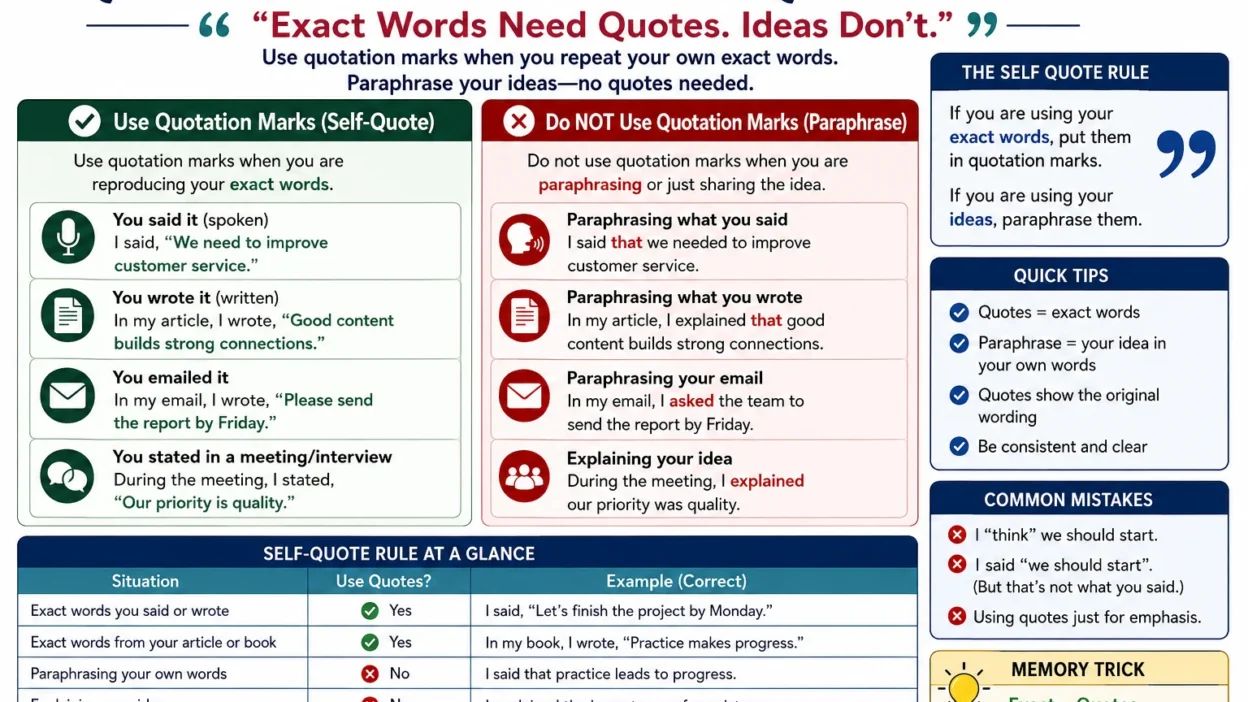
Understanding the quotation marks self quote rule can be confusing because writers often wonder if they should use quotation marks when repeating their own words.
The answer depends on what you are doing with the quotation. If you are reproducing your exact words from something you previously said or wrote, quotation marks can show readers that the wording is being presented as a direct quotation.
However, if you are simply restating your own idea, quotation marks are usually unnecessary.
The quotation marks self quote rule is especially useful in essays, articles, interviews, business writing, academic work, and social media posts.
Writers may quote themselves to emphasize an earlier statement, document what they said, or distinguish exact words a later explanation.
Knowing when quotation marks are appropriate helps prevent awkward punctuation and makes your writing clearer and more professional.
This guide explains the quotation marks self quote rule, examples, common mistakes, and practical usage.
Quick Answer
You can use quotation marks when you reproduce your own exact words from an earlier statement, speech, interview, email, or written work.
If you are only paraphrasing your own idea, quotation marks are normally unnecessary.
Example: I said, “We need to focus on quality first.”
When quoting yourself in formal writing, make it clear that the quoted words are yours.
What Does the Quotation Marks Self Quote Rule Mean?
The quotation marks self quote rule refers to the use of quotation marks when a writer or speaker quotes their own previously spoken or written words.
The basic principle is simple:
Use quotation marks when presenting your exact earlier words as a direct quotation.
For example:
Correct:
I told the team, “We need a better strategy.”
Here, the quotation marks show the reader exactly what the speaker said.
However, consider this sentence:
I told the team that we needed a better strategy.
This is a paraphrase. The writer is communicating the idea without claiming that these were the speaker’s exact words, so quotation marks are not required.
Basic Rule
| Situation | Quotation Marks? | Example |
|---|---|---|
| Repeating your exact words | Yes | I said, “This is our best option.” |
| Paraphrasing yourself | Usually no | I said that it was our best option. |
| Referring to an idea | No | I explained my strategy. |
| Quoting a previous written statement | Yes | My article stated, “Clear writing matters.” |
| Mentioning a word as a word | Often yes | I used the word “effective.” |
| Reproducing a long formal quotation | Follow the applicable style guide | Academic or professional block quotation |
When Should You Quote Yourself?
You should quote yourself when the exact wording matters.
For example, imagine that you made a statement during a meeting and later wrote a report about that meeting. If you want to reproduce the exact statement, quotation marks make that distinction clear.
Example:
During the meeting, I said, “Our priority should be customer satisfaction.”
The quotation marks tell readers that the words inside them are being presented as the speaker’s exact words.
Self-quotation can also be useful when discussing something you wrote previously.
Example:
In my earlier article, I wrote, “Good writing should make complicated ideas easier to understand.”
Here, quotation marks identify the exact language from the earlier article.
When Exact Wording Matters
| Purpose | Example |
|---|---|
| Recalling a speech | I said, “We can solve this problem.” |
| Referring to an article | I previously wrote, “Clarity is essential.” |
| Reproducing an email | My email stated, “The project will begin Monday.” |
| Referring to an interview | I explained, “The decision was based on the available evidence.” |
| Discussing your own published words | My book says, “Language changes over time.” |
When Should You Not Use Quotation Marks for Yourself?
Quotation marks are not normally needed simply because you are talking about something you previously said.
If you are paraphrasing yourself, you can report the idea without quotation marks.
Without quotation marks:
I explained that the project needed more time.
This sentence does not claim to reproduce your exact words.
Compare it with:
With quotation marks:
I explained, “The project needs more time.”
The second sentence presents the words as a direct quotation.
This distinction is one of the most important parts of the quotation marks self quote rule.
Direct Quote vs. Paraphrase
| Type | Sentence | Quotation Marks |
|---|---|---|
| Direct quotation | I said, “We should leave now.” | Yes |
| Paraphrase | I said that we should leave. | No |
| Summary | I explained the situation. | No |
| Exact written wording | I wrote, “The deadline is Friday.” | Yes |
| General reference | I previously discussed the deadline. | No |
Can You Quote Yourself in an Essay?
Yes, you can quote yourself in an essay, but whether you should depends on the purpose and the academic context.
For example, if an assignment asks you to reflect on something you previously wrote, you might include your earlier words as a quotation.
Example:
In my earlier reflection, I wrote, “I initially believed that leadership was mainly about authority.”
The quotation shows exactly what you wrote previously.
However, academic writing often requires careful documentation. If your earlier work has been formally published, submitted, or made available elsewhere, your institution or style guide may have specific rules about self-citation.
In academic contexts, quoting yourself does not automatically eliminate the need for attribution.
Academic Self-Quotation
| Situation | Recommended Approach |
|---|---|
| Quoting an unpublished personal note | Explain the context clearly |
| Quoting your previous essay | Follow your institution’s citation rules |
| Quoting your published article | Cite the earlier publication where required |
| Referring to your own research | Use the appropriate citation style |
| Simply explaining your previous idea | Paraphrase if exact wording is unnecessary |
Can You Put Your Own Words in Quotation Marks?
Yes, if you are deliberately presenting those words as a quotation.
For example:
I told my colleague, “Let’s review the numbers one more time.”
The fact that you are quoting yourself does not change the basic function of quotation marks. Quotation marks identify direct speech or reproduced wording.
However, quotation marks should not be added simply to make your statement look important.
Incorrect or unnecessary:
I think “good communication” is important.
This could be correct if “good communication” is being treated as a particular phrase or term. But if you are simply expressing your idea, quotation marks may be unnecessary.
Better:
I think good communication is important.
Quoting Yourself in a Conversation
When writing dialogue, quotation marks are used for your spoken words just as they are for anyone else’s spoken words.
For example:
“I don’t think we should rush the decision,” I said.
“Why not?” she asked.
“Because we don’t have enough information,” I replied.
The quotation marks do not depend on whether the speaker is the writer, narrator, or another person.
Dialogue Example
Incorrect:
I said that “we should wait.”
If you are reporting exact speech, punctuation and quotation placement should follow the applicable style conventions.
Clearer:
I said, “We should wait.”
The second version clearly presents the words as direct speech.
Self-Quotation in Business Writing
Self-quotation can be particularly useful in professional communication when documenting decisions, statements, or commitments.
For example:
During the meeting, I stated, “We will complete the first phase by Friday.”
This can be useful when a report needs to preserve the exact wording of a commitment.
Another example:
In my previous email, I wrote, “Please send the final figures before noon.”
The quotation helps distinguish the original wording from the writer’s current explanation.
Business Examples
| Context | Example |
|---|---|
| Meeting minutes | I said, “We need additional data.” |
| Project report | I previously stated, “The deadline remains unchanged.” |
| Email follow-up | My earlier email said, “Please confirm receipt.” |
| Presentation | As I mentioned earlier, “Customer feedback is our priority.” |
| Policy discussion | I explained, “The policy applies to all departments.” |
Self-Quotation in Academic Writing
In academic writing, quotation marks can identify your exact earlier words, but writers should avoid unnecessary self-quotation.
Academic writing generally values evidence, analysis, and clarity. Quoting yourself is most useful when the wording itself is relevant.
For example:
In my previous study, I described the problem as “a significant barrier to effective communication.”
Here, the phrase is reproduced as a direct quotation.
If the exact wording is not important, paraphrasing may be more natural:
In my previous study, I identified the problem as a significant barrier to effective communication.
Academic Comparison
| Purpose | Better Choice |
|---|---|
| Exact wording matters | Direct quotation |
| Only the idea matters | Paraphrase |
| Previous published work is discussed | Cite appropriately |
| A phrase is being analyzed | Quote it |
| Long irrelevant passage | Summarize instead |
Self-Quotation in Articles and Blog Posts
Writers frequently quote themselves in articles when referring to an earlier post, interview, or publication.
For example:
In an earlier article, I wrote, “Readers often confuse these two expressions.”
The quotation tells the reader that the phrase comes from an earlier piece of writing.
You can also use a short self-quotation to connect an earlier statement with a new argument:
I previously described the issue as “a problem of clarity rather than grammar.” That distinction remains important.
This approach is useful because it separates the writer’s previous wording from the new commentary.
Self-Quotation in Interviews
Interview writers often quote themselves when explaining what they said during an interview.
For example:
When asked about the project’s future, I said, “We are focusing on sustainable growth.”
If the interview has been published, the exact wording may be reproduced with quotation marks.
If you are summarizing what you said rather than reproducing your exact words, quotation marks are not necessary:
When asked about the project’s future, I explained that we were focusing on sustainable growth.
Interview Examples
| Direct Self-Quote | Paraphrase |
|---|---|
| I said, “We need more time.” | I said that we needed more time. |
| I explained, “The results were unexpected.” | I explained that the results were unexpected. |
| I stated, “Quality comes first.” | I stated that quality was the priority. |
| I told them, “We should reconsider.” | I told them that we should reconsider. |
Quotation Marks Around Your Own Words for Emphasis
One common mistake is using quotation marks around your own words simply for emphasis.
Quotation marks have specific functions. They can indicate direct quotations, certain titles, words used in a special sense, or other style-dependent purposes.
They should not normally replace italics or bold formatting merely to make a word stand out.
Unnecessary:
Our company provides “excellent” service.
If excellent is simply the writer’s normal adjective, quotation marks can make the statement sound sarcastic or doubtful.
Better:
Our company provides excellent service.
If the quotation marks are intentionally signaling irony or skepticism, however, they can be meaningful:
The company’s “excellent” service resulted in three complaints.
Here, the quotation marks suggest that the writer questions whether the service was actually excellent.
Quotation Marks and Self-Reference
Sometimes writers use quotation marks when referring to a particular phrase they have coined or used.
For example:
I call this approach “structured simplicity.”
The quotation marks identify the phrase as a specific expression.
But if the phrase has become an established term in the context, the punctuation may depend on the publication’s style.
Self-Reference Examples
| Sentence | Function |
|---|---|
| I call this method “structured simplicity.” | Names a phrase |
| I said, “Let’s try again.” | Direct quotation |
| I previously described the method as simple. | Paraphrase |
| The method is known as structured simplicity. | Established term |
What Is the Difference Between a Direct Quote and a Self-Quote?
A direct quote reproduces someone’s exact words. A self-quote is simply a direct quote in which the original speaker or writer is the same person who is now discussing those words.
Therefore, a self-quote is not a completely separate grammatical category.
The punctuation rules are generally based on the fact that the words are being quoted, not on who originally said them.
Main Comparison Table
| Feature | Direct Quote | Self-Quote |
|---|---|---|
| Exact wording | Yes | Yes |
| Uses quotation marks | Usually | Usually |
| Original speaker | Someone else | Yourself |
| Can occur in dialogue | Yes | Yes |
| Can occur in writing | Yes | Yes |
| May require citation | Sometimes | Sometimes |
| Can be paraphrased | Yes | Yes |
This is why the quotation marks self quote rule is easier to understand when you think of self-quotation as a type of direct quotation.
Grammar Forms for Self-Quotation
The structure used for a self-quotation depends on whether you are quoting speech, writing, or a previous statement.
| Structure | Example |
|---|---|
| I said, “…” | I said, “We should leave.” |
| I wrote, “…” | I wrote, “The results were clear.” |
| I stated, “…” | I stated, “The policy needs revision.” |
| I explained, “…” | I explained, “The figures are incomplete.” |
| I previously wrote, “…” | I previously wrote, “Clarity matters.” |
| In my earlier article, I wrote, “…” | In my earlier article, I wrote, “Clarity matters.” |
The reporting verb helps readers understand that the quotation contains the speaker’s or writer’s exact words.
Common Mistakes With Self-Quotation
Understanding common errors makes the quotation marks self quote rule much easier to apply.
Mistake 1: Quoting a Paraphrase
Incorrect:
I said, “I was tired,” when the original statement was actually “I needed a break.”
If the wording has been changed, it should not be presented as an exact quotation.
Correct:
I said that I needed a break.
Mistake 2: Using Quotes for Every Mention of Your Own Words
Incorrect:
I “explained” the problem to the team.
If explained is being used normally, quotation marks are unnecessary.
Correct:
I explained the problem to the team.
Mistake 3: Adding Quotes for Emphasis
Incorrect:
We provide “professional” services.
Unless the quotation marks have a deliberate meaning, they can create unintended skepticism.
Correct:
We provide professional services.
Mistake 4: Forgetting That Exact Words Matter
Incorrect:
I wrote, “The project may be delayed,” when the original text said, “The project will probably be delayed.”
If the wording is being presented as exact, it should remain faithful to the original.
Mistake 5: Confusing Quotation With Paraphrasing
Incorrect:
I said, “The meeting was postponed,” when you actually said that the meeting had been moved to Friday.
Correct:
I said that the meeting had been moved to Friday.
Common Mistakes Table
| Incorrect | Correct |
|---|---|
| I “said” the meeting was canceled. | I said the meeting was canceled. |
| I said, “The meeting was moved,” when you only meant that idea. | I said that the meeting was moved. |
| I wrote “an important report” when discussing the phrase casually. | I wrote an important report. |
| I stated, “We need help,” when the original wording differed. | I stated that we needed help. |
Why Do People Confuse the Self-Quote Rule?
People often assume quotation marks depend on whether the original words belong to someone else.
They do not.
Quotation marks primarily signal that the enclosed words are being presented as a quotation or in another special quoted use. Therefore, your own words can be quoted just as another person’s words can.
Another source of confusion is the difference between quoting and paraphrasing.
Compare:
Quote:
I said, “We need more time.”
Paraphrase:
I said that we needed more time.
The first reproduces the wording. The second communicates the meaning.
A Simple Memory Trick
Use the EXACT test:
E — Exact words?
Are you reproducing the exact words?
X — eXpressing the original wording?
Are you presenting the original phrasing rather than just the idea?
A — Attribution?
Can readers tell whose words they are?
C — Context?
Does the quotation need context to make sense?
T — Then use quotation marks.
A simple version is:
This memory trick works whether you are quoting yourself or someone else.
The Process: How to Quote Yourself Correctly
Follow these steps when applying the quotation marks self quote rule.
| Step | What to Do | Example |
|---|---|---|
| 1 | Identify the original statement | You said something in a meeting |
| 2 | Decide whether exact wording matters | You want to reproduce it |
| 3 | Check the original wording | Confirm what you actually said |
| 4 | Introduce the quotation | I said, “…” |
| 5 | Add quotation marks | “We need more time.” |
| 6 | Check punctuation | Make sure the sentence is correctly punctuated |
| 7 | Add attribution if needed | Refer to the earlier article or statement |
This process is especially helpful in professional, academic, and published writing.
Professional and Industry Usage
The quotation marks self quote rule can appear in many professional environments.
| Industry | Typical Use | Example |
|---|---|---|
| Journalism | Recalling an earlier statement | I said, “The investigation continues.” |
| Business | Documenting a commitment | I stated, “The deadline remains Friday.” |
| Education | Reflecting on previous writing | I wrote, “My original assumption was incorrect.” |
| Science | Referring to previous research wording | I described the finding as “unexpected.” |
| Law | Preserving exact statements | I stated, “I did not authorize the transaction.” |
| Marketing | Reusing campaign language | Our original campaign described the product as “simple and reliable.” |
| Publishing | Referring to previous work | My earlier article stated, “Language evolves.” |
The exact citation and formatting requirements can vary by industry and style guide.
Quotation Marks in British and American English
Quotation mark conventions differ somewhat between American and British English.
American English commonly uses double quotation marks for direct quotations:
I said, “We should leave.”
British English may use single quotation marks in many publishing contexts:
I said, ‘We should leave.’
Neither convention changes the underlying principle: quotation marks identify quoted material according to the style being followed.
Style Comparison
| English Variety | Common Primary Marks | Example |
|---|---|---|
| American English | Double quotation marks | “We should leave.” |
| British English | Often single quotation marks | ‘We should leave.’ |
| Academic styles | Depends on style guide | Follow the required guide |
| Corporate writing | Follow organizational style | Be consistent |
Consistency is more important than mixing conventions randomly.
Does Quoting Yourself Require a Citation?
Not always.
If you are quoting something you just said in the same piece of writing, a formal citation may not be necessary.
For example:
I told the team, “We need to reconsider the schedule.”
However, if you are quoting a previous published work, academic paper, book, article, or other identifiable source, a citation may be appropriate or required.
For example:
In my earlier article, I wrote, “Clear language improves communication.”
If that article is part of a formal academic discussion, follow the citation style required by your institution or publisher.
Can You Quote Yourself in an Email?
Yes. Quoting yourself in an email is completely acceptable when it helps clarify an earlier message.
For example:
In my previous email, I wrote, “Please send the final report by Friday.”
This is useful when you want to refer to a specific instruction without making the recipient search through an earlier message.
You can also quote your own earlier statement when resolving a misunderstanding:
I previously wrote, “The meeting will begin at 10 a.m.” I was referring to the local office time.
The quotation makes the original wording visible to the reader.
Can You Quote Yourself on Social Media?
Yes. Social media posts frequently reuse or quote previous statements.
For example:
Last year, I wrote, “Consistency matters more than speed.” I still believe that today.
Here, quotation marks clearly separate the earlier statement from the new commentary.
If the original post is being reproduced word-for-word, quotation marks are appropriate. If you are merely summarizing the old idea, they are generally unnecessary.
Quotation Marks Self Quote Rule vs. Paraphrasing
The most useful distinction is between exact reproduction and restatement.
| Question | If Yes | If No |
|---|---|---|
| Are these your exact original words? | Consider quotation marks | Paraphrase |
| Are you reproducing a previous sentence? | Use quotation marks | No quotation marks needed |
| Are you only explaining the idea? | Usually paraphrase | No quotation |
| Does wording itself matter? | Quote it | Summarize it |
| Are you using a special phrase? | Quotation marks may be appropriate | Usually no |
This distinction handles most everyday cases.
Real-Life Examples of Self-Quotation
Business Example
I told the management team, “Our priority is customer retention.”
This is a direct quotation of your own words.
Education Example
In my first essay, I wrote, “I initially misunderstood the concept.”
The quotation identifies your exact earlier wording.
Science Example
In my research notes, I described the result as “unexpected but significant.”
The quotation preserves the original descriptive phrase.
Interview Example
When asked about the decision, I said, “We considered several alternatives.”
Again, quotation marks indicate exact speech.
Personal Writing Example
I once wrote, “Patience is a skill that can be developed.”
If you are reproducing your earlier sentence exactly, quotation marks are appropriate.
Frequently Asked Questions
1. Can I use quotation marks around something I said myself?
Yes. If you are reproducing your exact earlier words, quotation marks can identify them as a direct quotation.
2. Do I need quotation marks when paraphrasing myself?
Usually not. If you are communicating the idea rather than reproducing the exact wording, paraphrasing is normally better.
3. Is self-quotation grammatically correct?
Yes. Self-quotation follows the same basic principles as other direct quotations. The fact that you are quoting yourself does not change the fundamental rule.
4. Can I quote myself in an academic paper?
Yes, but follow the academic style and citation requirements that apply to your work, particularly when referring to previously published or submitted material.
5. Should I quote myself for emphasis?
Not usually. Quotation marks should have a clear purpose. Do not use them merely to make ordinary words look more important.
6. What is the easiest way to remember the rule?
Remember: exact words = quotation marks; idea only = usually paraphrase without quotation marks.
Final Comparison: The Rule at a Glance
| Situation | Use Quotation Marks? | Example |
|---|---|---|
| Exact words you previously said | Yes | I said, “We need more time.” |
| Exact words from your article | Yes | I wrote, “Clarity matters.” |
| Paraphrased version of your words | No | I said that clarity mattered. |
| General reference to your idea | No | I discussed the importance of clarity. |
| Word or phrase being discussed | Often | I used the word “clarity.” |
| Ironic or skeptical use | Sometimes | His “perfect” plan failed. |
| Formal academic self-quotation | Usually, if exact wording is reproduced | Follow the required style |
Conclusion
The quotation marks self quote rule is straightforward once you separate direct quotation from paraphrasing.
If you reproduce your own exact words from an earlier conversation, speech, email, article, essay, interview, or statement, quotation marks can show readers that those are your original words.
If you are only restating the idea, quotation marks are generally unnecessary. The most important question is not “Who said it?” but “Am I reproducing the exact wording?”
Remember the simple rule: exact words deserve quotation marks; a paraphrased idea usually does not.
Apply that principle consistently, follow the appropriate style guide when necessary, and your self-quotations will remain clear, accurate, and professional.