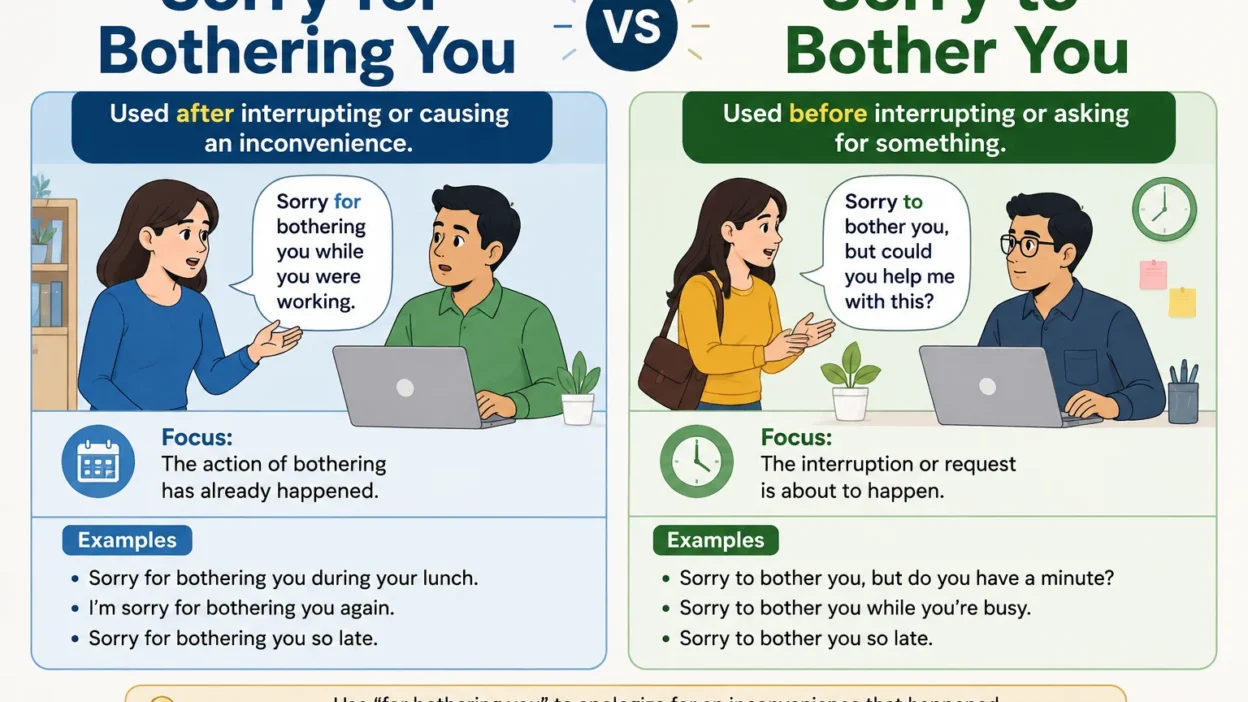
When you need to interrupt someone, ask for help, or contact someone unexpectedly, you may wonder if to say “sorry for bothering you” or “sorry to bother you.”
Both expressions are grammatically , polite, and commonly used in English, but they are not always in exactly the same situation.
Understanding the small difference can make your English sound more natural and appropriate.
The main confusion comes from the verb forms bothering and to bother. “Sorry for bothering you” usually refers to an interruption or inconvenience that is happening or has already happened.
“Sorry to bother you” is often used before or at the moment of interrupting someone.
In this guide, we will explain sorry for bothering you vs sorry to bother you, including their meanings, differences, grammar, examples, professional usage, common mistakes, and easy memory tricks.
Quick Answer
“Sorry to bother you” is generally used before interrupting someone or asking for something.
“Sorry for bothering you” is generally used when you are apologizing for an interruption or inconvenience that has happened or is continuing.
Both are correct. The choice depends mainly on the timing and context.
What Does “Sorry to Bother You” Mean?
“Sorry to bother you” is a polite expression used when you are about to interrupt someone, ask them a question, request help, or take some of their time.
The structure is:
Sorry + to + verb
Here, “to bother” is an infinitive.
For example:
Sorry to bother you, but could you help me with this report?
The speaker is apologizing before making the request. The expression is especially common when approaching someone who appears busy.
Examples of “Sorry to Bother You”
- Sorry to bother you, but could you check this document?
- Sorry to bother you so late.
- Sorry to bother you while you’re working.
- Sorry to bother you, but I have a quick question.
- Sorry to bother you, but do you know where the manager is?
The expression is polite without necessarily suggesting that the person has already been seriously inconvenienced.
What Does “Sorry for Bothering You” Mean?
“Sorry for bothering you” is used when the speaker is apologizing for the act of bothering someone.
The structure is:
Sorry + for + -ing verb
“Bothering” is a gerund, or an -ing form functioning after the preposition “for.”
For example:
Sorry for bothering you while you were trying to concentrate.
Here, the speaker recognizes that their interruption caused an inconvenience.
Examples of “Sorry for Bothering You”
- Sorry for bothering you during your lunch break.
- I’m sorry for bothering you again.
- Sorry for bothering you with another question.
- Sorry for bothering you so late at night.
- I apologize for bothering you while you were busy.
This form can sound particularly appropriate when the interruption has already occurred or when the speaker feels they have repeatedly inconvenienced someone.
Sorry for Bothering You vs Sorry to Bother You: Main Difference
The primary difference is timing and perspective.
“Sorry to bother you” often introduces an interruption or request. “Sorry for bothering you” focuses on the act of bothering someone and often sounds more retrospective.
| Expression | Main Meaning | Typical Timing | Example |
|---|---|---|---|
| Sorry to bother you | Apology before interrupting | Before or at the beginning | Sorry to bother you, but I have a question. |
| Sorry for bothering you | Apology for the interruption | During or after | Sorry for bothering you while you were working. |
| Sorry to bother you again | Polite acknowledgment before another request | Before | Sorry to bother you again, but could you clarify this? |
| Sorry for bothering you again | Apology for repeated interruption | During/after | Sorry for bothering you again about the same issue. |
Both expressions can sometimes be used interchangeably, especially in casual conversation.
When Should You Say “Sorry to Bother You”?
Use “sorry to bother you” when you are about to approach, interrupt, or ask something of another person.
It works particularly well when the person is busy or when you are unsure whether your request is convenient.
Examples
At work:
Sorry to bother you, but do you have a minute?
In a classroom:
Sorry to bother you, Professor, but could you explain this equation?
On the phone:
Sorry to bother you so late, but I wanted to confirm tomorrow’s appointment.
In public:
Sorry to bother you, but could you tell me where the train station is?
The expression prepares the listener for your request and signals politeness.
When Should You Say “Sorry for Bothering You”?
Use “sorry for bothering you” when you are focusing on the fact that you have already interrupted, disturbed, or inconvenienced someone.
It is especially natural after you realize that you have taken too much of someone’s time.
Examples
I’m sorry for bothering you while you were having lunch.
Sorry for bothering you again. I know you’re busy.
I apologize for bothering you with such a small issue.
Sorry for bothering you during your meeting.
The phrase can also be used when an interruption has continued for some time.
Grammar Difference Between “To Bother” and “Bothering”
The grammatical difference is important.
| Expression | Grammar | Function |
|---|---|---|
| to bother | Infinitive | Refers to the action in a general or prospective way |
| bothering | Gerund/-ing form | Refers to the act or activity |
| sorry to bother | Sorry + infinitive | Apology before an interruption |
| sorry for bothering | Sorry + preposition + gerund | Apology for an act or situation |
The preposition “for” is normally followed by a noun or gerund.
Therefore:
Correct: Sorry for bothering you.
Incorrect: Sorry for to bother you.
After “to” in this expression, use the base form:
Correct: Sorry to bother you.
Incorrect: Sorry to bothering you.
Comparison Table: Sorry to Bother You vs Sorry for Bothering You
| Feature | Sorry to Bother You | Sorry for Bothering You |
|---|---|---|
| Grammar | To-infinitive | Preposition + gerund |
| Common use | Before an interruption | During/after an interruption |
| Focus | Intended interruption | Actual interruption |
| Tone | Polite and natural | Polite and apologetic |
| Formality | Neutral to polite | Neutral to polite |
| Common in speech | Very common | Very common |
| Suitable for emails | Yes | Yes |
| Suitable for workplaces | Yes | Yes |
| Suitable for requests | Excellent | Good |
| Suitable after an interruption | Possible | Often better |
Real-Life Examples of “Sorry to Bother You”
1. Business Example
Sorry to bother you, but could you send me the updated sales figures?
This is natural because the speaker is introducing a request.
2. Education Example
Sorry to bother you, Professor, but I don’t understand the last step.
The student politely interrupts the professor.
3. Customer Service Example
Sorry to bother you, but could you help me find my order?
The customer is approaching an employee with a request.
4. Workplace Example
Sorry to bother you while you’re working, but I need your approval.
This is appropriate when the speaker knows the other person is busy.
5. Everyday Conversation
Sorry to bother you, but is this seat taken?
This is a common polite way to approach a stranger.
Real-Life Examples of “Sorry for Bothering You”
1. Business Example
Sorry for bothering you during the meeting earlier.
The interruption has already happened.
2. Education Example
Sorry for bothering you with so many questions.
The student recognizes that they have asked many questions.
3. Workplace Example
I’m sorry for bothering you again about this issue.
The speaker has contacted the person previously.
4. Customer Service Example
Sorry for bothering you, but I wanted to follow up on my previous request.
The speaker is apologizing for the additional contact.
5. Everyday Conversation
Sorry for bothering you while you were resting.
The speaker recognizes that they interrupted the other person.
Professional and Business Usage
Both expressions are acceptable in professional English, but the situation determines which one sounds more natural.
“Sorry to bother you” is particularly useful when opening an email, message, phone call, or face-to-face request.
“Sorry for bothering you” works well when acknowledging a previous interruption or repeated request.
| Situation | Best Expression | Example |
|---|---|---|
| Starting a quick request | Sorry to bother you | Sorry to bother you, but I need your approval. |
| Asking a busy manager | Sorry to bother you | Sorry to bother you while you’re busy. |
| Apologizing afterward | Sorry for bothering you | Sorry for bothering you during the meeting. |
| Repeated request | Sorry for bothering you | Sorry for bothering you again. |
| Starting a follow-up | Sorry to bother you | Sorry to bother you, but I’m following up on my email. |
| Acknowledging inconvenience | Sorry for bothering you | Sorry for bothering you with this issue. |
In very formal business communication, you may sometimes replace either phrase with a more direct and professional alternative.
For example:
I apologize for the interruption.
Or:
I apologize for taking your time.
These alternatives can sound more polished in formal correspondence.
“Sorry to Bother You” in Emails and Messages
“Sorry to bother you” is common in emails, especially when requesting information from someone who may be busy.
For example:
Hi James,
Sorry to bother you, but could you please send me the revised document when you have a chance?
This sounds polite and conversational.
However, you do not need to apologize every time you contact someone professionally. In many situations, a confident and direct request is actually better.
Instead of:
Sorry to bother you, but could you please send the report?
You could write:
Could you please send the report when you have a chance?
The second version is polite without unnecessarily suggesting that your request is an inconvenience.
“Sorry for Bothering You” in Emails and Messages
“Sorry for bothering you” is useful when you have already contacted someone or made several requests.
For example:
Sorry for bothering you again, but I wanted to check whether there has been any update.
This acknowledges that you have contacted the person before.
Another example:
I’m sorry for bothering you during your vacation. I just wanted to confirm the deadline.
The phrase communicates awareness that the timing may have been inconvenient.
Common Mistakes
Many English learners confuse the two expressions because they have similar meanings.
Mistake 1: Using “to” With “bothering”
Incorrect:
Sorry to bothering you.
Correct:
Sorry to bother you.
After “to” in this structure, use the base form of the verb.
Mistake 2: Using “for” With “to bother”
Incorrect:
Sorry for to bother you.
Correct:
Sorry for bothering you.
After the preposition “for,” use a noun or gerund.
Mistake 3: Using “sorry for bother”
Incorrect:
Sorry for bother you.
Correct:
Sorry for bothering you.
“Bothering” is required because “for” is followed by the -ing form here.
Mistake 4: Assuming One Expression Is Wrong
Incorrect assumption:
“Sorry for bothering you” is incorrect.
Correct understanding:
Both expressions are grammatically correct. Their difference is mainly related to timing, emphasis, and context.
Mistake 5: Over-Apologizing
Some speakers use “sorry to bother you” before every small request.
For example:
Sorry to bother you. Sorry to ask. Sorry to message. Sorry to follow up.
This can make professional communication sound overly hesitant.
A simple, confident request is often better.
Why Do People Confuse These Expressions?
There are several reasons people confuse sorry for bothering you vs sorry to bother you.
First, both expressions communicate essentially the same basic idea: the speaker recognizes that they may be interrupting or inconveniencing another person.
Second, the difference between an infinitive and a gerund can be difficult for English learners.
Third, native speakers sometimes use both expressions in overlapping situations. The distinction is therefore not an absolute rule.
The most useful way to remember the difference is to focus on when the apology is being made.
Easy Memory Trick
Use this simple rule:
TO = before the action
FOR + -ING = for the action
Think of it this way:
Sorry to bother you = I’m about to interrupt you.
Sorry for bothering you = I interrupted or inconvenienced you.
This is not a rule that works for every possible use of “sorry,” but it is an excellent guide for these two expressions.
Grammar Forms Table
| Pattern | Example |
|---|---|
| Sorry to + verb | Sorry to bother you. |
| Sorry for + -ing | Sorry for bothering you. |
| Sorry to bother you + request | Sorry to bother you, but can you help me? |
| Sorry for bothering you + reason | Sorry for bothering you during your lunch. |
| Sorry to bother you again | Sorry to bother you again, but I have another question. |
| Sorry for bothering you again | Sorry for bothering you again about the same issue. |
Which One Sounds More Polite?
Both expressions are polite.
However, “sorry to bother you” can sound slightly more natural when beginning a request because it prepares the listener for the interruption.
“Sorry for bothering you” can sound more apologetic because it explicitly focuses on the act of bothering.
Compare:
Sorry to bother you, but could I ask a quick question?
This sounds like a polite introduction to a request.
Sorry for bothering you. I know you’ve been busy.
This sounds more like an acknowledgment of an inconvenience.
The difference is subtle rather than absolute.
Is “Sorry to Bother You” Formal or Informal?
“Sorry to bother you” is neutral and polite. It can be used in casual conversations as well as professional settings.
Examples include:
- talking to a coworker
- speaking to a teacher
- contacting a manager
- approaching a stranger
- asking a customer-service employee for help
- sending a polite message
For highly formal situations, alternatives such as “I apologize for the interruption” may be more appropriate.
Is “Sorry for Bothering You” Formal or Informal?
“Sorry for bothering you” is also neutral and polite.
It can appear in everyday conversation, emails, workplace messages, and customer-service communication.
For example:
Sorry for bothering you again. I appreciate your help.
This is polite and natural.
In formal writing, you may choose:
or:
I apologize for taking up your time.
The best choice depends on the relationship and situation.
Industry Usage Comparison
| Industry | “Sorry to Bother You” | “Sorry for Bothering You” |
|---|---|---|
| Business | Very common for requests | Common for follow-ups |
| Education | Common when approaching teachers | Common after repeated questions |
| Customer service | Common when asking for help | Common when apologizing for inconvenience |
| Healthcare | Possible when addressing staff | Possible after an interruption |
| Technology | Common in workplace chats | Common after repeated messages |
| Science | Appropriate for questions | Appropriate after interrupting research/work |
| Hospitality | Common when approaching staff | Common when acknowledging inconvenience |
| Administration | Common for requests | Common for follow-ups |
Can You Use “Sorry to Bother You” After Interrupting Someone?
Yes.
Although “sorry to bother you” often introduces an interruption, English speakers can use it during or immediately after an interruption as well.
For example:
The expression is flexible in real-world English.
Therefore, do not treat the timing distinction as an absolute grammatical rule. It is primarily a useful guide for choosing the most natural expression.
Can You Say “Sorry for Bothering You Again”?
Yes. This is a very common and natural expression.
For example:
The phrase is especially useful when you have already contacted someone about the same issue.
You can also say:
Both are correct, but the emphasis differs slightly.
“Sorry to Bother You” vs “Sorry for Bothering You” in Follow-Ups
Follow-up communication is one situation where both expressions are frequently used.
| Situation | Natural Choice |
|---|---|
| Before sending a follow-up | Sorry to bother you again… |
| Apologizing for repeated contact | Sorry for bothering you again… |
| Asking one more question | Sorry to bother you, but… |
| Recognizing repeated inconvenience | Sorry for bothering you… |
For example:
This introduces the new request.:
This focuses more strongly on the inconvenience.
Alternatives to “Sorry to Bother You”
Depending on the situation, you can use several alternatives.
| Alternative | Best Use |
|---|---|
| Excuse me | Getting someone’s attention |
| I apologize for the interruption | Formal situations |
| Sorry to interrupt | Direct interruption |
| I hope I’m not disturbing you | Polite and gentle |
| Do you have a moment? | Professional requests |
| Could I ask you something? | Casual or neutral |
| I apologize for taking your time | Formal communication |
For professional communication, “Do you have a moment?” can often sound more confident than repeatedly apologizing.
Alternatives to “Sorry for Bothering You”
If you want to apologize for an inconvenience, consider these alternatives:
- I apologize for the interruption.
- Sorry for the inconvenience.
- I apologize for taking your time.
- I hope I didn’t inconvenience you.
- Sorry for disturbing you.
- I apologize for contacting you again.
- Thank you for your patience.
The best alternative depends on how serious the inconvenience was.
A Simple Decision Guide
Use this process when deciding between the two phrases.
| Step | Question | Recommended Expression |
|---|---|---|
| 1 | Are you about to interrupt someone? | Sorry to bother you |
| 2 | Are you making a request? | Sorry to bother you |
| 3 | Have you already interrupted them? | Sorry for bothering you |
| 4 | Have you contacted them repeatedly? | Sorry for bothering you |
| 5 | Are you starting a follow-up? | Sorry to bother you |
| 6 | Are you acknowledging inconvenience? | Sorry for bothering you |
This guide is not a strict grammar law, but it provides a reliable way to choose naturally.
Side-by-Side Examples
Example 2
Introducing a phone call:
Sorry to bother you so late.
Acknowledging a late interruption:
Both can be correct depending on the speaker’s perspective.
Example 3
New request:
Sorry to bother you again, but I have another question.
Example 4
After interrupting:
The second sentence more clearly presents the interruption as something that already happened.
Frequently Asked Questions
Is “sorry for bothering you” correct?
Yes. “Sorry for bothering you” is grammatically correct and commonly used when apologizing for interrupting or inconveniencing someone.
Is “sorry to bother you” correct?
Yes. “Sorry to bother you” is also grammatically correct and is often used before making a request or interrupting someone.
Which is better: “sorry for bothering you” or “sorry to bother you”?
Neither is universally better. Use “sorry to bother you” when introducing an interruption or request, and “sorry for bothering you” when emphasizing an interruption that has happened or is causing inconvenience.
Can I use “sorry to bother you” in a professional email?
Yes. It is polite and natural in professional emails, especially when asking someone for help or information. However, you can often sound more confident by making a direct request without apologizing unnecessarily.
Is “sorry for to bother you” correct?
No. The correct expression is “sorry for bothering you.” The preposition “for” is followed by the -ing form in this construction.
Are “sorry to bother you” and “sorry for bothering you” interchangeable?
Sometimes. Their meanings overlap, but “sorry to bother you” tends to introduce an interruption or request, while “sorry for bothering you” more strongly emphasizes the act or inconvenience of bothering someone.
Final Comparison
| Point | Sorry to Bother You | Sorry for Bothering You |
|---|---|---|
| Correct? | Yes | Yes |
| Grammar | Infinitive | Gerund |
| Main focus | Intended/current interruption | Actual or ongoing inconvenience |
| Best for requests | Yes | Sometimes |
| Best after interruption | Sometimes | Yes |
| Professional use | Yes | Yes |
| Casual use | Yes | Yes |
| Common mistake | “Sorry to bothering you” | “Sorry for to bother you” |
Conclusion
The difference between sorry for bothering you vs sorry to bother you is small but useful.
“Sorry to bother you” is generally the better when you are about to interrupt someone, ask a question, or make a request. “
Sorry for bothering you” is more appropriate when you are apologizing for an interruption or inconvenience that has already happened or is continuing.
The easiest memory trick is “to” for the action you are about to take and for the action you are apologizing for.
However, remember that native English speakers sometimes use both expressions in overlapping situations.
Both are correct, polite, and natural when used appropriately.