
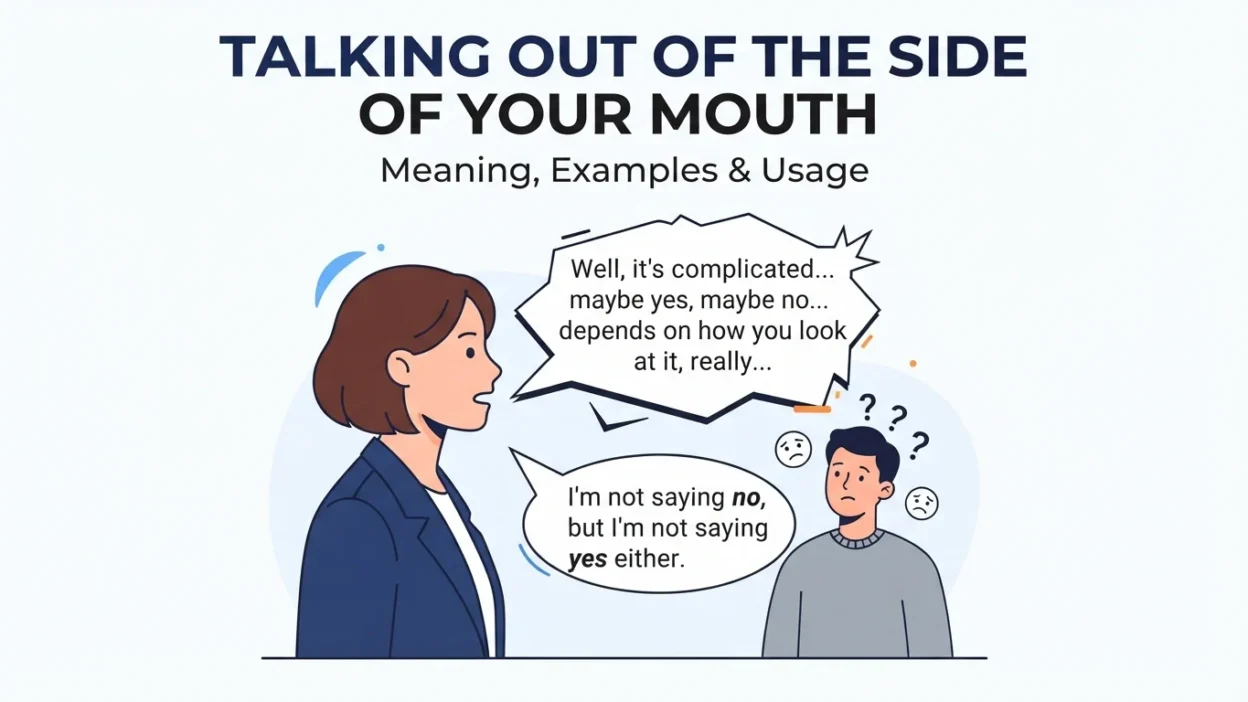
The talking out of the side of your mouth meaning can be confusing because the phrase may sound like it describes a physical way of speaking.
In everyday English, however, “talking out of the side of your mouth” is usually an idiomatic expression.
It can describe speaking indirectly, making a comment in a sly or evasive way, or saying something that is not completely straightforward.
The exact meaning depends on the context and the speaker’s intention.
Understanding the talking out of the side of your mouth meaning is especially useful when reading informal English, conversations, movies, social media posts, and workplace discussions. The phrase can suggest that someone is avoiding a direct statement or communicating something subtly. This article explains its meaning, usage, examples, related expressions, common mistakes, and the difference between literal and figurative uses.
Quick Answer
“Talking out of the side of your mouth” usually means speaking indirectly, evasively, slyly, or in a way that avoids saying something plainly.
Example: He was talking out of the side of his mouth instead of answering the question directly.
It can also have a literal meaning if someone is physically speaking from one side of their mouth.
What Is the Talking Out of the Side of Your Mouth Meaning?
The talking out of the side of your mouth meaning is generally connected with indirect, evasive, or sly speech.
When someone “talks out of the side of their mouth,” they may be communicating something without saying it openly. The phrase can suggest that the person is being secretive, sarcastic, evasive, or deliberately indirect.
For example:
Stop talking out of the side of your mouth and tell me what you really think.
Here, the speaker is asking the other person to communicate honestly and directly.
The expression does not necessarily mean that the person is lying. It can simply imply that their communication is not straightforward.
Literal vs. Figurative Meaning
The phrase can be understood literally or figuratively.
Literal Meaning
Someone may physically speak from one side of their mouth because of habit, an injury, dental treatment, or another physical reason.
After his dental procedure, he was talking out of the side of his mouth.
In this sentence, there is no hidden meaning.
Figurative Meaning
The phrase can describe indirect or evasive communication.
She was talking out of the side of her mouth when I asked about the missing report.
Here, the phrase suggests that she was not giving a clear or direct answer.
| Meaning | Explanation | Example |
|---|---|---|
| Literal | Physically speaking from one side of the mouth | He was talking out of the side of his mouth after the procedure. |
| Figurative | Speaking indirectly or evasively | He was talking out of the side of his mouth instead of answering. |
Is “Talking Out of the Side of Your Mouth” an Idiom?
It can function as an idiomatic expression in informal English, especially when it is used figuratively.
The phrase is not as universally fixed as some traditional idioms such as “break the ice” or “spill the beans.” Its meaning can depend strongly on context.
When used figuratively, it often communicates an attitude such as:
- being indirect
- avoiding a direct answer
- speaking slyly
- making a subtle remark
- communicating secretly
- saying something in an evasive manner
The surrounding sentence usually makes the intended meaning clear.
Talking Out of the Side of Your Mouth vs. Speaking Directly
The biggest contrast is between indirect communication and direct communication.
| Talking out of the side of your mouth | Speaking directly |
|---|---|
| Indirect | Straightforward |
| May be evasive | Clear |
| Can sound sly | Usually transparent |
| May hide the speaker’s real opinion | Clearly expresses the opinion |
| Often informal | Appropriate in most contexts |
For example:
Indirect:
He was talking out of the side of his mouth about the manager.
Direct:
He told me exactly what he thought about the manager.
The first sentence suggests that the speaker was not communicating openly.
Why Do People Use This Expression?
People use this expression when they want to criticize or describe someone’s communication style.
Imagine asking someone:
Did you approve the proposal?
Instead of answering yes or no, they say:
Well, let’s just say that everyone has different opinions about the proposal.
You might describe this as talking out of the side of their mouth because they have avoided giving a clear answer.
The expression can therefore emphasize evasiveness or lack of directness.
Common Situations Where the Phrase Is Used
The expression can occur in many informal situations.
| Situation | Example |
|---|---|
| Avoiding a question | He kept talking out of the side of his mouth instead of answering. |
| Political discussion | The candidate was talking out of the side of his mouth about the proposal. |
| Workplace conversation | My coworker was talking out of the side of her mouth about the new policy. |
| Personal disagreement | He was talking out of the side of his mouth instead of telling me the truth. |
| Gossip | They were talking out of the side of their mouths about their colleague. |
| Sarcasm | She was talking out of the side of her mouth when she complimented him. |
Because the phrase can sound critical, it is generally more suitable for informal conversation than highly formal writing.
Real-Life Examples of the Phrase
Everyday Conversation
I asked him whether he wanted to come, but he was talking out of the side of his mouth and never gave me a clear answer.
The speaker is criticizing the person’s indirect response.
Business Example
The manager was talking out of the side of his mouth about the company’s future plans.
This suggests that the manager was not speaking openly or clearly.
Education Example
When the teacher asked whether he had completed the assignment, he started talking out of the side of his mouth.
The student may be avoiding a direct answer.
Science Example
In scientific communication, clarity is important, so the expression would normally be used critically rather than technically.
The researcher felt that the spokesperson was talking out of the side of his mouth instead of explaining the findings clearly.
Social Media Example
That post sounds like she’s talking out of the side of her mouth. Why doesn’t she just say what she means?
This is a natural informal use.
Grammar and Sentence Forms
The phrase changes according to the subject and possessive pronoun.
| Subject | Example |
|---|---|
| I | I was talking out of the side of my mouth. |
| You | You are talking out of the side of your mouth. |
| He | He was talking out of the side of his mouth. |
| She | She was talking out of the side of her mouth. |
| We | We were talking out of the side of our mouths. |
| They | They were talking out of the side of their mouths. |
The important point is that the possessive pronoun changes with the subject.
Your is used when speaking directly to someone:
Why are you talking out of the side of your mouth?
His is used for a male person:
He was talking out of the side of his mouth.
Her is used for a female person:
She was talking out of the side of her mouth.
Grammar Forms Table
| Tense/Form | Example |
|---|---|
| Present | He talks out of the side of his mouth. |
| Present continuous | He is talking out of the side of his mouth. |
| Past | He talked out of the side of his mouth. |
| Past continuous | He was talking out of the side of his mouth. |
| Present perfect | He has talked out of the side of his mouth. |
| Future | He will talk out of the side of his mouth. |
| Question | Why are you talking out of the side of your mouth? |
| Negative | He wasn’t talking out of the side of his mouth. |
The most natural form depends on whether you are describing a repeated behavior, something happening now, or something that happened in the past.
Talking Out of the Side of Your Mouth vs. Talking Out of Both Sides of Your Mouth
These expressions should not automatically be treated as identical.
Talking out of the side of your mouth can suggest indirect or sly speech.
Talking out of both sides of your mouth is a different expression that usually means saying contradictory things or holding two conflicting positions.
| Expression | Typical meaning |
|---|---|
| Talking out of the side of your mouth | Speaking indirectly, evasively, or slyly |
| Talking out of both sides of your mouth | Saying contradictory things or taking conflicting positions |
| Speaking directly | Saying something clearly and openly |
| Talking around the issue | Avoiding the main point |
For example:
He was talking out of the side of his mouth.
This can suggest indirect speech.
But:
He’s talking out of both sides of his mouth.
This more strongly suggests that his statements contradict each other.
Related Expressions and Synonyms
Several expressions can have a similar meaning depending on context.
| Expression | Meaning |
|---|---|
| Talking around the issue | Avoiding the main point |
| Being evasive | Avoiding a clear answer |
| Speaking indirectly | Not stating something plainly |
| Beating around the bush | Avoiding the main point |
| Talking in circles | Giving an unclear or repetitive explanation |
| Being vague | Not providing specific information |
| Speaking slyly | Communicating in a secretive or cunning manner |
| Not saying what you mean | Avoiding a direct statement |
These expressions are related but not always interchangeable.
Professional and Workplace Usage
In professional settings, the phrase can be used when describing unclear communication, but it has an informal and sometimes critical tone.
For example:
The executive was talking out of the side of his mouth when asked about the layoffs.
This implies that the executive avoided giving a straightforward answer.
In a formal report, however, you might write:
The executive provided an evasive response.
Or:
The executive did not directly address the question.
| Informal expression | More formal alternative |
|---|---|
| Talking out of the side of your mouth | Speaking indirectly |
| Talking around the issue | Avoiding the central issue |
| Beating around the bush | Avoiding a direct response |
| Talking in circles | Providing an unclear explanation |
| Not saying what you mean | Failing to communicate directly |
Common Mistakes
Mistake 1: Assuming It Always Means Lying
The phrase can suggest dishonesty, but it does not automatically mean lying.
Incorrect interpretation:
Talking out of the side of your mouth always means telling a lie.
Better understanding:
It usually suggests indirect, evasive, or sly communication. The person may or may not be lying.
Mistake 2: Treating It as a Literal Expression Every Time
The phrase can have a literal meaning.
He was talking out of the side of his mouth because his jaw was sore.
Here, there is no implication that he is being dishonest.
Mistake 3: Confusing It With “Talking Out of Both Sides of Your Mouth”
These expressions have different typical meanings.
Talking out of the side of your mouth: indirect or sly communication.
Talking out of both sides of your mouth: contradictory statements or positions.
Mistake 4: Using “The Side of Your Mouth” Without Context
If the meaning is figurative, context is important.
Compare:
He talks out of the side of his mouth.
with:
He talks out of the side of his mouth whenever he doesn’t want to answer a difficult question.
The second sentence makes the intended meaning much clearer.
Correct vs. Incorrect Sentences
| Incorrect or unclear | Better | Reason |
|---|---|---|
| He talks out of side of his mouth. | He talks out of the side of his mouth. | The phrase normally includes “the.” |
| She was talking from the side of her mouth. | She was talking out of the side of her mouth. | “Out of” is the established wording when using the idiom. |
| It always means lying. | It can suggest evasive or indirect speech. | The phrase does not automatically mean lying. |
| He talks out of both sides of his mouth. | He talks out of the side of his mouth. | Use “both sides” when describing contradictory positions. |
How to Remember the Meaning
Use this simple memory trick:
Side = not straight.
If someone is “talking out of the side of their mouth,” imagine that their words are coming from an unusual direction instead of being spoken straight toward you.
That gives you the figurative idea:
Side → indirect → not straightforward.
Another easy memory phrase is:
This is not a strict dictionary rule, but it is a useful way to remember the common figurative sense.
How to Understand the Phrase From Context
When you encounter the expression, ask three questions:
| Step | Question | What it tells you |
|---|---|---|
| 1 | Is the person literally speaking from one side? | It may have a physical meaning. |
| 2 | Is the person avoiding a direct answer? | It is probably figurative. |
| 3 | Are their statements contradictory? | “Both sides of the mouth” may be more appropriate. |
For example:
He was talking out of the side of his mouth after his dental surgery.
This is probably literal.
But:
He was talking out of the side of his mouth when I asked him about the missing money.
This is probably figurative.
Is the Phrase Formal or Informal?
“Talking out of the side of your mouth” is primarily an informal expression.
It is suitable for:
- casual conversations
- dialogue
- social media
- informal articles
- storytelling
- everyday discussions
It may be less appropriate in:
- academic papers
- legal documents
- technical reports
- formal business reports
In those contexts, clearer alternatives such as “speaking evasively,” “responding indirectly,” or “avoiding a direct answer” are usually better.
Comparison Table: Similar Expressions
| Phrase | Main idea | Tone |
|---|---|---|
| Talking out of the side of your mouth | Indirect or sly speech | Informal |
| Talking out of both sides of your mouth | Contradictory statements | Informal |
| Beating around the bush | Avoiding the main point | Informal |
| Talking around the issue | Avoiding direct discussion | Neutral/informal |
| Speaking evasively | Avoiding a clear answer | Neutral/formal |
| Speaking directly | Communicating clearly | Neutral |
When Should You Use This Expression?
Use the phrase when you want to describe someone who is not communicating openly or directly.
A simple process is:
- Identify whether the person is being indirect.
- Decide whether the phrase is figurative or literal.
- Consider the tone of your conversation.
- Use the phrase mainly in informal contexts.
- Choose a more formal alternative when writing professionally.
For example:
I don’t know why you’re talking out of the side of your mouth. Just tell me what happened.
This sounds natural in an informal conversation.
More Example Sentences
- Why are you talking out of the side of your mouth instead of answering me?
- She was talking out of the side of her mouth about the new employee.
- He tends to talk out of the side of his mouth when he’s uncomfortable.
- I could tell he was talking out of the side of his mouth because he wouldn’t give me a straight answer.
- The politician seemed to be talking out of the side of his mouth during the interview.
- Don’t talk out of the side of your mouth; just tell me what you mean.
- He wasn’t lying exactly, but he was talking out of the side of his mouth.
- After the dental procedure, she was literally talking out of the side of her mouth.
Frequently Asked Questions
What does talking out of the side of your mouth mean?
It usually means speaking indirectly, evasively, or slyly instead of communicating something clearly and directly.
Does talking out of the side of your mouth mean lying?
Not necessarily. It can suggest evasiveness or indirect speech, but the person may not actually be lying.
Is “talking out of the side of your mouth” an idiom?
It can be used idiomatically to describe indirect or evasive communication, although its meaning is highly dependent on context.
What is the difference between talking out of the side and both sides of your mouth?
“Talking out of the side of your mouth” can suggest indirect or sly speech. “Talking out of both sides of your mouth” usually means making contradictory statements or expressing conflicting positions.
What is a synonym for talking out of the side of your mouth?
Depending on the context, synonyms include speaking evasively, speaking indirectly, talking around the issue, and beating around the bush.
Is the phrase formal?
No. It is mainly an informal expression. In formal writing, phrases such as “speaking evasively” or “avoiding a direct response” are usually more appropriate.
Conclusion
The talking out of the side of your mouth meaning generally refers to speaking indirectly, evasively, or slyly, especially when someone avoids saying something clearly.
However, the phrase can also be literal when someone is physically speaking from one side of their mouth.
The most important usage rule is to consider the context. If someone is avoiding a direct answer, the expression is probably figurative.
If a physical condition causes someone to speak from one side of their mouth, it may be literal.
Also remember that “talking out of both sides of your mouth” usually has a different meaning: it describes contradictory statements or conflicting positions.
Understanding these distinctions will help you recognize the phrase naturally in conversations, movies, social media, and informal English.

Julian Wyatt is a passionate researcher and writer who explores symbols, mythology, cultural traditions, and hidden meanings. Through engaging articles, he helps readers uncover the fascinating stories and significance behind symbols worldwide.