
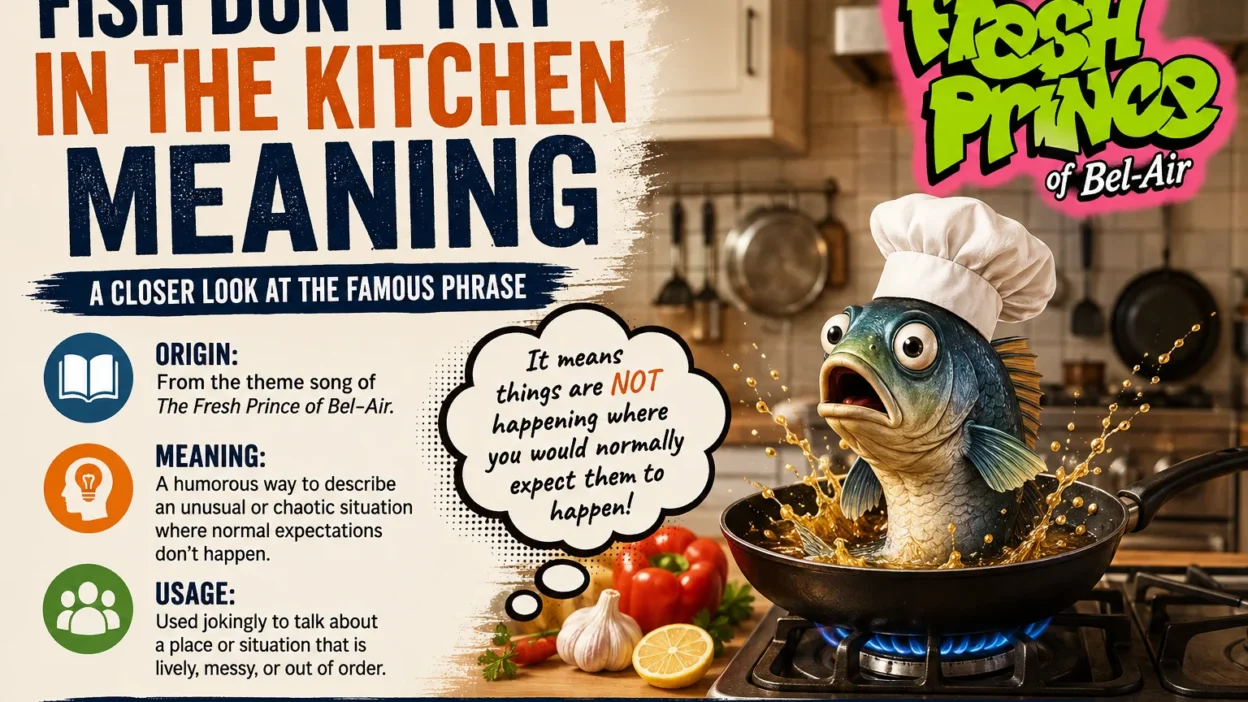
The fish don’t fry in the kitchen meaning can seem confusing if you hear the phrase without knowing where it comes from.
It is best known from the opening theme song of The Fresh Prince of Bel-Air, where the line appears as part of a playful description of life in Philadelphia.
At first, the phrase sounds like a simple statement about cooking, but its real purpose is more humorous and contextual.
It helps describe an ordinary, somewhat chaotic home and city environment before the story shifts to the main character’s new life in Bel-Air.
Understanding the fish don’t fry in the kitchen meaning also requires looking at the phrase as part of a larger expression.
The wording is intentionally informal and vivid rather than a traditional English idiom.
In everyday conversation, someone may use it humorously to describe a busy household, an unusual situation, or the idea that things are not happening where you would normally expect them to happen.
The phrase is memorable because it combines a familiar activity with an unexpected negative statement.
Quick Answer: What Does “Fish Don’t Fry in the Kitchen” Mean?
The fish don’t fry in the kitchen meaning is essentially a humorous description of a place where normal expectations are being turned upside down.
The phrase comes from The Fresh Prince of Bel-Air theme song and refers to the lively, chaotic atmosphere associated with Philadelphia.
It is not a standard idiom with one fixed dictionary definition.
Where Does “Fish Don’t Fry in the Kitchen” Come From?
The phrase is most famously associated with the theme song of The Fresh Prince of Bel-Air, the popular television sitcom starring Will Smith.
In the song, the opening lines describe Philadelphia through a series of memorable images. The phrase about fish and the kitchen is part of that playful description.
The wording creates an immediate picture: you might normally expect fish to be cooked in a kitchen, so saying that fish do not fry there suggests something unusual or chaotic.
The song uses this type of language to establish the character’s original environment before explaining how his life changes when he moves to Bel-Air.
The phrase in context
Rather than treating the sentence as a serious cooking statement, it is more useful to understand it as colorful storytelling.
The songwriter uses ordinary objects and activities to create a sense of place. The unusual wording makes the opening memorable and gives the song a conversational, humorous tone.
| Element | Explanation |
|---|---|
| Fish | A familiar food associated with cooking |
| Fry | A common cooking action |
| Kitchen | The expected place for cooking |
| “Don’t” | Creates an unexpected contrast |
| Overall effect | Humor, imagery, and a sense of unusual surroundings |
Is “Fish Don’t Fry in the Kitchen” an Idiom?
Not exactly.
A traditional idiom has a recognized figurative meaning that speakers commonly understand, such as “break the ice” or “hit the nail on the head.”
Fish don’t fry in the kitchen is better described as a lyrical expression or humorous phrase.
Its meaning comes largely from its context rather than from a standard idiomatic definition.
That distinction is important for anyone searching for the fish don’t fry in the kitchen meaning. You should not assume that every dictionary will list it as an established idiom.
Idiom vs. lyrical expression
| Feature | Traditional idiom | “Fish don’t fry in the kitchen” |
|---|---|---|
| Fixed expression | Usually | Yes, in its famous context |
| Standard dictionary meaning | Usually | Not necessarily |
| Figurative interpretation | Common | Context-dependent |
| Origin | General language | Famous television theme |
| Everyday use | Common | Mostly humorous or cultural |
What Does the Phrase Literally Mean?
Literally, the phrase says that fish are not being fried in the kitchen.
That is the simplest grammatical interpretation.
However, the literal meaning is not the most important part of the phrase. The humor comes from the fact that a kitchen is exactly the kind of place where you might expect food to be prepared.
By saying that the expected activity is not happening, the line creates an image of a place where ordinary expectations are disrupted.
Think of it this way:
Expected situation: Fish are being fried in a kitchen.
Unexpected situation: The fish are not frying there.
That contrast makes the expression catchy.
What Is the Figurative Meaning of “Fish Don’t Fry in the Kitchen”?
The figurative fish don’t fry in the kitchen meaning can be understood as an image of unusual circumstances, disorder, or an environment that does not follow ordinary expectations.
It is not necessarily saying that the kitchen is literally empty or that someone cannot cook fish.
Instead, the phrase contributes to a broader picture of a lively and unpredictable environment.
This is why context matters so much.
If someone says, “Fish don’t fry in the kitchen,” outside the television-song context, listeners may simply interpret it literally unless the speaker has established a humorous or metaphorical context.
Why Is the Phrase So Famous?
The phrase became famous because of its association with The Fresh Prince of Bel-Air.
The show’s opening theme became one of the most recognizable television theme songs of its era. Its storytelling style quickly introduces the character, his hometown, and the circumstances that lead him to Bel-Air.
The line about fish is memorable because it is short, rhythmic, unusual, and visual.
It also demonstrates an important feature of popular songwriting: a phrase does not always need to have a conventional dictionary meaning to be effective.
A strange image can be more memorable than a straightforward description.
Fish Don’t Fry in the Kitchen Meaning in “The Fresh Prince of Bel-Air”
Within the Fresh Prince context, the phrase helps establish the atmosphere of Philadelphia described in the opening song.
The theme uses exaggerated and playful imagery rather than giving a formal geographical descripti
The song moves from the character’s life in Philadelphia toward his dramatic relocation to Bel-Air. The contrast between these environments is central to the show’s premise.
| Context | Meaning or purpose |
|---|---|
| Fresh Prince theme | Establishes the character’s original environment |
| Songwriting | Creates memorable imagery |
| Humor | Makes the description playful |
| Storytelling | Helps introduce the character’s background |
| Everyday speech | Can be used jokingly to describe disorder or unexpected circumstances |
Why Do People Search for “Fish Don’t Fry in the Kitchen Meaning”?
People often search for the phrase because it sounds like an idiom.
Someone may hear the line in the television theme, a meme, a social media post, or a conversation and wonder whether it has a hidden meaning.
The confusion comes from the structure of the sentence.
It contains familiar words—fish, fry, kitchen—but combines them in an unusual way. Because many English expressions use ordinary words figuratively, readers may assume this phrase has a secret definition.
In reality, the context does most of the work.
Fish Don’t Fry in the Kitchen vs. a Normal Statement
Compare the famous phrase with an ordinary sentence about cooking.
| Sentence | Type | Meaning |
|---|---|---|
| Fish fry in the kitchen. | Literal | Fish are cooked there. |
| Fish don’t fry in the kitchen. | Literal negative | Fish are not cooked there. |
| “Fish don’t fry in the kitchen” in the song | Cultural/lyrical | Creates humorous imagery |
| Fish are frying in the kitchen. | Literal | Fish are currently being cooked. |
| The kitchen is where fish are fried. | Literal | States the expected location of cooking |
The grammar is simple. The interesting part is the contextual meaning.
Grammar of “Fish Don’t Fry in the Kitchen”
From a grammar perspective, the sentence is straightforward.
Fish is the subject, don’t is the negative auxiliary, fry is the base-form verb, and in the kitchen is a prepositional phrase describing location.
Grammar breakdown
| Word/Phrase | Grammatical role |
|---|---|
| Fish | Subject |
| Don’t | Negative auxiliary verb |
| Fry | Main verb |
| In | Preposition |
| The kitchen | Object of the preposition |
The sentence uses the simple present tense.
The simple present can describe general facts, habits, repeated actions, or states.
Grammar forms
| Form | Example |
|---|---|
| Affirmative | Fish fry in the kitchen. |
| Negative | Fish don’t fry in the kitchen. |
| Question | Do fish fry in the kitchen? |
| Singular subject | The fish doesn’t fry in the kitchen. |
| Past | The fish didn’t fry in the kitchen. |
| Future | The fish won’t fry in the kitchen. |
One important point is that fish can be singular or plural depending on context.
Real-Life Examples of the Phrase
Example 1: A messy home
Someone walks into a friend’s apartment and sees cooking equipment everywhere.
They might jokingly say:
“This place is so chaotic, fish don’t fry in the kitchen anymore.”
Here, the speaker is creatively adapting the famous phrase to describe disorder.
Example 2: A busy workplace
Imagine an office where employees are working in completely unexpected places.
Someone could joke:
“Around here, fish don’t fry in the kitchen; everything happens everywhere.”
This creates a humorous comparison between the workplace and a chaotic environment.
Example 3: A classroom
A teacher might use the phrase creatively while explaining expectations:
“In this classroom, fish don’t fry in the kitchen—we keep everything in its proper place.”
Here, the phrase becomes a playful teaching device.
Example 4: A restaurant
A restaurant employee might use the phrase jokingly when discussing kitchen organization.
“If fish don’t fry in the kitchen, something has definitely gone wrong.”
Business and Professional Usag
A manager would generally avoid using it in a report because its meaning depends heavily on humor and cultural context.
However, it can appear in informal presentations, advertising, social media campaigns, creative writing, or entertainment-related content.
| Industry | Possible use | Formality |
|---|---|---|
| Business | Humorous presentation | Low |
| Marketing | Creative slogan | Medium |
| Education | Teaching example | Informal |
| Entertainment | Cultural reference | High |
| Journalism | Pop-culture discussion | Medium |
| Science | Usually inappropriate | Low |
| Social media | Joke or reference | High |
| Creative writing | Figurative imagery | High |
Can You Use “Fish Don’t Fry in the Kitchen” in Everyday Conversation?
Yes, but context is important.
If you use the phrase casually, some people may recognize the Fresh Prince reference immediately. Others may interpret it literally or ask what you mean.
For that reason, it works best when the listener understands the cultural reference.
For example:
“You know that old Fresh Prince line? Fish don’t fry in the kitchen.”
This makes the reference clear.
Common Mistakes When Understanding the Phrase
One of the biggest mistakes is assuming that fish don’t fry in the kitchen has one official figurative definition.
It does not function like a conventional idiom such as “once in a blue moon.”
Another mistake is interpreting the line as an important rule about cooking.
The phrase is primarily memorable because of its lyrical and cultural context.
Correct vs. incorrect interpretations
| Incorrect assumption | Better understanding |
|---|---|
| It is a common English proverb. | It is a famous lyrical expression. |
| It always means failure. | Its meaning depends on context. |
| It literally describes all kitchens. | It is humorous imagery in the song. |
| It is a standard idiom. | It is better understood as a cultural phrase. |
| It has one fixed figurative meaning. | Its interpretation changes with context. |
Common Sentence Mistakes
Incorrect: Treating it as a universal idiom
“Fish don’t fry in the kitchen means you should never trust someone.”
This is incorrect because the phrase does not have that standard meaning.
Better:
“The phrase ‘fish don’t fry in the kitchen’ is a humorous line from The Fresh Prince of Bel-Air theme song.”
Incorrect: Assuming it is a cooking rule
“According to the expression, you shouldn’t fry fish in a kitchen.”
This takes the phrase too literally.
Better:
“The phrase uses an unexpected image to create humor and describe an unusual environment.”
Why Do People Confuse the Meaning?
There are several reasons for the confusion.
First, the sentence is grammatically ordinary but semantically unusual. Every word is familiar, yet the combination sounds strange.
Second, English contains thousands of idioms whose literal meanings differ from their figurative meanings. This makes learners naturally wonder whether the phrase works the same way.
People who encounter it without the surrounding lyrics may not understand the intended context.
Finally, popular culture often turns unusual lines into standalone expressions. Once removed from the original song, the original meaning can become less obvious.
A Simple Memory Trick
Use this easy memory trick:
Fish + fry + kitchen = expected cooking.
Then remember:
“Don’t” = unexpected situation.
So, the phrase creates humor by saying that something you would normally expect to happen in a kitchen is not happening there.
You can remember it as:
Normal expectation → unexpected result → humorous image
This helps explain why the line sounds strange but memorable.
Fish Don’t Fry in the Kitchen Meaning vs. Similar Expressions
| Expression | General meaning |
|---|---|
| Fish don’t fry in the kitchen | Humorous image of something unexpected |
| Things are upside down | Situation is confused or disorganized |
| Nothing is where it should be | Normal order is missing |
| Everything is out of place | Things are not properly arranged |
| Chaos rules the day | Disorder dominates the situation |
| Something is off | A situation does not feel normal |
These expressions are not exact synonyms. They simply share the idea of unexpected circumstances.
Is “Fish Don’t Fry in the Kitchen” Sarcastic?
For example, if someone enters a completely disorganized kitchen and says:
“Well, fish don’t fry in the kitchen around here.”
However, the original song does not require you to interpret every use of the phrase as sarcasm.
The tone depends on the speaker and situation.
Is the Phrase Used Literally or Figuratively?
It can be either.
Literal use
A person could literally say:
“Fish don’t fry in the kitchen because we use an outdoor grill.”
Here, the sentence is a factual statement.
Figurative or humorous use
A person could say:
“In this office, fish don’t fry in the kitchen.”
Here, the speaker may be joking about how unusual or disorganized the office is.
Comparison table
| Use | Meaning |
|---|---|
| Literal | Fish are not cooked in the kitchen |
| Humorous | Normal expectations are being disrupted |
| Cultural | Reference to The Fresh Prince of Bel-Air |
| Figurative | Used creatively to describe unusual circumstances |
How to Explain the Phrase to an English Learner
If you’re teaching someone English, avoid saying that the phrase simply means “chaos.”
That explanation is too narrow.
A better explanation is:
This explanation covers both the literal and cultural meanings.
How to Use the Phrase Naturally
If you want to use the phrase yourself, make the context obvious.
Natural examples
“You know the Fresh Prince song? That ‘fish don’t fry in the kitchen’ line always makes me laugh.”
“This house is so chaotic that fish don’t fry in the kitchen anymore.”
“Everything is happening in the wrong place around here—fish don’t fry in the kitchen.”
These examples make the humorous intention clear.
Less natural example
“I was studying grammar yesterday, so fish don’t fry in the kitchen.”
This feels confusing because there is no logical connection between the statement and the situation.
People Also Ask: Fish Don’t Fry in the Kitchen Meaning
What does “fish don’t fry in the kitchen” mean?
Its broader meaning depends on context and often suggests something unexpected or unusual.
Is “fish don’t fry in the kitchen” an idiom?
Not in the traditional sense.
Where did “fish don’t fry in the kitchen” come from?
What does the fish line mean in Fresh Prince?
It contributes to the playful description of the character’s original environment. The unusual image helps establish the humorous storytelling style of the opening theme.
Can I use “fish don’t fry in the kitchen” in everyday English?
Yes, especially as a joke or cultural reference. However, because it is not a standard idiom, you should provide enough context for listeners who may not recognize the reference.
Is “fish don’t fry in the kitchen” literal?
The sentence can be interpreted literally, but in its famous cultural context, it works primarily as humorous imagery rather than a serious statement about cooking.
Final Comparison: What You Need to Remember
| Point | Key takeaway |
|---|---|
| Literal meaning | Fish are not frying in the kitchen |
| Famous source | The Fresh Prince of Bel-Air theme |
| Main effect | Humor and vivid imagery |
| Standard idiom? | No |
| Figurative meaning | Context-dependent |
| Best everyday use | Humor, cultural references, creative language |
| Formal writing | Usually avoid unless discussing the phrase itself |
Conclusion
The fish don’t fry in the kitchen meaning is easier to understand once you separate the literal words from the cultural context. Literally, the s. However, the phrase became famous through The Fresh Prince of Bel-Air, where it forms part of a playful description of Philadelphia and the main character’s original life.
The most important poidefinition. Its humorous effect comes from the unexpected combination of fish, frying, and a kitchen. When used outside its original context, it can suggest that things are unusual, chaotic, or happening somewhere other than where you would expect. Understanding the context is therefore the key to understanding the phrase correctly.