The for example comma rule is one of the most commonly misunderstood punctuation rules in English grammar.
Many writers are unsure whether they should place a comma before, after, or around the phrase for example.
This confusion often leads to awkward or incorrect sentences in emails, essays, reports, and everyday writing.
Understanding the for example comma rule helps you write more clearly and professionally.
If you’re a student, business professional, or English learner, knowing when commas are required can improve readability and prevent grammar mistakes.
This guide explains the for example comma rule with simple explanations, comparison tables, real-life examples, and practical tips you can use immediately.
Quick Answer
The for example comma rule depends on where the phrase appears in a sentence.
- If for example begins a sentence, place a comma after it.
- If it interrupts a sentence, place commas before and after it.
- If it introduces a list naturally, punctuation depends on the sentence structure.
Main Comparison Table: For Example Comma Rule
| Position of “For Example” | Comma Needed? | Example |
|---|---|---|
| Beginning of sentence | Yes, after it | For example, apples are healthy. |
| Middle of sentence | Yes, before and after | Fruits, for example, are rich in vitamins. |
| End of sentence | Usually before it | Many fruits are healthy, for example. |
| Before a list | Usually yes | Bring fruit, for example, apples and oranges. |
| Integrated naturally | Sometimes no extra comma | Foods such as apples, bananas, and pears are examples. |
What Is the For Example Comma Rule?
The for example comma rule explains how to punctuate the phrase for example depending on its position in a sentence.
“For example” acts as an introductory or interrupting expression. Since it adds extra information rather than forming the main sentence, commas are often needed to separate it from the rest of the sentence.
Why Is the For Example Comma Rule Important?
Correct comma placement improves readability and prevents confusion.
Benefits include:
- Makes writing easier to understand
- Improves grammar accuracy
- Creates professional-looking documents
- Helps readers recognize examples quickly
- Reduces punctuation errors
When to Use a Comma After “For Example”
If for example starts a sentence, always place a comma immediately after it.
Correct Examples
- For example, birds can migrate thousands of miles.
- For example, many students prefer online learning.
- For example, coffee contains caffeine.
Incorrect Examples
- For example birds can migrate thousands of miles.
- For example many students study online.
When to Use Commas Around “For Example”
When for example appears in the middle of a sentence as an interrupter, use commas before and after it.
Correct Examples
- Some animals, for example, dolphins, are highly intelligent.
- Healthy snacks, for example, nuts and yogurt, provide energy.
- Certain cities, for example, Tokyo, are densely populated.
Incorrect Examples
- Some animals for example dolphins are intelligent.
- Healthy snacks for example nuts provide energy.
Can “For Example” Come at the End of a Sentence?
Yes. When placed at the end, a comma usually comes before the phrase.
Examples
- Many vegetables are nutritious, for example.
- Some jobs require certification, for example.
Although this structure is grammatically acceptable, it is less common than placing for example at the beginning or middle.
For Example vs Such As
Many people confuse for example with such as, but they are used differently.
| Feature | For Example | Such As |
|---|---|---|
| Purpose | Introduces one or more examples | Introduces specific examples directly |
| Needs commas | Often | Usually no before the list unless sentence requires it |
| Formal writing | Common | Very common |
| Can begin sentence | Yes | Rare |
Examples
For example
- Many countries export fruit. For example, Spain exports oranges.
Such as
- Many countries export fruit, such as Spain and Italy.
Grammar Forms Table
| Grammar Feature | Rule |
|---|---|
| Part of Speech | Transitional phrase |
| Function | Introduces examples |
| Beginning of sentence | Comma after |
| Middle of sentence | Commas before and after |
| End of sentence | Usually comma before |
| Formal writing | Widely accepted |
Real-Life Examples
Business
- Our company offers several benefits. For example, employees receive health insurance.
- Some departments, for example, marketing and sales, work closely together.
Education
- Students learn through different methods. For example, group discussions improve communication.
- Science classes, for example, include laboratory work.
Science
- Some metals, for example, copper and aluminum, conduct electricity.
- Renewable energy sources include, for example, solar power.
Healthcare
- Healthy habits, for example, regular exercise, reduce disease risk.
- Doctors recommend balanced diets, for example, meals rich in vegetables.
Industry Usage Table
| Industry | Example Sentence |
|---|---|
| Business | Our services include, for example, consulting. |
| Education | For example, homework improves learning. |
| Healthcare | Healthy foods, for example, vegetables, support immunity. |
| Marketing | Some campaigns, for example, social media ads, perform well. |
| Technology | Programming languages, for example, Python, are beginner-friendly. |
| Science | Some gases, for example, oxygen, support life. |
How to Apply the For Example Comma Rule
| Step | Action |
|---|---|
| 1 | Find the phrase “for example.” |
| 2 | Check its position in the sentence. |
| 3 | Beginning? Add a comma after it. |
| 4 | Middle? Add commas before and after it. |
| 5 | End? Usually place a comma before it. |
| 6 | Read the sentence aloud to ensure it flows naturally. |
Why People Confuse the For Example Comma Rule
Several reasons make this punctuation rule confusing.
- Different punctuation styles exist.
- Writers confuse it with such as.
- Informal writing often skips commas.
- Some online examples are incorrect.
- English punctuation rules vary depending on sentence structure.
Common Mistakes
| Incorrect | Correct |
|---|---|
| For example students need practice. | For example, students need practice. |
| Animals for example dogs are loyal. | Animals, for example, dogs are loyal. |
| Books for example novels teach lessons. | Books, for example, novels teach lessons. |
| For example many people recycle. | For example, many people recycle. |
| Technology for example AI changes business. | Technology, for example, AI, changes business. |
More Example Sentences
Beginning
- For example, winter temperatures can fall below freezing.
- For example, teamwork improves productivity.
- For example, reading daily builds vocabulary.
Middle
- Modern phones, for example, include advanced cameras.
- Renewable energy, for example, wind power, reduces pollution.
- Healthy habits, for example, walking daily, improve fitness.
End
- Many sports improve coordination, for example.
- Some jobs require uniforms, for example.
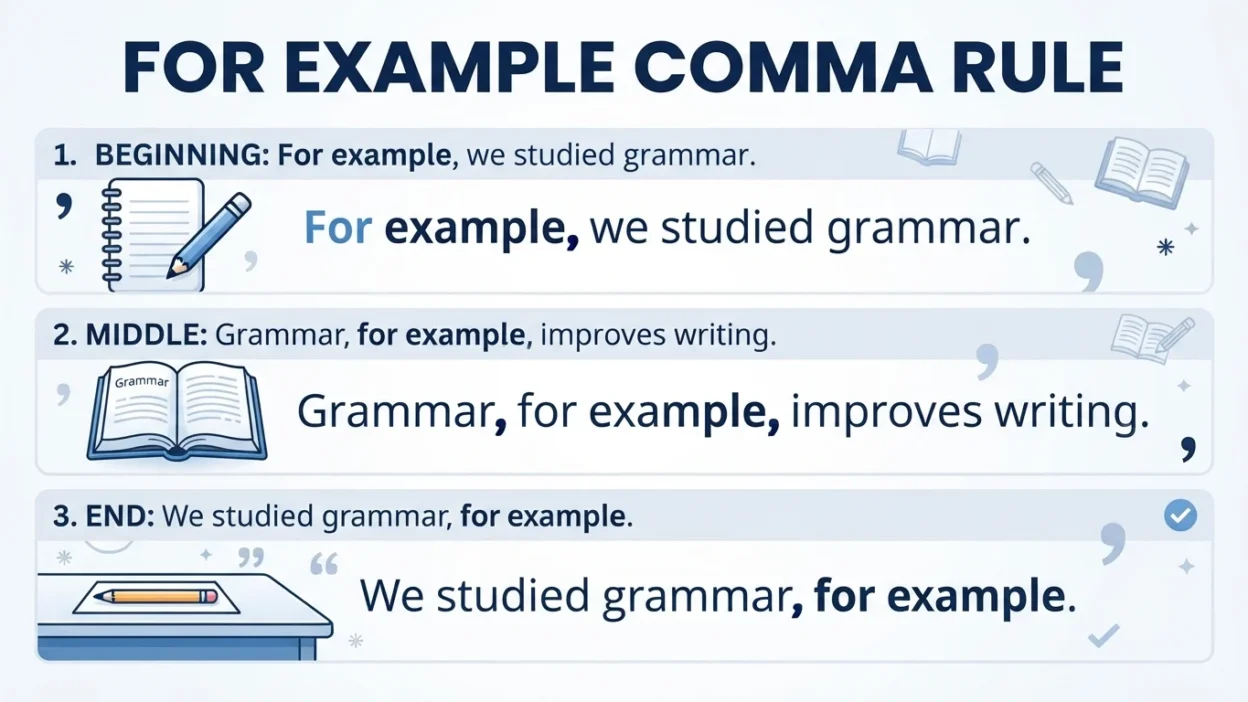
Memory Trick
Remember this simple rule:
Beginning = comma after.
Middle = commas around.
End = comma before.
If for example interrupts your sentence, imagine it sitting inside a pair of commas.
People Also Ask
Do you always put a comma after “for example”?
Yes, when it starts a sentence, a comma should follow for example.
Does “for example” need commas in the middle of a sentence?
Yes. It is normally enclosed by commas when interrupting a sentence.
Is “for example” the same as “such as”?
No. Both introduce examples, but such as directly introduces items, while for example acts as a transitional phrase.
Can I use “for example” in formal writing?
Yes. It is widely accepted in academic, business, and professional writing.
Is it wrong to omit commas with “for example”?
Sometimes. Omitting commas where they are required can make sentences harder to read and grammatically incorrect.
Frequently Asked Questions
What is the easiest way to remember the for example comma rule?
Remember: Beginning—comma after. Middle—commas around. End—comma before.
Is “for example” a transition phrase?
Yes. It connects ideas by introducing an example.
Can I replace “for example” with “e.g.”?
Yes, especially in formal or academic writing, although for example is generally easier for all readers to understand.
Should I use commas in every sentence with “for example”?
Not always. The need for commas depends on where the phrase appears and how it functions in the sentence.
Which is better: “for example” or “such as”?
Neither is better. Choose for example when introducing an illustrative example and such as when directly listing examples.
Conclusion
The for example comma rule is straightforward once you understand where the phrase appears in a sentence.
Use a comma after for example when it begins a sentence, place commas before and after it when it interrupts a sentence, and usually use a comma before it if it appears at the end.
Mastering this punctuation rule makes your writing clearer, more professional, and easier to read.
By following these simple guidelines and practicing with real-world examples, you’ll apply the for example comma rule confidently in academic, business, and everyday writing.