The phrase stick a fork in it meaning often confuses English learners because the words sound literal at first.
You might imagine putting a fork into food, but this popular idiom usually has a figurative meaning.
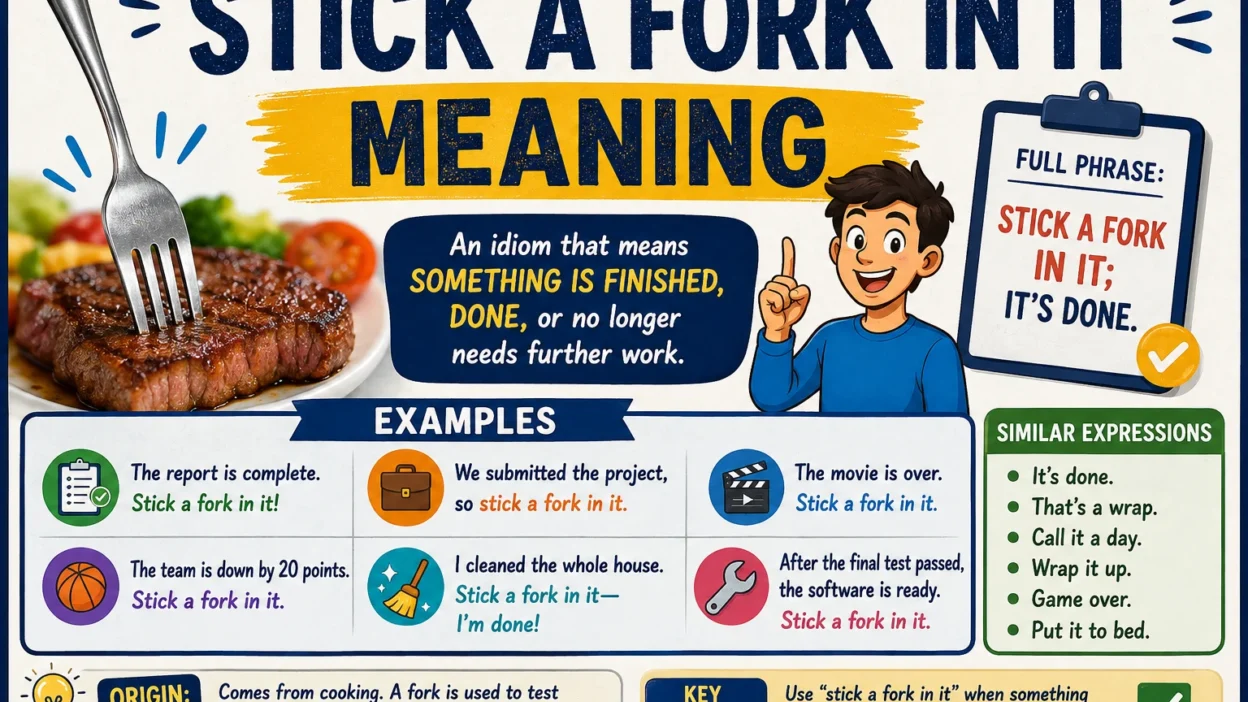
In everyday English, people use it to say that something is completely finished, done, or no longer needs further attention.
Understanding the stick a fork in it meaning can help you follow conversations, movies, workplace discussions, and casual expressions more naturally.
The stick a fork in it meaning is closely connected to the idea of checking whether food is cooked.
If you can stick a fork into something and determine that it is done, the cooking process is over.
Over time, the expression developed into a casual way to say that a task, project, competition, situation, or even a person is finished.
Quick Answer
“Stick a fork in it” means “it is done” or “it is finished.”
It is an informal idiom often used when something no longer needs more work or when the outcome is clearly decided.
Example: “The report is complete. Stick a fork in it!”
What Does “Stick a Fork in It” Mean?
The basic stick a fork in it meaning is to say that something is finished, completed, or beyond further work.
People often use the expression when a task has reached its end. It can also suggest that a situation is so clearly over that there is no reason to continue discussing, fixing, or working on it.
Simple Examples
- The presentation is finished. Stick a fork in it.
- We submitted the project, so stick a fork in it.
- The game is over. Stick a fork in it—we lost.
- After three hours of repairs, the mechanic said, “Stick a fork in it; it’s done.”
The tone is usually casual, confident, and sometimes humorous.
The Literal Meaning vs the Idiomatic Meaning
The expression has both a literal and figurative usage. Knowing the difference helps you understand the phrase correctly.
| Usage | Meaning | Example |
|---|---|---|
| Literal | Putting a fork into food | Stick a fork in the potato to see if it is cooked. |
| Idiomatic | Something is finished | The project is complete—stick a fork in it. |
| Humorous | Something is clearly over | The team is down by 30 points. Stick a fork in it. |
| Emphatic | No more work is needed | The repairs are done. Stick a fork in it! |
In most conversations, context makes it clear whether the speaker is talking about food or using the idiom.
Where Does “Stick a Fork in It” Come From?
The expression is connected to cooking. A fork is often used to test whether certain foods, such as potatoes, meat, or baked dishes, are fully cooked.
If the food is done, there is no need to keep cooking it. This simple idea led to the figurative meaning: something has reached its end and needs no more work.
The familiar expanded version is:
“Stick a fork in it; it’s done.”
Even when speakers use only “stick a fork in it,” the word done is usually understood.
How to Use “Stick a Fork in It” Correctly
The idiom works best in informal situations. You can use it as a complete expression or include it within a longer sentence.
Common Sentence Patterns
| Pattern | Example |
|---|---|
| Stick a fork in it. | The job is complete. Stick a fork in it. |
| Stick a fork in + noun. | Stick a fork in this project; we are finished. |
| You can stick a fork in it. | You can stick a fork in it—we solved the problem. |
| Stick a fork in it; it’s done. | The meal is ready. Stick a fork in it; it’s done. |
| We can stick a fork in it. | We can stick a fork in it and go home now. |
The phrase is flexible, but it usually refers to something that has clearly reached completion.
Stick a Fork in It Meaning in Everyday Conversations
In daily conversation, the idiom often makes a simple statement more colorful.
Instead of saying:
“The task is finished.”
You might say:
“Stick a fork in it—it’s done.”
Everyday Examples
- I cleaned the kitchen, finished the laundry, and paid the bills. Stick a fork in it; my chores are done.
- The movie has ended, so stick a fork in it.
- We finally assembled the furniture. Stick a fork in it!
- That old phone will not turn on anymore. You can stick a fork in it.
The final example shows that the phrase can sometimes mean something is finished for good or beyond repair.
Stick a Fork in It Meaning in Business and Work
The stick a fork in it meaning can also appear in casual workplace communication. However, it is best used with colleagues who understand informal English.
Business Examples
- The client approved the design. Stick a fork in it; the project is complete.
- We finished the quarterly report, so you can stick a fork in it.
- After the final test passed, the development team said the product was ready.
- The marketing campaign has ended. Stick a fork in it and move on to the next one.
In a formal report or professional email, a more direct phrase may be better.
| Informal Expression | More Professional Alternative |
|---|---|
| Stick a fork in it. | The task is complete. |
| Stick a fork in the project. | The project has been finalized. |
| It’s done—stick a fork in it. | All required work has been completed. |
| You can stick a fork in this. | This matter has been resolved. |
The idiom adds personality, but formal communication usually requires clearer and more neutral language.
Using the Idiom in Education and Academic Settings
Students and teachers may use stick a fork in it casually when discussing assignments, exams, or projects.
Examples in Education
- I submitted my final essay. Stick a fork in it!
- The group completed its science project, so stick a fork in it.
- After the last exam, the students felt the semester was finally over.
- We finished checking every answer. Stick a fork in it; the test is ready.
The phrase should generally not be used in formal academic writing. Instead, use expressions such as:
- The assignment is complete.
- The research has concluded.
- The experiment has been completed.
- The analysis is finished.
Stick a Fork in It Meaning in Sports and Competition
In sports, the expression often means that the result is obvious and the competition is effectively over.
For example:
“The team is leading by 25 points with two minutes left. Stick a fork in it.”
This suggests that the losing team has almost no realistic chance of recovering.
Sports Examples
- With seconds left and a huge lead, stick a fork in it—the game is over.
- The champion scored again. Stick a fork in the match.
- Once the final point was scored, everyone knew the competition was finished.
This use can sound dramatic or humorous, especially when the outcome is already clear before the official ending.
Stick a Fork in It in Technology and Science
The idiom can also be used informally in technical fields, although formal documents should use more precise language.
Technology Examples
- The software passed all final tests. Stick a fork in it; the release is ready.
- The engineers fixed the last bug, so the update was complete.
- After the final security check, the team said, “Stick a fork in it.”
Science Examples
- The researchers completed all scheduled trials. Stick a fork in it—the experiment is finished.
- The data collection phase ended after the final sample was tested.
- Once the results were verified, the analysis phase was complete.
Industry Usage Table
| Industry | Informal Example | Preferred Formal Wording |
|---|---|---|
| Business | Stick a fork in it; the deal is done. | The agreement has been finalized. |
| Education | Stick a fork in the assignment. | The assignment has been completed. |
| Technology | Stick a fork in the update. | The software update is ready for release. |
| Science | Stick a fork in the experiment. | The experiment has concluded. |
| Construction | Stick a fork in the job. | The construction work has been completed. |
| Sports | Stick a fork in it—the game is over. | The result is no longer in doubt. |
When Should You Not Use “Stick a Fork in It”?
Although the idiom is common and understandable, it is not appropriate for every situation.
Avoid it when the tone needs to be highly formal, serious, or sensitive.
Less Suitable Situations
- Legal documents
- Academic research papers
- Formal business reports
- Serious announcements
- Sensitive personal situations
For example, saying “Stick a fork in it” after discussing a serious medical, legal, or emotional issue may sound careless.
Better Alternatives
| Situation | Better Expression |
|---|---|
| Formal business | The project is complete. |
| Academic writing | The study has concluded. |
| Legal context | The matter has been resolved. |
| Technical report | The testing process has been completed. |
| General formal use | The task is finished. |
Always consider the audience and tone before using an idiom.
Why Do People Say “Stick a Fork in It”?
People use idioms because they make language more vivid, memorable, and expressive.
Saying “stick a fork in it” creates a stronger image than simply saying “it is finished.” The listener can imagine checking cooked food with a fork and deciding that no more cooking is needed.
The expression can also communicate confidence. When someone says it, they often mean:
- The work is definitely finished.
- No further action is needed.
- The outcome is already clear.
- It is time to move on.
That strong sense of finality is an important part of the idiom’s usage.
Common Mistakes With “Stick a Fork in It”
A common mistake is using the idiom when something is not actually finished.
Incorrect vs Correct Examples
| Incorrect | Correct | Why |
|---|---|---|
| Stick a fork in the project; we still have three tasks left. | We still have three tasks left, so the project is not finished yet. | The idiom means completion. |
| Stick a fork in it because we will continue tomorrow. | Let’s stop for today and continue tomorrow. | The work is paused, not done. |
| I sticked a fork in it. | I stuck a fork in it. | The past tense of stick is usually stuck. |
| Stick a fork in my homework while I finish it. | Stick a fork in my homework once I finish it. | The phrase should describe completion. |
| The meeting is boring, so stick a fork in it. | The meeting should end; it has gone on too long. | Boredom alone does not mean something is finished. |
Another mistake is treating the idiom as appropriate for every formal situation. Its informal and colorful tone is important to remember.
Grammar Forms and Variations
The phrase can appear in different grammatical forms.
| Form | Example | Usage |
|---|---|---|
| Base form | Stick a fork in it. | Direct command or expression |
| Present tense | We can stick a fork in it. | Current situation |
| Past tense | We stuck a fork in it. | Completed past situation |
| Future possibility | We’ll stick a fork in it tomorrow. | Expected completion |
| Expanded form | Stick a fork in it; it’s done. | Most explicit version |
| Question form | Can we stick a fork in it now? | Asking whether something is finished |
The phrase does not have to be used exactly the same way every time. Speakers may adjust the grammar to fit the sentence.
A Simple Memory Trick
Think about cooking food.
Fork = Checking
Done = Finished
Stick a fork in it = It is finished
This visual connection makes the expression easy to remember.
Another helpful memory rule is:
If you could replace the phrase with “It’s done,” the idiom may fit.
For example:
“The report is complete.”
You could say:
“Stick a fork in it—it’s done.”
If something still needs work, however, the expression probably does not fit.
Step-by-Step Guide to Using the Idiom
Use this simple process before adding the phrase to your sentence.
| Step | Question | Result |
|---|---|---|
| 1 | Is something finished? | If yes, continue. |
| 2 | Is the outcome final or clearly decided? | The idiom may fit. |
| 3 | Is the situation informal or conversational? | It is more appropriate. |
| 4 | Does the audience understand casual idioms? | Use it naturally. |
| 5 | Is the situation formal or sensitive? | Choose a clearer alternative. |
Example Process
Situation: Your team completed every part of a presentation.
Step 1: Is it finished? Yes.
Step 2: Is more work needed? No.
Step 3: Is the conversation casual? Yes.
Result: “Stick a fork in it—the presentation is done.”
Real-World Examples of “Stick a Fork in It”
Here are examples from different situations.
At Home
“I cleaned the house, cooked dinner, and washed the dishes. Stick a fork in it—I’m done for the day.”
At Work
“The client approved the final version. Stick a fork in the project.”
In School
“I finished my last exam. Stick a fork in it—the semester is over.”
In Technology
“The final bug was fixed, and all tests passed. Stick a fork in it; the update is ready.”
In Sports
“The team has a huge lead with only seconds remaining. Stick a fork in it.”
In Everyday Conversation
“That old printer has stopped working again. You can stick a fork in it.”
These examples show how the idiom can describe successful completion, a clear ending, or something that is effectively beyond further use.
Similar Expressions and Their Differences
Several English expressions have meanings similar to stick a fork in it, but their tone and usage are slightly different.
| Expression | Meaning | Main Difference |
|---|---|---|
| Stick a fork in it | It is finished | Informal and colorful |
| It’s done | It is complete | Simple and direct |
| Call it a day | Stop working for now | May not mean permanently finished |
| Wrap it up | Finish something soon | Focuses on ending the process |
| That’s a wrap | The work is finished | Often used after filming or production |
| Game over | The situation is finished | Often dramatic or competitive |
| Put it to bed | Finish and settle something | Often used in work or discussion |
The biggest difference is that stick a fork in it strongly emphasizes the idea that the matter is finished and no more work is needed.
Stick a Fork in It vs “Call It a Day”
These two expressions are sometimes confused because both can appear when work stops.
However, they are not exactly the same.
Stick a fork in it means something is finished.
Call it a day means to stop working for now, even if the work is not finished.
Comparison Table
| Expression | Meaning | Is the Work Necessarily Complete? |
|---|---|---|
| Stick a fork in it | It is done | Yes, usually |
| Call it a day | Stop for now | No |
| Wrap it up | Finish soon | Usually close to completion |
| Game over | It is finished | Yes |
| That’s a wrap | Production or work is finished | Yes |
Example
“We still have half the report left. Let’s call it a day.”
This is correct because the work will continue later.
“We still have half the report left. Stick a fork in it.”
This would usually be incorrect because the report is not finished.
Is “Stick a Fork in It” Positive or Negative?
The expression can be either positive or negative depending on the situation.
Positive Usage
- We finished the project successfully. Stick a fork in it!
- The meal is ready. Stick a fork in it—it’s done!
Negative Usage
- The old computer has failed again. Stick a fork in it.
- The losing team cannot recover now. Stick a fork in the game.
The phrase itself is neutral. The surrounding context determines whether completion is good, disappointing, humorous, or final.
FAQs About Stick a Fork in It Meaning
1. What does “stick a fork in it” mean?
It means that something is finished, completed, or clearly over and does not need more work.
2. Is “stick a fork in it” an idiom?
Yes. It is an informal English idiom with a figurative meaning beyond its literal cooking-related meaning.
3. What is the full phrase?
The common full version is “Stick a fork in it; it’s done.”
4. Can I use “stick a fork in it” at work?
Yes, in casual workplace conversations. For formal emails and reports, use a more professional phrase such as “the project is complete.”
5. Does “stick a fork in it” always mean something is successfully finished?
No. It can also mean something is over because it failed, became unusable, or has no chance of continuing.
6. What is another way to say “stick a fork in it”?
Depending on the context, you can say “it’s done,” “that’s a wrap,” “game over,” or “we’ve finished.”
Conclusion
The stick a fork in it meaning is simple: something is finished, done, or clearly over. The idiom comes from the idea of checking cooked food with a fork and deciding that it needs no more cooking.
Use stick a fork in it in casual conversations when a task, project, event, competition, or situation has reached its end. The most important usage rule is to make sure the thing you are describing is truly finished or effectively over. For formal writing, choose clearer alternatives such as “the task is complete” or “the matter has been resolved.”
Once you remember fork = done cooking = finished, the meaning and usage of this popular English idiom become much easier to understand.