
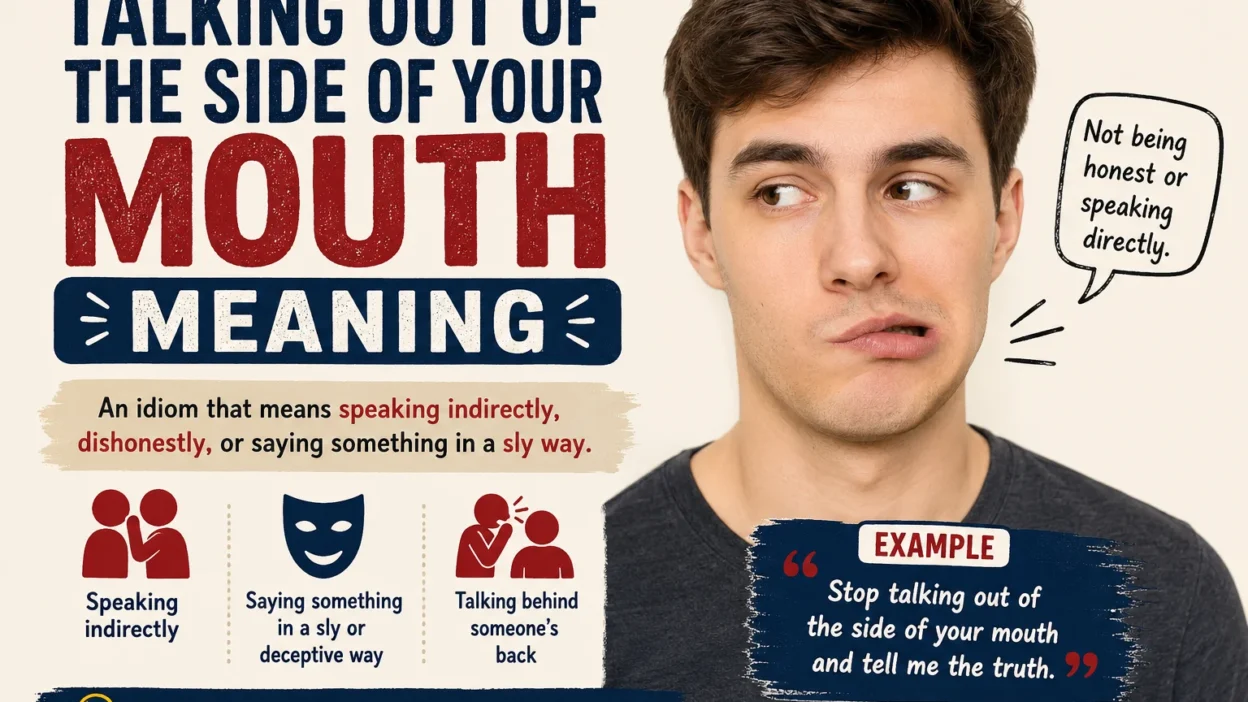
If you are searching for the talking out of the side of your mouth meaning, you may have encountered this expression in a conversation, movie, song, or casual discussion and wondered what it really implies.
The phrase usually does not refer literally to speaking from the side of your mouth. Instead, it is commonly used figuratively to describe someone who is speaking dishonestly, indirectly, disrespectfully, or in a way that suggests they are saying something they should not be saying. In some contexts, it can also describe speaking while trying to hide what you are saying.
Understanding the talking out of the side of your mouth meaning depends on context because the expression can carry slightly different shades of meaning.
It may suggest talking behind someone’s back, making sarcastic remarks, speaking deceptively, or saying one thing while meaning another.
Learning the talking out of the side of your mouth meaning can help you recognize whether the phrase is being used literally, figuratively, humorously, or as criticism.
Quick Answer
Talking out of the side of your mouth usually means speaking indirectly, dishonestly, disrespectfully, or saying something in a sly way.
It can also describe someone who talks behind another person’s back or makes remarks they would not say openly.
The exact meaning depends on the context and tone.
What Is the Meaning of “Talking Out of the Side of Your Mouth”?
The phrase talking out of the side of your mouth is an informal expression. It is generally used when someone is perceived as speaking in a sneaky, indirect, sarcastic, or dishonest manner.
For example:
“Why are you talking out of the side of your mouth? If you have something to say, say it directly.”
Here, the speaker is not talking about the physical movement of the person’s mouth. They are criticizing the person’s manner of speaking.
Basic meaning
| Expression | Meaning |
|---|---|
| Talking out of the side of your mouth | Speaking indirectly or slyly |
| Talking behind someone’s back | Discussing someone when they are absent |
| Speaking directly | Saying exactly what you mean |
| Speaking sarcastically | Saying something that may mean the opposite of the literal words |
| Speaking deceptively | Deliberately misleading someone |
What Does “Talk Out of the Side of Your Mouth” Mean?
The expression talk out of the side of your mouth can mean to make comments indirectly instead of speaking openly.
It can also suggest that someone is being two-faced or saying something behind another person’s back.
For example:
“He talks out of the side of his mouth whenever his manager leaves the room.”
This sentence suggests that he says things privately that he would probably not say openly.
The phrase can therefore carry a negative tone.
Is the Phrase Literal or Figurative?
Most of the time, the expression is figurative.
Someone might physically move their mouth to one side while talking, but when people use the expression idiomatically, they are usually commenting on the speaker’s behavior rather than their physical speech.
| Use | Meaning | Example |
|---|---|---|
| Literal | Speaking with the mouth physically positioned to one side | “The dentist noticed that she was talking out of the side of her mouth.” |
| Figurative | Speaking indirectly or dishonestly | “Stop talking out of the side of your mouth and tell me what happened.” |
| Informal criticism | Making sly or disrespectful comments | “He was talking out of the side of his mouth during the meeting.” |
Talking Out of the Side of Your Mouth vs. Talking Behind Someone’s Back
These expressions are related, but they are not always identical.
Talking behind someone’s back specifically means discussing someone negatively or secretly when that person is absent.
Talking out of the side of your mouth is broader. It can describe indirect, deceptive, sarcastic, or sly speech even when the other person is present.
| Expression | Main idea | Example |
|---|---|---|
| Talking out of the side of your mouth | Speaking slyly or indirectly | “Stop talking out of the side of your mouth.” |
| Talking behind someone’s back | Talking about someone in their absence | “She talks behind her coworker’s back.” |
| Beating around the bush | Avoiding a direct answer | “Stop beating around the bush.” |
| Speaking plainly | Communicating directly | “Just speak plainly.” |
Talking Out of the Side of Your Mouth vs. Speaking Directly
The biggest contrast is between indirect speech and direct speech.
When someone speaks directly, they communicate their thoughts clearly and openly. When someone is described as talking out of the side of their mouth, the speaker may believe that the person is hiding their real intentions.
Example
Indirect:
“Well, some people around here don’t exactly do their jobs.”
Direct:
“I think you are not doing your job properly.”
The first sentence could be considered indirect or sly depending on the context. The second sentence clearly identifies the intended message.
Why Do People Use This Expression?
People often use this expression to criticize someone’s communication style.
It may imply that the speaker is:
- avoiding direct communication
- making a secretive comment
- being sarcastic
- speaking dishonestly
- criticizing someone indirectly
- saying something they would not say openly
- trying to hide their real intentions
The phrase is particularly common in informal conversations.
Real-Life Examples of Talking Out of the Side of Your Mouth
Example 1: Everyday Conversation
“Don’t talk out of the side of your mouth. If you’re angry with me, just tell me.”
Here, the speaker wants honest and direct communication.
Example 2: Workplace
“During the meeting, Jake kept talking out of the side of his mouth about the new manager.”
This suggests that Jake made indirect or possibly disrespectful comments.
Example 3: Education
“The teacher told the students not to talk out of the side of their mouths when discussing their classmates.”
The expression can describe inappropriate or indirect criticism.
Example 4: Family Conversation
“My brother always talks out of the side of his mouth when he disagrees with Dad.”
This suggests that the brother may express disagreement indirectly.
Example 5: Business
“If you have concerns about the contract, tell me directly instead of talking out of the side of your mouth.”
In professional communication, direct wording is usually preferred.
Talking Out of the Side of Your Mouth in Professional Settings
The phrase itself is informal, so it is usually better to avoid it in formal reports, academic papers, or professional correspondence.
Instead, use more precise expressions.
| Informal phrase | Professional alternative |
|---|---|
| Talking out of the side of your mouth | Speaking indirectly |
| Talking behind someone’s back | Discussing someone in their absence |
| Talking trash | Making disparaging remarks |
| Beating around the bush | Avoiding a direct response |
| Being two-faced | Showing inconsistent behavior |
| Talking nonsense | Making unsupported claims |
For example, instead of writing:
“The employee was talking out of the side of his mouth.”
A professional report could say:
“The employee made indirect and critical remarks about the management team.”
Grammar Forms and Common Variations
The expression can appear in several grammatical forms.
| Form | Example |
|---|---|
| Talk out of the side of your mouth | “Don’t talk out of the side of your mouth.” |
| Talking out of the side of your mouth | “She was talking out of the side of her mouth.” |
| Talks out of the side of his mouth | “He talks out of the side of his mouth.” |
| Talked out of the side of her mouth | “She talked out of the side of her mouth.” |
| Talking out of the side of their mouths | “They were talking out of the side of their mouths.” |
The pronoun changes according to the subject.
Examples
- I talk out of the side of my mouth.
- You talk out of the side of your mouth.
- He talks out of the side of his mouth.
- She talks out of the side of her mouth.
- They talk out of the side of their mouths.
Common Mistakes
Because the phrase is informal and idiomatic, learners sometimes use it incorrectly.
| Incorrect | Correct | Why |
|---|---|---|
| “He talking out of the side of his mouth.” | “He is talking out of the side of his mouth.” | The progressive form needs is. |
| “She talks out of side of her mouth.” | “She talks out of the side of her mouth.” | Include the. |
| “I am talking out of side my mouth.” | “I am talking out of the side of my mouth.” | Use the complete expression. |
| “He talk out of the side of his mouth.” | “He talks out of the side of his mouth.” | Third-person singular needs talks. |
More Correct vs. Incorrect Examples
Incorrect:
“Why you are talking out of side your mouth?”
Correct:
“Why are you talking out of the side of your mouth?”
Incorrect:
“She talk out of the side of her mouth when angry.”
Correct:
“She talks out of the side of her mouth when she is angry.”
Why Do People Confuse the Meaning?
The expression can be confusing because it sounds like a description of physical behavior.
Someone unfamiliar with the idiom may imagine a person literally speaking from one side of their mouth.
However, idiomatic expressions often have meanings that are different from their individual words. In this case, the phrase can communicate an idea of indirectness, secrecy, or insincerity.
Context is therefore important.
How to Remember the Meaning
A simple memory trick is:
Side of the mouth = not saying it straight.
Think of a person who refuses to speak openly and instead makes a comment from “the side.”
That mental image can help you remember that the expression is often associated with indirect or sly communication.
Memory trick
Straight talk = direct.
Side-of-the-mouth talk = indirect or sly.
This is not a literal grammar rule, but it is an easy way to remember the figurative meaning.
What Does It Mean When Someone Says “Stop Talking Out of the Side of Your Mouth”?
When someone says:
“Stop talking out of the side of your mouth.”
they are usually telling another person to stop speaking indirectly, sarcastically, dishonestly, or disrespectfully.
The exact interpretation depends on the situation.
For example, if two people are arguing, it may mean:
“Stop making indirect comments and tell me what you really think.”
If someone is criticizing another person privately, it could mean:
“Don’t say things about people behind their backs.”
Is “Talking Out of the Side of Your Mouth” an Idiom?
Yes, it can function as an informal idiomatic expression.
Its meaning is not necessarily based on the literal physical act of speaking from one side of the mouth. Instead, speakers can use it figuratively to describe a particular style or manner of communication.
Because idioms can vary by region and community, the expression may carry slightly different shades of meaning for different speakers.
How to Use the Expression Naturally
Use the expression when talking about someone’s communication style in an informal situation.
Natural examples
“Don’t talk out of the side of your mouth. Just be honest.”
“He was talking out of the side of his mouth about his coworker.”
“Why are you talking out of the side of your mouth? Tell me directly.”
“She doesn’t like people who talk out of the side of their mouths.”
Less suitable situations
Avoid the expression in:
- academic essays
- formal business reports
- legal documents
- scientific writing
- formal presentations
In these settings, precise language is usually better.
Industry and Context Usage
| Context | Likely meaning | Recommended interpretation |
|---|---|---|
| Everyday conversation | Sly or indirect speech | Not speaking openly |
| Workplace | Indirect criticism | Avoiding direct communication |
| Education | Indirect comments | Not expressing something clearly |
| Business | Hidden or unclear criticism | Communication lacks directness |
| Social relationships | Two-faced or secretive speech | Saying things indirectly |
| Entertainment | Informal criticism or sarcasm | Character speaking slyly |
Comparison Table: Similar Expressions
| Expression | Meaning | Tone |
|---|---|---|
| Talking out of the side of your mouth | Speaking indirectly or slyly | Informal |
| Talking behind someone’s back | Speaking negatively when someone is absent | Negative |
| Beating around the bush | Avoiding the main point | Informal |
| Speaking indirectly | Not communicating directly | Neutral |
| Speaking under one’s breath | Speaking very quietly | Informal |
| Being two-faced | Acting differently toward different people | Strongly negative |
| Speaking plainly | Communicating directly | Neutral/positive |
“Talking Out of the Side of Your Mouth” in Different Tenses
The phrase can be used naturally in different tenses.
| Tense | Example |
|---|---|
| Present simple | “He talks out of the side of his mouth.” |
| Present continuous | “He is talking out of the side of his mouth.” |
| Past simple | “He talked out of the side of his mouth.” |
| Past continuous | “He was talking out of the side of his mouth.” |
| Present perfect | “He has talked out of the side of his mouth before.” |
| Future | “He will probably talk out of the side of his mouth again.” |
The idiomatic meaning remains essentially the same; the tense simply changes the timing of the action.
Literal Meaning vs. Figurative Meaning
One of the easiest ways to understand the phrase is to separate its literal and figurative meanings.
| Meaning type | Explanation | Example |
|---|---|---|
| Literal | Physically speaking with the mouth positioned to one side | “He was talking out of the side of his mouth after the dental procedure.” |
| Figurative | Speaking indirectly or slyly | “Stop talking out of the side of your mouth and be honest.” |
The figurative use is the one most people mean in ordinary conversations when using the expression as an idiom.
What Are Better Alternatives?
If you want to communicate the same general idea more clearly, several alternatives are available.
Informal alternatives
- Stop being indirect.
- Say what you mean.
- Speak honestly.
- Tell me directly.
- Stop making side comments.
- Don’t talk behind people’s backs.
Formal alternatives
- Please communicate your concerns directly.
- Please avoid indirect criticism.
- State your position clearly.
- Express your concerns openly.
- Provide a direct response.
Choosing the right alternative depends on the audience and situation.
Frequently Asked Questions
What is the talking out of the side of your mouth meaning?
It generally means speaking indirectly, slyly, sarcastically, or dishonestly rather than saying something openly and directly.
Is talking out of the side of your mouth a negative expression?
Usually, yes. It often criticizes someone’s communication style, although the exact tone depends on context.
Does talking out of the side of your mouth mean lying?
Not necessarily. It can imply dishonesty, but it may also mean speaking indirectly, making sarcastic remarks, or avoiding a direct statement.
Is “talking out of the side of your mouth” an idiom?
Yes. It can be used idiomatically to describe indirect or sly communication rather than literal mouth movement.
What is another way to say talking out of the side of your mouth?
Depending on the context, you can say speaking indirectly, talking behind someone’s back, being indirect, beating around the bush, or making sly remarks.
Can I use this phrase in formal writing?
It is better to avoid it in formal writing. Use precise alternatives such as speaking indirectly, making indirect remarks, or avoiding direct communication.
Conclusion
The talking out of the side of your mouth meaning is usually connected with speaking in an indirect, sly, sarcastic, or sometimes dishonest way. Although the phrase can have a literal meaning, its common figurative use focuses on how someone communicates rather than the physical position of their mouth.
The key usage rule is simple: when someone is talking out of the side of their mouth, they are often not speaking plainly or openly. Depending on context, the phrase may suggest indirect criticism, secretive comments, sarcasm, or talking behind someone’s back. For casual conversations, it is a natural informal expression, while professional and academic writing generally benefits from clearer alternatives such as speaking indirectly or making indirect remarks.