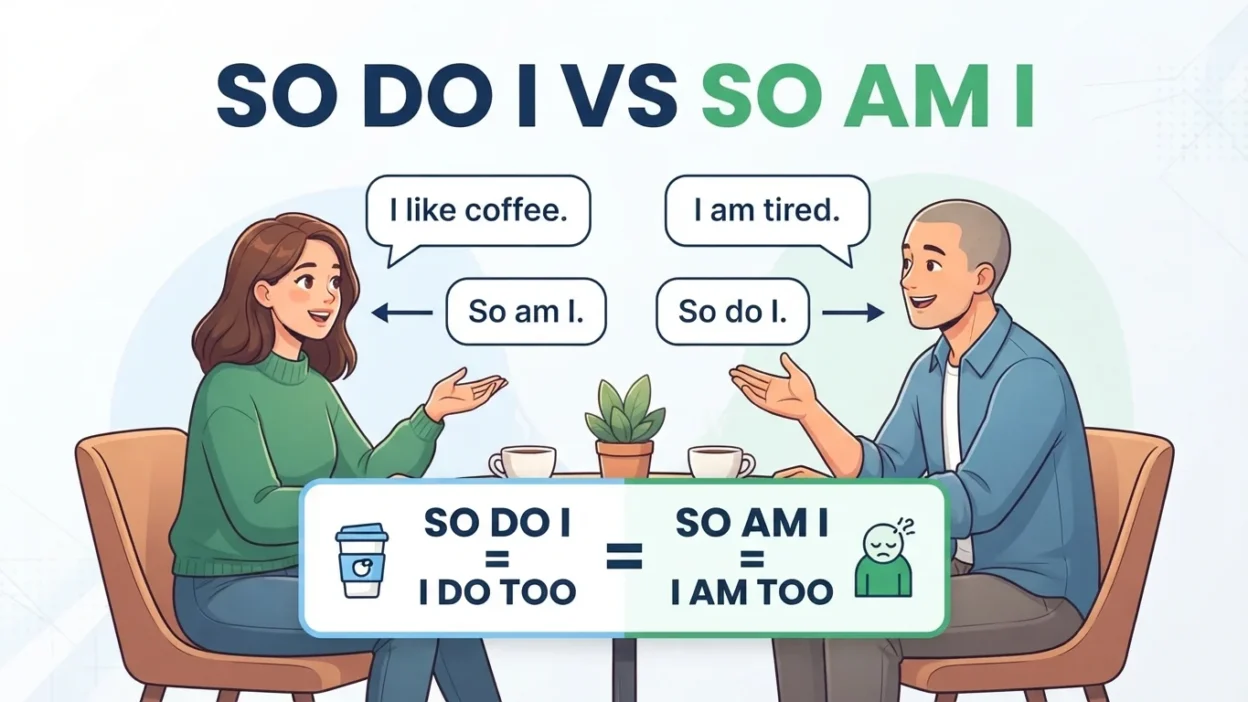
So do I vs so am I is a common English grammar question because both expressions are used to agree with another person.
The confusion happens because “so do I” and “so am I” look almost identical, but they cannot normally be used interchangeably.
The correct expression depends on the verb used in the original statement. Understanding this small grammar rule can make your English sound much more natural and accurate.
In so do I vs so am I, the main difference is the helping verb.
“So do I” is generally used when the original statement contains a main verb that takes do as its auxiliary, while “so am I” is used when the original statement uses the verb be and the subject is “I.”
Once you understand which auxiliary verb to repeat, the choice becomes easy.
Quick Answer
“So do I” means “I do too” and agrees with a statement using a suitable main verb.
“So am I” means “I am too” and agrees with a statement using am/is/are.
- I like coffee. → So do I.
- I am tired. → So am I.
What Does “So Do I” Mean?
“So do I” is used to agree with a positive statement when the original sentence has a main verb that can take do as its auxiliary.
It is similar to saying “I do too” or “I also do.”
For example:
A: I like pizza.
B: So do I.
The first speaker says, “I like pizza.” The second speaker agrees by using do instead of repeating the entire sentence.
Instead of saying:
I like pizza too.
You can say:
So do I.
Both are grammatically correct, but so do I is a concise way to show agreement.
What Does “So Am I” Mean?
“So am I” is used when the original statement uses the verb be and the statement applies to the second speaker as well.
For example:
A: I am tired.
B: So am I.
Here, am is the correct auxiliary because the original statement uses am.
The expression means:
I am tired too.
Another example:
A: I am ready for the meeting.
B: So am I.
Using “So do I” in this situation would be incorrect because the original sentence uses am, not do.
So Do I vs So Am I: Main Difference
The easiest way to understand so do I vs so am I is to look at the verb in the original sentence.
| Original statement | Correct response | Meaning |
|---|---|---|
| I like tea. | So do I. | I like tea too. |
| I work here. | So do I. | I work here too. |
| I play tennis. | So do I. | I play tennis too. |
| I am tired. | So am I. | I am tired too. |
| I am happy. | So am I. | I am happy too. |
| I am ready. | So am I. | I am ready too. |
The Basic Rule
Use “so do I” with suitable main verbs.
Use “so am I” with “I am” statements.
This simple rule solves most so do I vs so am I questions.
Why Do People Confuse “So Do I” and “So Am I”?
The expressions are confusing because they have the same basic structure:
So + auxiliary verb + subject
The only obvious difference is the auxiliary verb:
- So do I.
- So am I.
However, English requires the auxiliary verb to agree with the structure of the original statement.
Compare:
I love music. → So do I.
with:
I am a musician. → So am I.
The first sentence uses love, so do is used for the short agreement response. The second sentence uses am, so am must be repeated.
Grammar Rule Behind “So Do I”
The construction so + auxiliary + subject is called an agreement structure or affirmative agreement construction.
When the original sentence contains an ordinary present-tense or past-tense main verb, do, does, or did may be used as the auxiliary.
| Original sentence | Agreement response |
|---|---|
| I like it. | So do I. |
| She likes it. | So do I. |
| He works here. | So do I. |
| I watched the movie. | So did I. |
| She studied English. | So did I. |
The auxiliary changes according to the tense and grammatical structure of the original sentence.
Grammar Rule Behind “So Am I”
“So am I” uses the verb be as the auxiliary.
The same pattern changes depending on the subject and tense.
| Original statement | Agreement |
|---|---|
| I am tired. | So am I. |
| You are tired. | So am I. |
| She is tired. | So am I. |
| They are tired. | So am I. |
| I was tired. | So was I. |
| They were tired. | So was I. |
Notice that the response is determined by the speaker who is agreeing.
If someone says:
I am nervous.
You can say:
So am I.
If someone says:
I was nervous.
You say:
So was I.
“So Do I” vs “So Am I” Grammar Table
| Feature | So do I | So am I |
|---|---|---|
| Main verb type | Ordinary verb | Verb “be” |
| Present example | I like it. → So do I. | I am happy. → So am I. |
| Past example | I liked it. → So did I. | I was happy. → So was I. |
| Meaning | I do the same / I agree | I am the same |
| Common mistake | Using it after “am” | Using it after ordinary verbs |
Real-Life Examples of “So Do I”
Everyday Conversation
A: I love chocolate.
B: So do I.
Business
A: I work better in the morning.
B: So do I.
Education
A: I study English every evening.
B: So do I.
Hobbies
A: I play the guitar.
B: So do I.
Technology
A: I use this software every day.
B: So do I.
In each example, the original sentence contains an ordinary verb: love, work, study, play, use.
Therefore, so do I is appropriate.
Real-Life Examples of “So Am I”
Everyday Conversation
A: I am hungry.
B: So am I.
Business
A: I am ready for the presentation.
B: So am I.
Education
A: I am nervous about the exam.
B: So am I.
Travel
A: I am excited about the trip.
B: So am I.
Personal Conversation
A: I am happy to see you.
B: So am I.
Here, the original statements use am, so the correct agreement expression is so am I.
Other Forms: So Does I, So Did I, So Can I, and More
A major point to remember is that “so do I” is only one version of the agreement structure.
The auxiliary changes depending on the original sentence.
| Original statement | Correct response |
|---|---|
| I like coffee. | So do I. |
| She likes coffee. | So do I. |
| I liked coffee. | So did I. |
| I am happy. | So am I. |
| I was happy. | So was I. |
| I can swim. | So can I. |
| I will go. | So will I. |
| I have finished. | So have I. |
| I should leave. | So should I. |
This is why simply memorizing “so do I” is not enough. You need to identify the auxiliary or verb structure in the original statement.
So Do I vs So Am I vs So Have I
These three expressions are especially easy to confuse.
| Expression | Example | Meaning |
|---|---|---|
| So do I | I like it. → So do I. | I like it too. |
| So am I | I am tired. → So am I. | I am tired too. |
| So have I | I have finished. → So have I. | I have finished too. |
The auxiliary must match the original grammar.
Compare These Examples
I enjoy reading.
→ So do I.
I am an avid reader.
→ So am I.
I have read that book.
→ So have I.
All three express agreement, but the auxiliary verb changes.
So Do I vs So Am I in Professional English
These expressions are perfectly natural in workplace conversations.
| Professional situation | Statement | Agreement |
|---|---|---|
| Meeting | I work remotely. | So do I. |
| Project | I enjoy this project. | So do I. |
| Presentation | I am prepared. | So am I. |
| Deadline | I am worried about the deadline. | So am I. |
| Work habits | I check my email early. | So do I. |
| Teamwork | I am available tomorrow. | So am I. |
In formal reports, it is usually better to write the complete statement if maximum clarity is important. In spoken professional English, however, these short agreement forms are completely natural.
Positive Agreement vs Negative Agreement
One important grammar point is that so is normally used for agreement with positive statements.
For negative statements, English commonly uses neither, nor, or an appropriate negative auxiliary.
Compare:
I like coffee.
So do I.
But:
I don’t like coffee.
Neither do I.
Similarly:
I am not tired.
Neither am I.
| Positive statement | Negative statement |
|---|---|
| I like it. → So do I. | I don’t like it. → Neither do I. |
| I am tired. → So am I. | I am not tired. → Neither am I. |
| I can swim. → So can I. | I can’t swim. → Neither can I. |
| I have finished. → So have I. | I haven’t finished. → Neither have I. |
Common Mistakes With “So Do I” and “So Am I”
Mistake 1: Using “So Do I” After “I Am”
Incorrect:
I am tired. → So do I.
Correct:
I am tired. → So am I.
The original statement uses am, so the response must use am.
Mistake 2: Using “So Am I” After an Ordinary Verb
Incorrect:
I like pizza. → So am I.
Correct:
I like pizza. → So do I.
“Like” is an ordinary main verb, so do is appropriate.
Mistake 3: Using “So Do I” for Every Present-Tense Statement
Not every present-tense statement requires do.
For example:
I am excited. → So am I.
The present tense alone does not determine the answer. The verb structure does.
Mistake 4: Confusing “So Do I” With “So Did I”
For a past-tense action:
I watched the movie. → So did I.
Not:
So do I.
The auxiliary did matches the past tense.
Correct vs Incorrect Sentences
| Incorrect | Correct | Reason |
|---|---|---|
| I am tired. → So do I. | I am tired. → So am I. | “Am” must be repeated. |
| I like tea. → So am I. | I like tea. → So do I. | “Like” uses do-support. |
| I watched it. → So do I. | I watched it. → So did I. | Past tense requires “did.” |
| I can drive. → So do I. | I can drive. → So can I. | Modal “can” is repeated. |
| I have finished. → So do I. | I have finished. → So have I. | Present perfect uses “have.” |
A Simple Memory Trick
Use this formula:
Find the verb → Match the helper → Add “I.”
For example:
I like pizza.
Verb = like
Helper = do
Answer = So do I.
I am hungry.
Verb = am
Helper = am
Answer = So am I.
I can swim.
Helper = can
Answer = So can I.
The “Echo the Helper” Trick
Think of the response as an echo.
I am tired.
→ So am I.
I like coffee.
→ So do I.
I can swim.
→ So can I.
I have finished.
→ So have I.
The key is to echo the appropriate auxiliary verb, not necessarily the main verb.
How to Choose the Correct Expression
Use this simple process whenever you are unsure about so do I vs so am I.
| Step | What to do | Example |
|---|---|---|
| 1 | Look at the original statement | I am happy. |
| 2 | Identify the verb structure | am |
| 3 | Find the appropriate auxiliary | am |
| 4 | Put it after “so” | So am |
| 5 | Add the subject | So am I. |
Another example:
| Step | What to do | Example |
|---|---|---|
| 1 | Look at the statement | I enjoy music. |
| 2 | Identify the main verb | enjoy |
| 3 | Use do-support | do |
| 4 | Add the subject | I |
| 5 | Final answer | So do I. |
Comparison: So Do I vs So Am I
| Point | So Do I | So Am I |
|---|---|---|
| Basic meaning | I do the same | I am the same |
| Used after | Ordinary verbs | “Am” statements |
| Example | I love music. → So do I. | I am happy. → So am I. |
| Main function | Shows agreement | Shows agreement |
| Negative counterpart | Neither do I | Neither am I |
| Can replace the other? | No | No |
FAQs About So Do I vs So Am I
Is it “so do I” or “so am I”?
Both are correct, but they are used in different situations. Use so do I with appropriate ordinary verbs and so am I when agreeing with an am statement.
Can I say “so do I” after “I am”?
No. If someone says “I am tired,” the natural agreement is “So am I.”
What does “so do I” mean?
“So do I” means “I do too” or “I also do.” For example, “I love reading.” → “So do I.”
What does “so am I” mean?
“So am I” means “I am too.” For example, “I am excited.” → “So am I.”
Is “so am I” grammatically correct?
Yes. It is grammatically correct when agreeing with a statement that uses am, such as “I am tired.” → “So am I.”
What is the difference between “so do I” and “me too”?
Both can express agreement, but “me too” is more general and informal. “So do I” specifically follows the grammatical structure of the original statement.
Conclusion
The key to so do I vs so am I is simple: match the auxiliary verb to the original sentence. Use “so do I” when agreeing with an ordinary verb, as in “I like coffee.” → “So do I.” Use “so am I” when agreeing with an am statement, as in “I am tired.” → “So am I.”
Remember that English agreement expressions can use other auxiliaries too: so did I, so can I, so will I, so have I, and so was I. Instead of memorizing every expression separately, identify the verb or auxiliary in the original sentence and use the matching form. This makes the difference between so do I vs so am I much easier to understand and use naturally.

Julian Wyatt is a passionate researcher and writer who explores symbols, mythology, cultural traditions, and hidden meanings. Through engaging articles, he helps readers uncover the fascinating stories and significance behind symbols worldwide.