Many English learners and even native speakers get confused by per se vs per say because they sound exactly the same.
Since the phrase is usually heard in conversations rather than read, people often assume the spelling is per say, when the correct form is actually per se.
Understanding per se vs per say is important if you want to write professionally and avoid a common spelling mistake.
In this guide, you’ll learn the meaning of per se, why per say is incorrect, real-life examples, grammar tips, memory tricks, and common mistakes so you can use the phrase confidently.
Quick Answer
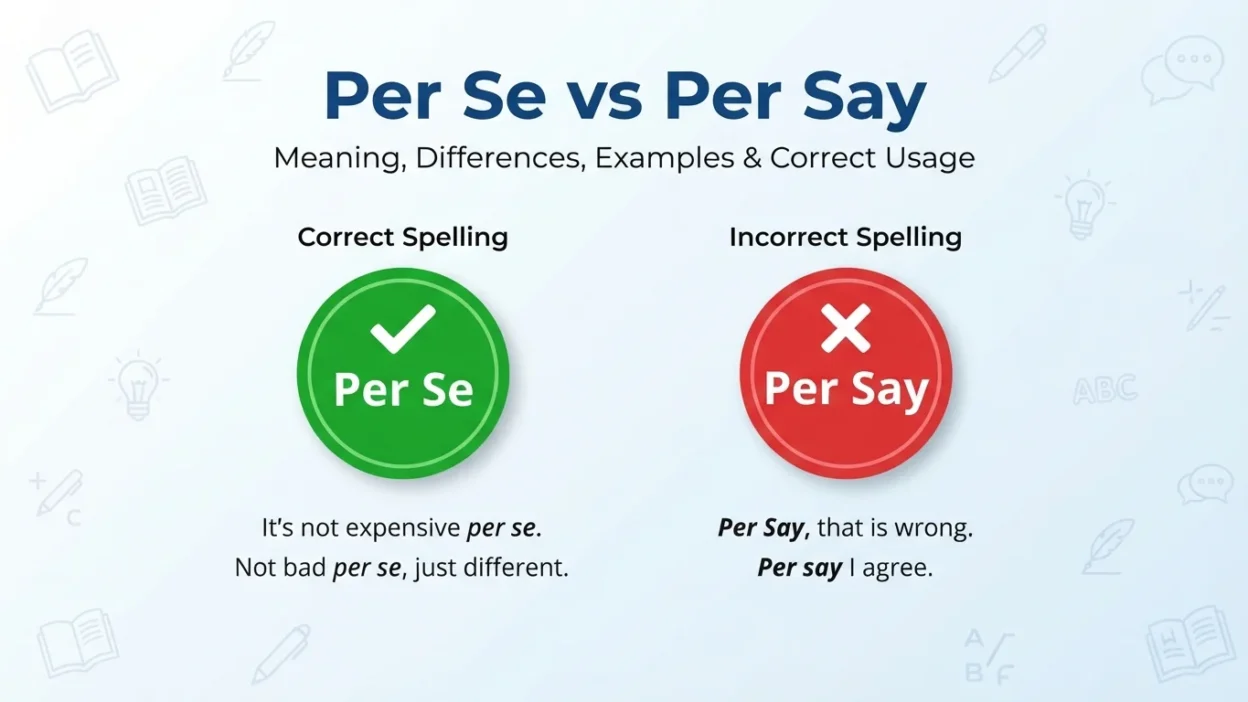
Per se is the correct spelling and means “by itself” or “in itself.”
Per say is a common misspelling caused by pronunciation. Always use per se in both formal and informal writing.
Per Se vs Per Say Comparison Table
| Feature | Per Se | Per Say |
|---|---|---|
| Correct spelling | ✅ Yes | ❌ No |
| Meaning | By itself; in itself | No meaning in English |
| Origin | Latin | Misspelling |
| Used in dictionaries | Yes | No |
| Suitable for formal writing | Yes | No |
| Common in speech | Yes | Often heard due to mishearing |
What Does Per Se Mean?
Per se is a Latin phrase that literally means “by itself” or “in itself.”
It is used when something is being discussed independently, without considering other related factors.
Examples
- Money is not bad per se.
- The plan isn’t impossible per se.
- Technology isn’t harmful per se; misuse causes problems.
- The policy isn’t unfair per se, but it could be improved.
In every example, per se means “in itself.”
What Does Per Say Mean?
Per say is not a correct English expression.
People usually write per say because that’s how per se sounds when spoken.
Example
❌ The proposal isn’t wrong per say.
✅ The proposal isn’t wrong per se.
Whenever you see per say, replace it with per se.
Per Se vs Per Say: Key Differences
| Aspect | Per Se | Per Say |
|---|---|---|
| Correctness | Correct | Incorrect |
| Dictionary entry | Yes | No |
| Language origin | Latin | None |
| Meaning | By itself | No meaning |
| Appropriate in essays | Yes | No |
| Recommended usage | Always | Never |
Why Do People Confuse Per Se and Per Say?
Several reasons explain this common mistake.
1. They Sound the Same
Both expressions are pronounced almost identically.
2. Latin Origin
Since per se comes from Latin, many people have never seen it written.
3. Learning by Listening
People who first hear the phrase naturally assume it is spelled per say.
4. Autocorrect Doesn’t Always Help
Some writing tools fail to flag per say, allowing the mistake to remain.
Grammar and Usage Rules
Although per se is a foreign phrase, it functions as an adverbial expression in English.
Grammar Forms Table
| Grammar Point | Rule | Example |
|---|---|---|
| Part of speech | Adverbial phrase | It’s not dangerous per se. |
| Capitalization | Lowercase in normal sentences | The issue isn’t per se illegal. |
| Italics | Optional in modern English | The plan isn’t per se impossible. |
| Plural form | None | Not applicable |
| Hyphen | Never | Write “per se,” not “per-se.” |
When Should You Use Per Se?
Use per se whenever you mean:
- By itself
- In itself
- Intrinsically
- Essentially
- Considered alone
Examples
- Exercise isn’t exhausting per se.
- Coffee isn’t unhealthy per se.
- Online learning isn’t ineffective per se.
- Artificial intelligence isn’t dangerous per se.
Real-Life Examples
Business
“The company’s strategy isn’t flawed per se, but execution needs improvement.”
Education
“Memorization isn’t bad per se if combined with understanding.”
Science
“The chemical isn’t toxic per se, but excessive exposure is harmful.”
Healthcare
“The medicine isn’t risky per se when used correctly.”
Technology
“Social media isn’t harmful per se; excessive use creates problems.”
Everyday Conversation
“I’m not against travel per se—I just prefer staying home.”
Industry Usage Table
| Industry | Example Sentence |
|---|---|
| Business | The marketing strategy isn’t ineffective per se. |
| Education | Exams aren’t unfair per se. |
| Medicine | The treatment isn’t dangerous per se. |
| Law | The action wasn’t illegal per se. |
| Science | The compound isn’t unstable per se. |
| Technology | AI isn’t harmful per se. |
Similar Expressions
Sometimes these phrases can replace per se, depending on context.
| Expression | Meaning |
|---|---|
| In itself | Nearly identical |
| By itself | Very close meaning |
| Intrinsically | Naturally |
| Essentially | Fundamentally |
| Alone | Without other factors |
Common Mistakes
Incorrect vs Correct Sentences
| Incorrect | Correct |
|---|---|
| It isn’t bad per say. | It isn’t bad per se. |
| The idea isn’t wrong per say. | The idea isn’t wrong per se. |
| Social media isn’t harmful per say. | Social media isn’t harmful per se. |
| Exercise isn’t difficult per say. | Exercise isn’t difficult per se. |
| The rule isn’t unfair per say. | The rule isn’t unfair per se. |
Memory Trick
Remember this simple phrase:
“Per SE = Standalone Essence.”
Think of SE as “self” or “itself.”
Since per se means “by itself,” you’ll remember the correct spelling.
Another easy trick:
- Per Se = Correct
- Per Say = Sounds Right but Wrong
How to Avoid This Mistake
Process Table
| Step | Action |
|---|---|
| Step 1 | Hear the phrase carefully. |
| Step 2 | Remember it comes from Latin. |
| Step 3 | Spell it as per se. |
| Step 4 | Replace “per say” whenever you see it. |
| Step 5 | Proofread your writing before publishing. |
Per Se in Professional Writing
Professional writers, editors, lawyers, academics, and journalists regularly use per se because it expresses a precise meaning.
Examples include:
- Legal documents
- Academic papers
- Business reports
- Scientific research
- News articles
In all these contexts, per say would be considered an error.
People Also Ask
Is per say ever correct?
No. Per say is always considered a misspelling of per se.
What does per se literally mean?
It means “by itself” or “in itself.”
Is per se formal?
Yes. It is appropriate in both formal and informal writing.
Why is per se Latin?
The phrase originated in Latin but has become a standard part of modern English.
Can I replace per se with in itself?
Yes. In many sentences, in itself has nearly the same meaning.
Frequently Asked Questions
Is “per se” an English word?
No. It is a Latin phrase that has been adopted into English.
Why do so many people write “per say”?
Because both expressions sound nearly identical when spoken.
Should per se be italicized?
Modern style guides generally do not require italics, although they are acceptable in some formal publications.
Is per se used in everyday conversation?
Yes. Native speakers commonly use it in both speech and writing.
Can I use per se in academic writing?
Absolutely. It is widely accepted in academic, legal, and professional contexts.
Conclusion
Understanding per se vs per say is simple once you know the difference. Per se is the only correct spelling and means “by itself” or “in itself.” Per say has no meaning in English and is simply a spelling mistake caused by pronunciation.
Whenever you need to express that something should be considered independently, choose per se. Remember this rule, and you’ll avoid one of the most common writing errors while making your English clearer and more professional.

Julian Wyatt is a passionate researcher and writer who explores symbols, mythology, cultural traditions, and hidden meanings. Through engaging articles, he helps readers uncover the fascinating stories and significance behind symbols worldwide.