A nonfinite verb is one of the most important grammar concepts in English, yet it often confuses learners because it does not behave like a regular verb.
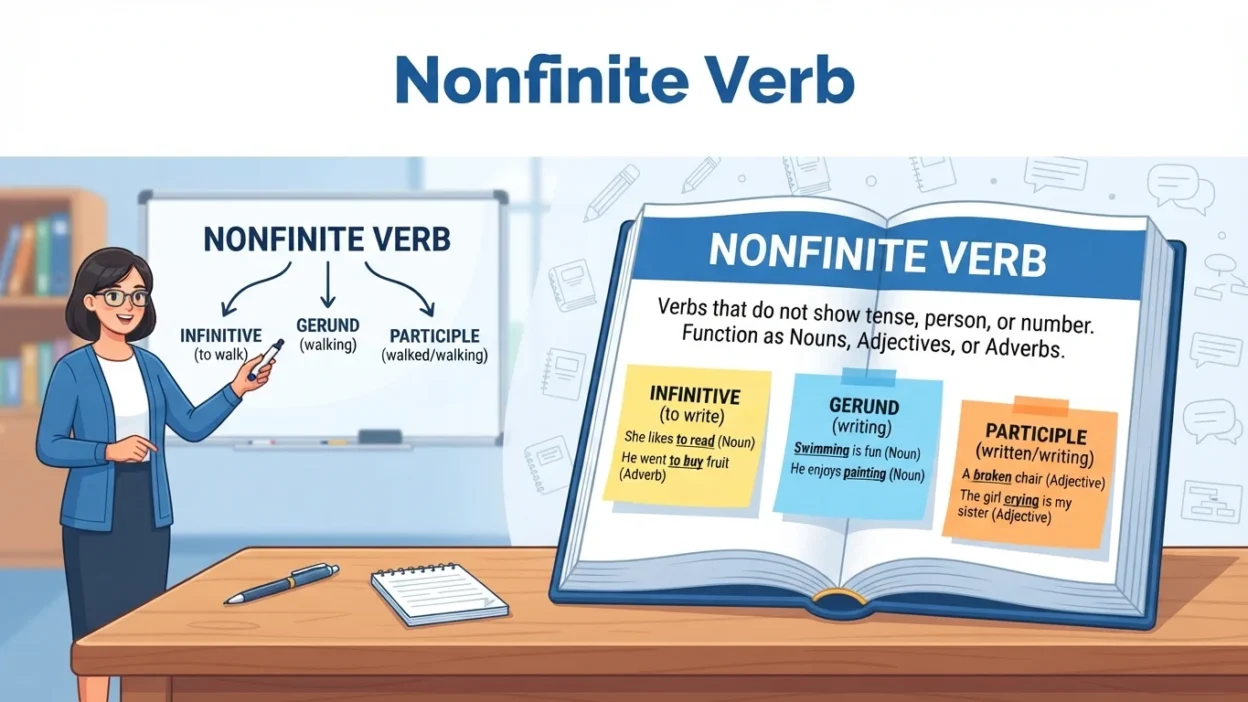
Unlike finite verbs, a nonfinite verb does not show tense, person, or number.
Instead, it functions as a noun, adjective, or adverb while still expressing an action or state.
Understanding the nonfinite verb is essential for writing clear, natural, and grammatically correct English.
If you’re a student, teacher, writer, or English learner, knowing the meaning, types, usage, and examples of nonfinite verbs will help you build better sentences.
This guide explains everything in simple English with tables, examples, grammar rules, common mistakes, and FAQs.
Quick Answer
A nonfinite verb is a verb form that does not show tense, person, or number.
The three main types of nonfinite verbs are infinitives, gerunds, and participles.
What Is a Nonfinite Verb?
A nonfinite verb is a verb that does not act as the main verb of a sentence. It does not change according to the subject or tense.
Examples
- She wants to travel.
- Reading improves vocabulary.
- The broken window needs repair.
In these sentences:
- to travel = infinitive
- reading = gerund
- broken = participle
All are nonfinite verbs.
Finite Verb vs Nonfinite Verb
Understanding the difference is essential.
| Feature | Finite Verb | Nonfinite Verb |
|---|---|---|
| Shows tense | Yes | No |
| Changes with subject | Yes | No |
| Can be the main verb | Yes | Usually no |
| Shows person and number | Yes | No |
| Examples | walks, walked, is | to walk, walking, walked |
Example
Finite:
- She writes every day.
Nonfinite:
- She likes to write every day.
Types of Nonfinite Verbs
English has three main types.
| Type | Example | Function |
|---|---|---|
| Infinitive | to eat | Noun, adjective, adverb |
| Gerund | eating | Noun |
| Participle | eaten, eating | Adjective or verb phrase |
Infinitive as a Nonfinite Verb
An infinitive usually begins with to + base verb.
Examples
- I want to learn.
- They decided to stay.
- She hopes to succeed.
Functions
| Function | Example |
|---|---|
| Subject | To exercise is healthy. |
| Object | I want to win. |
| Adjective | I have work to finish. |
| Adverb | She came to help. |
Gerund as a Nonfinite Verb
A gerund ends in -ing but functions as a noun.
Examples
- Swimming is fun.
- He enjoys reading.
- Cooking takes practice.
Grammar Table
| Gerund Function | Example |
|---|---|
| Subject | Reading improves memory. |
| Object | I enjoy singing. |
| Object of preposition | She is interested in learning. |
Participle as a Nonfinite Verb
Participles function mainly as adjectives.
Types
| Type | Example |
|---|---|
| Present participle | smiling child |
| Past participle | broken chair |
Examples
- The crying baby needs attention.
- The written report was excellent.
How Nonfinite Verbs Are Used
Nonfinite verbs make sentences shorter and smoother.
Examples
Instead of:
- He went home because he wanted to sleep.
You can say:
- He went home to sleep.
Instead of:
- The girl who is singing won.
You can say:
- The singing girl won.
Grammar Forms of Nonfinite Verbs
| Form | Structure | Example |
|---|---|---|
| Infinitive | to + base verb | to read |
| Bare infinitive | base verb | let him go |
| Gerund | verb + ing | reading |
| Present participle | verb + ing | smiling boy |
| Past participle | verb (third form) | broken glass |
Real-Life Examples
Business
- The manager plans to hire more employees.
- Improving customer service increases sales.
Education
- Students enjoy learning online.
- Teachers encourage students to participate.
Science
- Scientists continue to study climate change.
- Growing bacteria requires sterile equipment.
Healthcare
- Doctors recommend drinking more water.
- Patients need to rest after surgery.
Daily Conversation
- I forgot to call you.
- Walking every morning improves health.
Why Do People Confuse Nonfinite Verbs?
Many learners assume every verb shows tense.
However, nonfinite verbs never indicate when an action happens by themselves.
Another reason is that -ing forms can be:
- Gerunds
- Present participles
- Continuous tense verbs
The sentence determines their function.
Industry Usage
| Industry | Example of Nonfinite Verb |
|---|---|
| Education | Learning develops critical thinking. |
| Journalism | To report accurately is essential. |
| Business | Improving efficiency saves money. |
| Healthcare | To diagnose correctly is important. |
| Technology | Developing software requires teamwork. |
Comparison Table of Nonfinite Verb Types
| Feature | Infinitive | Gerund | Participle |
|---|---|---|---|
| Form | to + verb | verb + ing | verb + ing / third form |
| Functions as | Noun, adjective, adverb | Noun | Adjective |
| Example | to study | studying | studied |
Memory Trick
Use this simple trick:
| Type | Memory Tip |
|---|---|
| Infinitive | Starts with to |
| Gerund | Ends in -ing and acts like a noun |
| Participle | Describes a noun |
Remember:
To do = infinitive
Doing = gerund or participle
Done = past participle
Common Mistakes
| Incorrect | Correct |
|---|---|
| I enjoy to swim. | I enjoy swimming. |
| She suggested to leave. | She suggested leaving. |
| Reading are fun. | Reading is fun. |
| I made him to laugh. | I made him laugh. |
Correct vs Incorrect Sentences
Correct
- She hopes to travel.
- Reading improves knowledge.
- The broken chair is old.
- They enjoy playing football.
Incorrect
- She hopes traveling tomorrow. (after hope, infinitive is preferred)
- Reading improve knowledge.
- The break chair is old.
- They enjoy to play football.
How to Identify a Nonfinite Verb
| Step | What to Check |
|---|---|
| 1 | Is it a verb? |
| 2 | Does it show tense? |
| 3 | Does it change with the subject? |
| 4 | Is it acting as a noun, adjective, or adverb? |
| 5 | If yes, it is likely a nonfinite verb. |
People Also Ask
What is a nonfinite verb?
A nonfinite verb is a verb form that does not show tense or agree with the subject.
What are the three types of nonfinite verbs?
They are infinitives, gerunds, and participles.
Can a nonfinite verb be the main verb?
Usually no. A sentence normally needs a finite verb as its main verb.
Is “walking” always a nonfinite verb?
No. It can also be part of a finite continuous tense, depending on the sentence.
Why are nonfinite verbs important?
They make sentences more concise, flexible, and grammatically correct.
FAQs
What is the easiest way to recognize a nonfinite verb?
Check whether the verb shows tense. If it does not, it is usually nonfinite.
Is every verb ending in “-ing” a gerund?
No. Some -ing forms are gerunds, while others are present participles or parts of continuous tenses.
Can one sentence have multiple nonfinite verbs?
Yes. Example: She hopes to travel after finishing college.
Are infinitives always written with “to”?
Usually yes, but English also has bare infinitives, such as after make, let, and modal verbs.
Why should English learners study nonfinite verbs?
Because they improve grammar, sentence variety, writing quality, and speaking fluency.
Conclusion
A nonfinite verb is a verb form that does not express tense, person, or number. Instead, it functions as a noun, adjective, or adverb while supporting the main verb in a sentence.
The three major types are infinitives, gerunds, and participles, each serving a different grammatical purpose. By learning how each type works and practicing with real-life examples, you can avoid common mistakes and write more natural English.
Whenever you see a verb that does not change with the subject or indicate tense, check whether it is functioning as a nonfinite verb.

Julian Wyatt is a passionate researcher and writer who explores symbols, mythology, cultural traditions, and hidden meanings. Through engaging articles, he helps readers uncover the fascinating stories and significance behind symbols worldwide.