The difference between patron vs benefactor can be confusing because both words describe a person who supports another person, organization, cause, or activity.
However, their meanings are not exactly the same. A patron often provides regular support, encouragement, business, or sponsorship, while a benefactor usually gives financial or material help for the benefit of others.
Understanding patron vs benefactor is useful in business, education, art, charity, science, and everyday communication.
The right word depends on the type of support and the relationship involved.
This guide explains the meaning, difference, usage, examples, grammar, common mistakes, and professional contexts of patron vs benefactor so you can choose the correct term confidently.
Quick Answer
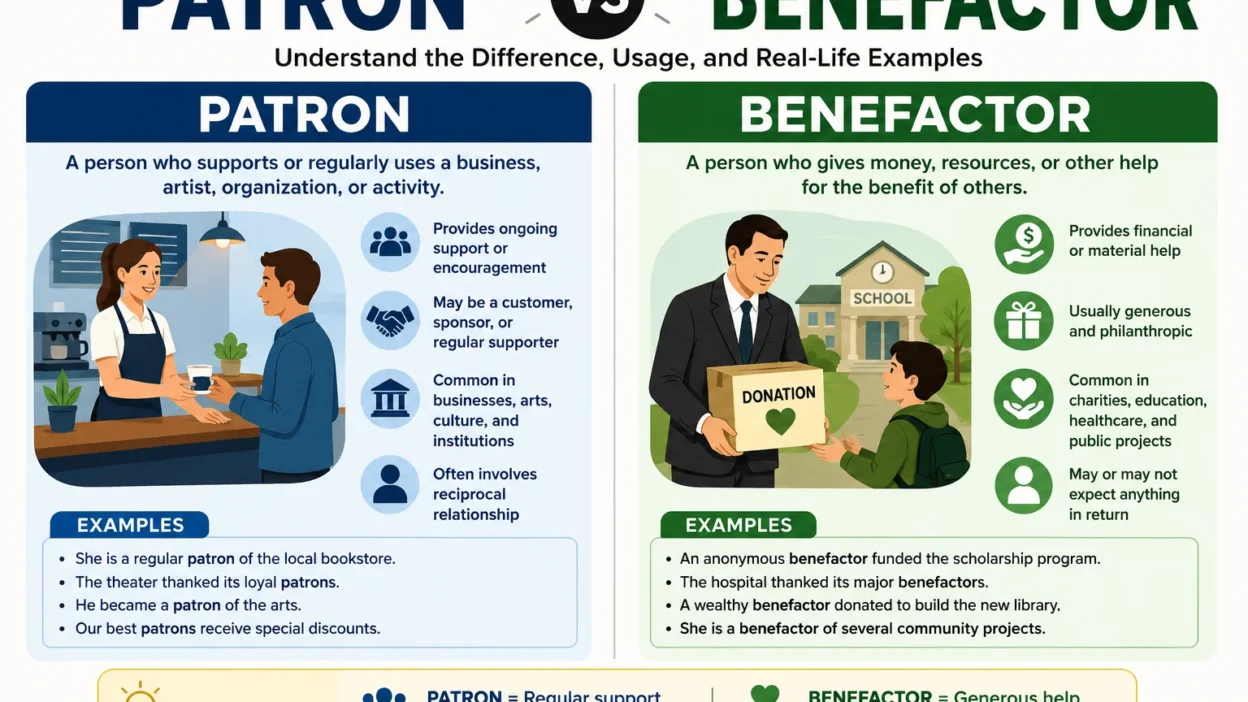
A patron is someone who regularly supports a business, artist, institution, or activity.
A benefactor is someone who gives money, resources, or other help to benefit a person, organization, or cause.
The main difference is that a patron often supports something through continued involvement or sponsorship, while a benefactor is more strongly associated with generous financial or material assistance.
Patron vs Benefactor: Main Comparison Table
| Feature | Patron | Benefactor |
|---|---|---|
| Main meaning | A person who supports or regularly uses a business, artist, or institution | A person who gives help, especially money or resources |
| Type of support | Business, artistic, cultural, or institutional support | Financial, material, or charitable support |
| Regular involvement | Often regular or ongoing | May be one-time or ongoing |
| Common context | Restaurants, arts, museums, libraries, theaters | Charities, schools, hospitals, individuals |
| Payment expected? | Sometimes, especially as a customer | Usually no direct benefit is expected |
| Tone | Broad and flexible | More formal and generous |
| Example | A loyal theater patron | A benefactor who funded scholarships |
What Does Patron Mean?
A patron is a person who supports a person, organization, activity, or business.
The word has several common meanings. A patron can be a regular customer, a supporter of the arts, or someone who provides financial backing for an institution or project.
Examples of Patron
- She is a regular patron of the local bookstore.
- The museum thanked its long-term patrons for their support.
- A wealthy patron funded the young artist’s exhibition.
- The library offers special benefits to frequent patrons.
The exact meaning depends on context.
For example, a restaurant patron is usually a customer, while an arts patron may provide financial support.
What Does Benefactor Mean?
A benefactor is a person who gives money, resources, or assistance to help another person, organization, or cause.
The word usually has a generous and charitable meaning. A benefactor is often associated with donations, scholarships, hospitals, schools, charities, and public projects.
Examples of Benefactor
- The university’s benefactor funded a new research center.
- An anonymous benefactor paid for the children’s education.
- The hospital thanked its major benefactors.
- She became a benefactor of several community programs.
A benefactor usually provides help without receiving a direct commercial service in return.
Patron vs Benefactor: What Is the Main Difference?
The main difference between patron vs benefactor is the nature of the support.
A patron may support something by becoming a regular customer, sponsor, or long-term supporter. The relationship can involve business, culture, or personal interest.
A benefactor, however, is more specifically someone who provides help for the benefit of others. This support is often financial or material and is usually connected with generosity or philanthropy.
Simple Rule
Patron = supporter or regular customer
Benefactor = generous giver who provides help or resources
Patron vs Benefactor in Different Contexts
The correct word can change depending on the situation.
In Business
A patron may simply be a customer who regularly visits or supports a business.
Example:
“The café values its loyal patrons.”
A benefactor is less likely to be used for an ordinary business customer.
Example:
“A private benefactor provided funds to help the small business recover after the disaster.”
In Education
A patron may support a university, student organization, or educational institution.
Example:
“The arts program received support from several patrons.”
A benefactor often donates money for scholarships, buildings, or research.
Example:
“A generous benefactor created a scholarship fund for disadvantaged students.”
In Art and Culture
Patron is especially common in the arts.
Example:
“The painter found a wealthy patron who supported her work.”
Benefactor can also be used, but it focuses more on the gift or financial assistance.
Example:
“The benefactor donated funds to restore the historic theater.”
In Charity
Benefactor is generally the more natural word when emphasizing generosity.
Example:
“The charity honored its largest benefactors at the annual event.”
A patron may also support a charity, particularly through ongoing sponsorship.
Example:
“The organization invited its patrons to a special fundraising event.”
Industry Usage Table
| Industry or Field | Patron Usage | Benefactor Usage |
|---|---|---|
| Business | Regular customer or supporter | Person providing financial help |
| Education | Supporter of a program | Donor funding scholarships or facilities |
| Arts | Sponsor or supporter of artists | Donor supporting cultural projects |
| Healthcare | Supporter of an institution | Major donor funding services or research |
| Charity | Ongoing supporter or sponsor | Generous donor or financial contributor |
| Science | Supporter of research or institutions | Person funding research or equipment |
| Hospitality | Customer or guest | Rarely used |
Can a Patron Also Be a Benefactor?
Yes, a person can sometimes be both a patron and a benefactor.
For example, someone may regularly support a museum and also donate a large amount of money to build a new exhibition hall. In that situation, the person acts as both a patron and a benefactor.
However, the words emphasize different aspects of the relationship.
- Patron emphasizes ongoing support or association.
- Benefactor emphasizes giving help or resources for the benefit of others.
Example
“Mr. Ahmed has been a patron of the arts for many years and became a major benefactor by funding the new cultural center.”
Both words are correct because they describe different kinds of support.
Grammar Forms of Patron and Benefactor
Both patron and benefactor are countable nouns.
Grammar Forms Table
| Word | Singular | Plural | Related Form |
|---|---|---|---|
| Patron | patron | patrons | patronage |
| Benefactor | benefactor | benefactors | benefaction |
| Benefactress | benefactress | benefactresses | feminine traditional form |
| Patronize | patronize | patronizes | verb form |
| Benefit | benefit | benefits | related verb/noun |
Example Sentences
- The restaurant welcomed every patron warmly.
- Several patrons supported the local theater.
- The school thanked its benefactor.
- Wealthy benefactors funded the project.
The noun patronage refers to support or business given by patrons.
Example:
“The theater depends on public patronage.”
Patron vs Benefactor vs Donor
A donor is another related word, but it is not always identical to either patron or benefactor.
| Word | Main Meaning | Typical Example |
|---|---|---|
| Patron | Supporter, customer, or sponsor | A patron of the arts |
| Benefactor | Person who generously helps others | A benefactor of the university |
| Donor | Person who gives money, goods, or something else | A donor to the charity |
| Sponsor | Person or organization supporting an activity | A sponsor of the event |
A donor focuses on the act of giving.
A benefactor emphasizes the positive help or benefit created by the gift.
A patron often suggests an ongoing relationship or continued support.
Real-Life Examples of Patron vs Benefactor
Example 1: A Restaurant
Patron:
“The restaurant rewarded its frequent patrons with a loyalty discount.”
Here, patron means customer.
Benefactor:
“A local benefactor helped the restaurant reopen after a major fire.”
Here, benefactor means someone who provided financial assistance.
Example 2: A University
Patron:
“The university’s arts patrons regularly support student performances.”
Benefactor:
“A major benefactor donated funds for a new science laboratory.”
The patron supports the program, while the benefactor provides significant help or resources.
Example 3: Scientific Research
Patron:
“The research institute received ongoing support from private patrons.”
Benefactor:
“A benefactor funded the purchase of advanced laboratory equipment.”
Both involve support, but benefactor places more emphasis on the generous contribution.
Example 4: A Museum
Patron:
“Members and patrons attended the museum’s private exhibition.”
Benefactor:
“The museum named the new gallery after its principal benefactor.”
When Should You Use Patron?
Use patron when you are talking about:
- A regular customer
- A supporter of the arts
- A sponsor or long-term supporter
- Someone connected with a cultural institution
- A person who regularly supports a business or organization
Examples
- The theater depends on its loyal patrons.
- She became a patron of the local arts foundation.
- Every patron received a free program.
- The artist thanked her longtime patron.
A simple clue is this: if the person is known for regularly supporting, attending, sponsoring, or using something, patron may be the right choice.
When Should You Use Benefactor?
Use benefactor when you want to emphasize:
- Generous financial support
- Donations to help others
- Funding for education or research
- Material assistance
- Charitable or philanthropic contributions
Examples
- The school’s benefactor funded a new library.
- An anonymous benefactor paid the family’s expenses.
- The hospital honored its leading benefactors.
- Several benefactors contributed to the disaster relief fund.
If the main idea is generous help that benefits others, benefactor is usually the better choice.
How to Choose Between Patron and Benefactor
Use this simple decision process.
| Step | Question | Best Choice |
|---|---|---|
| 1 | Is the person a regular customer? | Patron |
| 2 | Is the person supporting an artist or cultural institution? | Patron |
| 3 | Is the main focus generous financial help? | Benefactor |
| 4 | Is the person funding a scholarship or public project? | Benefactor |
| 5 | Does the support involve ongoing sponsorship? | Often patron |
| 6 | Does the support mainly benefit others? | Usually benefactor |
Quick Formula
Customer or ongoing supporter → Patron
Generous giver or major helper → Benefactor
Why Do People Confuse Patron and Benefactor?
People confuse these words because both describe people who provide support.
The confusion becomes stronger in areas such as museums, universities, charities, and the arts. A wealthy person may donate money and also maintain a long-term relationship with an institution.
For example, someone who supports an art gallery every year may be called a patron. If that same person gives a large donation to build a new gallery, they may also be called a benefactor.
The words can overlap, but their emphasis is different.
Common Mistakes With Patron and Benefactor
A common mistake is using benefactor for an ordinary customer.
Correct vs Incorrect Sentences
| Incorrect | Correct | Reason |
|---|---|---|
| The restaurant thanked every benefactor for visiting. | The restaurant thanked every patron for visiting. | Customers are patrons, not usually benefactors. |
| The artist thanked her benefactor for buying coffee every week. | The artist thanked her patron for supporting her work. | Patron better describes ongoing support. |
| The university patron donated millions for scholarships. | The university benefactor donated millions for scholarships. | Benefactor emphasizes major financial help. |
| Every customer is a benefactor. | Every customer is a patron. | A customer does not automatically provide charitable help. |
| The charity’s patrons always donate large sums. | The charity’s benefactors donated large sums. | Benefactor better emphasizes generous giving. |
The best choice depends on what the person actually does, not simply on whether they are described as supportive.
A Simple Memory Trick
Use the word associations below to remember the difference.
Remember Patron as “Support and Participation”
A patron may:
- Visit
- Buy
- Attend
- Sponsor
- Support regularly
Think:
Patron = person who supports through participation or ongoing association.
Remember Benefactor as “Benefit”
The word benefactor is connected to benefit.
A benefactor gives something that benefits another person or organization.
Think:
Benefactor = a person who gives a benefit.
This simple connection can help you choose the right word quickly.
Professional Usage of Patron vs Benefactor
In professional writing, these terms should be chosen carefully because they can create different impressions.
In Fundraising
Use benefactor for major donors or people whose contributions provide significant benefits.
Use patron for supporters, members, or people involved in ongoing cultural or charitable support.
In Hospitality
Use patron for customers and guests.
Example:
“The establishment reserves the right to refuse service to any patron.”
Benefactor would usually sound unnatural in this context.
In Academic Writing
Use benefactor when discussing financial contributors to institutions, scholarships, research, or educational programs.
Use patron when discussing historical supporters of artists, writers, or intellectual work.
In Historical and Cultural Writing
Patron is particularly useful when discussing people who supported artists, musicians, writers, and cultural institutions.
Example:
“The composer depended on wealthy patrons to support his work.”
Patron vs Benefactor: Formality and Tone
Both words are appropriate in formal writing, but they create slightly different tones.
| Word | Tone | Common Setting |
|---|---|---|
| Patron | Neutral to formal | Business, arts, culture, hospitality |
| Benefactor | Formal and appreciative | Charity, education, philanthropy |
| Donor | Neutral and direct | Fundraising and charitable giving |
| Sponsor | Professional and commercial | Events, sports, marketing |
If you are writing a thank-you message for a major financial supporter, benefactor may sound more respectful and specific.
If you are describing loyal customers or supporters of the arts, patron is often more natural.
Frequently Asked Questions
What is the main difference between patron and benefactor?
A patron is generally a supporter, regular customer, or sponsor, while a benefactor is someone who generously provides help or resources.
Can a patron be a benefactor?
Yes. A person can be both if they provide ongoing support and also make significant financial or charitable contributions.
Is a customer a patron?
Yes. In many business and hospitality contexts, a patron simply means a customer.
Is a benefactor the same as a donor?
Not exactly. A donor gives something, while a benefactor is usually described as someone whose generous help benefits another person or organization.
Which word is better for someone funding a scholarship?
Benefactor is usually the better choice because it emphasizes financial help and the benefit provided to others.
Which word should I use for a restaurant customer?
Use patron, not benefactor.
Conclusion
The difference between patron vs benefactor is mainly about the type and purpose of support.
A patron is usually a regular customer, sponsor, or ongoing supporter of a business, artist, organization, or institution.
A benefactor is someone who gives money, resources, or significant assistance to help others.
Remember this simple rule: patron means supporter or customer, while benefactor means generous helper or giver.
The two roles can sometimes overlap, but choosing the right word depends on if you want to emphasize ongoing support and participation or generous assistance that benefits others.