Have you ever typed “of course” and wondered whether it should actually be written as “ofcourse”?
You are not alone. The confusion between of course vs ofcourse is common, especially when people write quickly in texts, social media posts, or informal online conversations.
Although the two forms look almost identical, only one is considered correct in standard English.
Understanding the difference between of course vs ofcourse is useful for students, ESL learners, writers, and professionals who want their English to sound natural and accurate.
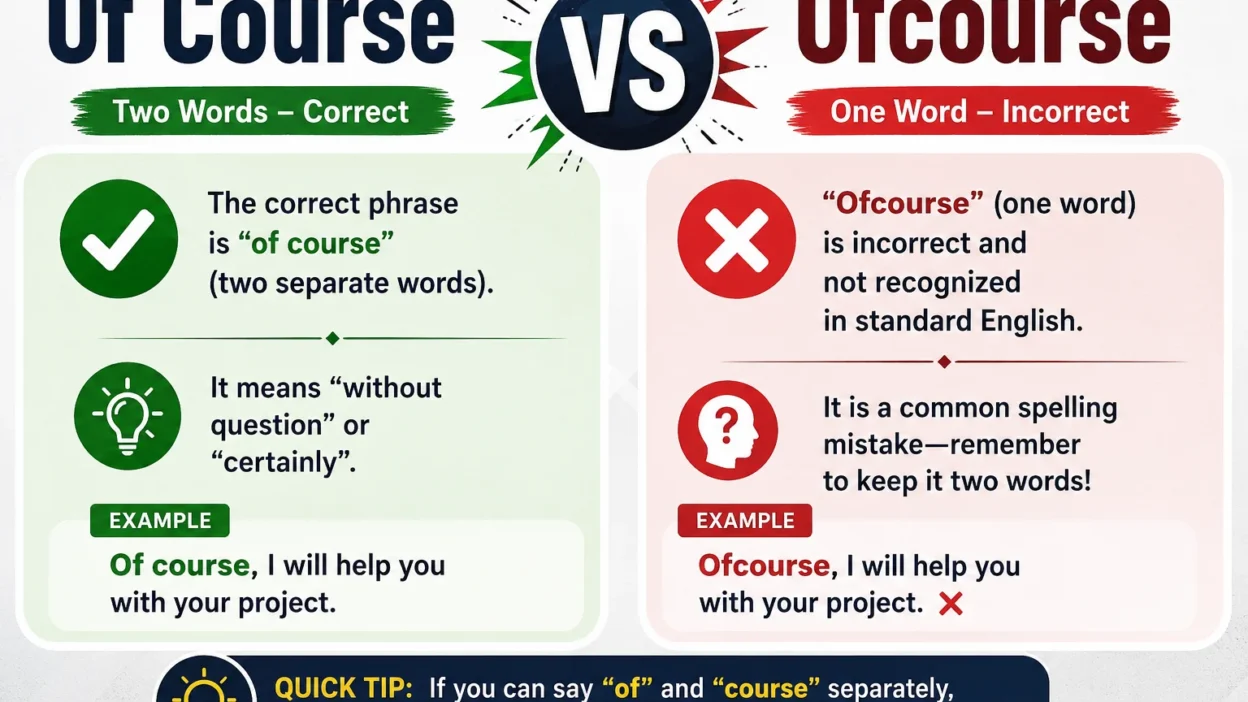
The correct form is written as two separate words: of course. It is commonly used to mean “certainly,” “naturally,” or “as expected.”
Ofcourse is generally considered a spelling mistake rather than a standard English word.
Quick Answer: Of Course vs Ofcourse
Of course is the correct standard English spelling.
Ofcourse is incorrect in standard English and should normally be avoided.
Example: Of course, I can help you. ✅
Incorrect: Ofcourse, I can help you. ❌
What Does “Of Course” Mean?
Of course is a common English phrase used to express agreement, certainty, or something that is obvious or expected.
Depending on context, it can mean:
- Certainly
- Naturally
- Yes
- Without doubt
- As expected
For example:
“Can you send me the report?”
“Of course!”
Here, of course means “Certainly” or “Yes, I can.”
The phrase can also introduce information that the speaker considers obvious.
“Of course, water freezes at 0°C under standard conditions.”
In this sentence, the phrase emphasizes that the information is generally known or expected.
Is “Ofcourse” a Correct Word?
No. Ofcourse is not the standard spelling in modern English.
The correct expression is always written as two words:
of course ✅
The incorrect form is:
ofcourse ❌
People often write ofcourse because English contains many compound words, and because the phrase is pronounced naturally as a connected expression. However, pronunciation does not determine whether words should be written together.
Correct vs Incorrect
| Form | Correct? | Explanation |
|---|---|---|
| of course | ✅ Yes | Standard English spelling |
| ofcourse | ❌ No | Common spelling mistake |
| Of course | ✅ Yes | Correct at the beginning of a sentence |
| Ofcourse | ❌ No | Still incorrect when capitalized |
Of Course vs Ofcourse: Main Difference
The biggest difference between of course vs ofcourse is simply spelling.
Of course consists of two separate words: of + course. It is a standard English phrase.
Ofcourse combines those words into one word, but that spelling is not accepted as standard English.
| Feature | Of course | Ofcourse |
|---|---|---|
| Spelling | Two words | One word |
| Standard English | Yes | No |
| Meaning | Certainly, naturally, obviously | Intended to mean “of course” |
| Formal writing | Appropriate | Avoid |
| Academic writing | Appropriate | Incorrect |
| Texting | Appropriate | Sometimes seen as a typo |
| Dictionaries | Standard phrase | Not standard |
Why Do People Confuse “Of Course” and “Ofcourse”?
There are several reasons people make this mistake.
First, of course is frequently pronounced quickly. In everyday speech, the two words can sound closely connected, making them feel like one word.
Second, English has many words that combine two original words, such as however, although, and notebook. Learners may assume ofcourse follows the same pattern.
Third, texting and social media encourage fast typing. A person may accidentally leave out the space and not notice the mistake.
Search engines, autocorrect, and informal online writing can also expose learners to incorrect spellings repeatedly.
How to Use “Of Course” Correctly
The phrase of course can appear in several positions within a sentence.
At the Beginning
Of course, I will attend the meeting.
Here, the phrase emphasizes certainty or willingness.
In the Middle
She will, of course, need more time.
In this case, of course works as an interrupting expression.
At the End
I can help you with that, of course.
The phrase reinforces the speaker’s agreement.
| Position | Example | Purpose |
|---|---|---|
| Beginning | Of course, I understand. | Shows certainty |
| Middle | He will, of course, agree. | Adds emphasis |
| End | I can help, of course. | Reinforces agreement |
Grammar Forms and Related Expressions
Unlike a regular verb, of course does not change form according to tense, number, or person.
It remains of course regardless of who is speaking.
| Grammar situation | Correct form | Example |
|---|---|---|
| Present | of course | Of course, she knows. |
| Past | of course | Of course, he understood. |
| Future | of course | Of course, they will come. |
| Question response | of course | “Can I join?” “Of course!” |
| Formal statement | of course | Of course, further research is needed. |
Some related expressions include certainly, naturally, surely, definitely, and without question.
However, these alternatives are not always interchangeable. The best choice depends on tone and context.
Of Course in Everyday Conversation
In everyday speech, of course is extremely common.
It can show agreement, reassurance, or confidence.
Examples
Friend: Can you help me move this weekend?
You: Of course!
Parent: Did you remember your homework?
Student: Of course I did.
Friend: Are you coming to dinner?
You: Of course!
The expression usually sounds friendly and natural, although tone of voice can change its meaning.
For example, saying “Of course!” enthusiastically can sound warm, while saying “Of course…” sarcastically can sound irritated.
Of Course in Business and Professional Writing
Of course is acceptable in professional communication, but writers should consider the tone.
In an email, it can communicate willingness or agreement:
Of course, we can provide the requested documents.
It can also introduce an expected point:
Of course, all final figures are subject to approval.
However, in highly formal writing, alternatives such as certainly, naturally, or a direct statement may sometimes sound more precise.
| Professional situation | Example |
|---|---|
| Customer service | Of course, we can assist you. |
| Business email | Of course, I will forward the file. |
| Meeting | Of course, we should consider the budget. |
| Workplace discussion | Of course, safety remains our priority. |
| Formal report | Of course, these findings require further review. |
Of Course in Education and Academic Writing
Students often use of course in essays and classroom discussions.
It can be grammatically correct, but academic writers should avoid using it to make an unsupported claim sound obvious.
For example:
Of course, technology has changed education.
This sentence is grammatically fine, but the phrase may be unnecessary in an academic essay.
A more precise sentence could be:
Technology has significantly changed modern education.
Student Examples
Of course, I completed the assignment.
The experiment was, of course, repeated several times.
Of course, the results need further analysis.
The key is to use the phrase when it adds meaning rather than simply filling space.
Of Course in Science and Technical Writing
Scientific writing generally favors precision and evidence.
Although of course is grammatically correct, it should not replace an explanation or source.
For example:
Of course, temperature affects the reaction rate.
A more scientific version might be:
Temperature can affect the rate of a chemical reaction.
The second sentence communicates the idea more objectively.
| Context | Natural use |
|---|---|
| General explanation | Of course, gravity affects motion. |
| Scientific paper | Avoid unnecessary “of course” |
| Technical report | Prefer precise statements |
| Classroom discussion | Of course, that is possible. |
| Informal science explanation | Of course, the result depends on conditions. |
Common Mistakes: Correct vs Incorrect
The most common mistake is joining the two words together.
Mistake 1
❌ Ofcourse, I will come.
✅ Of course, I will come.
Mistake 2
❌ She ofcourse knew the answer.
✅ She of course knew the answer.
Mistake 3
❌ Ofcourse we can change the schedule.
✅ Of course, we can change the schedule.
Mistake 4
❌ I will help you ofcourse.
✅ I will help you, of course.
| Incorrect | Correct |
|---|---|
| Ofcourse, I agree. | Of course, I agree. |
| I ofcourse remember. | I of course remember. |
| Ofcourse she can help. | Of course she can help. |
| Thanks, ofcourse. | Thanks, of course. |
Why Is “Ofcourse” So Common Online?
The internet has made spelling mistakes more visible than ever.
People type quickly on phones, use abbreviated language, and sometimes rely on autocorrect. Because ofcourse is easy to understand, readers often overlook the error.
Social media also contains huge amounts of user-generated content. Seeing the incorrect spelling repeatedly can make it appear legitimate.
However, frequency does not make a spelling standard.
If you are writing an essay, application, article, business email, website, or professional document, use of course.
A Simple Memory Trick
The easiest way to remember the correct spelling is to think about the phrase as two separate ideas:
of + course = of course
Imagine saying:
“Of what?”
“Of course!”
The space between the words is important.
Another useful trick is to remember that of is normally a separate preposition.
So when you see of course, keep the space.
Memory rule: If you can see “of,” give it its space.
Professional Usage Guide
Different industries may use of course slightly differently.
| Industry | Example | Recommendation |
|---|---|---|
| Business | Of course, we can review the contract. | Good |
| Education | Of course, students need feedback. | Good |
| Science | Of course, conditions affect results. | Use carefully |
| Healthcare | Of course, patient safety comes first. | Natural in conversation |
| Technology | Of course, security is important. | Good in general writing |
| Journalism | Of course, the story needs verification. | Use according to tone |
| Customer service | Of course, I’d be happy to help. | Very natural |
The incorrect one-word form ofcourse should generally be avoided in all professional contexts.
When Should You Use “Of Course”?
Use of course when you want to express:
- Agreement
- Certainty
- Willingness
- Something natural or expected
- A fact that seems obvious in context
Examples
Of course, you can ask questions.
Of course, I remember your name.
We can, of course, discuss the proposal.
“Can I borrow your pen?”
“Of course!”
The phrase is flexible and works in both spoken and written English.
When Should You Avoid “Of Course”?
Although of course is correct, it is not always the best stylistic choice.
Avoid overusing it when writing formally or academically. If a statement requires evidence, saying something is “of course” obvious does not provide evidence.
Instead of:
Of course, exercise improves health.
Consider:
Regular exercise can provide several health benefits.
The second version is more objective and appropriate for formal writing.
Comparison Table: Of Course vs Ofcourse
| Question | Of course | Ofcourse |
|---|---|---|
| Is it spelled correctly? | Yes | No |
| Is it standard English? | Yes | No |
| Can I use it in an essay? | Yes | No |
| Can I use it professionally? | Yes | No |
| Does it mean “certainly”? | Yes | Intended meaning |
| Is it two words? | Yes | No |
| Should ESL learners use it? | Yes | No |
| Is it common online? | Yes | Yes, but the incorrect form appears too |
Of Course vs Similar Expressions
Several words can replace of course, but their meanings and tones can differ.
| Expression | Basic meaning | Tone |
|---|---|---|
| Of course | Certainly/naturally | Natural |
| Certainly | Definitely | Polite/formal |
| Definitely | Without doubt | Strong |
| Surely | Expectedly/without doubt | Context-dependent |
| Naturally | In a natural way | Formal/literary |
| Absolutely | Completely/strongly yes | Strong/informal |
| Obviously | Clearly | Can sound blunt |
For example:
Of course, I can help.
and
Certainly, I can help.
are both correct, but certainly sounds somewhat more formal.
A Quick Decision Process
When you are unsure about of course vs ofcourse, follow these simple steps.
| Step | What to do |
|---|---|
| 1 | Identify the intended phrase |
| 2 | Remember that it means “certainly” or “naturally” |
| 3 | Write “of” and “course” separately |
| 4 | Check the sentence for punctuation |
| 5 | Use “of course” in professional writing |
The process is simple because there is only one standard spelling you need to remember.
Real-Life Examples
Here are examples from different situations.
At Work
Of course, I’ll send the revised proposal today.
At School
Of course, you can submit the assignment tomorrow.
In a Text Message
“Are you free tonight?”
“Of course 😊”
In Customer Service
Of course, we’d be happy to help you with your order.
In a Meeting
Of course, we should review the risks before making a decision.
In a Conversation
“Do you know Sarah?”
“Of course! We went to school together.”
These examples show how naturally the phrase works across everyday and professional communication.
FAQs About Of Course vs Ofcourse
Is “ofcourse” one word or two?
The correct spelling is of course, which consists of two separate words. Ofcourse is a common spelling error.
Is “of course” grammatically correct?
Yes. Of course is a standard English phrase used to express certainty, agreement, willingness, or something considered natural or expected.
Why do people write “ofcourse”?
People may write ofcourse because the phrase is pronounced quickly, they type fast, or they mistakenly treat it as a compound word.
Can I use “of course” in formal writing?
Yes, but use it thoughtfully. It is grammatically correct, although formal or academic writing may sometimes benefit from a more precise statement.
Is “ofcourse” accepted in texting?
You may see ofcourse in informal messages, but that does not make it standard spelling. For correct English, write of course.
What is an easy way to remember the spelling?
Remember: “of” and “course” are two words, so keep the space. Write of course, never ofcourse in standard English.
Conclusion: Of Course Is the Correct Form
The difference between of course vs ofcourse is straightforward: of course is the correct standard English expression, while ofcourse is generally a spelling mistake.
Use of course when you mean “certainly,” “naturally,” or “as expected.” It can be used in conversations, emails, education, business, and many other contexts.
The easiest rule is simple: always write “of course” as two words. Once you remember that rule, you will never need to wonder about of course vs ofcourse again.