The phrase much better is commonly used to compare two things, situations, results, or conditions.
It means that one thing is better than another by a significant or noticeable amount.
Although the phrase seems simple, learners sometimes wonder whether much better is grammatically correct and how it differs from phrases such as better, far better, or a lot better.
Understanding the meaning and usage of much better can help you make your English sound more natural.
The phrase is widely used in everyday conversations, business communication, education, healthcare, science, and writing.
This guide explains its definition, grammar, examples, common mistakes, and practical usage.
Quick Answer: What Does “Much Better” Mean?
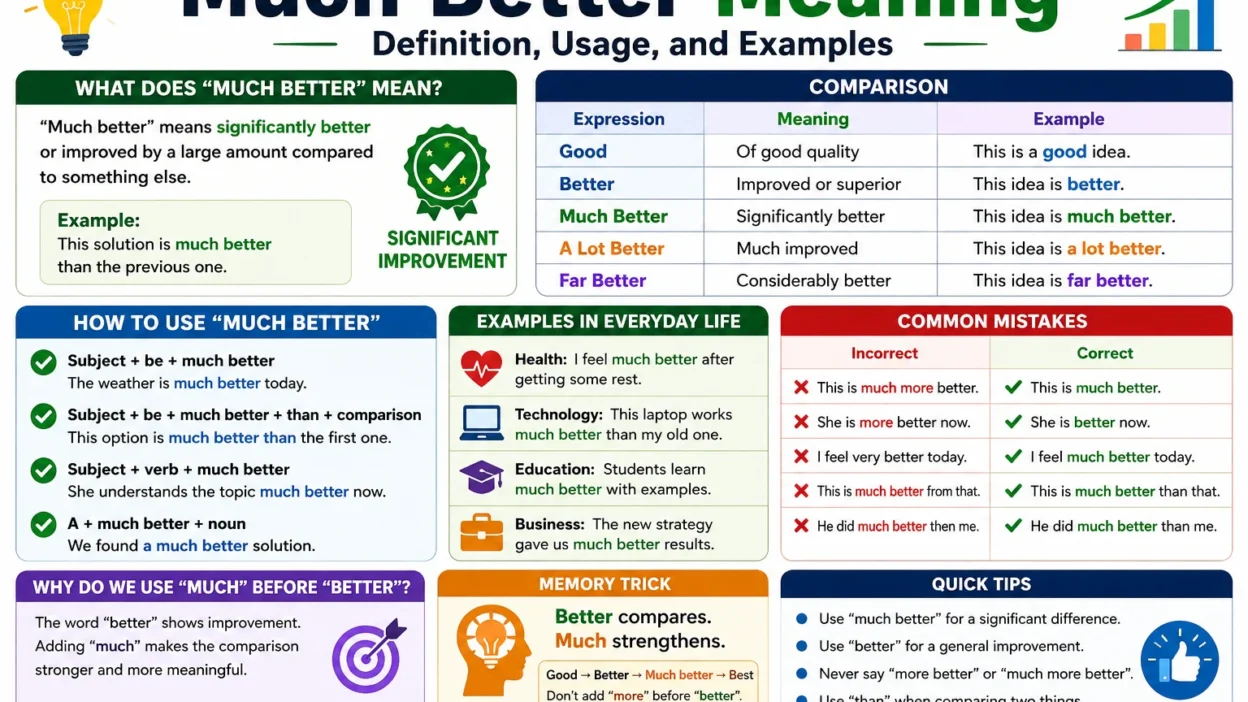
Much better means “better by a large or noticeable degree.”
It is used to emphasize a comparison. For example: “This solution is much better than the previous one.”
The word much strengthens the comparative adjective better.
What Does “Much Better” Mean?
Much better means considerably better, significantly better, or better to a great extent.
The phrase compares two or more things and shows that the improvement or difference is substantial.
Simple examples:
- This phone is much better than my old one.
- I feel much better today.
- Her presentation was much better this time.
- The new system works much better than the previous system.
In each example, much adds emphasis to better.
| Phrase | Meaning | Level of Difference |
|---|---|---|
| Better | Improved or superior | General |
| Much better | Significantly improved or superior | Strong |
| A lot better | Significantly improved | Strong, informal |
| Far better | Considerably superior | Strong, often formal |
| Slightly better | Improved by a small amount | Small |
Is “Much Better” Grammatically Correct?
Yes, much better is completely grammatically correct.
Here, better is the comparative form of good. The word much acts as an intensifier that strengthens the comparison.
The basic pattern is:
Subject + verb + much better + than + comparison
Examples:
- This plan is much better than the old plan.
- She performs much better than before.
- The weather is much better today.
- Our results are much better than expected.
You can also use the phrase without directly stating the thing being compared when the context is already clear.
Example:
“How do you feel now?”
“I feel much better.”
Much Better vs Better: What Is the Difference?
The main difference is the degree of improvement or superiority.
Better simply means that something has improved or is superior. Much better emphasizes that the improvement is significant.
| Expression | Meaning | Example |
|---|---|---|
| Better | More good or improved | This design is better. |
| Much better | Significantly more good or improved | This design is much better. |
| A little better | Slightly improved | This design is a little better. |
| Far better | Much more superior | This design is far better. |
Consider these two sentences:
- The second draft is better.
- The second draft is much better.
The first sentence gives a general comparison. The second suggests a clear and substantial improvement.
Why Do People Use “Much” Before “Better”?
People use much before better to make the comparative adjective stronger.
English commonly allows words such as much, far, a lot, and considerably before comparative forms.
Common intensifiers with comparatives:
| Intensifier | Example | Meaning |
|---|---|---|
| Much | Much better | Significantly better |
| Far | Far better | Much better by a large degree |
| A lot | A lot better | Considerably better |
| Even | Even better | Better than before or expected |
| Considerably | Considerably better | Significantly better, formal |
| Slightly | Slightly better | A little better |
This pattern helps speakers express the exact strength of a comparison.
How to Use “Much Better” in a Sentence
You can use much better after linking verbs such as be, feel, seem, look, and become. It can also appear after action verbs when describing how well an action is performed.
Common sentence patterns
| Grammar Pattern | Example |
|---|---|
| Subject + be + much better | The new version is much better. |
| Subject + feel + much better | I feel much better today. |
| Subject + be + much better + than | This option is much better than the first one. |
| Subject + verb + much better | She understands the topic much better now. |
| Much better + noun phrase | We found a much better solution. |
Examples in context:
- The internet connection is much better today.
- After resting, he felt much better.
- Students understand the lesson much better with examples.
- The company found a much better approach to customer support.
“Much Better” vs “A Lot Better”
Both much better and a lot better usually express a significant improvement.
However, there is a slight difference in style.
Much better works well in both formal and informal English. A lot better is especially common in everyday conversation.
| Phrase | Typical Style | Example |
|---|---|---|
| Much better | Neutral and versatile | This method is much better. |
| A lot better | More conversational | This method is a lot better. |
| Far better | More formal or emphatic | This method is far better. |
| Considerably better | Formal and professional | Results are considerably better. |
Examples:
- The new website is much better than the old one.
- The new website is a lot better than the old one.
Both are natural. The first may sound slightly more neutral in professional writing.
“Much Better” vs “Far Better”
Much better and far better have very similar meanings, but their tone can differ.
Much better is common in everyday English. Far better can sound more formal, stronger, or more literary.
Compare:
- This option is much better for beginners.
- This option is far better for beginners.
Both sentences mean that the option is significantly superior.
Usage comparison table:
| Feature | Much Better | Far Better |
|---|---|---|
| Meaning | Significantly better | Significantly better |
| Everyday speech | Very common | Common |
| Formal writing | Common | Common |
| Strong emphasis | Yes | Yes |
| Natural conversational use | Very natural | Slightly more formal |
Real-Life Examples of “Much Better”
The phrase appears naturally in many real-world situations.
In business
- The new marketing strategy produced much better results.
- Our updated process is much better for managing customer requests.
- The team found a much better way to reduce costs.
In education
- Students learn much better when lessons include practical examples.
- Her grades became much better after she developed a study routine.
- The revised textbook explains the subject much better.
In science and technology
- The new model predicts outcomes much better than the older version.
- Improved equipment provides much better measurements.
- This material performs much better under high temperatures.
In healthcare and everyday situations
- I feel much better after getting some rest.
- He is doing much better today.
- The new chair is much better for working comfortably.
Professional and Industry Usage
In professional settings, much better can describe improvements in quality, performance, efficiency, communication, or results.
| Industry | Example of Usage |
|---|---|
| Business | The new strategy delivered much better results. |
| Education | Visual lessons help students understand much better. |
| Technology | The updated software performs much better. |
| Science | The new method provides much better accuracy. |
| Customer Service | The revised process offers a much better experience. |
| Marketing | The campaign achieved much better engagement. |
| Manufacturing | The new system produces much better consistency. |
In highly formal reports, writers may sometimes choose significantly better, considerably better, or substantially better when they want a more technical tone.
Can You Say “Much More Better”?
No. Much more better is generally incorrect in standard English.
The word better is already a comparative form. Adding more creates an unnecessary double comparative.
Correct vs incorrect:
| Incorrect | Correct |
|---|---|
| This is much more better. | This is much better. |
| She is more better now. | She is better now. |
| This solution is much more better than ours. | This solution is much better than ours. |
| The new design looks more better. | The new design looks better. |
The correct intensifier is much, not more, when you want to strengthen better.
Common Mistakes With “Much Better”
One of the most common mistakes is treating better like a regular adjective that needs more before it.
Another mistake is using much better without a clear comparison when the context makes the meaning confusing.
Common mistakes table
| Incorrect Sentence | Correct Sentence | Why? |
|---|---|---|
| This is much more better. | This is much better. | “Better” is already comparative. |
| I am feeling very much better. | I am feeling much better. | “Very much better” is usually unnatural in this meaning. |
| This is much better from that. | This is much better than that. | Use “than” for comparison. |
| She did much better then me. | She did much better than me. | Use “than,” not “then.” |
| A much better than plan. | A much better plan. | “Much better” comes before the noun in this structure. |
Why Do People Confuse “Much Better” With Similar Phrases?
People often confuse much better with expressions such as more better, very better, and much more better because English comparison rules can be difficult.
Regular comparative adjectives often use -er or more, but irregular forms follow different patterns.
For example:
- Good → Better → Best
- Bad → Worse → Worst
- Little → Less → Least
Because better already means “more good,” adding more is unnecessary.
Grammar Forms Related to “Much Better”
Understanding the forms of good makes the phrase easier to remember.
| Form | Word | Example |
|---|---|---|
| Positive | Good | This is a good option. |
| Comparative | Better | This is a better option. |
| Intensified comparative | Much better | This is a much better option. |
| Superlative | Best | This is the best option. |
| Negative comparative | Worse | This option is worse. |
| Superlative negative | Worst | This is the worst option. |
Notice that much better does not replace better. It simply adds stronger emphasis.
A Simple Process for Using “Much Better” Correctly
Use this quick process when deciding whether the phrase fits your sentence.
| Step | Question | What to Do |
|---|---|---|
| 1 | Are you making a comparison? | Compare two things, situations, or results. |
| 2 | Is “better” the correct comparative? | Use it for improvement or superiority. |
| 3 | Is the difference significant? | Add “much” for stronger emphasis. |
| 4 | Do you name the comparison? | Use “than” when needed. |
| 5 | Is the sentence natural? | Read it aloud and remove unnecessary words. |
Example process:
Basic: The new system is better.
Stronger comparison: The new system is much better.
Complete comparison: The new system is much better than the old system.
Where Does “Much Better” Go in a Sentence?
The position of much better depends on the sentence structure.
After a linking verb:
- The weather is much better today.
- Your idea seems much better.
Before a noun:
- We need a much better solution.
- She found a much better job.
After an action verb:
- He understands English much better now.
- The software runs much better after the update.
These patterns are all grammatically correct.
A Memory Trick for “Much Better”
Remember this simple rule:
Better = comparative already. Much = extra emphasis.
So think:
Good → Better → Much better
Do not add more before better.
A useful memory sentence is:
“Better compares; much strengthens.”
This can help you remember why much better is correct but more better is not.
“Much Better” Examples in Everyday Conversations
Here are some natural examples you can use in daily English:
- “How are you feeling now?”
“I’m much better, thanks.” - “Is the new apartment nicer?”
“Yes, it’s much better than the old one.” - “Did the new study method help?”
“Yes, I understand the subject much better now.” - “What do you think of the updated design?”
“It looks much better.” - “Has the internet improved?”
“Yes, it’s much better today.”
These examples show that the phrase is flexible and useful in both spoken and written English.
Frequently Asked Questions About “Much Better”
Is “much better” correct English?
Yes. Much better is grammatically correct and means significantly or noticeably better.
What does “I feel much better” mean?
It means that your condition has improved significantly compared with how you felt before.
Can I say “much more better”?
No. Better is already comparative, so much more better is incorrect. Use much better instead.
What is the difference between “better” and “much better”?
Better indicates improvement, while much better emphasizes that the improvement is significant.
Is “a lot better” the same as “much better”?
Yes, in most situations. Both mean significantly better, although a lot better is generally more conversational.
Can “much better” be used in formal writing?
Yes. It is suitable for many formal and professional contexts. For highly technical writing, significantly better or considerably better may sometimes be more precise.
Conclusion
The phrase much better is a correct and natural English expression used to show a significant improvement or a difference between two things.
Better is already the comparative form of good, while much adds extra emphasis.
The key usage rule is simple: use much better when something is noticeably or significantly improved, and do not say more better or more better. if you are speaking casually, writing an email, discussing business results, or explaining academic progress, this phrase is an effective way to make comparisons clear and natural.