The confusion between foolproof vs fullproof is common because both words sound similar when spoken quickly.
However, their meanings and standard usage are not the same. If you want to describe a plan, method, system, or process that is designed to prevent mistakes, foolproof is the correct word.
Understanding foolproof vs fullproof can help you avoid a common spelling error in business writing, school assignments, technical instructions, and everyday communication.
In most situations, fullproof is simply a misspelling of foolproof. This guide explains the meaning, difference, usage, examples, common mistakes, and an easy way to remember the correct spelling.
Quick Answer: Foolproof vs Fullproof
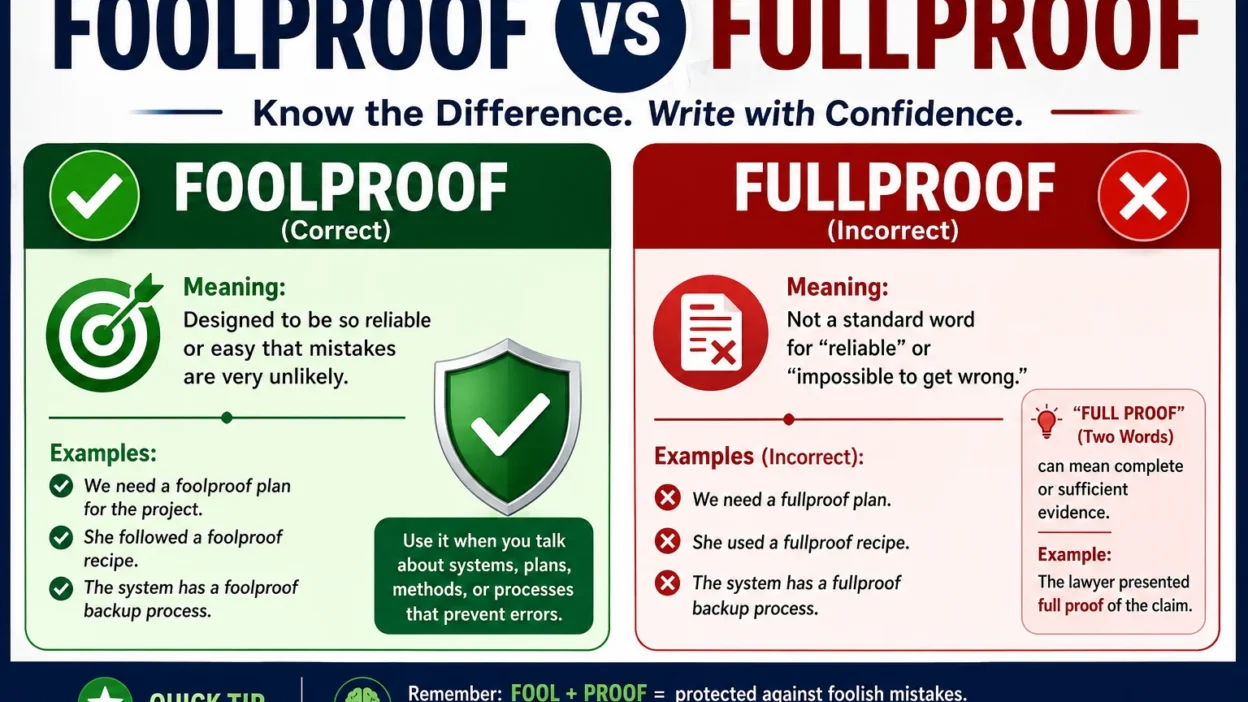
Foolproof is the correct standard English word. It means designed to be so simple, reliable, or effective that mistakes are very unlikely.
Fullproof is generally an incorrect spelling when you mean foolproof. However, full proof may occasionally appear as two separate words when referring literally to complete or sufficient proof.
Foolproof vs Fullproof: Main Difference at a Glance
| Feature | Foolproof | Fullproof |
|---|---|---|
| Standard English word | Yes | Generally no |
| Main meaning | Difficult to fail or make mistakes with | Usually a misspelling |
| Correct spelling for reliable systems | Yes | No |
| Common usage | Foolproof plan, method, system | Not standard in this meaning |
| Example | We need a foolproof backup system. | We need a fullproof backup system. ❌ |
The simplest rule is this: if you mean “easy to use and hard to get wrong,” always use foolproof.
What Does Foolproof Mean?
Foolproof means designed or planned in a way that prevents mistakes or makes failure extremely unlikely.
The word is often used for:
- Systems
- Plans
- Instructions
- Methods
- Processes
- Safety procedures
- Strategies
Examples of Foolproof
- The engineer created a foolproof safety system.
- She followed a foolproof recipe for chocolate cake.
- We need a foolproof method for tracking customer orders.
- The teacher gave students foolproof instructions for the experiment.
A foolproof system does not literally guarantee perfection. Instead, it means the system is designed to reduce the chances of error as much as possible.
What Does Fullproof Mean?
Fullproof is generally not a standard English word when used to mean “reliable” or “impossible to get wrong.”
For example:
Incorrect: This is a fullproof plan.
Correct: This is a foolproof plan.
People often write fullproof because they incorrectly connect the word with “full” and “proof.” However, the established adjective is foolproof.
There is one important distinction: full proof, written as two words, can sometimes be used literally to mean complete evidence or sufficient proof.
For example:
- The lawyer presented full proof of the claim.
This does not mean the same thing as foolproof.
Why Do People Confuse Foolproof and Fullproof?
The foolproof vs fullproof confusion usually happens for three main reasons.
1. They Sound Similar
In fast speech, fool and full may sound somewhat alike, especially depending on a person’s accent.
2. “Full Proof” Looks Logical
Some writers assume that a reliable system should be called “fullproof” because it provides complete protection or proof. However, that is not how the word foolproof developed or is used in standard English.
3. Spellings Are Often Learned by Sound
Many common spelling mistakes happen when people write words based on pronunciation rather than memorized spelling.
Foolproof vs Fullproof: Meaning and Usage Comparison
| Point | Foolproof | Fullproof / Full Proof |
|---|---|---|
| Meaning | Designed to prevent mistakes or failure | “Fullproof” is usually incorrect |
| Part of speech | Adjective | Not normally used as a standard adjective |
| Used for systems | Yes | No |
| Used for plans | Yes | No |
| Used for instructions | Yes | No |
| Literal evidence meaning | No | “Full proof” may mean complete proof |
| Standard example | A foolproof solution | Complete or full proof of something |
This comparison shows why context matters. Foolproof describes reliability, while full proof can refer to evidence or a complete demonstration.
How to Use Foolproof Correctly
Foolproof is most commonly used before a noun.
Common Word Combinations
| Phrase | Example |
|---|---|
| Foolproof plan | We created a foolproof plan for the launch. |
| Foolproof method | This method offers a foolproof way to organize files. |
| Foolproof system | The company installed a foolproof security system. |
| Foolproof recipe | She used a foolproof recipe for beginners. |
| Foolproof strategy | The team developed a foolproof strategy. |
| Foolproof process | The new process reduces human errors. |
Sentence Examples
- The manager wants a foolproof process for approving payments.
- This app has a foolproof interface for new users.
- There is no completely foolproof solution to every problem.
- The scientist designed a foolproof procedure for recording results.
Is Foolproof One Word or Two?
In standard modern English, foolproof is usually written as one word.
Correct: foolproof
Incorrect: fool proof, when used as the standard adjective meaning difficult to get wrong
Examples:
- We need a foolproof system. ✔
- We need a fool proof system. ✘
However, writing conventions can vary in older texts or informal materials. For modern professional and general writing, foolproof is the safest choice.
Foolproof vs Fullproof in Business Usage
Businesses often use foolproof to describe processes that reduce errors, save time, and improve consistency.
Business Examples
- The finance department created a foolproof approval process.
- Our company needs a foolproof backup plan.
- The training manual provides foolproof instructions for new employees.
- The sales team developed a foolproof follow-up system.
| Business Area | Correct Usage |
|---|---|
| Finance | A foolproof method for checking invoices |
| Customer service | A foolproof process for handling complaints |
| Marketing | A foolproof campaign checklist |
| Human resources | Foolproof onboarding instructions |
| Technology | A foolproof data backup system |
In professional writing, using fullproof instead of foolproof may make the text appear less polished.
Foolproof vs Fullproof in Education
In education, foolproof can describe clear methods, instructions, or learning strategies.
Examples in Education
- The teacher created a foolproof revision schedule.
- The guide gives students a foolproof way to format citations.
- The science instructor provided foolproof instructions for the laboratory activity.
A teacher might say, “Follow these steps carefully for a foolproof method of solving the problem.”
However, students should not write fullproof method unless they are using “full proof” in a completely different literal sense.
Foolproof vs Fullproof in Science and Technology
Scientists, engineers, and technology professionals often discuss systems designed to minimize human error.
For example:
- Engineers test whether a safety feature is foolproof.
- Developers try to create foolproof user interfaces.
- Researchers use foolproof procedures to improve consistency.
- Laboratories create detailed steps to make experiments more reliable.
Still, professionals often avoid claiming that something is completely foolproof because unexpected problems can happen.
Industry Usage Table
| Industry | Typical Use of “Foolproof” | Example |
|---|---|---|
| Engineering | Safety and reliability | A foolproof emergency shutdown process |
| Technology | User experience | A foolproof password recovery system |
| Healthcare | Procedures | A foolproof identification process |
| Education | Instructions | A foolproof study method |
| Manufacturing | Quality control | A foolproof inspection checklist |
| Food and cooking | Recipes | A foolproof bread recipe |
Real-Life Examples of Foolproof
The word foolproof works naturally in many everyday situations.
In Cooking
“This is a foolproof recipe for beginners because every step is clearly explained.”
In Travel
“We made a foolproof checklist so we would not forget our passports.”
In Technology
“The website uses a foolproof login process with clear recovery options.”
In Business
“The manager introduced a foolproof system for recording attendance.”
In Science
“The laboratory followed a foolproof procedure to reduce contamination.”
In Personal Planning
“I need a foolproof reminder system because I keep forgetting appointments.”
Foolproof vs Fullproof: Common Mistakes
One of the most common errors is replacing fool with full.
| Incorrect | Correct |
|---|---|
| This is a fullproof plan. | This is a foolproof plan. |
| We need a fullproof system. | We need a foolproof system. |
| She found a fullproof recipe. | She found a foolproof recipe. |
| The app has a fullproof design. | The app has a foolproof design. |
| They created a fullproof process. | They created a foolproof process. |
Another Common Mistake
Incorrect: This plan is foolproofly designed.
Better: This plan is designed to be foolproof.
The adjective foolproof is common, but adding -ly is usually unnecessary and often sounds unnatural.
Grammar Forms of Foolproof
Foolproof is primarily an adjective. It describes a noun.
| Grammar Form | Usage | Example |
|---|---|---|
| Adjective | Describes something reliable | a foolproof system |
| Comparative-style idea | Usually expressed differently | more reliable, safer |
| Superlative-style idea | Usually expressed differently | the most reliable method |
| Adverb | “Foolproofly” is rare and awkward | The system was designed to prevent errors |
Because foolproof already suggests a very high level of reliability, phrases such as “very foolproof” may sound awkward in some contexts.
Instead, you can say:
- extremely reliable
- highly reliable
- carefully designed
- difficult to get wrong
- resistant to errors
When Should You Use “Full Proof” as Two Words?
Although fullproof is generally incorrect, full proof can be correct when the two words keep their separate literal meanings.
For example:
- The investigation provided full proof of the event.
- The document offered full proof that the agreement existed.
Here, full describes the noun proof. This is completely different from foolproof, which means reliable or difficult to get wrong.
Simple Context Check
| If You Mean… | Use… |
|---|---|
| Difficult to make mistakes with | Foolproof |
| Highly reliable system | Foolproof |
| Easy-to-follow method | Foolproof |
| Complete evidence | Full proof |
| Sufficient evidence | Full proof |
This context check is one of the easiest ways to understand the difference.
A Foolproof Process for Choosing the Correct Word
Use these steps whenever you are unsure about foolproof vs fullproof.
Step 1: Identify the Meaning
Ask yourself: “Am I describing something designed to prevent mistakes?”
If yes, choose foolproof.
Step 2: Check Whether You Mean Evidence
If you are talking about proof or evidence that is complete, you may mean full proof as two separate words.
Step 3: Avoid “Fullproof”
Do not use fullproof as a substitute for foolproof.
Quick Decision Table
| Question | Answer | Correct Choice |
|---|---|---|
| Does it describe a reliable system? | Yes | Foolproof |
| Does it describe an easy method? | Yes | Foolproof |
| Does it mean difficult to get wrong? | Yes | Foolproof |
| Does it mean complete evidence? | Yes | Full proof |
| Is “fullproof” being used as one word? | Usually a mistake | Foolproof or full proof, depending on context |
Memory Trick: How to Remember Foolproof
Here is a simple memory trick:
Foolproof = proof against foolish mistakes.
Think of the word as describing something designed so that even a careless or inexperienced person is less likely to make a mistake.
You can also remember:
FOOL + PROOF = protected against foolish errors.
This makes the spelling easier to remember and helps prevent the common fullproof mistake.
Synonyms and Related Words
Depending on the context, you can use several alternatives to foolproof.
| Word or Phrase | Best Context |
|---|---|
| Reliable | General reliability |
| Fail-safe | Safety systems |
| Error-resistant | Technical processes |
| Easy to use | User experience |
| Simple | Basic instructions |
| Dependable | General performance |
| Robust | Technology and engineering |
| User-friendly | Products and software |
Example
Instead of saying:
“The process is completely foolproof.”
You might say:
“The process is highly reliable and designed to minimize human error.”
This can sound more precise in formal or technical writing.
Can Anything Really Be Foolproof?
Not always. In everyday English, foolproof often means very difficult to get wrong, not literally impossible to fail.
For example, a company may advertise a “foolproof setup process,” but unexpected situations can still create problems.
This is why professional writers sometimes prefer more precise language:
- highly reliable
- designed to reduce errors
- built-in safeguards
- simple and easy to follow
- tested for common mistakes
The word foolproof is useful, but it should not be confused with a guarantee of absolute perfection.
Foolproof vs Fullproof: Which One Should You Use?
Use foolproof when describing a system, plan, process, recipe, method, or strategy that is designed to minimize mistakes.
Do not use fullproof for this meaning.
Use full proof only when you literally mean complete or sufficient evidence and the context clearly requires those two separate words.
Final Usage Examples
Correct: We created a foolproof plan for the event.
Correct: The experiment produced full proof of the theory.
Incorrect: We created a fullproof plan for the event.
Frequently Asked Questions About Foolproof vs Fullproof
Is fullproof a real word?
Fullproof is generally not a standard English word when used to mean reliable or impossible to get wrong. The correct word is foolproof.
Is foolproof one word?
Yes. Foolproof is normally written as one word in modern standard English.
What does foolproof mean?
Foolproof means designed to be so simple, reliable, or carefully planned that mistakes are very unlikely.
Can I use “full proof” instead of foolproof?
No. Full proof can mean complete evidence, while foolproof means difficult to get wrong. They have different meanings.
Why do people spell foolproof as fullproof?
People often confuse the spellings because fool and full can sound similar in quick speech, and “full proof” may appear logically related.
What is another word for foolproof?
Depending on the context, alternatives include reliable, fail-safe, dependable, robust, error-resistant, and easy to use.
Conclusion
The key difference in foolproof vs fullproof is simple: foolproof is the correct word for something designed to prevent mistakes or make failure unlikely. Fullproof is generally a misspelling in this context.
Remember that full proof, written as two words, may be correct when referring to complete evidence. When describing a reliable plan, system, recipe, method, or process, the correct choice is always foolproof. Keep the memory trick in mind: foolproof means proof against foolish mistakes.

Julian Wyatt is a passionate researcher and writer who explores symbols, mythology, cultural traditions, and hidden meanings. Through engaging articles, he helps readers uncover the fascinating stories and significance behind symbols worldwide.