The confusion between shown vs showed is one of the most common grammar mistakes in English. Since both words come from the verb show,
many learners wonder whether they can be used interchangeably. Understanding the difference between shown vs showed helps you write and speak more accurately in both casual and professional situations.
Whether you’re writing an email, completing school assignments, or speaking in everyday conversations, choosing the correct form matters.
In this guide, you’ll learn the meaning, grammar, usage, and real life examples of shown vs showed, along with simple memory tricks, comparison tables, and common mistakes to help you remember the correct usage.
Quick Answer
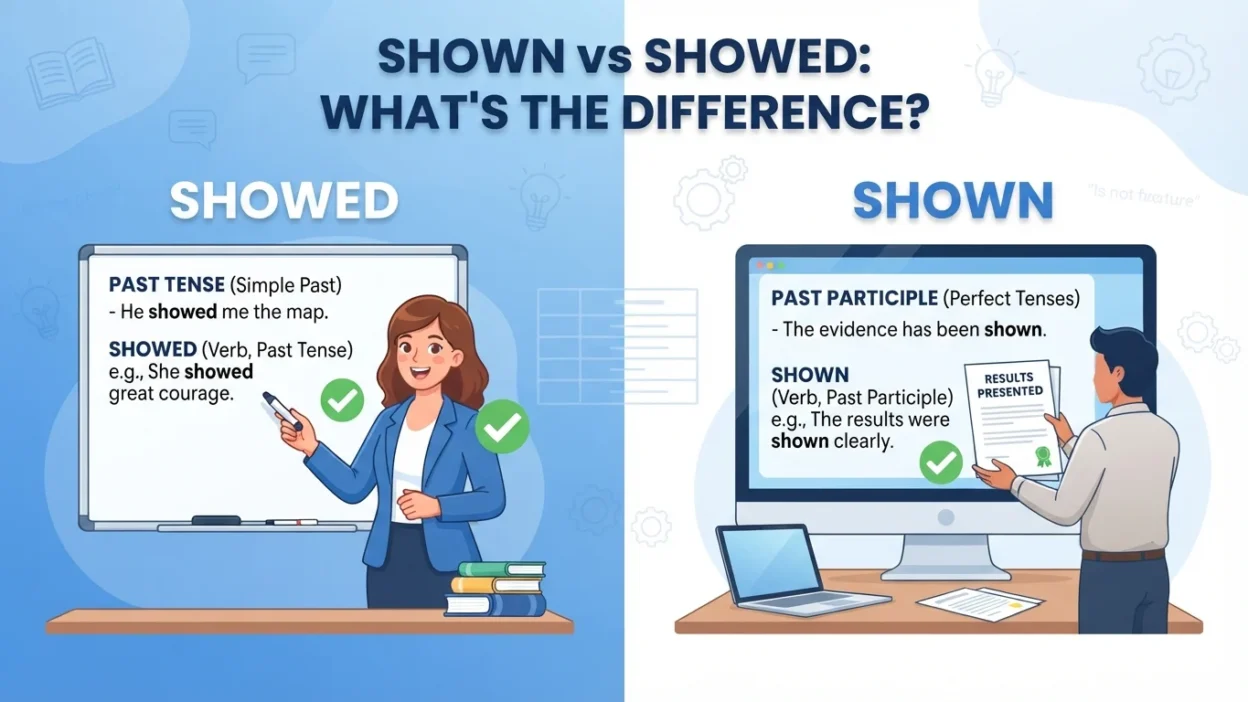
Showed is the simple past tense of the verb show.
Shown is the past participle and is usually used with helping verbs like has, have, had, was, were, or been.
Example:
- ✅ She showed me the report yesterday.
- ✅ She has shown me the report already.
Shown vs Showed Comparison Table
| Feature | Showed | Shown |
|---|---|---|
| Part of Speech | Simple past verb | Past participle |
| Can stand alone? | Yes | No (usually needs a helping verb) |
| Used with helping verbs? | No | Yes |
| Example | He showed me the map. | He has shown me the map. |
| Grammar Role | Past action | Completed action with auxiliary verb |
What Does “Showed” Mean?
Showed is the simple past tense of show. It describes an action that happened and ended in the past.
Examples
- She showed me her new phone.
- The teacher showed the students how to solve the equation.
- They showed kindness during the event.
- My manager showed me the updated schedule.
Whenever you’re talking about a completed action in the past without a helping verb, showed is the correct choice.
What Does “Shown” Mean?
Shown is the past participle of show. It cannot normally be used alone. Instead, it follows helping verbs such as has, have, had, was, were, or been.
Examples
- She has shown great improvement.
- The results were shown on the screen.
- I had shown the documents before the meeting.
- The evidence has been shown to the jury.
Think of shown as a form that completes perfect or passive verb constructions.
Shown vs Showed: Key Differences
| Point | Showed | Shown |
|---|---|---|
| Verb Form | Past tense | Past participle |
| Needs Helping Verb | No | Yes |
| Used in Perfect Tense | No | Yes |
| Used in Passive Voice | No | Yes |
| Example | We showed the plan. | The plan was shown. |
The biggest difference is grammatical.
- Showed tells what someone did.
- Shown often tells what has been done or what was done.
Grammar Forms of “Show”
| Verb Form | Word |
|---|---|
| Base Form | Show |
| Third Person | Shows |
| Present Participle | Showing |
| Simple Past | Showed |
| Past Participle | Shown |
Example in Every Form
| Tense | Example |
|---|---|
| Present | I show my work every day. |
| Present Continuous | I am showing my project. |
| Past | I showed my project yesterday. |
| Present Perfect | I have shown my project already. |
| Past Perfect | I had shown my project before class. |
| Passive Voice | The project was shown to everyone. |
When Should You Use “Showed”?
Use showed when describing a completed action in the past.
Examples
Business
- The manager showed the sales report.
Education
- The teacher showed the class a video.
Healthcare
- The doctor showed the patient the X-ray.
Daily Conversation
- My friend showed me his new bicycle.
When Should You Use “Shown”?
Use shown with helping verbs or in passive voice.
Examples
Business
- The results have been shown to investors.
Education
- The lesson has been shown to new students.
Science
- Research has shown positive outcomes.
Technology
- The error was shown on the screen.
Real-Life Examples in Different Industries
| Industry | Showed Example | Shown Example |
|---|---|---|
| Business | The CEO showed the quarterly report. | The report has been shown to shareholders. |
| Education | The teacher showed a diagram. | The diagram was shown during class. |
| Science | Researchers showed the experiment. | The results have been shown repeatedly. |
| Healthcare | The nurse showed the instructions. | The instructions were shown on the monitor. |
| Technology | The developer showed the prototype. | The final version has been shown online. |
| Marketing | The presenter showed campaign data. | The campaign has been shown to clients. |
Why Do People Confuse Shown and Showed?
There are several reasons:
- Both words come from the verb show.
- They refer to past actions.
- Many irregular verbs have confusing forms.
- Learners often forget that shown needs a helping verb.
- Spoken English sometimes makes both sound acceptable, even when one is grammatically incorrect.
Common Mistakes and Corrections
| Incorrect | Correct |
|---|---|
| I have showed the report. | I have shown the report. |
| She was showed the room. | She was shown the room. |
| They had showed us everything. | They had shown us everything. |
| He shown me the answer yesterday. | He showed me the answer yesterday. |
| We have showed our work. | We have shown our work. |
Correct Sentences
- I showed my passport at the airport.
- The passport was shown to the officer.
- She has shown excellent leadership.
- They showed us around the city.
Memory Trick to Remember the Difference
A simple trick is:
Showed = Past Action
Think of yesterday.
Example:
- I showed my homework yesterday.
Shown = Has/Have/Had
If you see words like has, have, had, or been, use shown.
Example:
- I have shown my homework.
This small rule works in most situations.
Step-by-Step Guide to Choosing the Correct Word
| Step | Question | Use |
|---|---|---|
| 1 | Is there a helping verb? | Shown |
| 2 | Is it simple past? | Showed |
| 3 | Is it passive voice? | Shown |
| 4 | Did the action simply happen yesterday? | Showed |
| 5 | Is it part of a perfect tense? | Shown |
Examples in Everyday Conversations
Using Showed
- Dad showed me how to fix the bike.
- The guide showed us the museum.
- Sarah showed everyone her artwork.
- My coach showed the correct technique.
Using Shown
- Dad has shown me that trick before.
- The museum was shown in the documentary.
- Sarah has shown impressive talent.
- The technique was shown during training.
Professional Writing Tips
In professional writing, choosing the correct verb form improves credibility.
Examples:
- The report showed a 15% increase last quarter.
- The findings have shown consistent improvement.
- The presentation showed market trends.
- The final results were shown during the conference.
Using the correct grammar makes reports, emails, and research papers sound more polished.
Quick Summary Table
| Situation | Correct Word |
|---|---|
| Yesterday | Showed |
| Last week | Showed |
| Has | Shown |
| Have | Shown |
| Had | Shown |
| Was/Were | Shown |
| Passive Voice | Shown |
| Simple Past | Showed |
FAQs
Is “shown” or “showed” correct?
Both are correct, but they serve different grammar functions. Showed is the simple past tense, while shown is the past participle.
Can I say “I have showed”?
No. The correct sentence is I have shown.
Is “showed” an irregular verb?
No. Showed is the regular simple past form of show, while shown is the irregular past participle.
Why does “shown” need a helping verb?
Because shown is a past participle, it normally appears with verbs like has, have, had, was, or been.
Which word is more common in formal writing?
Both are common. Showed is used for simple past events, while shown appears frequently in academic, business, and scientific writing because perfect tenses and passive voice are common there.
How can I remember the difference easily?
Remember this rule: Showed = simple past. Shown = helping verb required.
Conclusion
Understanding shown vs showed becomes easy once you know their grammar roles.
Showed is the simple past tense and describes an action completed in the past without a helping verb. Shown is the past participle and is used with helping verbs or in passive voice. By remembering this simple rule and practicing with real
life examples, you’ll avoid one of the most common English grammar mistakes and write with greater confidence and accuracy.