Understanding having vs having had can be confusing because both forms contain having, but they refer to different grammatical relationships and time frames.
The difference usually depends on whether you are describing an action, experience, or possession in a general sense or showing that one event happened before another past event.
Learning having vs having had helps you write clearer sentences in everyday, academic, and professional English.
Although the two expressions may look similar, their grammar is different.
Having is the present participle form of have, while having had is a perfect participle construction that emphasizes an earlier completed action or experience. This guide explains the having vs having had meaning, difference, usage, grammar rules, and examples in simple English.
Quick Answer
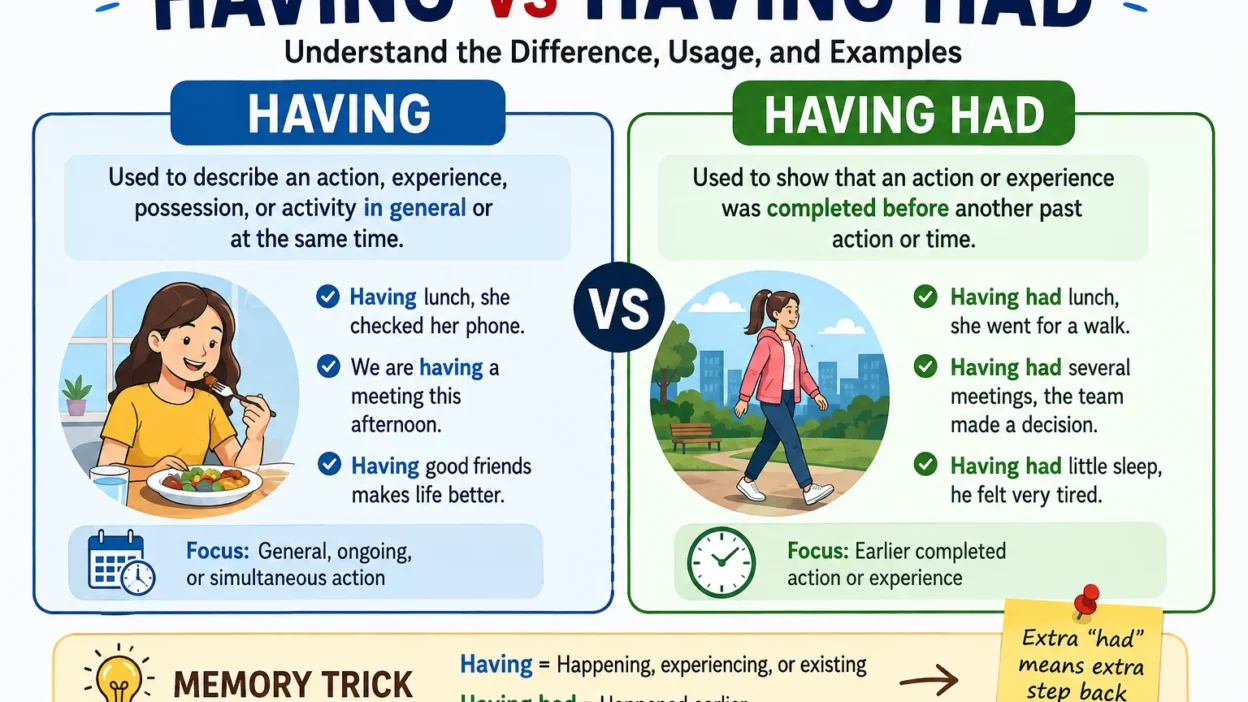
Having usually describes an action, possession, or experience happening generally or at the same time as another action.
Having had shows that something happened or existed before another past action or time.
Example:
- Having dinner, she checked her phone.
- Having had dinner, she went for a walk.
What Does “Having” Mean?
Having is the present participle form of the verb have. It can be used in continuous verb forms, participle phrases, and expressions involving possession, activities, experiences, or relationships.
The meaning of having depends on the sentence. It may refer to possessing something, experiencing something, taking part in an activity, or performing an action.
Examples of Having
- She is having lunch with her colleagues.
- They are having a meeting this afternoon.
- Having enough money can reduce financial stress.
- He left the room after having a short conversation with the manager.
In many cases, having does not clearly show that the action was completed before another action. The surrounding context determines the timing.
What Does “Having Had” Mean?
Having had is a perfect participle form. It combines having with the past participle had.
This structure is often used to show that one action, experience, or situation was completed before another action, usually in the past.
Examples of Having Had
- Having had breakfast, she left for work.
- Having had several meetings, the manager needed a break.
- Having had no previous experience, he found the job challenging.
- Having had the opportunity to study abroad, she understood different cultures better.
The key idea is earlier completion. Something happened first, and another action happened afterward.
Having vs Having Had: Main Difference
The main difference between having vs having had is the relationship between the actions.
Having generally describes an action, experience, or state without strongly emphasizing that it finished before another event. Having had clearly shows that an action or experience was already completed before the next event.
| Feature | Having | Having Had |
|---|---|---|
| Grammar form | Present participle | Perfect participle |
| Basic meaning | Experiencing, possessing, or doing | Previously experienced, possessed, or completed |
| Time emphasis | General or overlapping action | Earlier completed action |
| Common use | Continuous forms and participle phrases | Showing sequence between past events |
| Example | Having lunch, he answered the call. | Having had lunch, he returned to work. |
Grammar Structure of Having
The word having can appear in several grammatical structures. Understanding these forms makes the having vs having had difference easier to remember.
| Structure | Formula | Example |
|---|---|---|
| Present continuous | am/is/are + having | She is having coffee. |
| Past continuous | was/were + having | They were having dinner. |
| Gerund | having + object | Having friends nearby is helpful. |
| Participle phrase | having + object | Having no car, he walked home. |
| Perfect structure | having + past participle | Having finished the report, she sent it. |
Notice that having may be followed by a noun, object, or past participle, depending on the grammatical structure.
Grammar Structure of Having Had
Having had follows a more specific pattern:
having + had + object/complement
It is often followed by the earlier experience, possession, or event.
| Structure | Example |
|---|---|
| Having had + noun | Having had lunch, she left. |
| Having had + experience | Having had previous training, he learned quickly. |
| Having had + problem | Having had technical difficulties, the team restarted the system. |
| Having had + time expression | Having had little sleep, she felt tired. |
| Having had + opportunity | Having had the chance to travel, he gained confidence. |
This structure usually makes the order of events clear: first event → having had, later event → main clause.
When to Use “Having”
Use having when you want to describe possession, an experience, an activity, or an action without specifically emphasizing that it was completed before another event.
Everyday Examples
- I am having a difficult day.
- We are having dinner at eight.
- Having a reliable internet connection is important.
- She enjoys having friends over on weekends.
Business Example
- The company is having a meeting with potential investors.
Education Example
- Students benefit from having access to digital learning tools.
Science Example
- A substance having certain properties may react differently under pressure.
In formal writing, having can sometimes introduce a participle phrase, especially when describing a condition or characteristic.
When to Use “Having Had”
Use having had when an earlier action, experience, or situation happened before the main action in the sentence.
Everyday Examples
- Having had a long day, I went to bed early.
- Having had breakfast, they started their journey.
- Having had little sleep, he struggled to concentrate.
Business Examples
- Having had several discussions with the client, the team changed its proposal.
- Having had strong sales in the first quarter, the company increased production.
Education Examples
- Having had additional practice, the students performed better on the test.
- Having had feedback from her professor, she revised the essay.
Science Examples
- Having had repeated exposure to the substance, the sample showed measurable changes.
- Having had several failed trials, the researchers adjusted the experiment.
The phrase is especially useful when the earlier event explains the reason for the later event.
How Time Changes the Meaning
Time is the most important part of the having vs having had comparison.
Consider these sentences:
- Having dinner, she answered an email.
- Having had dinner, she answered an email.
The first sentence suggests the actions may overlap. She answered the email while she was eating dinner.
The second sentence means dinner happened first. After finishing dinner, she answered the email.
| Sentence | Likely Time Relationship |
|---|---|
| Having dinner, she answered an email. | Actions may happen at the same time |
| Having had dinner, she answered an email. | Dinner happened first |
| Having a meeting, he received a call. | The meeting was happening |
| Having had a meeting, he wrote a summary. | The meeting ended before the summary |
This timing difference is one of the easiest ways to choose the correct expression.
Having vs Having Had in Real-Life Situations
In Business
A manager may say:
Having had several conversations with the client, we understand their requirements better.
This means the conversations happened first, and the understanding developed afterward.
Compare it with:
Having regular conversations with clients helps us understand their needs.
This describes a general practice rather than a completed earlier event.
In Education
- Having good study habits can improve academic performance.
- Having had extra tutoring, the student felt more prepared.
The first sentence expresses a general condition. The second describes a previous experience that influenced a later result.
In Healthcare and Research
- Having access to accurate data improves research quality.
- Having had access to the earlier results, the researchers revised their hypothesis.
Again, having had creates a clear sequence.
In Everyday Life
- Having friends nearby makes moving to a new city easier.
- Having had friends support her during the move, she felt less anxious afterward.
Professional and Industry Usage
The choice between these expressions can affect clarity in reports, emails, research papers, and formal documents.
| Context | Having | Having Had |
|---|---|---|
| Business | Having regular meetings improves communication. | Having had several meetings, the team reached a decision. |
| Education | Having clear goals helps students. | Having had more preparation, students performed better. |
| Research | Having accurate measurements is essential. | Having had inconsistent results, researchers repeated the test. |
| Law | Having sufficient evidence strengthens a case. | Having had the evidence reviewed, the lawyer changed strategy. |
| Technology | Having reliable backups prevents data loss. | Having had a system failure, the company improved security. |
In professional writing, having had is useful when documenting a clear sequence of past events.
Common Mistakes With Having vs Having Had
One common mistake is using having when the writer needs to show that an earlier action was completed first.
Incorrect and Correct Examples
| Incorrect | Correct | Why |
|---|---|---|
| Having breakfast, she went to work. | Having had breakfast, she went to work. | Breakfast was completed before going to work. |
| Having several meetings, they made a decision. | Having had several meetings, they made a decision. | The meetings happened before the decision. |
| Having the report reviewed, she submitted it. | Having had the report reviewed, she submitted it. | The review was completed earlier. |
| Having a difficult week, he took a vacation. | Having had a difficult week, he took a vacation. | The difficult week came before the vacation. |
However, having is not always wrong. If the meaning is general or simultaneous, it may be the better choice.
Correct: Having lunch, she received an important call.
Here, she may have received the call while eating.
Why People Confuse “Having” and “Having Had”
People often confuse these forms because both begin with having, and the word had can look repetitive when paired with the verb have.
For example:
Having had a meeting, we discussed the results.
At first, having had may seem unusual, but it follows a normal grammatical pattern. The first having helps create the perfect participle construction, while had is the past participle of have.
The same pattern appears with other verbs:
- Having finished the work, she went home.
- Having seen the results, he changed his mind.
- Having had the experience, she understood the problem.
A Simple Memory Trick
Use this easy rule:
Having = happening, experiencing, or existing
Having had = happened earlier
Ask yourself:
Did one event finish before the main action?
- If no, use having when grammatically appropriate.
- If yes, having had may be the correct choice.
Quick Memory Formula
| Situation | Choose |
|---|---|
| General possession or experience | Having |
| Action happening around the same time | Having |
| Earlier experience completed first | Having had |
| Clear past sequence | Having had |
Remember: extra “had” = extra step back in time.
Step-by-Step Guide to Choosing the Correct Form
When deciding between having vs having had, follow these steps.
| Step | Question | Choice |
|---|---|---|
| 1 | Are you describing possession or an experience generally? | Usually having |
| 2 | Are two actions happening at roughly the same time? | Usually having |
| 3 | Did one experience finish before another past action? | Consider having had |
| 4 | Do you need to emphasize earlier completion? | Use having had |
| 5 | Does the sentence sound overly complicated? | Consider a full clause instead |
For example:
Step 1: She finished breakfast.
Step 2: She left for work.
Step 3: Breakfast happened first.
Result: Having had breakfast, she left for work.
Can “Having Had” Be Replaced With a Full Clause?
Yes. In many cases, a full clause sounds more natural, especially in everyday conversation.
Formal Version
Having had breakfast, she left for work.
More Natural Everyday Version
After she had breakfast, she left for work.
Both sentences communicate a similar sequence.
Here are more alternatives:
| Having Had Structure | Alternative |
|---|---|
| Having had lunch, he returned to work. | After he had lunch, he returned to work. |
| Having had the training, she felt confident. | After she completed the training, she felt confident. |
| Having had several discussions, they agreed. | After several discussions, they agreed. |
In conversation, the simpler alternative is often more common.
Examples of Having vs Having Had
These paired examples show the difference more clearly.
Example 1: Meals
- Having dinner, Mark checked his messages.
He checked messages during dinner. - Having had dinner, Mark checked his messages.
He checked messages after dinner.
Example 2: Meetings
- Having meetings regularly improves teamwork.
This is a general statement. - Having had several meetings, the team agreed on a plan.
The meetings happened before the agreement.
Example 3: Experience
- Having experience in sales is useful.
General possession of experience. - Having had experience in sales, she understood the customer’s concerns.
Previous experience influenced her understanding.
Example 4: Sleep
- Having little sleep can affect concentration.
General statement about a condition. - Having had little sleep, he struggled during the presentation.
Earlier lack of sleep caused a later result.
Is “Having Had” Too Formal?
Having had is grammatically correct, but it can sound formal or literary in some situations.
It appears more often in:
- Academic writing
- Business reports
- Formal documents
- Professional communication
- Narratives
- Edited written English
In casual conversation, speakers often choose simpler forms:
Formal: Having had enough time to review the proposal, she approved it.
More natural: After reviewing the proposal, she approved it.
Conversational: She reviewed the proposal and then approved it.
Choosing the simplest clear structure usually improves readability.
FAQs About Having vs Having Had
1. What is the main difference between having and having had?
Having describes a general, ongoing, or related action or experience. Having had shows that an action or experience was completed earlier.
2. Is “having had” grammatically correct?
Yes. Having had is completely correct. It is a perfect participle structure used to show that something happened before another action.
3. Can I say “having had lunch”?
Yes. Having had lunch, she went back to work means she ate lunch first and returned to work afterward.
4. Why does “having had” contain two forms of have?
The first word, having, helps form the perfect participle. Had is the past participle of have. Together, they show an earlier completed experience or action.
5. Can “having” and “having had” be used interchangeably?
No. Their meanings can change because having had emphasizes earlier completion, while having does not necessarily do so.
6. Is “having had” common in everyday speech?
It is less common in casual speech than simpler alternatives such as after I had or after doing something. However, it is common and correct in formal writing.
Conclusion
The key difference in having vs having had is time and completion. Having is used for general experiences, possession, activities, or actions that do not necessarily need to be placed before another event. Having had is used when an experience, action, or situation was completed earlier and influenced or came before the main action.
A simple rule is to remember that having had takes you one step further into the past. If you need to show first this happened, then that happened, having had may be the right choice. If you are simply describing an activity, condition, or experience, having is usually more appropriate.