Have you ever heard someone say, “Run like the wind!” and wondered exactly what it means?
The run like the wind meaning is usually connected with moving extremely fast. This popular English expression compares a person’s speed to the powerful, fast movement of the wind.
Understanding the run like the wind meaning can help you use the phrase naturally in conversations, stories, sports, and everyday writing.
Although it usually describes physical running, the expression can sometimes be used more broadly to describe doing something with great speed and energy.
Let’s explore its meaning, usage, examples, grammar, and common mistakes.
Quick Answer: What Does “Run Like the Wind” Mean?
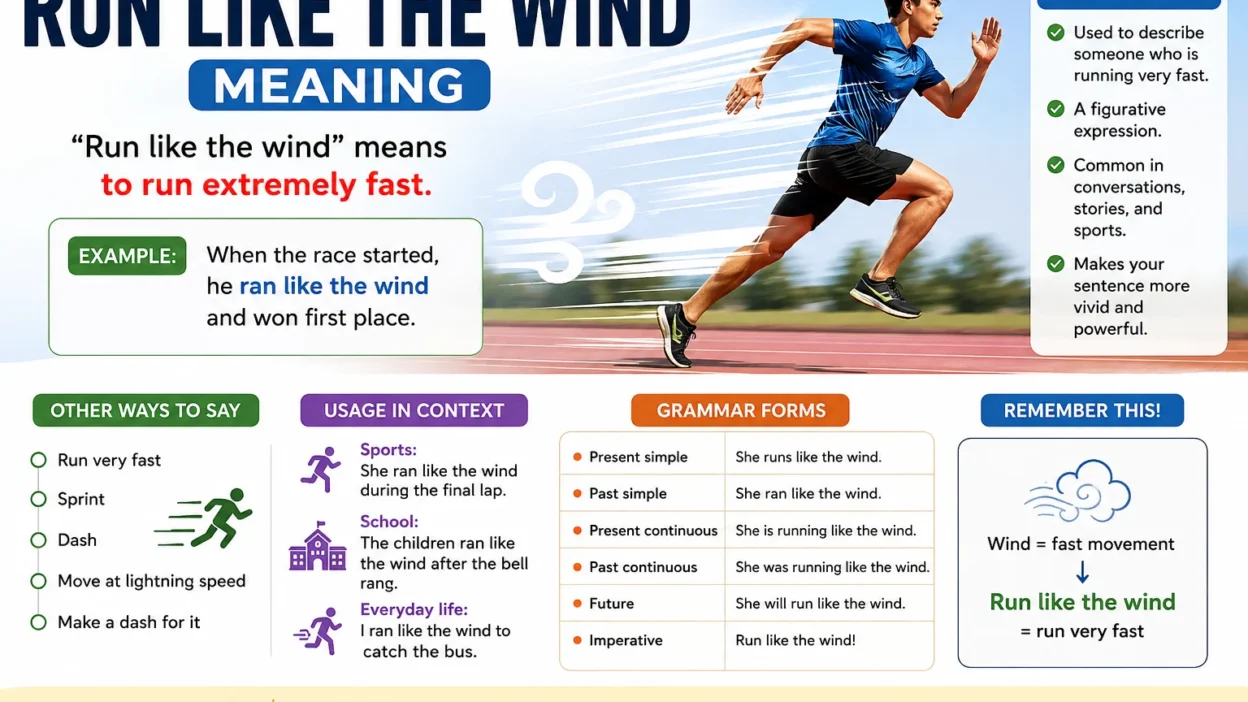
“Run like the wind” means to run extremely fast. It is an informal, figurative expression that compares a person’s speed to the fast movement of the wind.
Example: When the race started, Mia ran like the wind toward the finish line.
What Is the Run Like the Wind Meaning?
The run like the wind meaning is to run very quickly. The phrase creates a vivid image of someone moving with great speed, almost as if the wind is pushing them forward.
It is an idiomatic or figurative expression. This means the words are not meant to be understood literally. A person does not actually become the wind. Instead, the phrase emphasizes exceptional speed.
Simple meaning
| Expression | Simple Meaning |
|---|---|
| Run like the wind | Run extremely fast |
| Run quickly | Move fast on foot |
| Sprint | Run at maximum or near-maximum speed |
| Dash | Run somewhere suddenly and quickly |
| Race | Move quickly in competition or urgency |
Is “Run Like the Wind” an Idiom?
Yes, run like the wind is commonly treated as an idiomatic or figurative expression.
The phrase uses a comparison to make the description more powerful. Instead of simply saying, “He ran fast,” you can say, “He ran like the wind.” The second sentence sounds more vivid and energetic.
The expression is especially common in:
- Everyday conversation
- Sports commentary
- Children’s stories
- Fiction and creative writing
- Motivational language
Run Like the Wind vs Run Fast
Both expressions communicate speed, but their style and effect are different.
| Feature | Run Like the Wind | Run Fast |
|---|---|---|
| Meaning | Run extremely fast | Run at a high speed |
| Style | Figurative and expressive | Direct and literal |
| Tone | Vivid and energetic | Neutral |
| Common in creative writing | Very common | Common |
| Common in formal reports | Less common | More common |
| Example | She ran like the wind. | She ran fast. |
The main difference is that run fast simply states the action, while run like the wind adds imagery and emphasis.
Why Do People Say “Like the Wind”?
Wind can move rapidly and powerfully. The comparison creates the image of someone moving so quickly that they seem difficult to catch.
For example:
The thief ran like the wind.
This does not mean the thief moved in exactly the same way as air. It means the person escaped or moved extremely quickly.
The phrase is therefore a form of simile, because it compares one thing to another using like.
How to Use “Run Like the Wind” in a Sentence
The most common structure is:
Subject + form of run + like the wind
Here are some examples:
- I ran like the wind when I heard the final bell.
- She runs like the wind during track practice.
- They ran like the wind to catch the bus.
- He ran like the wind and won the race.
- The children were running like the wind across the field.
You can change the verb tense depending on the situation.
Grammar Forms of “Run Like the Wind”
The expression can be used with different forms of the verb run.
| Tense or Form | Example |
|---|---|
| Present simple | She runs like the wind. |
| Past simple | She ran like the wind. |
| Present continuous | He is running like the wind. |
| Past continuous | They were running like the wind. |
| Future | I will run like the wind. |
| Present perfect | She has run like the wind before. |
| Infinitive | He wants to run like the wind. |
| Imperative | Run like the wind! |
The core phrase like the wind usually stays the same.
Real-Life Examples of “Run Like the Wind”
The run like the wind meaning becomes easier to understand when you see it in real situations.
Sports
The runner ran like the wind during the final lap and overtook two competitors.
Here, the phrase emphasizes impressive speed and athletic performance.
Education
When the school bell rang, the students ran like the wind toward the playground.
This example uses the expression in a casual and vivid way.
Emergency Situations
When he saw the heavy rain approaching, he ran like the wind to reach the shelter.
The phrase suggests urgency as well as speed.
Everyday Life
I ran like the wind because I was late for my appointment.
This is a natural informal use in conversation.
Fiction and Storytelling
The young hero ran like the wind through the dark forest.
In creative writing, the expression helps readers imagine fast movement.
“Run Like the Wind” in Different Contexts
The phrase is flexible, but its tone may change depending on the context.
| Context | Example | Main Effect |
|---|---|---|
| Sports | She ran like the wind to the finish line. | Speed and performance |
| Education | The kids ran like the wind after class. | Energy and excitement |
| Business | He ran like the wind to catch the elevator. | Informal urgency |
| Science education | The athlete appeared to run like the wind. | Descriptive comparison |
| Fiction | The horse ran like the wind across the plains. | Strong imagery |
| Everyday speech | Run like the wind or you’ll miss the bus! | Urgency |
In highly formal writing, a direct phrase such as moved rapidly or ran at high speed may sometimes be more appropriate.
Can “Run Like the Wind” Describe Things Other Than People?
Yes. Although the phrase is most commonly used for people, it can also describe animals or fictional characters.
Examples:
- The horse ran like the wind across the field.
- The dog ran like the wind when the gate opened.
- The superhero ran like the wind to save the city.
However, the expression works best when the subject is something capable of physically running.
For machines or vehicles, phrases such as sped away, moved rapidly, or raced forward may sound more natural.
Run Like the Wind vs Other Expressions About Speed
English has several expressions that describe fast movement.
| Expression | Meaning | Example |
|---|---|---|
| Run like the wind | Run extremely fast | She ran like the wind. |
| Move at lightning speed | Move extremely quickly | He finished the task at lightning speed. |
| Like a bat out of hell | Move away extremely fast | The car went off like a bat out of hell. |
| In a flash | Very quickly | She finished the job in a flash. |
| Make a dash for it | Run quickly toward a destination | We made a dash for the train. |
| Full speed ahead | Move forward as fast as possible | The team went full speed ahead. |
These expressions are similar, but they are not always interchangeable.
For example, run like the wind specifically focuses on fast running, while in a flash can describe many kinds of quick actions.
Common Mistakes When Using “Run Like the Wind”
One common mistake is changing the expression in a way that sounds unnatural.
| Incorrect | Correct |
|---|---|
| He ran like wind. | He ran like the wind. |
| She run like the wind yesterday. | She ran like the wind yesterday. |
| He ran as the wind. | He ran like the wind. |
| She ran like a wind. | She ran like the wind. |
| They running like the wind. | They are running like the wind. |
| He runned like the wind. | He ran like the wind. |
Remember that ran is the correct past tense of run. English does not use runned.
Why Do People Get This Expression Wrong?
People may misunderstand run like the wind because they try to interpret every word literally.
Another source of confusion is the word like. In this phrase, like introduces a comparison. It means similar to or in the manner of.
The structure is:
run + like + comparison
For example:
- run like the wind
- fight like a tiger
- sleep like a baby
- shine like the sun
These comparisons make English more colorful and expressive.
A Simple Memory Trick
Use this simple image:
Wind = fast movement → run like the wind = run very fast
Imagine standing outside on a windy day and seeing leaves fly quickly across the ground. That mental picture can help you remember the run like the wind meaning.
Another easy rule is:
If someone is running so fast that “run fast” feels too ordinary, “run like the wind” may be the perfect expression.
When Should You Use “Run Like the Wind”?
Use the phrase when you want to make your sentence more expressive.
Use it when:
- Describing a fast runner
- Telling an exciting story
- Talking about sports
- Giving an urgent instruction
- Adding vivid imagery to creative writing
Example decision guide
| Situation | Use “Run Like the Wind”? | Why? |
|---|---|---|
| Casual conversation | Yes | Sounds natural and expressive |
| Children’s story | Yes | Creates strong imagery |
| Sports article | Yes | Adds excitement |
| Scientific report | Usually no | Direct language is clearer |
| Legal document | No | Too informal and figurative |
| Novel or short story | Yes | Improves description |
Professional and Industry Usage
The expression can appear in professional settings, but the context matters.
Marketing and advertising
A sports brand may use a phrase such as “Run like the wind” in a campaign because it sounds energetic and memorable.
Sports commentary
Commentators may say:
“She is running like the wind today!”
This adds excitement to the description.
Education
Teachers may use the phrase to explain idioms, similes, and figurative language.
Science and technical writing
The expression is generally less suitable for precise scientific writing. Instead of saying “The athlete ran like the wind,” a report might state the athlete’s actual speed or time.
| Industry or Field | Typical Usage | Best Style |
|---|---|---|
| Sports | Common | Expressive |
| Marketing | Common | Memorable |
| Education | Common | Instructional |
| Fiction publishing | Very common | Descriptive |
| Business reports | Limited | Informal only |
| Science | Rare | Prefer precise measurements |
| Legal writing | Avoid | Formal and literal |
Step-by-Step Guide to Using the Expression Correctly
Follow these simple steps to use the phrase naturally.
| Step | What to Do | Example |
|---|---|---|
| 1 | Identify fast physical movement | Someone is running quickly |
| 2 | Choose the correct form of run | run, runs, ran, running |
| 3 | Add like the wind | ran like the wind |
| 4 | Check the tense | Yesterday, she ran like the wind. |
| 5 | Consider the context | Best for vivid or informal language |
Example process
Basic sentence:
The athlete ran fast.
More expressive version:
The athlete ran like the wind.
The second version communicates the same basic idea but adds stronger imagery.
Is “Run Like the Wind” Always About Physical Speed?
Usually, yes. The phrase normally refers to actual running or movement.
However, in creative language, it may also suggest qualities such as:
- Freedom
- Energy
- Urgency
- Power
- Escape
For example:
He ran like the wind, leaving his worries behind.
Here, the person is physically running, but the sentence also creates an emotional sense of freedom.
Examples in Questions, Commands, and Statements
Statements
- Sarah runs like the wind.
- The boy ran like the wind.
- The dog was running like the wind.
Questions
- Can you run like the wind?
- Did he run like the wind to catch the train?
- Why were they running like the wind?
Commands
- Run like the wind!
- Run like the wind and get help!
These forms show how naturally the expression can fit into everyday English.
Frequently Asked Questions About “Run Like the Wind”
What does “run like the wind” mean?
It means to run extremely fast. The expression compares a person’s speed to the fast movement of the wind.
Is “run like the wind” an idiom?
Yes. It is a figurative expression and also uses a simile because it compares running with the wind using like.
Can I say “ran like the wind”?
Yes. Ran like the wind is the past-tense form and is correct for something that happened in the past.
Is “run like the wind” formal or informal?
It is generally informal or literary. It works well in conversation, sports, and creative writing.
Can animals run like the wind?
Yes. You can naturally say that a horse, dog, or other fast-running animal ran like the wind.
What is another way to say “run like the wind”?
Depending on the context, you can say run very fast, sprint, dash, or race.
Conclusion
The run like the wind meaning is simple: to run extremely fast. It is a vivid English expression that compares a person’s speed to the fast and powerful movement of the wind.
The key usage rule is to keep the standard structure run + like the wind and change only the form of run when needed: runs like the wind, ran like the wind, or running like the wind.
Use it in conversation, sports, stories, and other expressive contexts when you want a more colorful alternative to simply saying run fast.